

Radio Control: Soaring
Dan Pruss
HOW MANY OF US, through the course of our model flying, have had the occasion to help the new flier in our group with his, or her, first flight? We probably each have our own "talking through" techniques for the neophyte—and most of these procedures, no doubt, have been successful. Yet, how many of these new fliers really learned anything from those first flights?
It has been this scribe's observation that the normal "talk through" conversations, which range from "a little right"—"push the nose over"—"a little up"—to "Harvey, I think we better run for cover!" have left the new flier with not necessarily the same confidence it takes to run a sailplane on a slalom course through a string of telephone poles.
If, for the next few minutes, we can forget about aerodynamics, principles of flight, and the basic laws of physics, a simple point will be emphasized that I have found to work most successfully in getting the model of the new flier from off of the tow to safely on the ground. Nothing wrong in having any knowledge or background in the above studies, except to most new fliers these sciences usually are more useful in analyzing a wreckage than in making a successful first flight.
For the new flier that simple point is to know and recognize what the sailplane's fuselage profile—and angle with respect to the horizon—are in flight.
This can be readily determined by observing a particular trimmed out sailplane during some hand-launched tests or while a more experienced flier is testing the new ship. A Hobie-Hawk, for example, has a very low nose profile in a normal gliding attitude—somewhat deceiving when one realizes how efficient this sailplane is. Other models' profiles vary, and when compared with the horizon, their fuselage angles are from the pronounced nose-low appearance to that which is about parallel with the horizon. In no case have I seen any presently kitted models that would have a normal flight profile with a nose-above-the-horizon attitude.
In the present discussion concerning "fuselage angle," let us restrict the flying talk to the "off the tow—to safely on the ground" aspect of flying—omitting best L/D concepts, how to fly for distance, spot landing techniques, or why transparent yellow Monokote is easier to see than orange against a blue sky.
For the sake of using round numbers, let us assume that you, as a flier, have a sailplane that glides at 10 mph. Now, on a day when the air is absolutely calm and you test glide this plane it flies at 10 mph over the ground (its airspeed is also 10 mph). On the day when the wind is, say, 7 mph and you test glide (into the wind), this same sailplane appears to fly much slower. Over the ground it is slower—the groundspeed is only 3 mph but the airspeed is still 10 mph.
If you were able to compare the two distances that the model covered in calm air vs. the 7-mph wind, you would note that the distance over the ground was much less in the 7-mph wind (assuming the release height was the same in both cases) than in the calm air.
During both of these tests, the same "fuselage angle" should have been maintained.
Now if you were again to test glide that same plane from the same height and with the same "fuselage angle" but with that same 7-mph wind now at your back (tailwind), a greater distance would be covered over the ground. The airspeed would still be 10 mph but the ground speed would now be 17 mph.
Now, for the moment, let us refer to "fuselage angle" as something else. Technically speaking, when the wing is changing its angle with respect to the relative wind, the angle of attack is changing.
But since wings are attached to fuselages and the angular changes in fuselages are easier to see than a change in the wing, we will continue to refer to fuselage angle at a time with respect to angle of attack.
As this angle of attack increases so does drag, and as drag increases airspeed decreases. The angle of attack can be increased to a point where the air separates from the wing and the wing can no longer produce enough lift. When this critical angle is reached, the wing stalls and it, and whatever is attached to it, tends to fall out of the sky.
Now, let us present some examples:
- Let us say your model stalls at 6 mph. In the glide test where the air was calm, if you slowly increased the angle of attack—fuselage angle—you would see the plane slowly decrease its airspeed and drop, that is, stall, from its normal glide path. It would, however, still be moving at 4 mph over the ground at the time of the stall.
- In the test where you flew into the 7-mph wind, as the plane approached the stall, it would slow to the point where it would be motionless over the ground—airspeed would still be 7 mph—then move "backwards" until it stalled at, again, 6 mph but minus 1 mph groundspeed.
- Now let us suppose we test the same plane again with the 7-mph tailwind. As it glides now at 17 mph over the ground and we increase the angle of attack at what appears to be a safe flying speed—13 mph—the plane drops out of the sky. Right, the groundspeed was 13 mph but the airspeed was again 6 mph. To the seasoned flyer this is "old hat," but to the novice, this latest condition just mentioned is the most misunderstood and least recognized "plane cruncher" in our sport.
How do all of these "tests" apply to a regular flight? If you are new to the hobby, remember that no matter how fast or slow your sailplane appears to be flying, try to keep the fuselage angle with respect to the horizon at that angle relative to the horizon that you know is safe for your particular model — that is, nose low — try to keep the fuselage parallel with the horizon. This is especially true when making a turn from upwind to downwind. As you make a turn to go downwind, you are coming into a condition similar to example 3. A sudden increase in groundspeed is normal and the new flier instinctively pulls the nose up trying to fly the model at the speed it was accustomed to seeing while flying into the wind. A stall is the most likely to occur, and it is very close to the ground; it might be too late to effect a recovery. This, it has been said, tends to make kit manufacturers smile.
If the fuselage angle was maintained throughout the turn, it would be normal to see the plane increase its groundspeed as it proceeds downwind. This takes a bit of discipline; but once realizing what that safe angle or attitude is, it develops confidence that is necessary in assuring your first successful flights. Now if you begin your turn back into the wind, the groundspeed would then diminish and it would appear that the sailplane has slowed down. If the “fuselage angle” was still maintained throughout the turn, the “slowing down” of the plane would be expected; by knowing the fuselage angle, complete control can be obtained in time to effect a safe landing.
It should also be realized that winds are not necessarily steady in velocity or direction and any gusts or wind shifts, when they occur, can upset a model from its intended flight attitude. When this happens, the flier must suddenly trim the model in an attitude in which he is sure it will recover. If the model is tail-heavy and the flier, in panic, commands up elevator, the model will balloon up and inevitably reach an increased angle of attack, stall and usually snap-roll. This will often result in a spin into the ground. The better way is to avoid such a dangerous situation by keeping the model well trimmed, with the fuselage angle that you know will give you a safe performance.
Sometimes during the course of your flying you will probably hear of “the perils of a downwind turn” (I never did know why those should be “perils” rather than those upwind). If they are perilous, it is because the flier — while flying his plane downwind — tries to slow the model down (with the fuselage angle) before he commences the turn to upwind. This is poor procedure. By the time the model has slowed down to what he thinks is a safe speed, he will have no choice but to increase the angle of attack to prevent loss of altitude. The result is the stall. If the plane is too close to the ground, it’s back to the drawing board.
Again, the foregoing is not directed at the seasoned flier, who instinctively reacts to other than normal conditions, but to the novice. Neither does this guarantee 10-minute maxes of thermal lift, but it should make the new flier more aware of the problems involved and, hopefully, cause fewer needless losses.
An observation or two: If we, in RC soaring, can label our sport successful with regards to the contest program, then perhaps we should further realize why it has been so successful. First of all, many newcomers — those with less than one year’s experience — have been enjoying the contest circuit this past summer. Most of those fliers have experienced that perfect 10-minute max and have also made respectable scores.
Radio Control: Soaring
HOW MANY OF US, through course model flying, have occasion to help a new flier? A group first flight probably has one's own talking-through techniques — neophyte procedures — no doubt have been successful. Yet have new fliers really learned anything? First flights, as this scribe's observation, show that normal talk-through conversations range from "a little right," "push nose over," "a little up," "Harvey, think better run cover." These have left the new flier not necessarily with the same confidence it takes to run a sailplane slalom course through string telephone poles. In the next few minutes he can forget about aerodynamics, principles of flight and the basic laws of physics. The simple point to be emphasized is that we have found the most success fully in getting the model and new flier off tow safely to the ground.
Nothing wrong with having the background knowledge described above; such studies are useful in analyzing wreckage and in making successful first flights. The new flier's simple point to know and recognize is what a sailplane's fuselage profile and angle with respect to the horizon in flight can readily determine by observing a particular trimmed-out sailplane during some hand-launched tests. An experienced flier testing a new ship — Hobie-Hawk, for example — has a very low nose profile in its normal gliding attitude; somewhat deceiving, as he realizes an efficient sailplane. Other models' profiles vary. Compared to the horizon, fuselage angles may show a pronounced nose-low appearance or be about parallel to the horizon. In no case have I seen presently kitted models that would have a normal flight profile with a nose-above-the-horizon attitude.
In the present discussion concerning fuselage angle, let us restrict the flying talk to the off-tow-to-safely-ground aspect of flying, omitting best L/D concepts, fly distance and spot-landing techniques. Transparent yellow Monokote is easier to see than orange against a blue sky. For the sake of using round numbers, let us assume the flier has a sailplane that glides 10 mph.
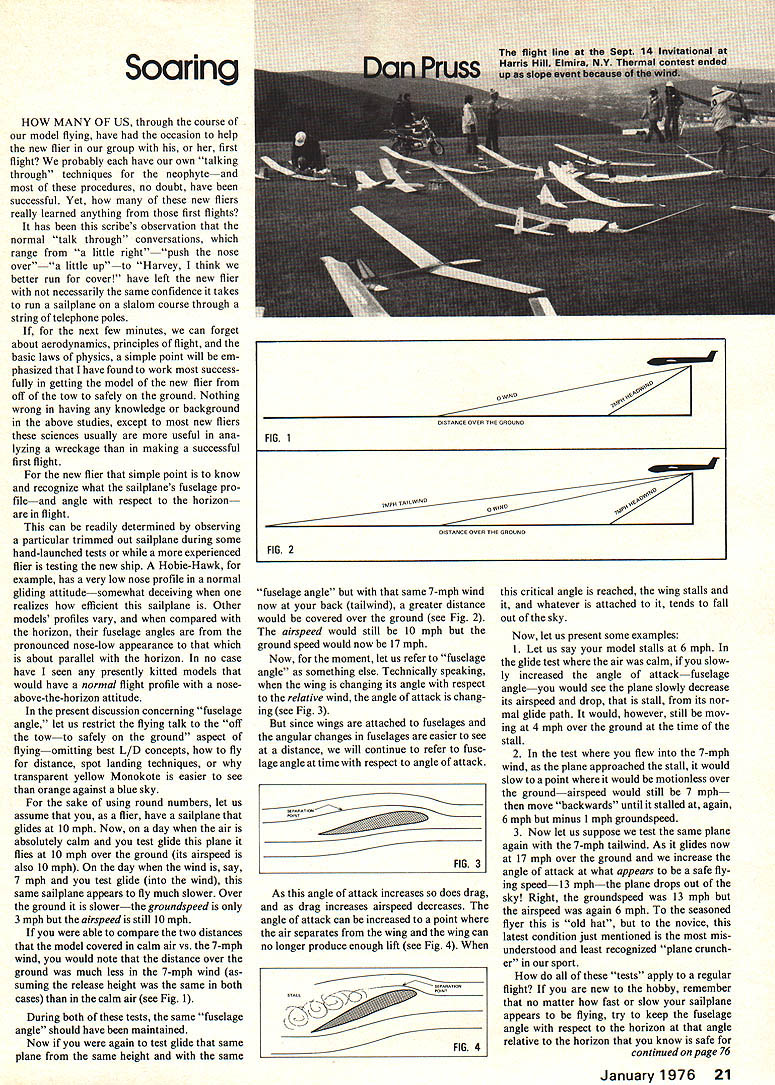
Now, on a day when the air is absolutely calm, a test glide plane flies 10 mph over the ground; its airspeed is also 10 mph. On a day when the wind is, say, 7 mph (a headwind for the test glide), the same sailplane appears to fly much slower over the ground. The groundspeed is 3 mph while the airspeed is still 10 mph. If one is able to compare the two distances the model covered — calm air vs. 7-mph wind — one would note the distance over ground is much less with the 7-mph wind, assuming release height is the same in both cases (calm air — see Fig. 1).
During both tests the same fuselage angle should have been maintained. Now, again testing the same glide, same plane, same height, with the same fuselage angle but with a 7-mph wind now at your back (a tailwind), a greater distance would be covered over the ground (see Fig. 2). The airspeed would still be 10 mph, but the groundspeed would now be 17 mph.
At this moment let us refer to the fuselage angle as something else. Technically speaking, the wing is changing its angle with respect to the relative wind — the angle of attack is changing (see Fig. 3). Since wings are attached to fuselages, angular changes of the fuselage are easier to see. For distance discussions we will continue to refer to fuselage angle when we mean angle with respect to angle of attack. As angle of attack increases, so does drag; drag increases, airspeed decreases. Angle of attack can be increased to the point where the air separates from the wing and the wing can no longer produce enough lift (see Fig. 4). When the critical angle is reached the wing stalls and whatever is attached tends to fall out of the sky.
Now let us present some examples:
- Let us say the model stalls at a 6 mph glide in a test where the air is calm. If the angle of attack is slowly increased (fuselage angle increased), you would see the plane slowly decrease its airspeed, drop into a stall. Its normal glide path would, however, still be moving 4 mph over the ground at the time of stall.
- Test flew in a 7-mph headwind: the plane, as it approached the stall, would slow to the point it would be motionless over the ground (airspeed would still be 7 mph) and would move backwards until stalled again — 6 mph minus 1 mph groundspeed.
- Now let us suppose we test the same plane again with a 7-mph tailwind. As it glides now 17 mph over the ground, increase angle of attack. What appears a safe flying speed — 13 mph over the ground — the plane drops out of the sky. Right: groundspeed 13 mph, airspeed again 6 mph.
To the seasoned flyer this is old hat. The novice in the last condition just mentioned may misunderstand or, at least, not recognize what the plane is about to do. Sport tests — apply regular flight and your new hobby — remember: no matter how fast or slow a sailplane appears to be flying, try to keep the fuselage angle with respect to the horizon. Angle relative to the horizon is what you must know to be safe.
Transcribed from original scans by AI. Minor OCR errors may remain.

