
Radio Control: Soaring
Dan Pruss
Distance record set
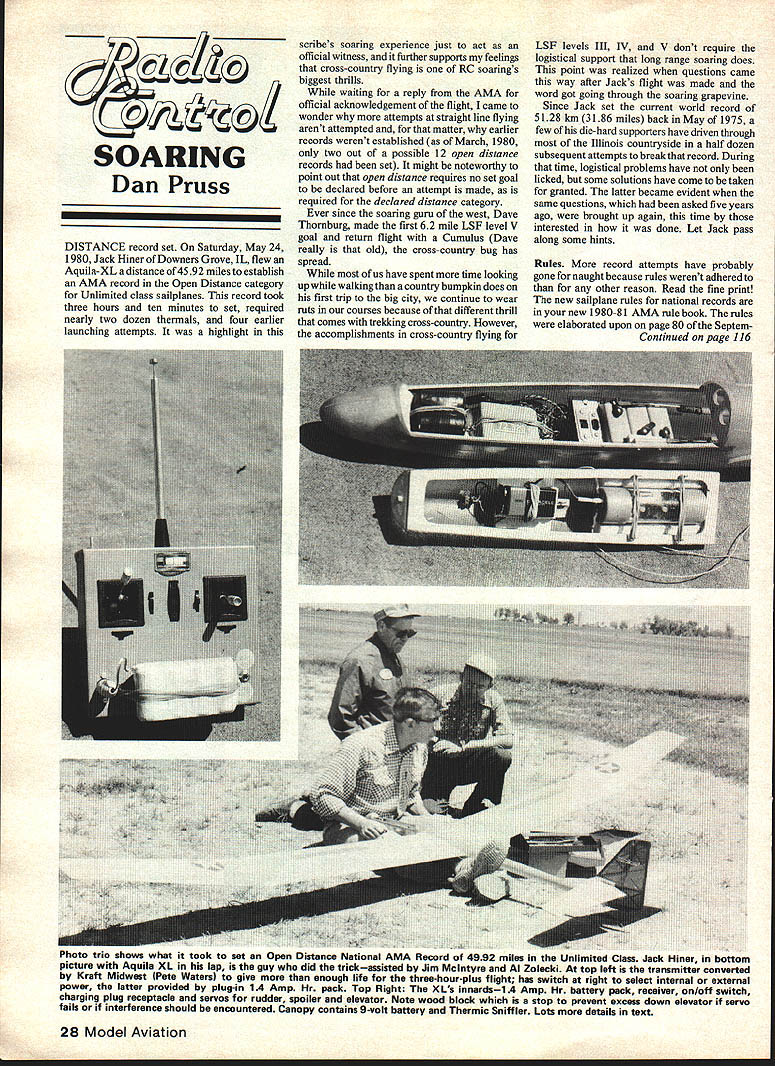
On Saturday, May 24, 1980, Jack Hiner of Downers Grove, IL, flew an Aquila-XL a distance of 45.92 miles to establish an AMA record in the Open Distance category for Unlimited class sailplanes. The flight took three hours and ten minutes to set, required nearly two dozen thermals, and four earlier launching attempts. It was a highlight in this scribe's soaring experience just to act as an official witness, and it further supports my belief that cross-country flying is one of RC soaring's biggest thrills.
While waiting for official AMA acknowledgement of the flight, I wondered why more straight-line attempts aren't made, and why earlier records weren't established (as of March 1980, only two out of a possible 12 open distance records had been set). Note: open distance requires no pre-declared goal before an attempt, unlike the declared distance category.
Ever since the soaring guru of the west, Dave Thornburg, made the first 62-mile LSF level V goal-and-return flight with a Cumulus, the cross-country bug has spread. While most of us spend more time looking up while walking than a country bumpkin does on his first trip to the big city, we keep wearing ruts in our local courses because of the different thrill that comes with trekking cross-country. Accomplishments in cross-country flying for LSF levels III, IV, and V don't require the logistical support that long-range soaring does.
This point became clear when questions arose after Jack's flight and the word went around the soaring grapevine. Since Jack set the current world record of 51.28 km (31.86 miles) in May 1975, a few of his supporters have driven the Illinois countryside in a half-dozen attempts to break that record. During that time, logistical problems have been solved and some solutions have become taken for granted. The same questions asked five years ago were asked again—this time by those interested in how it was done. Let Jack pass along some hints.
Rules
- More record attempts probably fail because rules weren't adhered to than for any other reason. Read the fine print!
- The new sailplane rules for national records are in the 1980–81 AMA rule book.
- The rules were elaborated on page 80 of the September 1979 issue of Model Aviation.
- For FAI records, get a copy of the rules through the AMA from the FAI's sporting code.
The course
- Know the route well. Select would-be routes well beforehand and pick options for every possible wind direction.
- Distance runs are best made running downwind.
- Choose remote country roads with minimal traffic (during Jack's run there were more thermals than cars). Remote roads also allow laying out a winch line without tying up traffic.
- Be aware of irregularities: busy highway crossings, railroad tracks, and changing speed limits through small towns.
- Watch for obstructions that can block your line of sight—groves of trees, high embankments, or other visual barriers.
- Example: An attempt at a new FAI record three years ago was ruined when a high row of trees blocked the chase crew's view. By the time the obstruction was cleared, the model was lost. It was found later, but the plane, radio, and thermal sniffer were destroyed. This year the plane has flown directly over that same area.
- Common sense and prior reconnaissance pay off.
Chase car
- For LSF levels III, IV, and V, a regular four-door sedan will serve many crews well.
- Poking one's head and transmitter out a car window is tolerable for about an hour; a sunroof extends that to maybe an hour and a half.
- For longer runs, a convertible is ideal if you can find one. If not, a pickup truck (with proper safety precautions) is a practical alternative.
- Riding in the back of a pickup is not as uncomfortable as it sounds; many crews stand or rest on the cab while advancing the course.
- Typical speeds: a sailplane at 30 mph with a 5–10 mph tailwind can produce comfortable ground speeds around 15 mph for the chase car.
- Crew roles: with one flier and three officials, one official drives while the other two stand in the back watching for traffic, reading maps, and keeping a log.
- Driving technique: use step-and-go driving—work thermals to altitude before continuing. Accelerating too quickly from zero can throw people off balance; safety should prevail.
Batteries
- For long flights (e.g., eight-hour LSF level V slope flights) plan battery usage carefully.
- Jack used 1.4 ampere-hour GE NiCads in both his transmitter (taped to the outside on the bottom) and his airborne pack.
- AA alkaline cells have lasted upwards of five hours in some setups and can serve well in two-meter or smaller sailplanes.
- Current drain varies with receivers and servos. Read equipment specification sheets.
- If using alkaline cells, bench-test a set until they wear out to confirm run time—it's worth the peace of mind.
Thermal sniffers
- A thermal sniffer is a must. Jack has used the "Thermic Sniffer" for years.
- Thermal sniffers detect both lift and sink. Sometimes lift is so strong that the model climbs out of safe range; flying through readable sink can bring the sailplane back to a comfortable altitude without overstraining the model.
Miscellaneous / Packing list
- Plan for a long day.
- Call your local weather bureau not only for surface weather but for "forecast winds at 3,000 feet." You may not get that high, but it gives useful direction indications and can be more accurate than surface reports.
- Pack water and food for the whole crew.
- Take binoculars.
- Bring goggles to protect the flier's and observers' eyes from dust.
- Add sunglasses, a visor hat, and suntan oil.
- The key phrase: be prepared.
The above ideas are simple and straightforward but are the result of solutions to problems encountered during over five years of cross-country flying. If you haven't tried this type of soaring yet, you're in for a new dimension to our quiet sport. Whether you set a national or world record or just attempt it, idling through the quiet countryside will give you its own rewards.
Have at it!
Dan Pruss RR 2, Box 490, Plainfield, IL 60544.
Transcribed from original scans by AI. Minor OCR errors may remain.

