


Radio Control: Soaring
Dan Pruss
Two Meter World Cup
Become the "Ace of the Deuces." That's the way the flyer reads announcing the Second Annual Two Meter World Cup. This event, scheduled for January 10 and 11, 1981, is being hosted by the San Fernando Valley Silent Flyers and the Antelope Valley Soaring Association. This contest is limited to two-meter sailplanes. Tasks will be similar to F3B types involving speed, distance, and duration. The site will be in or near Los Angeles. For further information, write to: Two Meter World Cup, c/o Doug Ford, 18630 Nau Avenue, Northridge, CA 91326 — USA.
For years soaring has needed a good winter-time event. This could be the answer.
Kestral-17 (Ralph Learmont)
We’ve talked about large-scale models in this column in the past, and most of them carried price tags of about $4 per inch of wingspan. If you’re interested in a 1/4-scale bird that is more affordable, Ralph Learmont of Australia has a Kestral-17 that fits right in with the high-priced spread — for about a fourth the cost.
This bird was offered some time ago, and at least two are flying on the West Coast. Packaging and shipping are always a high cost factor with large sailplanes, and Learmont’s Kestral was no exception. However, he has overcome that problem to some degree and has been able to drop the price to 179 Australian dollars, including shipping. It should be noted that this is a model-builder’s kit. Sheeting has to be purchased to cover the foam wing, but all the linkages are included for the flying surfaces.
The handbook is nearly 100 pages long and contains detailed drawings on nearly every page. These drawings include clever and innovative ideas that could be applied to other models. Details include retractable gear — with doors, spoilers, tail wheel, and gapless hinges. The canopy is a work of art and fits the fiberglass fuselage like a lid on a jar. If you are a builder, and if big prices have steered you away from big models, check into the Kestral-17 by writing: Southern Sailplanes, 31 Queens Parade, Burwood, VIC 3125, Melbourne, Australia.
Dayton DARTS — 2 km Out-and-Back Event
From the Dayton, OH, DARTS comes a report of a different kind of contest. The task was a two-kilometer out-and-back event over a concrete runway at Wright Field, this year’s AMA Nats site.
Procedure:
- Launch, and after one minute the clock was started.
- Once the flier felt he had enough altitude, he flew the course while riding in a chase car.
- Three rounds were flown, and all scores counted.
- If you didn’t finish the course, your distance was measured against the slowest finisher for that round.
Of 36 attempts, only three fliers completed the course, 11 didn’t get past "go," and Ken Bates of Ann Arbor, MI, took top honors with his Merlyn.
SOAR — Great Race V
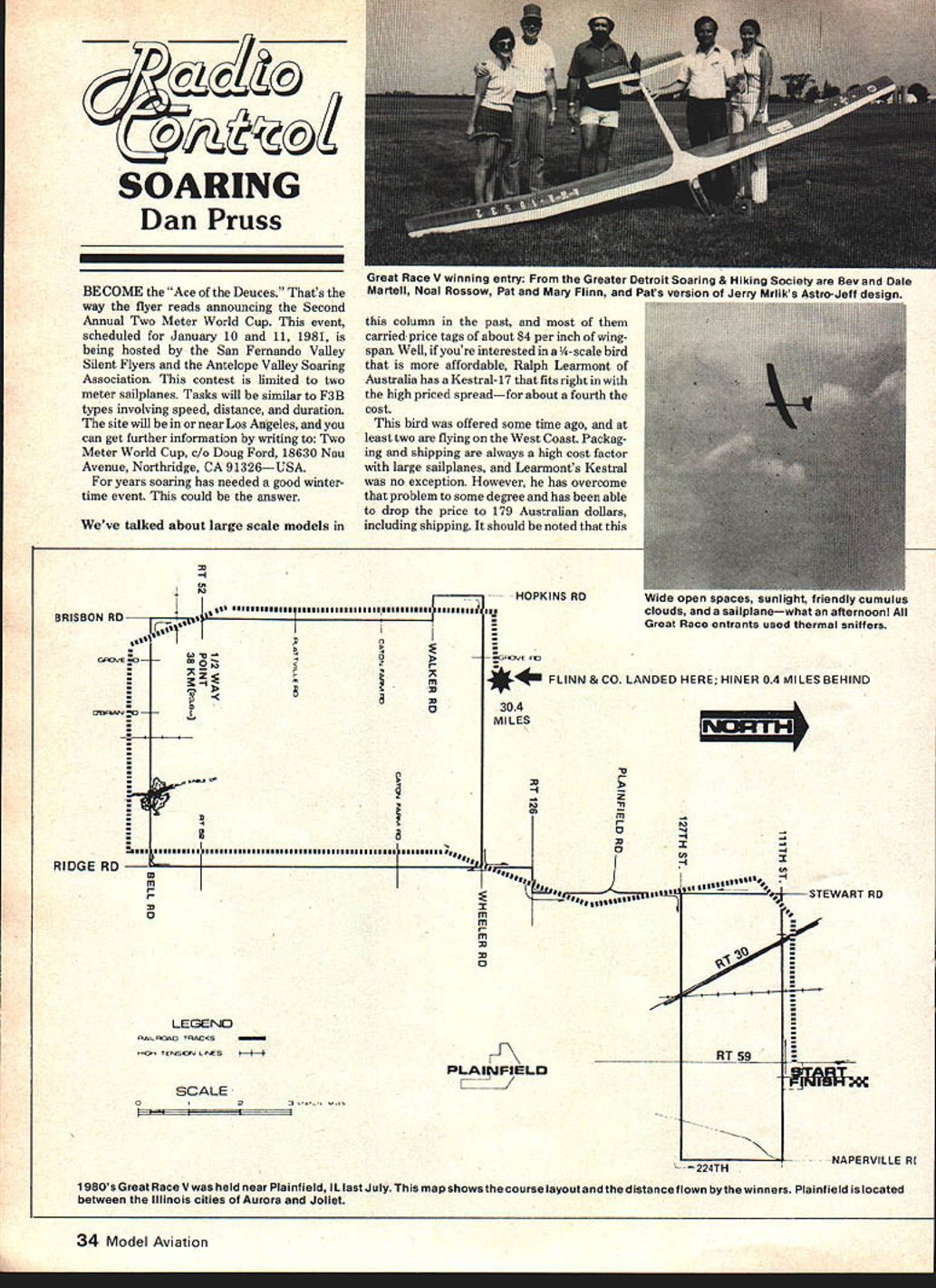
In July, SOAR held their cross-country event, Great Race V. Over the years the rules for this event have been modified and reduced in number — always in the interest of offering the maximum opportunity for flying. Entries are to clubs only, and each club is assigned one frequency. Any number of planes can be entered on that one frequency and selected as the weather suits them. The idea is to fly — as much and as long as possible with little or no restrictions. And this year they flew!
Key rules and format:
- The event was scheduled for two days to offer more time and a greater opportunity to score well.
- Only a club’s longest flight counted in the scoring.
- Relaunching carried no penalties.
- Time started only when the flier announced he was starting on the course; thermalling to gain height before the start carried no time penalty.
- There were no spot landings to measure, no working times, no false starts, no relaunch penalties for broken lines (relaunches would have been permitted), and no impound to monitor interference problems.
- Winches were open after the initial rotation was selected via the draw. Fliers called were allowed to launch or to pass; once all were given those choices, the winches were open.
- Briefing was at 9:00 a.m., first launch scheduled at 10:00 a.m., and the deadline for starting on the course was 3:00 p.m.
Participants included:
- Skip Miller — Rocky Mountain Soaring Association
- Ken Bates and the Michigan RC Society — Merlyns
- Stan Watson — Suburban Aero Club (Pegasus)
- Jack Hiner — SOAR (modified Aquila XL with "205-122" wing)
- Frank Spearman and Jerry Epps — Illinois Model Airplane Club (Leo)
- Greater Detroit Soaring & Hiking Society (GDS&HS) — Jerry Mrlik’s Astro Jeff
- Pat Flinn, Dale Martell, and Noal Rossow — GDS&HS representatives
Notes on entries: Frank and Jerry entered a Leo that had to be reduced in weight by two ounces to meet FAI weight limitations — one of the few restrictions. All came not only to grab the $500 offered for the best time around the course but to challenge the GDS&HS and its strong team.
Race narrative and results: Although the contest was scheduled for two days, all the action took place on the first day. Sunday the winds came up and no one got on the course. But Saturday was spectacular.
After bumping around in light lift, Pat Flinn and company took off down the course. Minutes behind him Jack Hiner left. Within 30 minutes all clubs were on the course except the IMACs (who attempted only on Sunday). But no sooner had the last club left than the GDS&HS returned with a measly 1.8 miles logged. Ken Bates returned with a 1.5-mile flight. Watson managed 1.8 miles, Skip Miller 4.7 miles, and Hiner 3.5 miles.
Relaunches were made. Flinn and Miller staged a classic display where both picked up lift 30 feet off the ground and rode it out for a go-for-broke run. For the next hour the flying site was absolutely still except for the tinkling of ice in a glass and a portable stereo — what a way to CD a contest! Shortly after, Watson returned with a 5.3-mile flight and relaunched again just before the 3 p.m. deadline.
Again it went quiet. Then Bates returned with a 7.1-mile run. Miller and his wife, Meesh, returned after chasing Flinn until Flinn made a tactical move by anticipating a turn on the course. Miller logged 10.9 miles.
Another hour went by and everyone felt this would be the day the full 76 km (47 miles) course would be flown non-stop for the first time. Then the Detroit gang arrived: the timer’s log showed 30.4 miles! Now it was wait for Hiner and his team. During another hour-long wait, Pat and his crew described how they worked thermals 11 different times and how the 3-hour and 18-minute flight had little effect on them physically despite 100° temperatures.
At about 5:00 p.m., the SOAR team returned with a flight that lasted 3 hours and 25 minutes for a distance of 30.0 miles. It took until Sunday to make it official, but the Greater Detroit Soaring & Hiking Society did it again with an incredible ending.
Hiner started his last run 53 minutes behind Flinn and landed exactly one hour after him. At no time on the course did either know the status of the other, and their points of landing were on the same farm field.
A hats-off to the GDS&HS and the Flinns, Martells, and Noal Rossow for not only a team effort but a family one as well.
Next year? Word is that the prize money has been increased and the rules will be just as relaxed — but the course will be just as challenging. Any takers out there to better the record of a bird that first showed up at the 1972 Soaring Nats at Miller Meadow?
Dan Pruss RR 2, Box 490, Plainfield, IL 60544
Transcribed from original scans by AI. Minor OCR errors may remain.

