
Radio Control: Soaring
Dan Pruss
If you thought Two-Meter designs had to be drab, unimaginative and winners of an ugly-duckling look-alike contest, you missed a few pleasant surprises that appeared at this year's AMA Nationals. True, Tom Killough of Alabama won the 2M event with a simple, straightforward design — a Drifter by Craftaire. But that just goes to prove that the three P's — pilot, plane, and practice — still win contests.
Highlights from the Nats
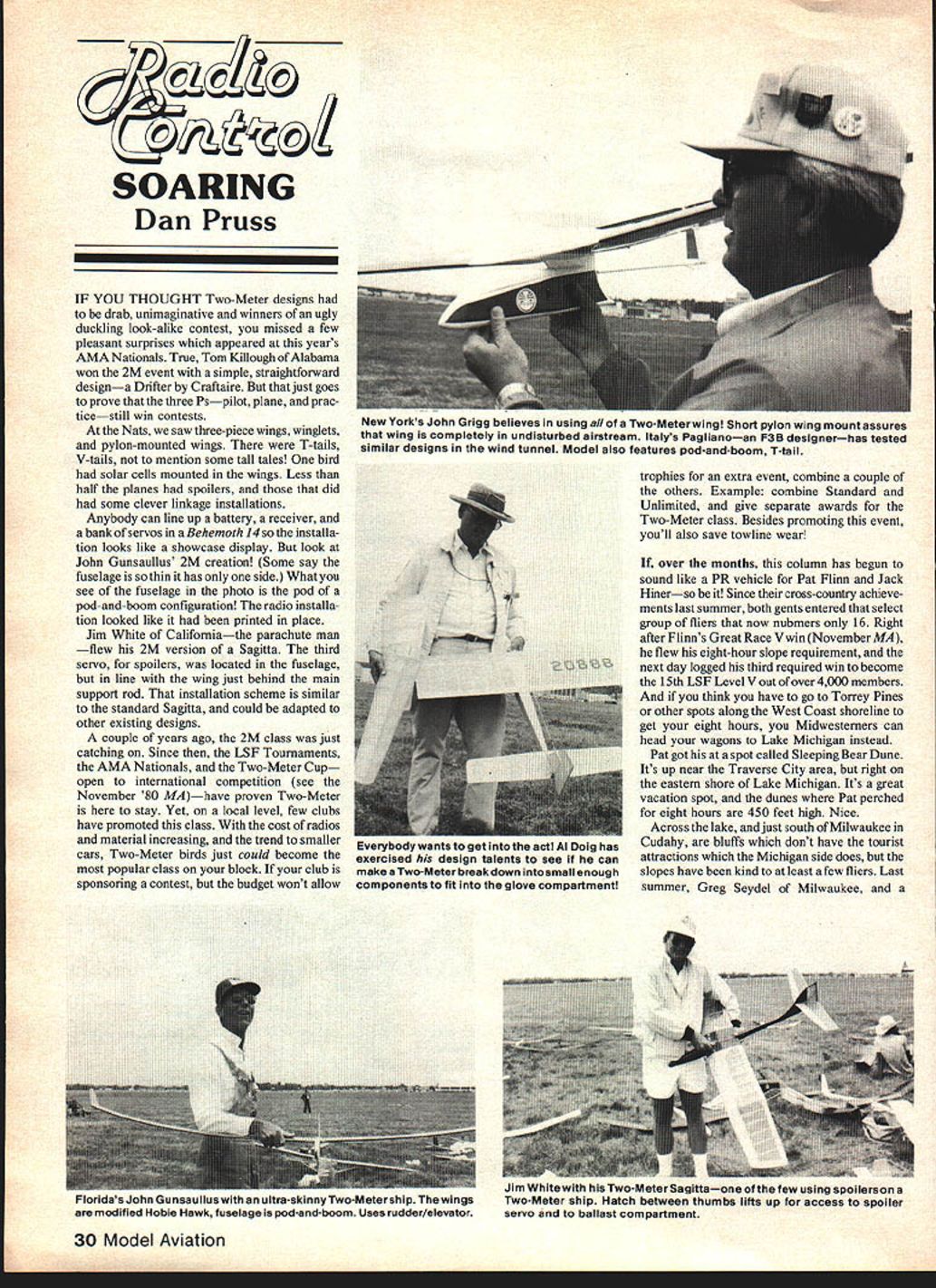
At the Nats we saw three-piece wings, winglets, and pylon-mounted wings. There were T-tails, V-tails, and not to mention some tall tales. One bird even had solar cells mounted in the wings. Less than half the planes had spoilers, and those that did featured some clever linkage installations.
Anybody can line up a battery, receiver, and a bank of servos in a Behemoth 14 so the installation looks like a showcase display. But look at John Gunsaullus' 2M creation — some say the fuselage is so thin it has only one side. What you see of the fuselage in the photo is the pod of a pod-and-boom configuration. The radio installation looked like it had been printed in place.
Jim White of California — the "parachute man" — flew his 2M version of a Sagitta. The third servo, for spoilers, was located in the fuselage but in line with the wing just behind the main support rod. That installation scheme is similar to the standard Sagitta and could be adapted to other existing designs.
Two-Meter class growth and suggestions
A couple of years ago the 2M class was just catching on. Since then, the LSF tournaments, the AMA Nationals, and the Two-Meter Cup — open to international competition (see the November '80 MA) — have proven Two-Meter is here to stay. Yet, on a local level, few clubs have promoted this class. With the cost of radios and materials increasing, and the trend to smaller cars, Two-Meter birds could become the most popular class on your block.
If your club is sponsoring a contest but the budget won't allow trophies for an extra event, consider combining events. Example:
- Combine Standard and Unlimited, and give separate awards for the Two-Meter class.
Not only will this promote the event, you'll also save towline wear.
Level V — Flinn and Hiner
If, over the months, this column has begun to sound like a PR vehicle for Pat Flinn and Jack Hiner — so be it. Since their cross-country achievements last summer, both entered that select group of fliers that now numbers only 16.
Right after Flinn's Great Race V win (November MA), he flew his eight-hour slope requirement, and the next day logged his third required win to become the 15th LSF Level V out of over 4,000 members. And if you think you have to go to Torrey Pines or other West Coast spots to get your eight hours, you Midwesterners can head your wagons to Lake Michigan instead.
Pat got his at a spot called Sleeping Bear Dune. It's up near the Traverse City area, right on the eastern shore of Lake Michigan. It's a great vacation spot, and the dunes where Pat perched for eight hours are 450 feet high.
Across the lake, just south of Milwaukee in Cudahy, are bluffs that don't have the tourist attractions the Michigan side does, but the slopes have been kind to at least a few fliers. Last summer, Greg Seydel of Milwaukee, a member of the Suds City Flyers, ho-hummed his way through the eight hours required toward his Level V.
In contrast to Seydel's first-try achievement, Hiner had been after the eight-hour goal since 1975. Back when John Baxter and Steve Work became the first and second to achieve Level V, the eight hours was all Jack needed. On October 12, Jack went to a third spot along Lake Michigan — Warren Dunes, along the southern edge of the lake near the Indiana/Michigan border. Jack flew an Aquila with C-size cells strapped to the top of the fuselage. Accompanying Hiner was Stan Watson, who flew his Pegasus (see August '80 MA). Like Seydel, it was Watson's first attempt.
Over the years there have been those who decried the eight-hour-slope task. But then there are also those who think the Boston Marathon should be about 20 miles shorter. The eight-hour slope is a test of pilot and plane.
Talk to Hiner. Back in '75, when he could have been the first to make Level V, a 1.2 amp-hour cell went sour in March and 5-1/2 hours went for naught. In July a rudder servo died at 6:53. In 1976 and 1977 Jack wasn't in the right place at the right time — and neither was the wind — as one flight ended at 6-1/2 hours. In 1978 radio interference aborted two flights at the four-hour mark, and again in 1979 the wind died at 6-1/2 hours. Jack's logbook shows that he flew 45 hours during 11 attempts to make the eight-hour requirement for Level V. And that, dear reader, is only one case to explain why there are only 16 of them out of 4,000 of us. Congrats, Flinn and Hiner.
Clubs and events
Three new club letters have come this way from metropolitan areas that should grow in soaring interest. The clubs are:
- Bluegrass Soaring Society, Box 286, Georgetown, KY 40324
- Atlanta Soaring Association, c/o Dick Renskers, President, 517 Fon du Lac Drive, Stone Mountain, GA 30088
- Steel City Soarers, 711 N. 3rd Street, Jeannette, PA 15644
Speaking of clubs, SOAR announced that it has upped the prize money to $1,000 for first place for the fastest time around the 76-kilometer (47.2-mi.) Great Race course. This is the race Pat Flinn and the Greater Detroit Soaring and Hiking Society won last year with a flight of 30.4 miles (November MA). The challenge is open only to AMA-chartered clubs. Further information may be obtained by sending a stamped, self-addressed business envelope to the address below.
Good lift.
Dan Pruss R.R. 2, Box 49D Plainfield, IL 60544
Transcribed from original scans by AI. Minor OCR errors may remain.

