
Radio Control: Soaring
Dan Pruss
Chicago Expo
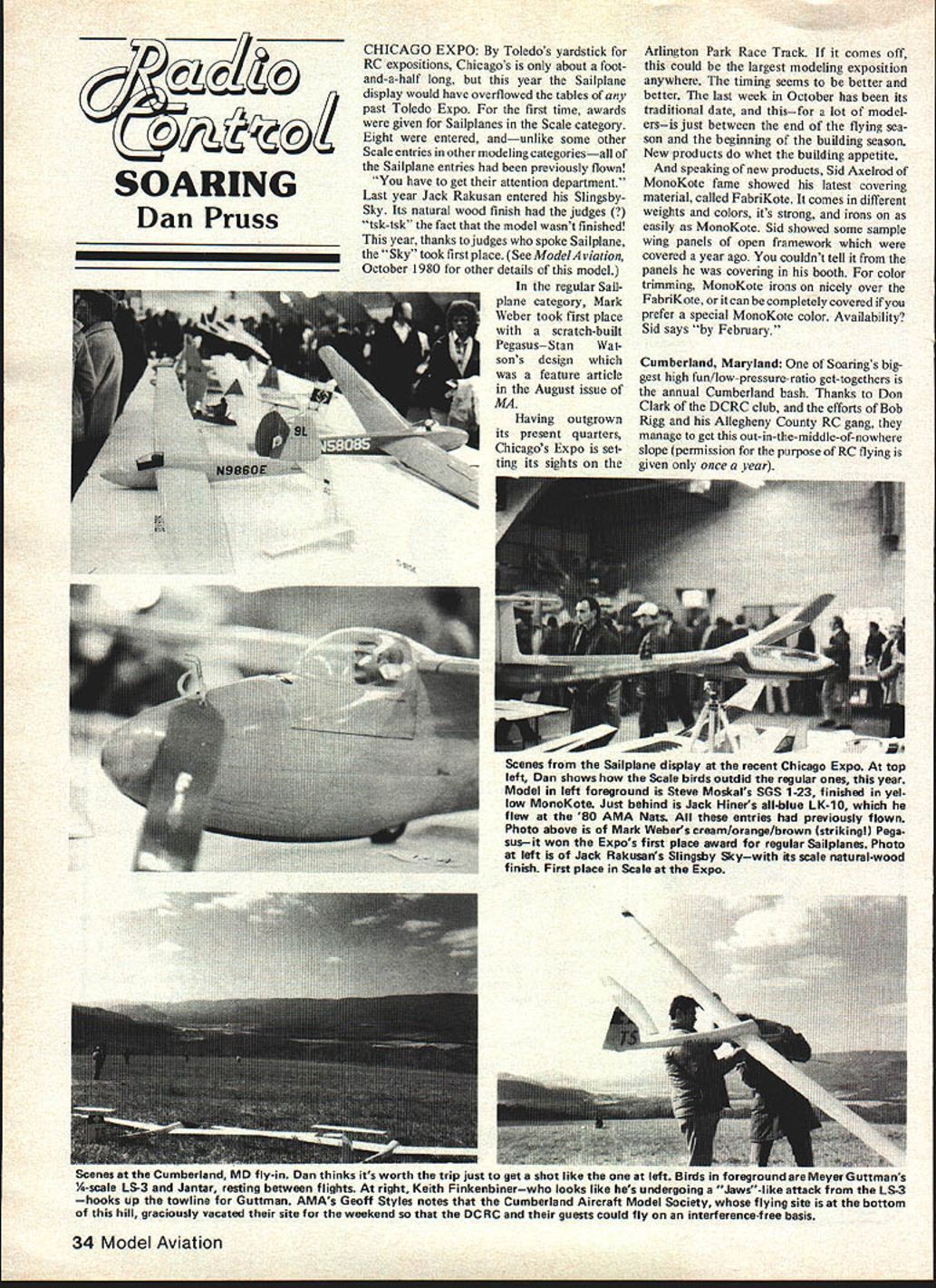
By Toledo's yardstick for RC expositions, Chicago's is only about a foot-and-a-half long, but this year the sailplane display would have overflowed the tables of any past Toledo Expo. For the first time, awards were given for sailplanes in the Scale category. Eight were entered, and—unlike some other scale entries in other modeling categories—all of the sailplane entries had been previously flown!
"You have to get their attention, department."
Last year Jack Rakusan entered his Slingsby Sky. Its natural wood finish had the judges "tsk-tsk" at the fact that the model wasn't finished. This year, thanks to judges who spoke sailplane, the Sky took first place. (See Model Aviation, October 1980 for other details of this model.)
In the regular sailplane category, Mark Weber took first place with a scratch-built Pegasus—Stan Watson's design, which was a feature article in the August issue of Model Aviation.
Having outgrown its present quarters, Chicago's Expo is setting its sights on the Arlington Park Race Track. If it comes off, this could be the largest modeling exposition anywhere. The timing seems to be better and better. The last week in October has been its traditional date, and this—for a lot of modelers—is just between the end of the flying season and the beginning of the building season. New products do whet the building appetite.
Sid Axelrod of MonoKote fame showed his latest covering material, called FabriKote. It comes in different weights and colors, it's strong, and it irons on as easily as MonoKote. Sid showed some sample wing panels of open framework that were covered a year ago; you couldn't tell them from the panels he was covering in his booth. For color trimming, MonoKote irons on nicely over FabriKote, or it can be completely covered if you prefer a special MonoKote color. Availability? Sid says "by February."
Cumberland, Maryland
One of soaring's biggest high-fun, low-pressure-ratio get-togethers is the annual Cumberland bash. Thanks to Don Clark of the DCRC club, and the efforts of Bob Rigg and his Allegheny County RC gang, they manage to get permission to use this out-in-the-middle-of-nowhere slope for RC flying—permission that is given only once a year.
What started out as a meeting for record trials—altitude mostly—over 10 years ago has evolved into a meeting place for unusual birds. Mention should be made of the unusual cheeses, breads, homemade sausages and wines. This year, Gene Shelkey, a Pittsburgh-area hill climber, had at least one model that made the whole hillside sit up and take notice.
Such a plane this year was Meyer Guttman's 1/4-scale LS-3. He wouldn't talk cost at the moment; in beauty it rivaled high-priced gems from Germany. The construction used materials and techniques usually seen in full-scale birds.
Key features of the 1/4-scale LS-3:
- Two-piece wing with factory-made top shells and bottom shells of epoxy fiberglass.
- Long, thin full-depth balsa spars joining the top and bottom skins; the skins were strong enough to take air loads.
- Spars designed to take hard impacts: they will break before the wing skins and can be easily repaired.
- Workmanship and craftsmanship were flawless; aside from the canopy, the plane's surfaces were 100% fiberglass.
Controls and performance:
- Controls: rudder, full-span flaperons (can be coupled or uncoupled in flight), elevator spoilers, and a releasable tow hook.
- The model pushed the FAI maximum weight limit of 11 pounds; wing loading was about 24 oz per sq ft.
- Despite the weight, launching was done with a 12-volt winch.
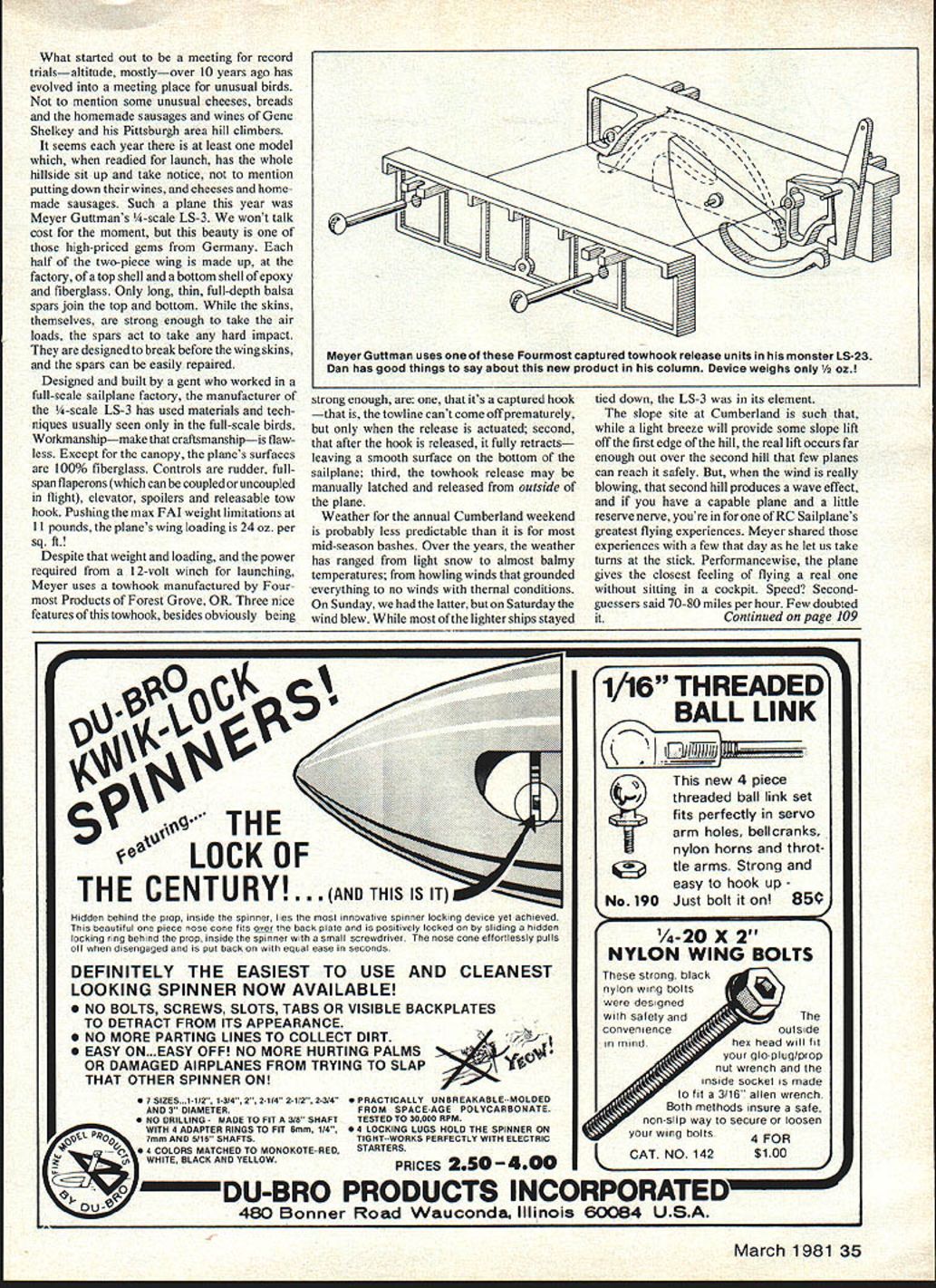
Meyer uses a tow hook manufactured by Fourmost Products, Forest Grove, OR. Three notable features of the tow hook:
- It is a captured hook—meaning the towline can't come off prematurely; it only releases when the release is actuated.
- After release, the hook fully retracts, leaving a smooth surface on the bottom of the sailplane.
- The tow-hook release may be manually latched and released from outside the plane.
Weather for the annual Cumberland weekend is probably less predictable than for most mid-season bashes. Over the years the weather has ranged from light snow to almost balmy temperatures; from howling winds that grounded everything to no winds with thermal conditions. On Sunday we had the latter, but on Saturday the wind blew, and while most of the lighter ships stayed tied down, the LS-3 was in its element.
The slope site at Cumberland is such that while a light breeze will provide some slope lift off the first edge of the hill, the real lift occurs far enough out over the second hill that few planes can reach it safely. But when the wind is really blowing, that second hill produces a wave effect, and if you have a capable plane and a little reserve nerve, you're in for one of RC sailplane's greatest flying experiences. Meyer shared those experiences with a few who day as he let us take turns at the stick. Performance-wise, the plane gives the closest feeling to flying a real one without sitting in a cockpit—second-guessers estimated speeds of 70–80 mph.
The irony in plane design came when Ned Smith from Virginia showed up with one of Jerry Nelson's old KA-6s. While we marvel at the slippery birds coming out of Europe at the tune of $800, it should be remembered that that old KA-6 was on the market about a dozen years ago. Construction and design techniques then were as good as those mentioned above. The cost was about $250—but remember that was over 10 years ago.
After a bad launch, which was too low for turning back and too high and heavy for catching, Ned weaved through the low spots around the face of the hill, stroked out for that second hill, and found the peace and insurance a 20 mph wind can give to an 11-lb bird. The wave was working, and Ned—like Meyer—showed us what that state of the art was once (and is now again) with high-performance sailplanes.
It's a shame that meetings like Cumberland come only once a year. It's a greater shame that we can't come up with events for soaring that would encourage further development of such marvels. We might have to eliminate spot landings and two-minute precision tasks for such planes, but other tasks could be devised. If they're not, we'll have to wait for Cumberland again—next year.
Dan Pruss RR 2, Box 490 Plainfield, IL 60544
Transcribed from original scans by AI. Minor OCR errors may remain.

