

Radio Control: Soaring
Dan Pruss
Getting started: book recommendation
If you're a newcomer to the sport of RC soaring, most of your questions can be answered by How to Build and Fly Radio Controlled Gliders, by Jack E. Schroder. It's available through your local hobby shop, or you can order direct from:
Kalmbach Books 1027 North Seventh Street Milwaukee, WI 53233
It sells for $3.50. If you aren't near a club for hands-on advice, Schroder's book covers building, launching, and the "how-to" needed to keep your model right side up.
Awards and giveaway ideas
Looking for inexpensive awards for contests or club giveaways? Two items come to mind.
- Parachutes ('chutes) from The White Company
- Manufacturer: Jim White (The White Co.)
- Color options: red, white, blue, green, black, orange, yellow
- Sizes: 81, 98, and 126 sq. in. (the smallest is still larger than the minimum FAI requirements)
- Construction: eight panels, 75-lb test shroud lines
- Personalization available (club logo, name, AMA number, LSF number, etc.)
- Price: $10 each, or five for $45
- Address: The White Co., 19372 Worcester Lane, Huntington Beach, CA 92646
- LSF glasses
- Sizes: low-ball (10½ oz) or hi-ball (12 oz)
- LSF logo frost-etched
- Price: set of six (either size) $9.95, including shipping
- Contact: Warren Tiahrt, LSF Secretary, 7647 Twilight Court, Clarkston, MI 48016
- Note: these make a great conversation-starter with non-modeling friends
Poster: Hawley Bowlus montage
For nostalgia buffs or anyone wanting color on a workshop wall: artist Bill Neale (whose work has appeared in Road & Track and Flying) created a multi-colored montage of Hawley Bowlus' pre-World War II contributions. The poster includes drawings of:
- Baby Albatross
- Super Albatross
- Dragonfly
- XCG-16 cargo glider (twin boom designed around a lifting fuselage)
- Bowlus Road Chief (an aluminum aerodynamic travel-trailer designed in the 1930s)
Poster size: 18 in. x 27 in. Price: $6. Obtain from: Mike Shoen, 6719 East Malcomb, Paradise Valley, AZ 85253.
F3B World Championships — July 12–17, 1981 (U.S.A.)
At the recent CIAM meeting at the FAI headquarters in Paris, the U.S.A. was selected to host the third F3B World Championships. Details should be finalized by the time you read this, so plan now for the San Francisco area, July 12–17.
If you're new to soaring and F3B competition, get familiar with the tasks and international competition by reading the F3B rules (see page 102 et seq. in the AMA's 1980–81 Official Model Aircraft Regulations). Those who have followed the last two World Championships will recognize that the fliers and their planes are often in a different design spectrum than those used at straight Duration contests.
Speed times have been recorded under nine seconds by at least three British fliers, and teams are still being selected. Judging from interest and numbers, it could be standing-room-only at the F3B arena this July.
International Soaring Forum (ISF)
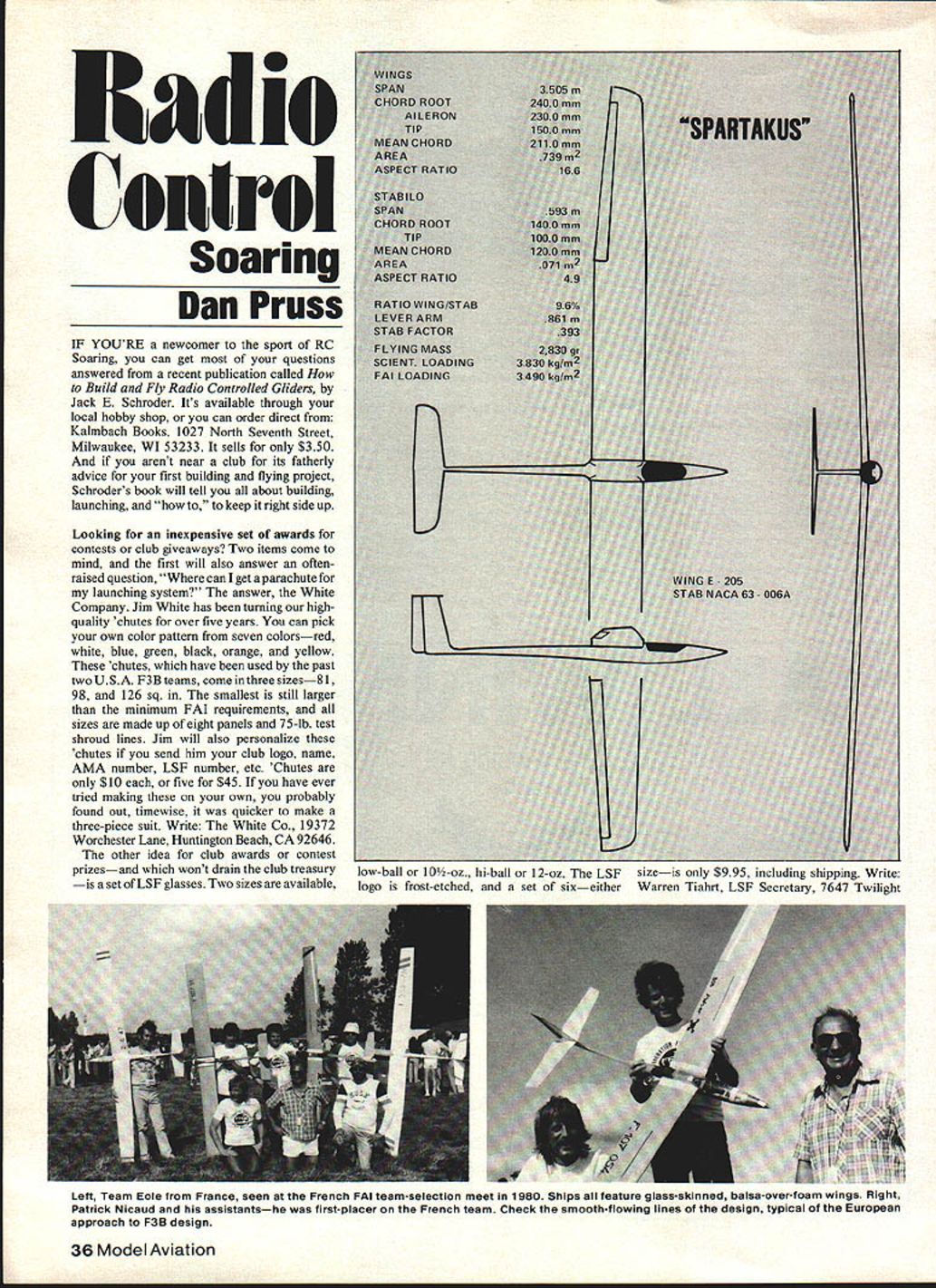
A group from Austria, Germany, and Switzerland has formed the ISF (International Soaring Forum). The weekend before CIAM, over 80 modelers from those countries met to discuss design, construction techniques, and airfoils. A 68-page report resulted; from that report the three-view of the Spartakus is presented this month, courtesy of Hansruedi Schlapfer of Switzerland.
Design notes: Spartakus and wing construction
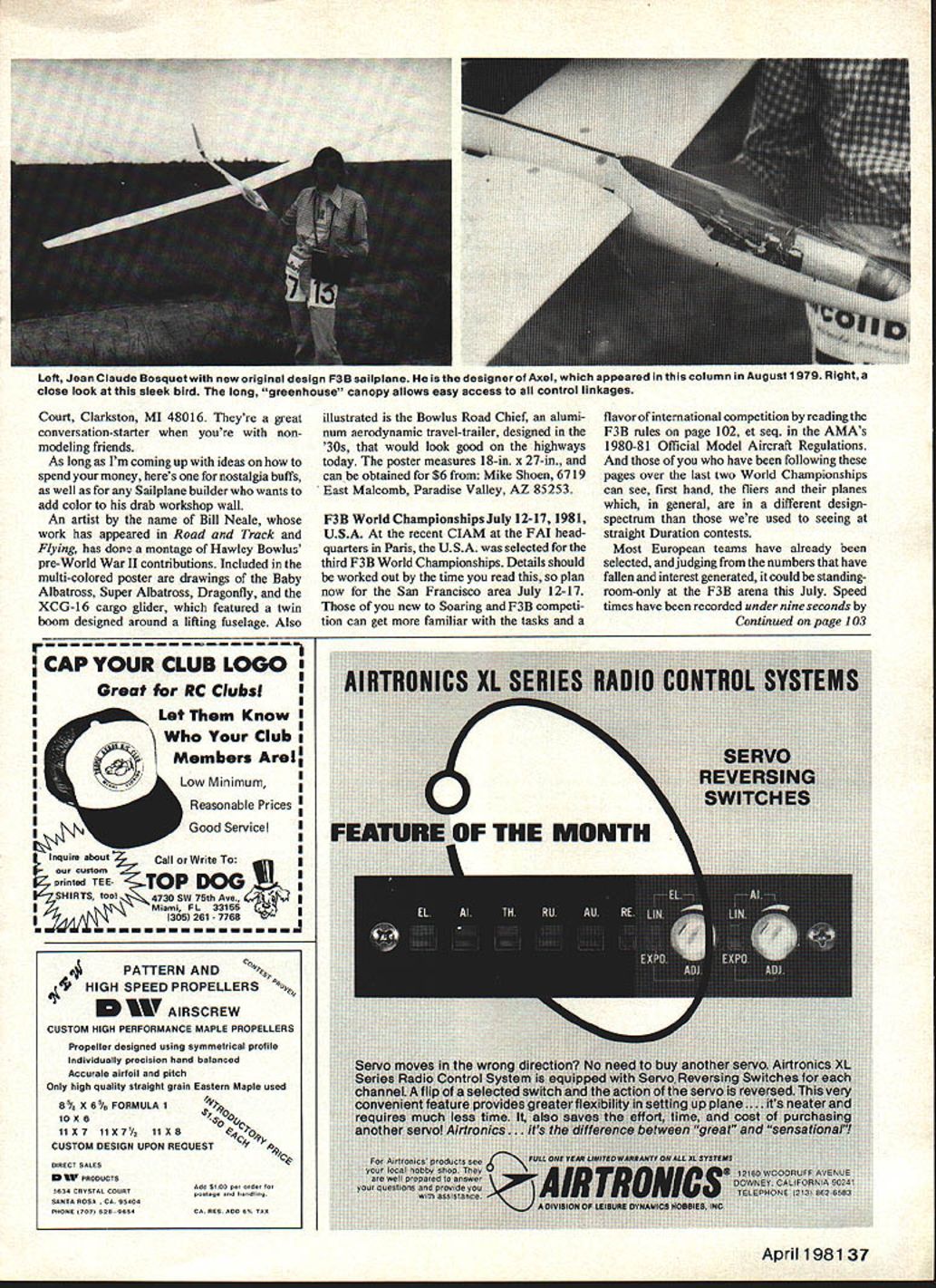
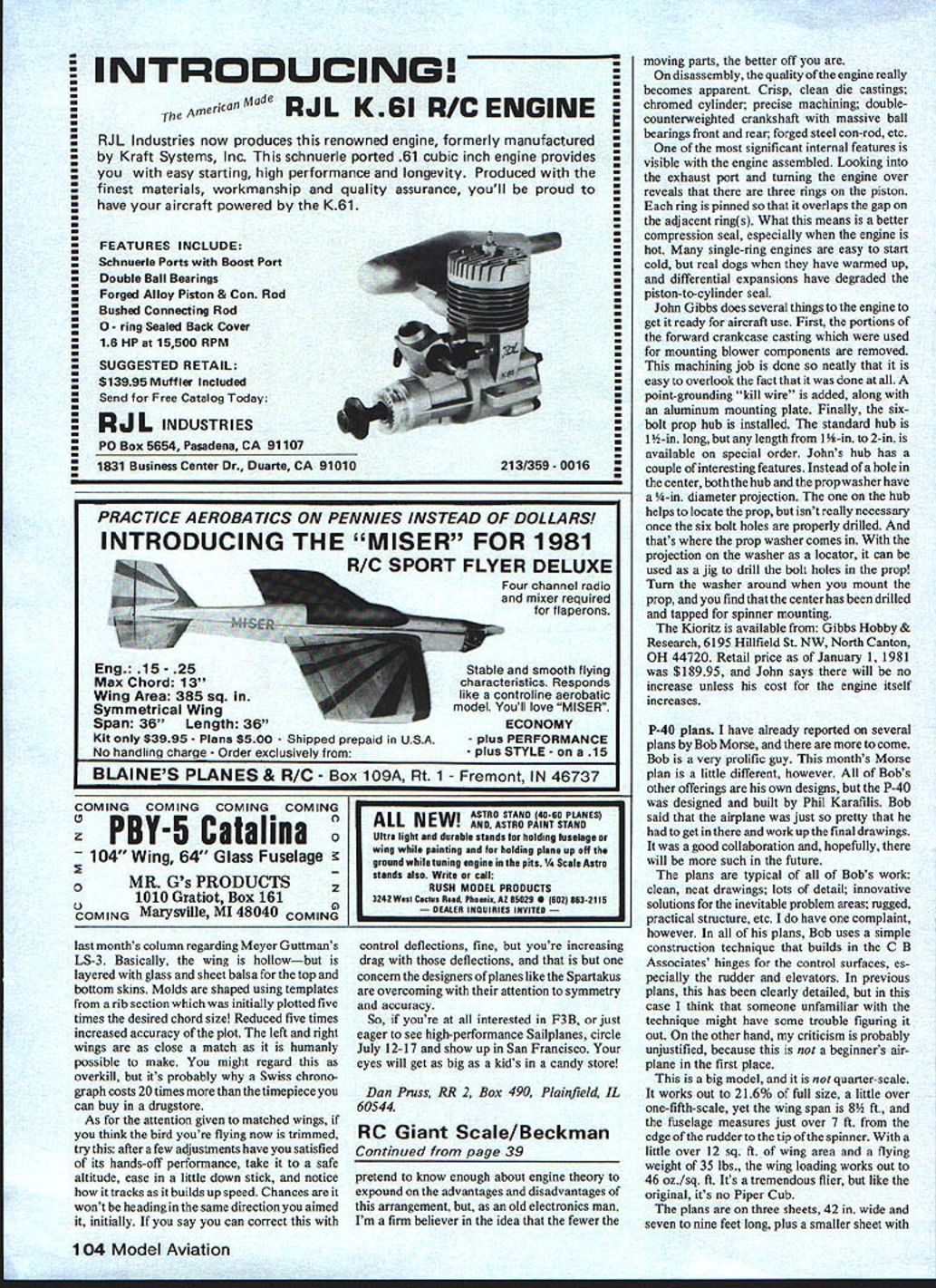
Years ago, when the three-task concept appeared, the U.S.A. tended to treat the distance task as one that required thermaling to gain altitude and thereby maximize distance during a four-minute flight. Most Europeans went the other route, designing very slippery machines that could fly a 12-lap course by virtue of low drag.
Designers of the Spartakus claim an L/D (lift-to-drag ratio) of nearly 20:1. If that doesn't shake up your 10-minute duration design envelope, consider this: from a standard 150-meter launch, a straight-line distance of 3,000 meters (well over a mile) can be flown in no-wind conditions — which translates to nearly 20 laps in an F3B Distance task.
A few notes on wing construction:
- Construction is similar to Meyer Guttman's LS-3: the wing is hollow but layered with glass and sheet balsa for the top and bottom skins.
- Molds are shaped using templates derived from a rib section originally plotted at five times the desired chord size. Reducing the plot by five increases accuracy.
- Left and right wings are matched as closely as possible — perhaps overkill, but attention to symmetry and accuracy reduces the need for control deflections that increase drag.
- If you think your current model is trimmed, test it by taking it to a safe altitude, easing in a little down stick, and observing how it tracks as speed builds. If it doesn't head straight, corrections via control deflections add drag; designers of planes like the Spartakus work to avoid that need.
If you're interested in F3B or eager to see high-performance sailplanes, circle July 12–17 and show up in San Francisco — it's an event that will make your eyes get as big as a kid's in a candy store!
Dan Pruss RR 2, Box 490 Plainfield, IL 60544
Transcribed from original scans by AI. Minor OCR errors may remain.

