
Radio Control: Soaring
Dan Pruss
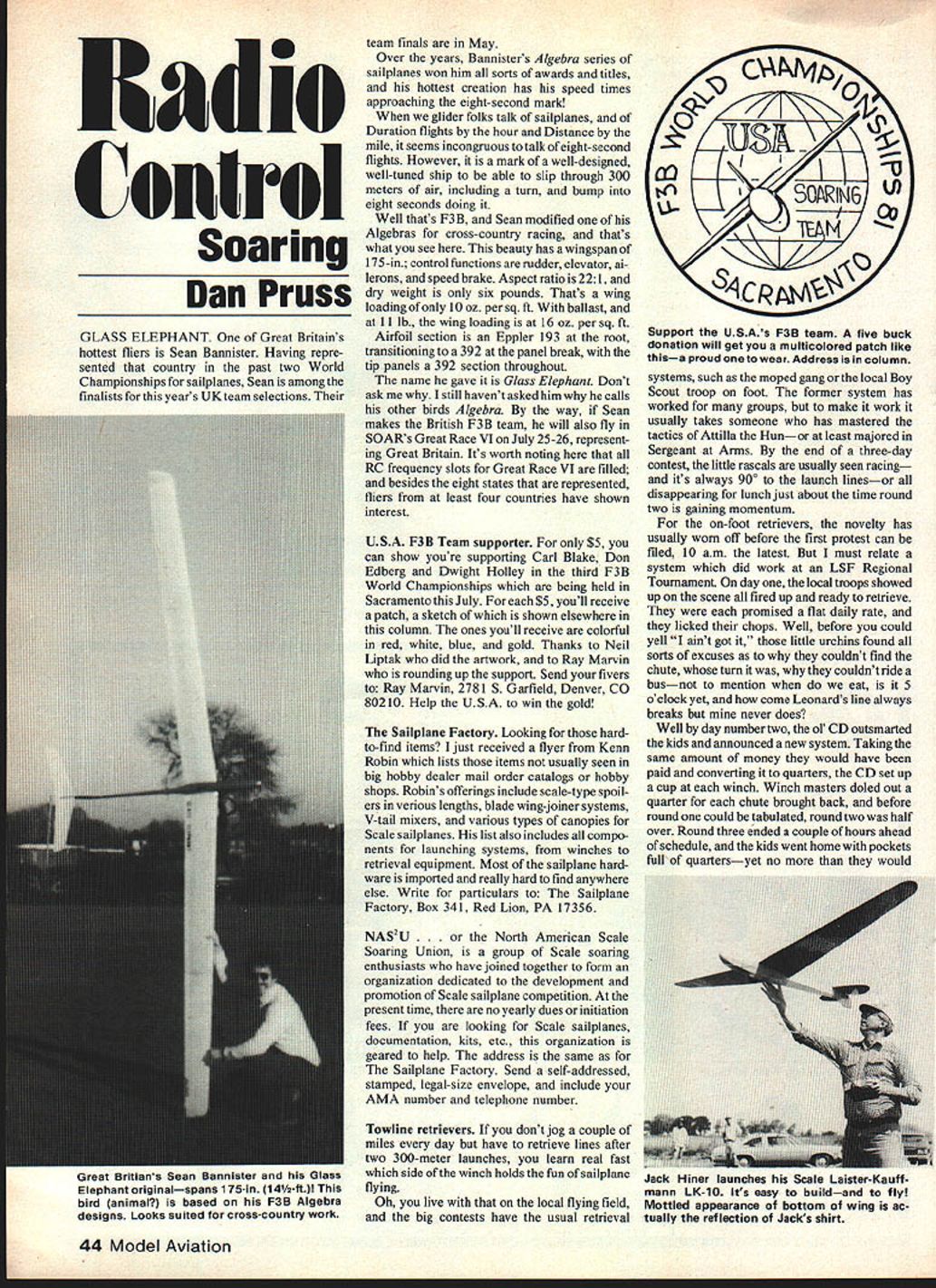
Glass Elephant
One of Great Britain's hottest fliers is Sean Bannister. Having represented that country in the past two World Championships for sailplanes, Sean is among the finalists for this year's UK team selections. Their team finals are in May.
Over the years, Bannister's Algebra series of sailplanes won him all sorts of awards and titles, and his hottest creation has his speed times approaching the eight-second mark. When we glider folks talk of sailplanes, and of duration flights by the hour and distance by the mile, it seems incongruous to talk of eight-second flights. However, it is a mark of a well-designed, well-tuned ship to be able to slip through 300 meters of air, including a turn, and bump into eight seconds doing it.
Well, that's F3B, and Sean modified one of his Algebras for cross-country racing, and that's what you see here. This beauty has a wingspan of 175 in.; control functions are rudder, elevator, ailerons, and speed brake. Aspect ratio is 22:1, and dry weight is only six pounds. That's a wing loading of only 10 oz. per sq. ft. With ballast, and at 11 lb., the wing loading is at 16 oz. per sq. ft. Airfoil section is an Eppler 193 at the root, transitioning to an Eppler 392 at the panel break, with the tip panels an Eppler 392 section throughout.
Key specs:
- Wingspan: 175 in.
- Controls: rudder, elevator, ailerons, speed brake
- Aspect ratio: 22:1
- Dry weight: 6 lb
- Wing loading: 10 oz/ft² (dry); 16 oz/ft² (with ballast)
- Airfoils: Eppler 193 (root) → Eppler 392 (panel break & tip)
The name he gave it is Glass Elephant. Don't ask me why. I still haven't asked him why he calls his other birds Algebra. By the way, if Sean makes the British F3B team, he will also fly in SOAR's Great Race VI on July 25–26, representing Great Britain. It's worth noting here that all RC frequency slots for Great Race VI are filled; and besides the eight states that are represented, fliers from at least four countries have shown interest.
U.S.A. F3B Team Supporter
For only $5, you can show you're supporting Carl Blake, Don Edberg and Dwight Holley in the third F3B World Championships which are being held in Sacramento this July. For each $5, you'll receive a patch, a sketch of which is shown elsewhere in this column. The ones you'll receive are colorful in red, white, blue, and gold. Thanks to Neil Liptak who did the artwork, and to Ray Marvin who is rounding up the support.
Send your fivers to: Ray Marvin, 2781 S. Garfield, Denver, CO 80210.
Help the U.S.A. to win the gold!
The Sailplane Factory
Looking for those hard-to-find items? I just received a flyer from Kenn Robin which lists items not usually seen in big hobby dealer mail-order catalogs or hobby shops. Robin's offerings include scale-type spoilers in various lengths, blade wing-joiner systems, V-tail mixers, and various types of canopies for scale sailplanes. His list also includes all components for launching systems, from winches to retrieval equipment. Most of the sailplane hardware is imported and really hard to find anywhere else.
Write for particulars to: The Sailplane Factory, Box 341, Red Lion, PA 17356.
NASU (North American Scale Soaring Union)
NASU, or the North American Scale Soaring Union, is a group of scale soaring enthusiasts who have joined together to form an organization dedicated to the development and promotion of scale sailplane competition. At the present time, there are no yearly dues or initiation fees. If you are looking for scale sailplanes, documentation, kits, etc., this organization is geared to help.
The address is the same as for The Sailplane Factory. Send a self-addressed, stamped, legal-size envelope, and include your AMA number and telephone number.
Towline Retrievers
If you don't jog a couple of miles every day but have to retrieve lines after two 300-meter launches, you learn real fast which side of the winch holds the fun of sailplane flying.
On local flying fields, the big contests have the usual retrieval systems, such as the moped gang or the local Boy Scout troop on foot. The former system has worked for many groups, but to make it work it usually takes someone who has mastered the tactics of Attila the Hun—or at least majored in sergeant-at-arms. By the end of a three-day contest, the little rascals are usually seen racing—and it's always 90° to the launch lines—or all disappearing for lunch just about the time round two is gaining momentum.
For the on-foot retrievers, the novelty has usually worn off before the first protest can be filed, 10 a.m. the latest. I must relate a system which did work at an LSF Regional Tournament. On day one, the local troops showed up on the scene all fired up and ready to retrieve. They were each promised a flat daily rate, and they licked their chops. Well, before you could yell "I ain't got it," those little urchins found all sorts of excuses as to why they couldn't find the chute, whose turn it was, why they couldn't ride a bus—not to mention when do we eat, is it 5 o'clock yet, and how come Leonard's line always breaks but mine never does?
By day number two, the ol' CD outsmarted the kids and announced a new system. Taking the same amount of money they would have been paid and converting it to quarters, the CD set up a cup at each winch. Winch masters doled out a quarter for each chute brought back, and before round two could be tabulated, round two was half over. Round three ended a couple of hours ahead of schedule, and the kids went home with pockets full of quarters—yet no more than they would have been paid under the "old" system.
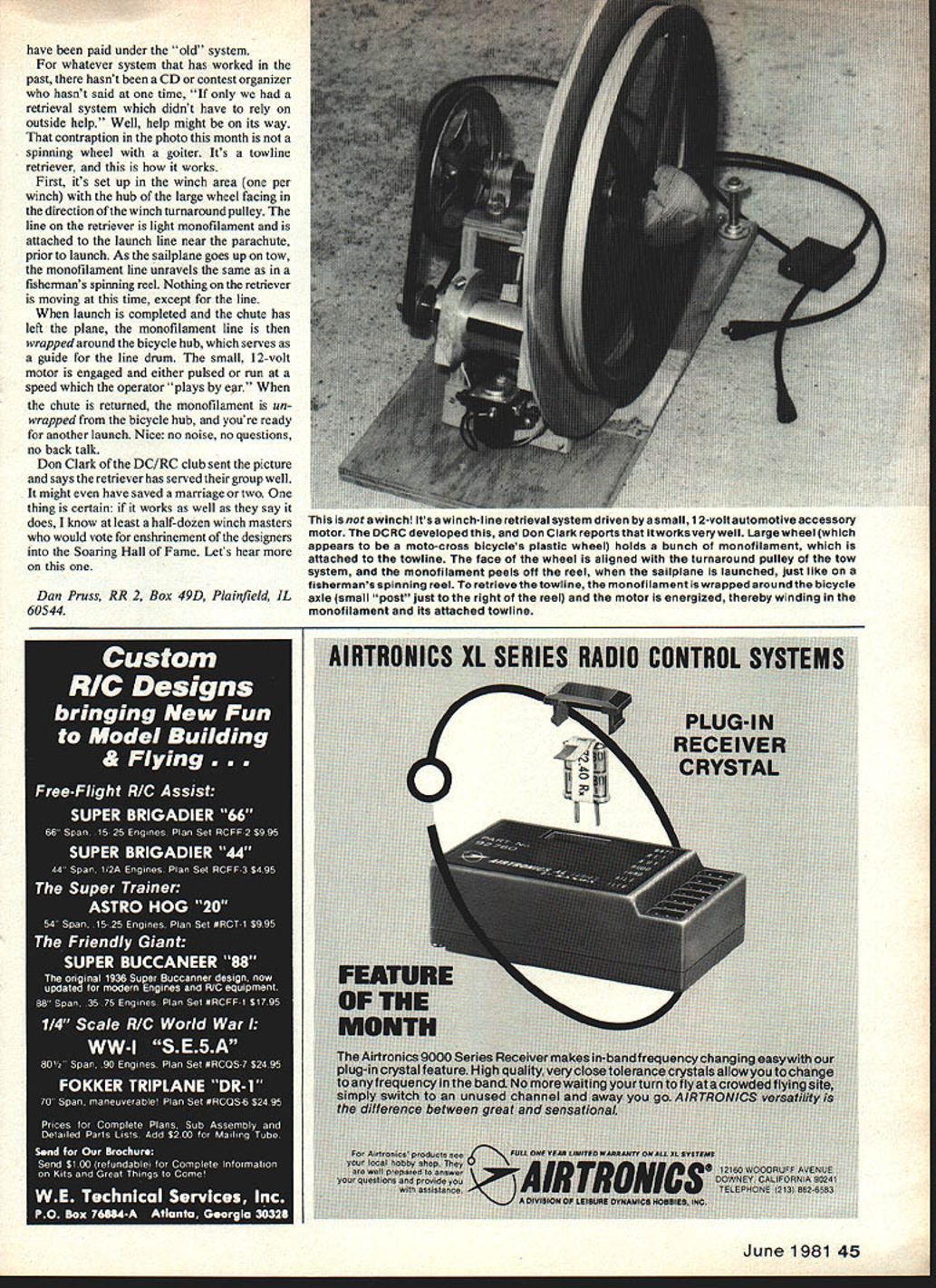
For whatever system that has worked in the past, there hasn't been a CD or contest organizer who hasn't said at one time, "If only we had a retrieval system which didn't have to rely on outside help." Well, help might be on its way. That contraption in the photo this month is not a spinning wheel with a goiter. It's a towline retriever, and this is how it works.
Setup and operation:
- Place the retriever in the winch area (one per winch) with the hub of the large wheel facing the winch turnaround pulley.
- Attach the light monofilament line on the retriever to the launch line near the parachute, prior to launch.
- As the sailplane goes up on tow, the monofilament unravels like a fisherman's spinning reel. Nothing on the retriever moves at this time except the line.
- When launch is completed and the chute has left the plane, wrap the monofilament around the bicycle hub, which serves as a guide for the line drum.
- Engage the small 12-volt motor and pulse or run it at a speed the operator judges appropriate. When the chute is returned, unwrap the monofilament from the hub and you're ready for the next launch.
Nice: no noise, no questions, no back talk.
Don Clark of the DC/RC club sent the picture and says the retriever has served their group well. It might even have saved a marriage or two. One thing is certain: if it works as well as they say, I know at least a half-dozen winch masters who would vote for enshrinement of the designers into the Soaring Hall of Fame. Let's hear more on this one.
Dan Pruss RR 2, Box 49D, Plainfield, IL 60544
Transcribed from original scans by AI. Minor OCR errors may remain.

