
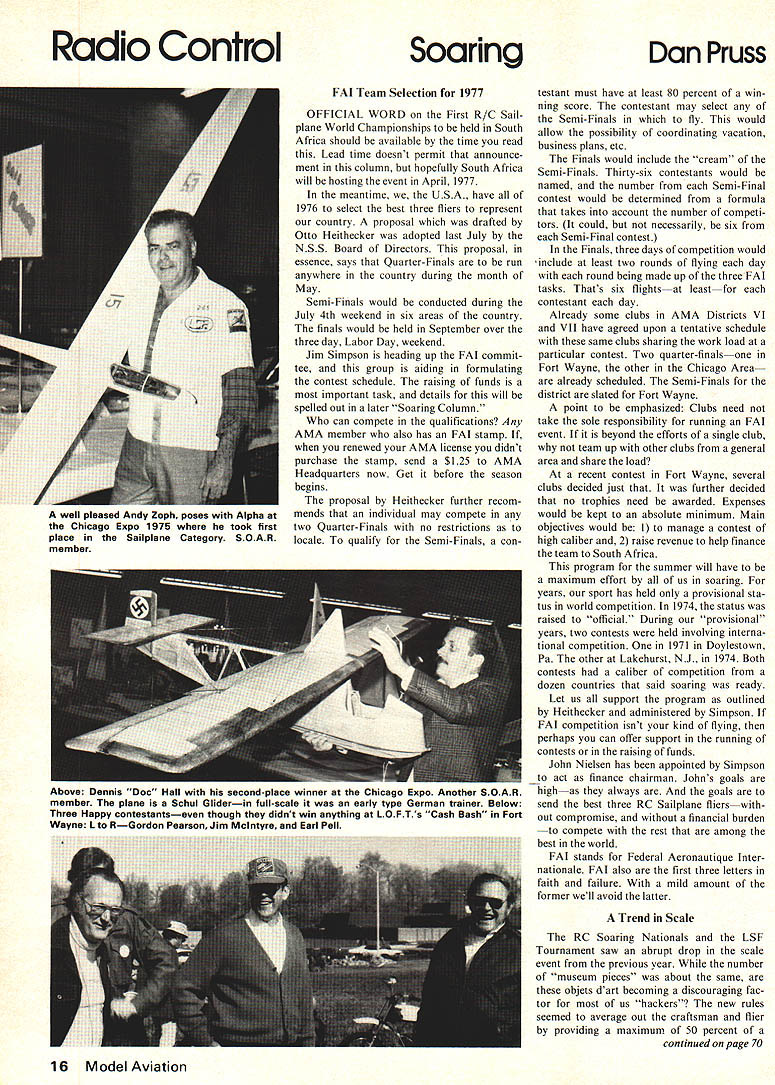
FAI Team Selection for 1977
OFFICIAL WORD on the First R/C Sailplane World Championships to be held in South Africa should be available by the time you read this. Lead time doesn't permit that announcement in this column, but hopefully South Africa will be hosting the event in April, 1977.
In the meantime, we, the U.S.A., have all of 1976 to select the best three fliers to represent our country. A proposal which was drafted by Otto Heithecker was adopted last July by the N.S.S. Board of Directors. This proposal, in essence, says that Quarter-Finals are to be run anywhere in the country during the month of May.
Semi-Finals would be conducted during the July 4th weekend in six areas of the country. The finals would be held in September over the three day, Labor Day, weekend.
Jim Simpson is heading up the FAI committee, and this group is aiding in formulating the contest schedule. The raising of funds is the most important task, and details for this will be spelled out in a later "Soaring Column."
Who can compete in the qualifications? Any AMA member who also has an FAI stamp. If, when you renewed your AMA license you didn't purchase the stamp, send a $1.25 to AMA Headquarters now. Get it before the season begins.
The proposal by Heithecker further recommends that an individual may compete in any two Quarter-Finals with no restrictions as to locale. To qualify for the Semi-Finals, a contestant must have at least 80 percent of a winning score. The contestant may select any of the Semi-Finals in which to fly. This would allow the possibility of coordinating vacation, business plans, etc.
The Finals would include the "cream" of the Semi-Finals. Thirty-six contestants would be named, and the number from each Semi-Final contest would be determined from a formula that takes into account the number of competitors. (It could, but not necessarily, be six from each Semi-Final contest.)
In the Finals, three days of competition would include at least two rounds of flying each day with each round being made up of the three FAI tasks. That's six flights — at least — for each contestant each day.
Already some clubs in AMA Districts VI and VII have agreed upon a tentative schedule with these same clubs sharing the work load at a particular contest. Two quarter-finals — one in Fort Wayne, the other in the Chicago Area — are already scheduled. The Semi-Finals for the district are slated for Fort Wayne.
A point to be emphasized: Clubs need not take the sole responsibility for running an FAI event. If it is beyond the efforts of a single club, they should team up with other clubs from a general area and share the load.
At a recent contest in Fort Wayne, several clubs decided just that. It was further decided that no trophies need be awarded. Expenses would be kept to an absolute minimum. Main objectives would be: 1) to manage a contest of high caliber, and 2) raise revenue to help finance the team to South Africa.
This program for the summer will have to be a maximum effort by all of us in soaring. For years, our sport has held only a provisional status in world competition. In 1974 the status was raised to "official." During our "provisional" years, two contests were held involving international competition. One in 1971 in Doylestown, Pa., the other at Lakehurst, N.J., in 1974. Both contests had a caliber of competition from a dozen countries that said soaring was ready.
Let us all support the program as outlined by Heithecker and administered by Simpson. If FAI competition isn't your kind of flying, then perhaps you can offer support in the running of contests or in the raising of funds.
John Nielsen has been appointed by Simpson to act as finance chairman. John's goals are as they always are. And the goals are to send the best three RC Sailplane fliers — without compromise, and without a financial burden — to compete with the rest that are among the best in the world.
FAI stands for Federal Aeronautique Internationale. FAI also are the first three letters in faith and failure. With a wild amount of the former we'll avoid the latter.
RC Soaring/Pruss continued from page 16
perfect score each for scale fidelity and flying. This was proven at the 1975 LSF Tournament when Ken Wagner with his not-so-museum-like Libelle took top honors. Don't be misled. Ken's efforts resulted in a most beautiful plane. It just wasn't of the Gier, Hall, Pearson, Thacker school of detailing, or as the guy said when asked if it wasn't a difficult task making a wheel chair for his trained flea act that was putting on the play The Man Who Came to Dinner, "No, but putting those tiny ball bearings in the wheels was." It should be realized that in soaring, as in other aspects of modeling, certain individuals gather as much pleasure — even more — in building as in seeing it perform. These craftsmen produce so that we all might enjoy.
One shortcoming for their efforts is that for so much detail to be evaluated, it takes the scrutinizing eyes of the most competent judges, a breed not found at every sailplane gathering. As a result, only the largest of contests can provide for this elite group of sailplane builders. This in turn tends to further refine the art and reduce the number of entries to only those that are capable of turning out a model in less than a year's time.
Last July a suggestion was made at the N.S.S. Board of Directors meeting that was to encourage a simple formula for more scale competition. This suggestion was for an event — without a long drawn out rules wrangle — for scale, whereby any club holding a sailplane contest could also have an event for scale.
Chet Tuthill from Tullahoma, Tenn., came up with a set of proposed rules that are surely worth trying. His suggestions:
- Number of Models: The contestant will be allowed only one entry in RC Sport Scale. This is in addition to any entry he may make in any other sailplane competition during the same contest. The same plane may be entered in more than one event; however, only one flight per round will be allowed, the score for that round being applied to both events. If the contestant enters one plane in scale and another plane in the regular competition, he will fly both planes in each task. However, all points achieved with the scale sailplane will apply only to the scale event and all points from the other plane will apply toward the regular competition score only.
- Special Contest Considerations: Where contest size (i.e., number of contestants and/or size of sponsoring organization) make it advisable, aircraft entered in the Sport Scale category may be required to fly during the rounds of regular competition. If the contestant has also entered a model in the regular competition, he shall be allowed two flights per round, one with each model. At the discretion of the Contest Director, the contestant entered in the Sport Scale category may not be required to fly in all rounds each event but all Sport Scale entrants will be given the opportunity to fly during the same rounds. The pre-contest announcements shall stipulate when Sport Scale is to be flown along with regular competition rounds.
- Proof of Scale: To prove that the model resembles a particular prototype, some proof of scale material is required.
a. Proof of Scale is the responsibility of the contestant.
b. To be eligible for Accuracy of Outline points, a published three-view drawing (line, tone or color), or a selection of photos of the aircraft modeled sufficient to show the outline of the aircraft in side view, front view and plan view, is required. Even if a three-view is available, some photos of the airplane are very useful for the judges and should be provided, if possible.
c. To be eligible for Finish, Color, and Markings points, some proof of the color scheme used is required. This can be a photo, some other pictorial presentation (as: magazine cover painting, IPMS color diagram, PMS color diagram, plastic kit coloring guide, etc.) or a detailed written description from a reliable source. A "Profile" or similar publication is an ideal proof for both outline and color scheme.
- If no proof of material accompanied the model, only craftsmanship and finish points may be awarded.
- Static Judging:
a. Static judging shall be done at a distance of 20 feet from the model. It is recommended that a 40' diameter circle be laid out and roped off. The model is to be placed in the center for judging with the judges free to circle the model with the rope as a guide for the 20' viewing distance. b. Details not deemed visible in flight are not to be considered in scoring of the model.
- Static Scoring: 100 point maximum may be earned as follows:
Accuracy of Outline (General Impression) Max. 40 pts. Craftsmanship Max. 30 pts. Finish, Color & Markings Max. 30 pts.
- Bonus Points: 10 points bonus shall be awarded to the contestant if the model entered is his own design. As proof the contestant should include his construction drawings in the scale presentation.
Presently, there are many scale sailplanes on the market that would fit into Tuthill's proposed Sport Scale category. Sailplanes such as the Sorecraft's and Travers's styles could easily be considered. Most of the models are of the glass types which go together in a straightforward manner and an advanced modeler can finish a kit in very little time. There are other imported kits that in most cases would meet the Tuthill proposal as well. A Tuthill contest, if held in the mid-west, could be a worthwhile winter project.
Shortlines: For LSF cross-country work — where an open top vehicle isn't available — the technique found to be most successful is to plant your flight, usually drifting downwind until you hit a thermal to the goal then head back upwind to the return. With that in mind, have a car ready to go in the downwind direction. Predetermine who will drive and act as witnesses. As the flight develops after launch, fly the plane favoring the side of the car on which you will be sitting. Get in the car — the window should be rolled down so you can maneuver your transmitter antenna — while the plane is still at a comfortable distance and begin to follow it to your goal. At the goal, get out of the car, steer the plane on a proper return course — again relative to where you will be sitting — and proceed to recover.
A typical contest provides a 1.5 meter circle inside of a 3.0 meter circle. Award points as you see fit. The circles provide an instant reference for those working on LSF Level I and II. Ray Hayes and L.O.F.T. tried this and had good results. New heavier spars — 1/8" x 3/8" — are in the new Sorecraft Magnum 12. The spars are much heavier than those in the prototype models. Overall, the result is quite a bit "beefier" and should withstand even mid-west type launches. New glow hook called "Fly Hook" by Glider Gurus of Phoenix, Arizona. Hook is fully adjustable, heavy steel rod but lightweight.
Soaring clubs send, or have your club secretary mail a club name and address on a postcard; include the number of members in club. Mail to: Dan Pruss, Box 490, Plainfield, IL 60544.
Transcribed from original scans by AI. Minor OCR errors may remain.

