
Radio Control: Soaring
Dan Pruss
Records — Official
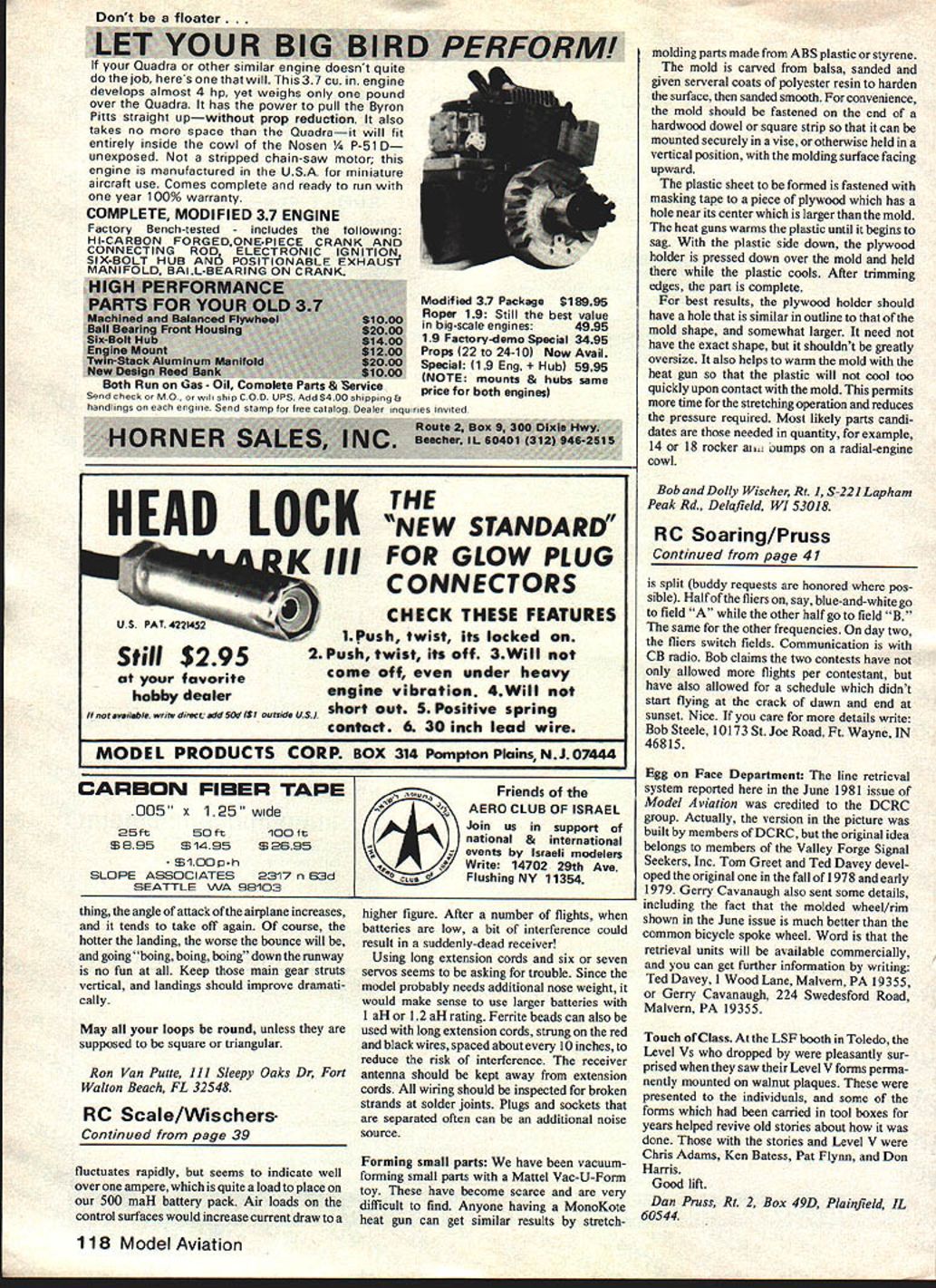
The San Fernando Valley Silent Flyers went out in force last May 9 and claimed 20 new AMA Soaring National Records. Most noteworthy was Jerry Krainock's new Open Distance, Unlimited class record of 66 miles — bettering the record set last year by Jack Hiner by over 20 miles. Krainock flew a Paramount (designed by Ed Slobod, who also designed the Pierce Arrow, Paragon, and Ridge Rat). Krainock's time for the 66 miles was three hours and 15 minutes.
According to the report sent by Krainock, the following records were also set that day (and were probably broken by the time you read this, because the club had scheduled more Record Trials):
- Jerry Krainock (Open age division)
- Declared Goal — Two Meter, Standard, Modified Standard, Unlimited
- Open Distance — Two Meter, Standard, Modified Standard
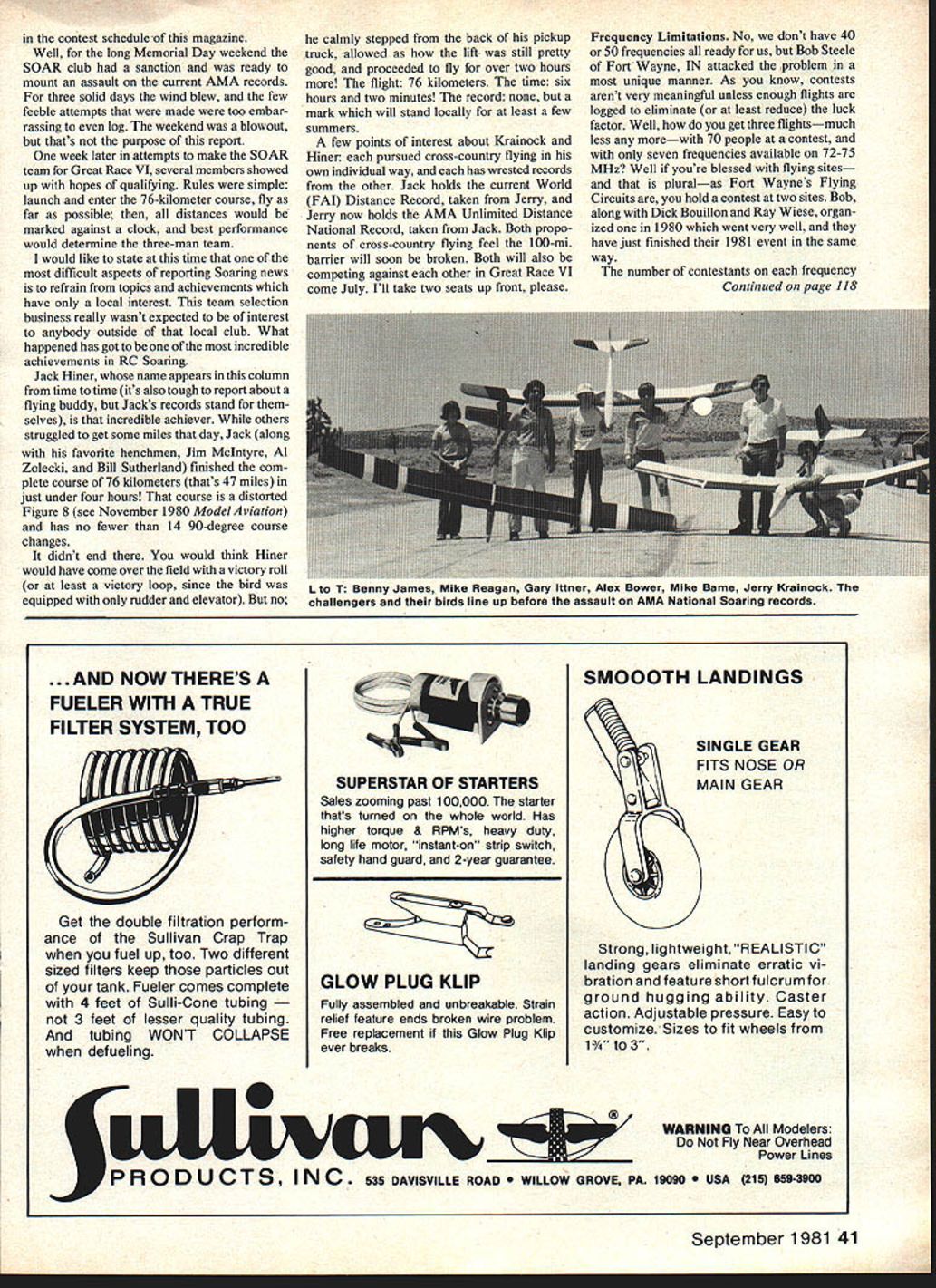
- Gary Ittner (Open division) — flying a Tai-Pan; distance: 12.21 miles
- Declared Distance — Standard, Modified Standard, Unlimited
- Open Distance — Standard, Modified Standard
- Benny James (Junior division) — flying a Paragon; distance: 12.21 miles
- Declared Distance — Unlimited
- Open Distance — Unlimited
- Alex Bower (Senior division)
- Declared Distance — Unlimited; Open Distance — Unlimited (with his Goose); distance: 16.95 miles
- Open Distance — Standard, Modified Standard, Unlimited (with his Gemini); distance: 10 miles (this distance is subject to change pending measurement on approved maps)
Thanks to Jerry Krainock, Ed Slobod, and the SFVSF Silent Flyers for the above information.
Records — Unofficial
As you know, for records to be official a sanction has to be obtained through your AMA district contest coordinator. This is a minor formality, but besides allowing proper coordination, it also gives you an announcement in the contest schedule of this magazine.
For the long Memorial Day weekend the SOAR club had a sanction and was ready to mount an assault on the current AMA records. For three solid days the wind blew, and the few feeble attempts that were made were too embarrassing to even log. The weekend was a blowout, but that's not the purpose of this report.
One week later, in attempts to make the SOAR team for Great Race VI, several members showed up hoping to qualify. Rules were simple: launch and enter the 76-kilometer course, fly as far as possible; then all distances would be marked against a clock, and best performance would determine the three-man team.
One of the most difficult aspects of reporting Soaring news is to refrain from topics and achievements that have only local interest. This team selection business really wasn't expected to interest anybody outside the local club. What happened, however, is one of the most incredible achievements in RC soaring.
Jack Hiner — whose name appears in this column from time to time — is that incredible achiever. While others struggled to get some miles that day, Jack (along with his henchmen Jim McIntyre, Al Zolecki, and Bill Sutherland) finished the complete course of 76 kilometers (47 miles) in just under four hours. That course is a distorted figure 8 (see November 1980 Model Aviation) and has no fewer than 14 90-degree course changes.
It didn't end there. You would think Hiner would have come over the field with a victory roll (or at least a victory loop, since the bird was equipped with only rudder and elevator). But no; he calmly stepped from the back of his pickup truck, noted that the lift was still pretty good, and proceeded to fly for over two hours more. The flight: 76 kilometers. The time: six hours and two minutes. The record: none, but a mark which will stand locally for at least a few summers.
A few points of interest about Krainock and Hiner: each pursued cross-country flying in his own individual way, and each has wrested records from the other. Jack holds the current World (FAI) Distance Record, taken from Jerry, and Jerry now holds the AMA Unlimited Distance National Record, taken from Jack. Both proponents of cross-country flying feel the 100-mile barrier will soon be broken. Both will also be competing against each other in Great Race VI come July. I'll take two seats up front, please.
Frequency Limitations
No, we don't have 40 or 50 frequencies all ready for us, but Bob Steele of Fort Wayne, IN attacked the problem in a most unique manner. As you know, contests aren't very meaningful unless enough flights are logged to eliminate (or at least reduce) the luck factor. Well, how do you get three flights — much less any more — with 70 people at a contest and only seven frequencies available on 72–75 MHz? If you're blessed with multiple flying sites, as Fort Wayne's Flying Circuits are, you hold a contest at two sites.
Bob, along with Dick Bouillon and Ray Wiese, organized one in 1980 which went very well, and they have just finished their 1981 event in the same way. The number of contestants on each frequency is split (buddy requests are honored where possible). Half of the fliers on, say, blue-and-white go to field "A" while the other half go to field "B." The same applies for the other frequencies. On day two, the fliers switch fields. Communication is by CB radio. Bob claims the two-contest arrangement has not only allowed more flights per contestant, but has also allowed for a schedule which didn't start at the crack of dawn and end at sunset. If you care for more details write: Bob Steele, 10173 St. Joe Road, Ft. Wayne, IN 46815.
Egg on Face Department
The line retrieval system reported in the June 1981 issue of Model Aviation was credited to the DCRC group. Actually, the version in the picture was built by members of DCRC, but the original idea belongs to members of the Valley Forge Signal Seekers, Inc. Tom Greet and Ted Davey developed the original one in the fall of 1978 and early 1979. Gerry Cavanaugh also sent some details, including the fact that the molded wheel/rim shown in the June issue is much better than the common bicycle spoke wheel. Word is that the retrieval units will be available commercially. For further information write: Ted Davey, 1 Wood Lane, Malvern, PA 19355, or Gerry Cavanaugh, 224 Swedesford Road, Malvern, PA 19355.
Touch of Class
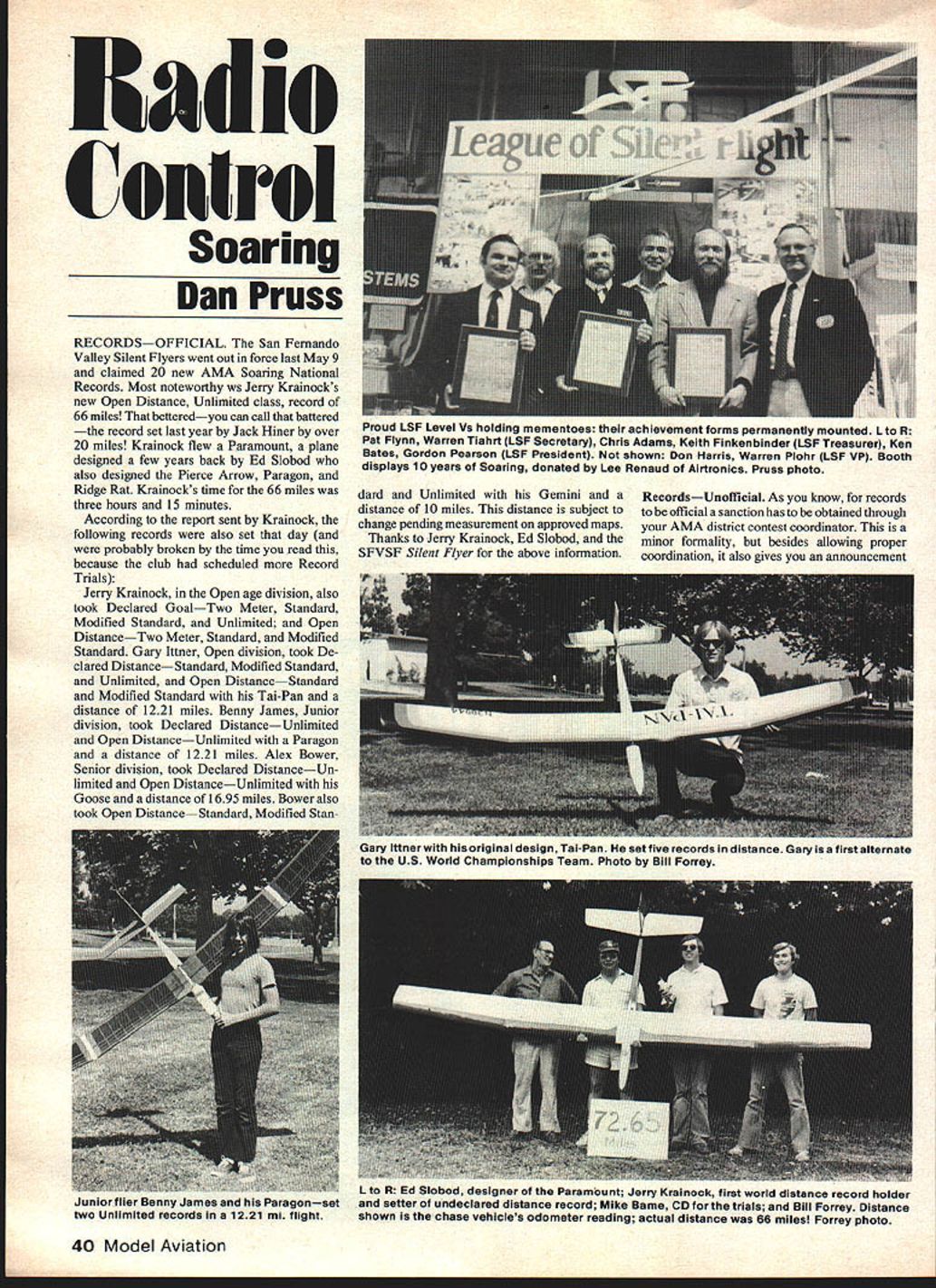
At the LSF booth in Toledo, the Level Vs who dropped by were pleasantly surprised when they saw their Level V forms permanently mounted on walnut plaques. These were presented to the individuals, and some of the forms which had been carried in tool boxes for years helped revive old stories about how it was done. Those with the stories and Level V were Chris Adams, Ken Bates, Pat Flynn, and Don Harris.
Good lift.
Dan Pruss Rt. 2, Box 49D Plainfield, IL 60544
Transcribed from original scans by AI. Minor OCR errors may remain.

