
Radio Control: Soaring
Dan Pruss
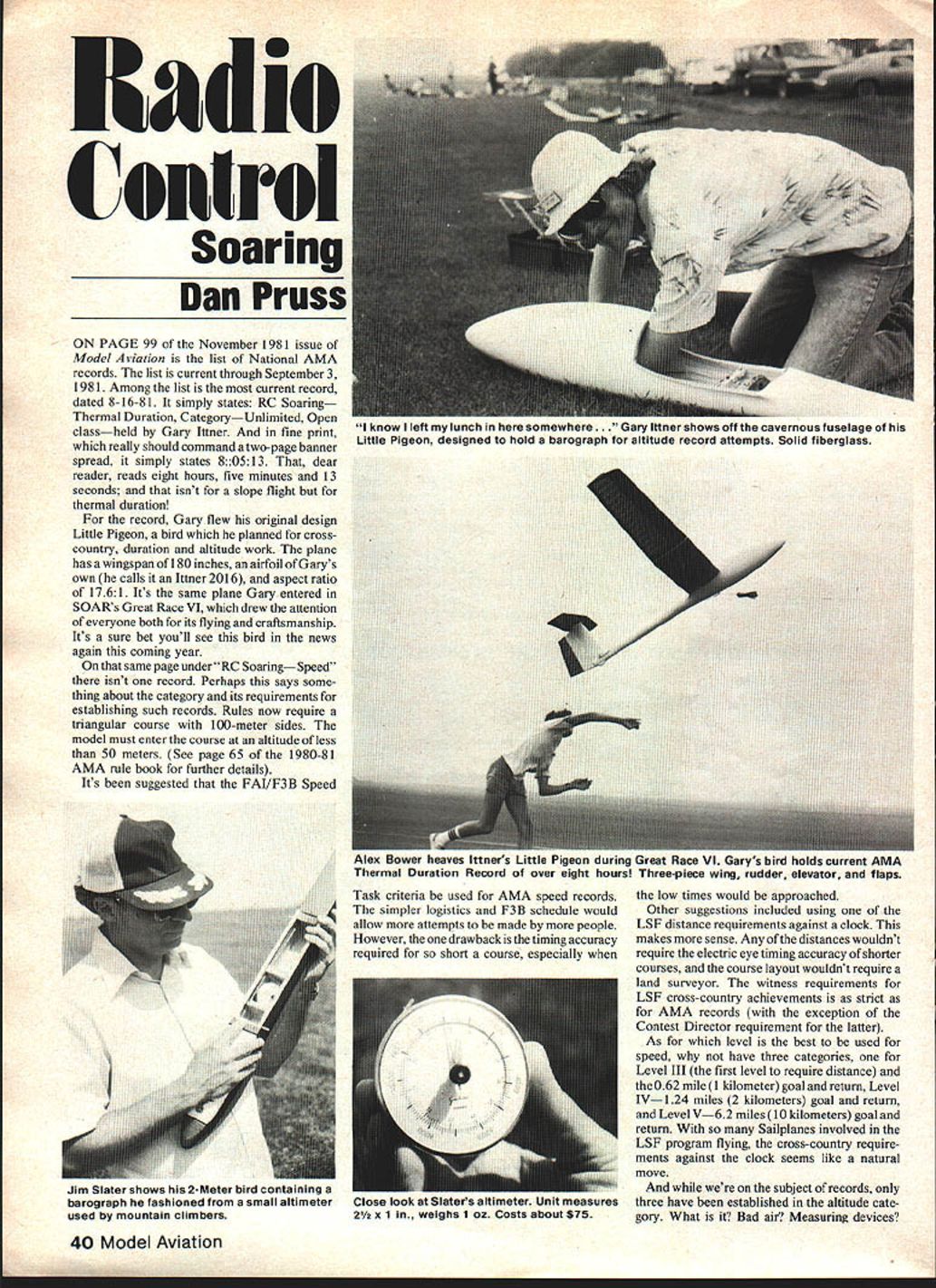
ON PAGE 99 of the November 1981 issue of Model Aviation is the list of National AMA records. The list is current through September 3, 1981. Among the list is the most current record, dated 8-16-81. It simply states: RC Soaring—Thermal Duration, Category—Unlimited, Open class—held by Gary Ittner. And in fine print, which really should command a two-page banner spread, it simply states: 8:05:13. That, dear reader, reads eight hours, five minutes and 13 seconds; and that isn't for a slope flight but for thermal duration!
For the record, Gary flew his original design Little Pigeon, a bird which he planned for cross-country, duration and altitude work. The plane has a wingspan of 180 inches, an airfoil of Gary's own (he calls it an Ittner 2016), and an aspect ratio of 17.6:1. It's the same plane Gary entered in SOAR's Great Race VI, which drew the attention of everyone both for its flying and craftsmanship. It's a sure bet you'll see this bird in the news again this coming year.
National AMA Records — Speed
On that same page under "RC Soaring—Speed" there isn't one record. Perhaps this says something about the category and its requirements for establishing such records. Rules now require a triangular course with 100-meter sides. The model must enter the course at an altitude of less than 50 meters. (See page 65 of the 1980-81 AMA rule book for further details.)
It's been suggested that the FAI/F3B Speed Task criteria be used for AMA speed records. The simpler logistics and F3B schedule would allow more attempts to be made by more people. However, the one drawback is the timing accuracy required for so short a course, especially when the low times would be approached.
Other suggestions included using one of the LSF distance requirements against a clock. This makes more sense. Any of the distances wouldn't require the electric-eye timing accuracy of shorter courses, and the course layout wouldn't require a land surveyor. The witness requirements for LSF cross-country achievements are as strict as for AMA records (with the exception of the Contest Director requirement for the latter).
As for which level is the best to be used for speed, why not have three categories:
- Level III — the first level to require distance, 0.62 mile (1 kilometer) goal and return.
- Level IV — 1.24 miles (2 kilometers) goal and return.
- Level V — 6.2 miles (10 kilometers) goal and return.
With so many sailplanes involved in the LSF program flying, the cross-country requirements against the clock seem like a natural move.
Altitude Records and Instruments
And while we're on the subject of records, only three have been established in the altitude category. What is it? Bad air? Measuring devices? Probably the latter. Or the lack of the latter.
The Replogle barograph has been mentioned in this article as a reliable recorder of altitude flights. The Unlimited—Open record of 3,400 ft. used the Replogle (which, incidentally, is the same type used by full-scale soarers). Jack Hiner carried one in a pod above the wing to establish that record back in 1979, and this past September Jack put one in the fuselage—a big fuselage—to establish a Standard Class record of 3,250 ft.
I don't know what young Jim Ealy III used to set a record of 1,863 ft. for Juniors in the Two-Meter division, but John Dineen used a version of the "Barometer Altimeter for R/C" from an article of the same name published in Model Aviation, January 1976. That system is small, accurate and inexpensive to build.
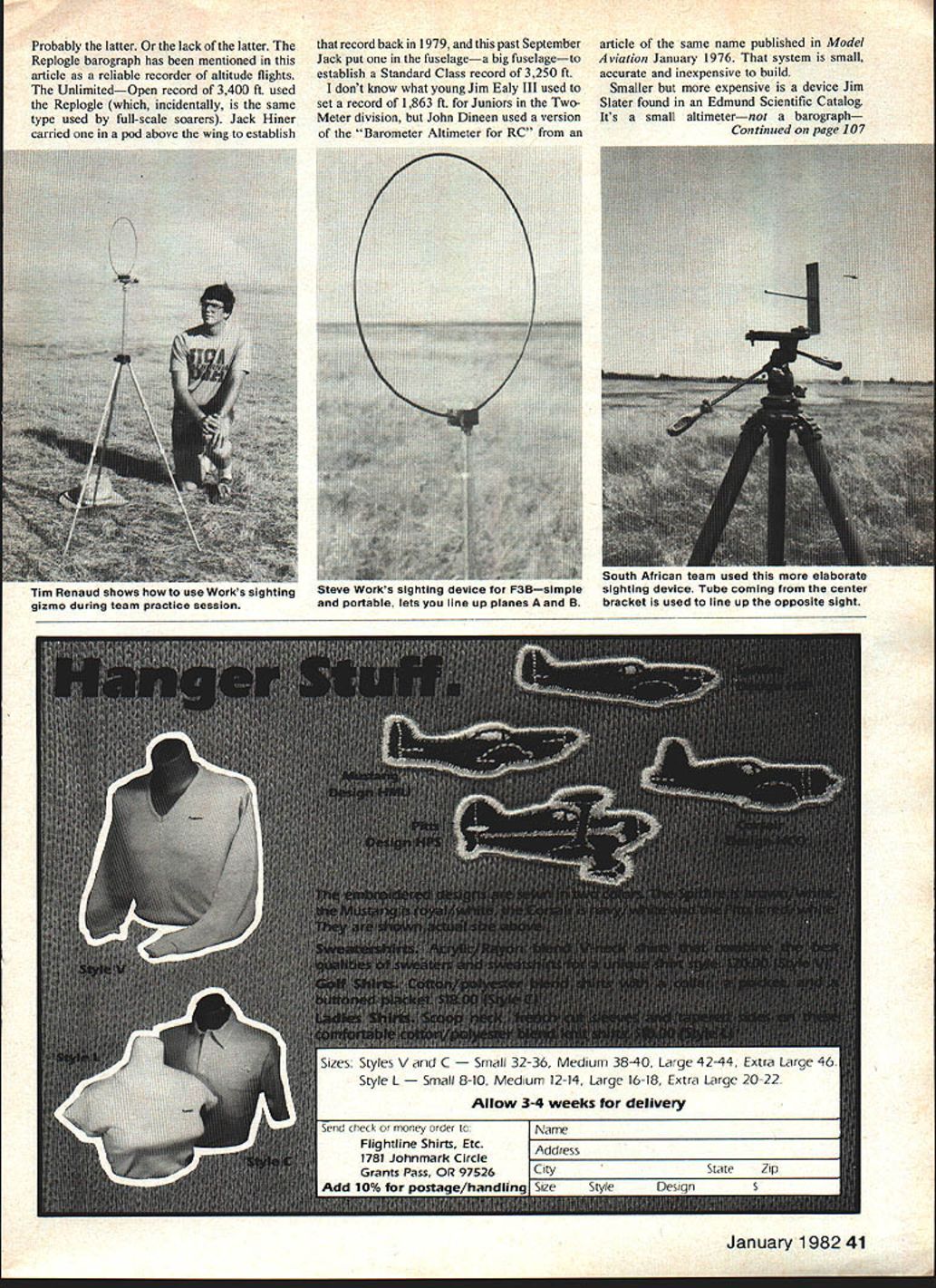
Smaller but more expensive is a device Jim Slater found in an Edmund Scientific catalog. It's a small altimeter—not a barograph—designed for mountain climbers and hikers; it registers 12,000 feet in increments of 100 feet. Jim modified the glass face to include another hand that follows the altimeter's pointer; a second pointer records altitude. Jim still has a few bugs to work out to assure accuracy. The altimeter itself is reliable; it was tested in a lightplane and its readings matched the aircraft's up to the 7,000 ft. limit test. What's nice about the unit is that it fits anywhere, from a Two-Meter ship to your favorite 16-footer. If you're a gadgeteer you might want to modify one of these.
Available from Edmund Scientific, Barrington, NJ; and American Science Center, 5700 Northwest Highway, Chicago, IL 60656.
F3B Hardware
A couple of the gadgets in the photos this month should make life a lot easier if you've been involved in F3B. If you haven't been involved, it could be because of the hardware it takes to run an F3B contest.
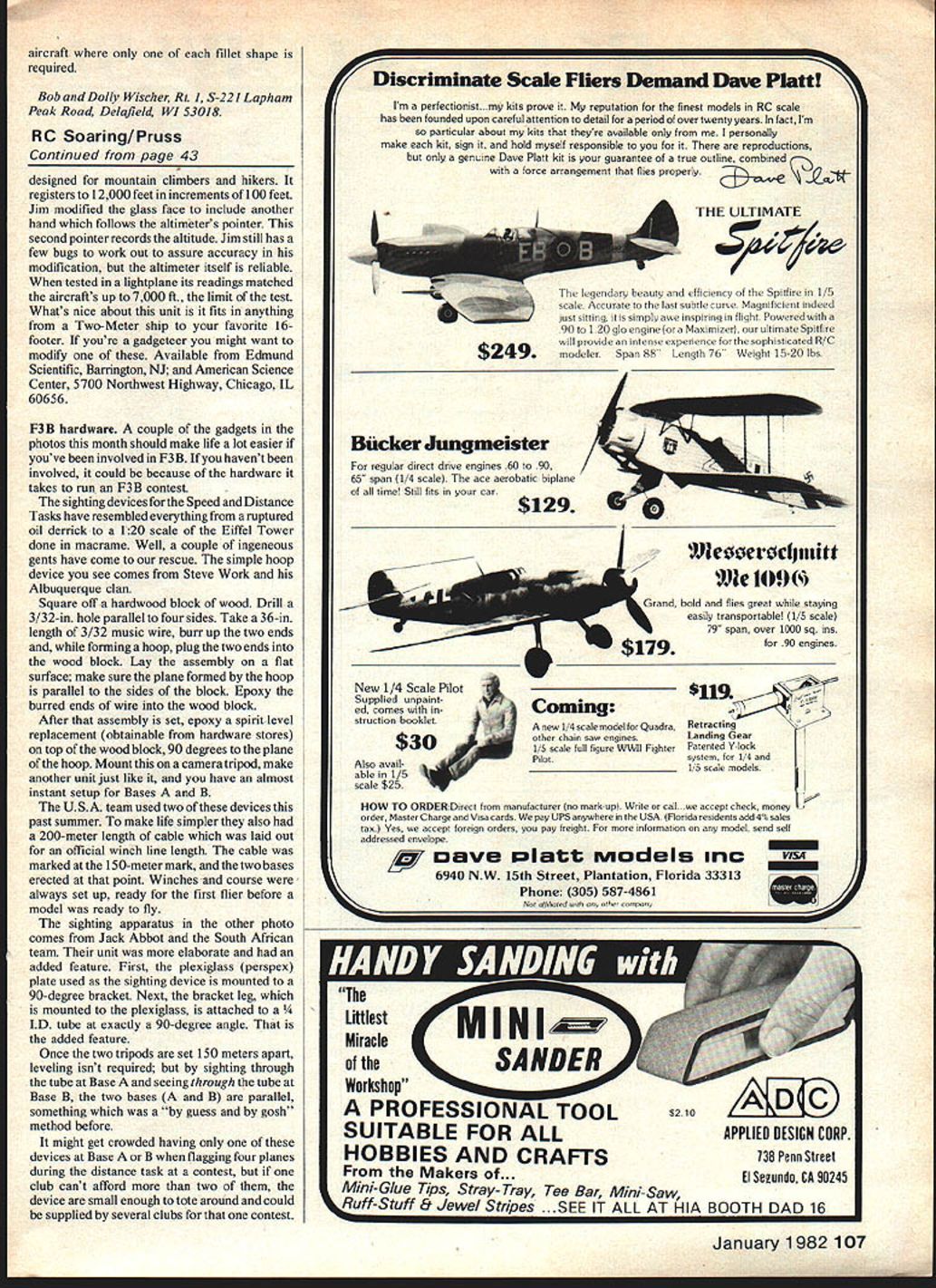
The sighting devices for the Speed and Distance Tasks have resembled everything from a ruptured oil derrick to a 1:20 scale of the Eiffel Tower done in macramé. Well, a couple of ingenious gents have come to our rescue. The simple hoop device you see comes from Steve Work and his Albuquerque clan.
Square off a hardwood block. Drill a 3/32-in. hole parallel to four sides. Take a 36-in. length of 3/32 music wire, burr up the two ends and, while forming a hoop, plug the two ends into the wood block. Lay the assembly on a flat surface; make sure the plane formed by the hoop is parallel to the sides of the block. Epoxy the burred ends of wire into the wood block.
After that assembly is set, epoxy a spirit-level replacement (obtainable from hardware stores) on top of the wood block, 90 degrees to the plane of the hoop. Mount this on a camera tripod, make another unit just like it, and you have an almost instant setup for Bases A and B.
The U.S.A. team used two of these devices this past summer. To make life simpler they also had a 200-meter length of cable which was laid out for an official winch line length. The cable was marked at the 150-meter mark, and the two posts erected at that point. Winches and course were always set up, ready for the first flier before a model was ready to fly.
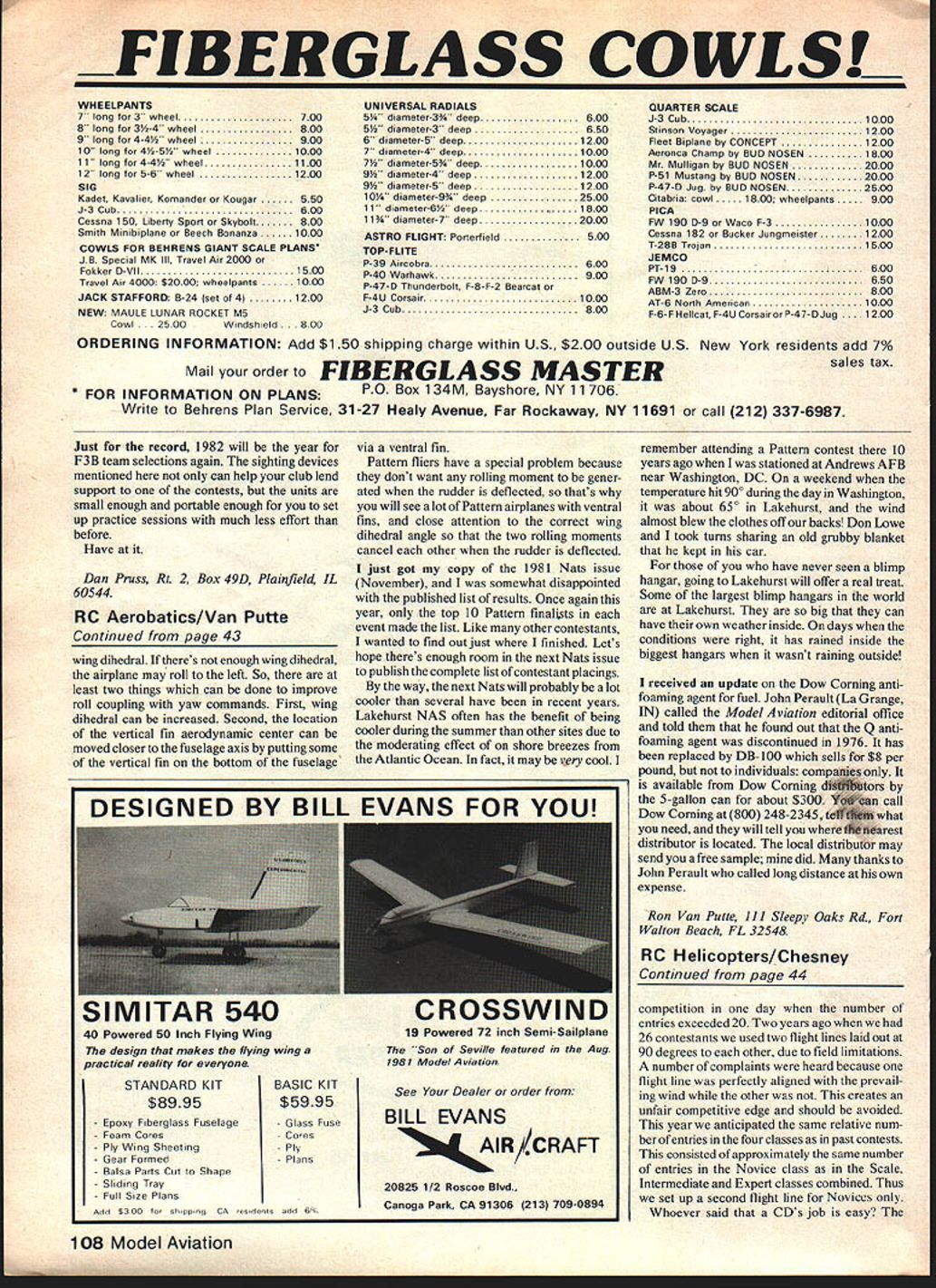
The sighting apparatus in the other photo comes from Jack Abbot and the South African team. Their unit was more elaborate and had an added feature. First, the plexiglass (perspex) plate used as the sighting device is mounted to a 90-degree bracket. Next, the bracket leg, which is mounted to the plexiglass, is attached to a 1/4 I.D. tube at exactly a 90-degree angle. That is the added feature.
Once the two tripods are set 150 meters apart, leveling isn't required; by sighting through the tube at Base A and seeing through the tube at Base B, the two bases (A and B) are parallel — something which was a "by guess and by gosh" method before.
It might get crowded having only one of these devices at Base A or B when flagging four planes during the distance task at a contest, but if one club can't afford more than two of them, the devices are small enough to tote around and could be supplied by several clubs for that one contest.
Just for the record, 1982 will be the year for F3B team selections again. The sighting devices mentioned here not only can help your club lend support to one of the contests, but the units are small enough and portable enough for you to set up practice sessions with much less effort than before.
Have at it.
Dan Pruss, Rt. 2, Box 49D, Plainfield, IL 60544.
Transcribed from original scans by AI. Minor OCR errors may remain.

