
Radio Control: Soaring
Dan Pruss
Two photos from the 1981 LSF Tournament report in the December issue of Model Aviation generated an unusual amount of comment from you, readers. One was Jim McIntyre's winch line retrieval system; the other was Jerry Mrlik's slim F3B design.
Winch Line Retrieval System (Jim McIntyre)
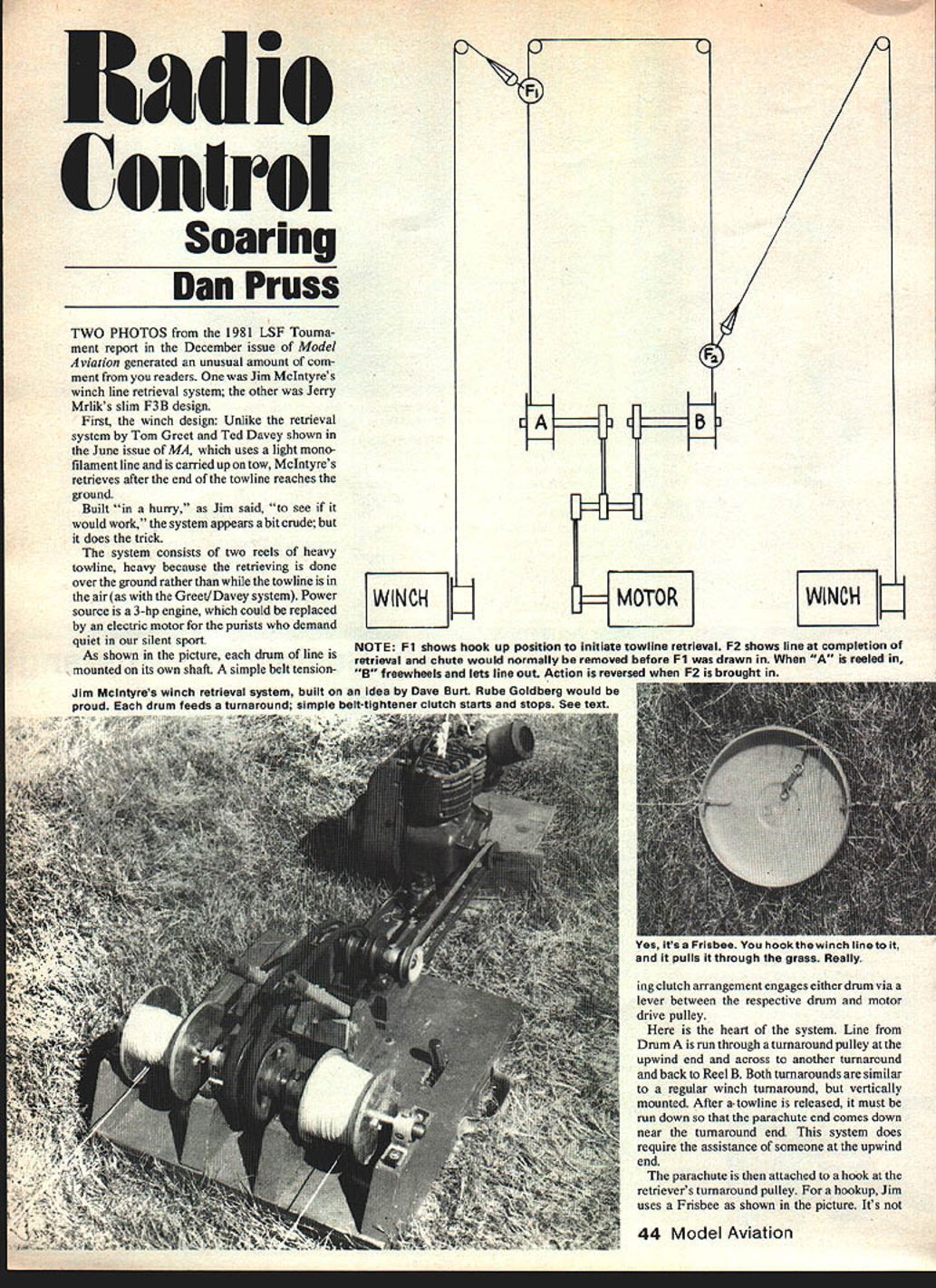
Unlike the retrieval system by Tom Greet and Ted Davey shown in the June issue of MA, which uses a light monofilament line and is carried up on tow, McIntyre's retrieves after the end of the towline reaches the ground.
Built "in a hurry," as Jim said, "to see if it would work," the system appears a bit crude, but it does the trick.
The system consists of:
- Two reels of heavy towline (heavy because the retrieving is done over the ground rather than while the towline is in the air, as with the Greet/Davey system).
- A power source: a 3-hp engine (could be replaced by an electric motor for those who prefer quiet).
- Each drum of line is mounted on its own shaft.
- A simple belt-tensioning clutch arrangement engages either drum via a lever between the respective drum and motor drive pulley.
Operation details:
- NOTE: F1 shows hook-up position to initiate towline retrieval. F2 shows line at completion of retrieval and chute would normally be removed before F1 was drawn in.
- When "A" is reeled in, "B" freewheels and lets line out. Action is reversed when F2 is brought in.
- Line from Drum A runs through a turnaround pulley at the upwind end, across to another turnaround, and back to Reel B. Both turnarounds are similar to a regular winch turnaround but are vertically mounted.
- After a towline is released, it must be run down so that the parachute end comes down near the turnaround end. This system does require the assistance of someone at the upwind end.
- The parachute is attached to a hook at the retriever's turnaround pulley using a Frisbee. The Frisbee is easily seen by the assistant and, after hookup, protects the chute as it slides over the ground back to the winch area.
- Two Frisbees are used: initially one positioned near its turnaround and the other near its retrieval drum. After hooking to the Frisbee near the turnaround, that drum is engaged; while the line is being retrieved, the other Frisbee is pulled upwind into position for the next hookup.
- This see-saw, back-and-forth action continues until you run out of fliers, gas, or frequencies.
Comparisons and notes:
- The Greet/Davey system does have the advantage of retrieving over deep grass and weeds. McIntyre's requires short grass and a relatively smooth field.
- With a winch on each side of the retrieval system, Jim's is more efficient than a horde of motorbikers — and it uses less fuel.
- The design was the brainchild of Dave Burt of the Tri-State Soaring Society.
Jerry Mrlik's F3B Design
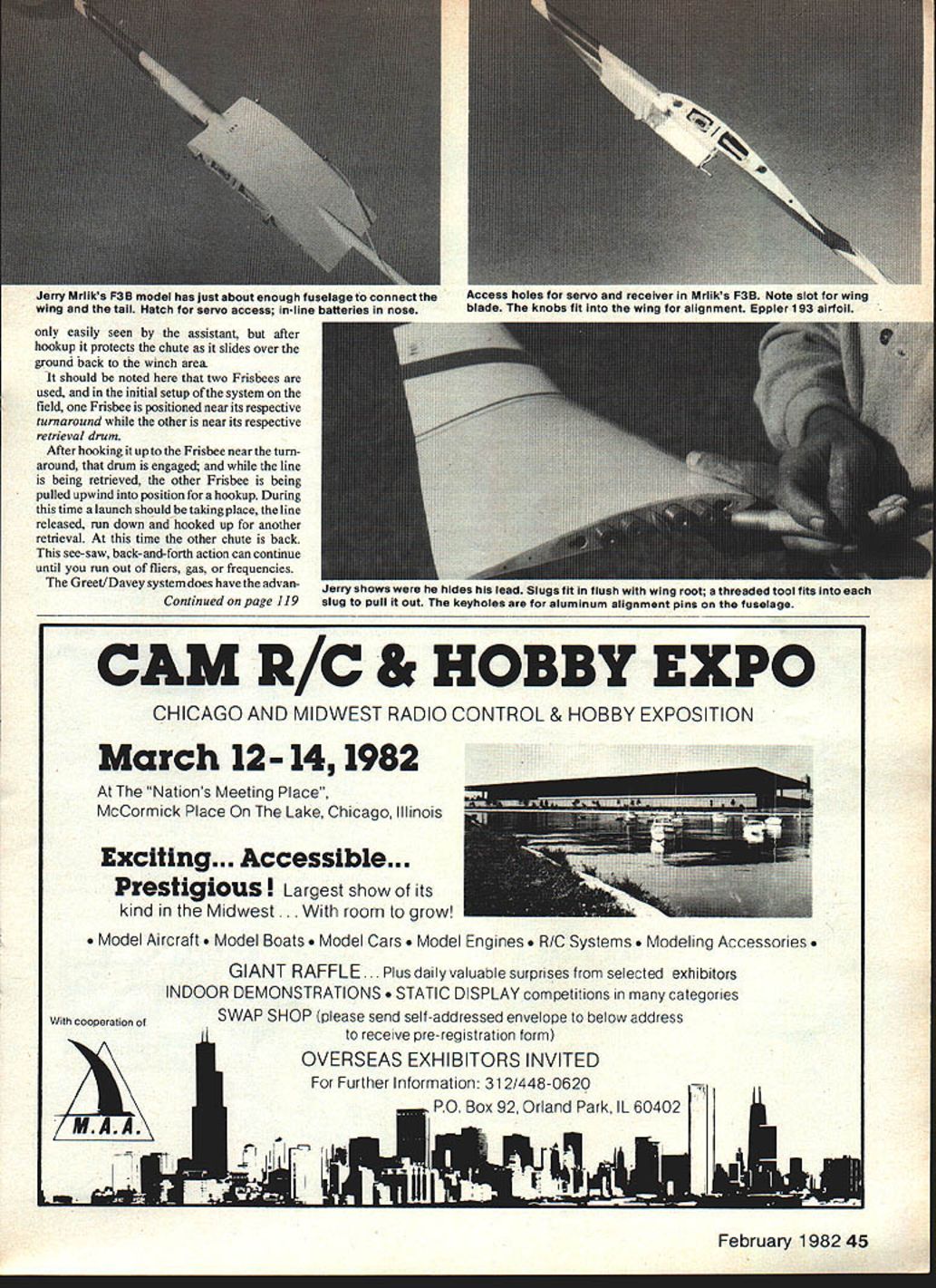
Jerry Mrlik, who was one of the first to bring an industrial-strength version of a simple sailplane to the scene, won fame when his son Jeff won the 1973 SOAR Nats with the Astro-Jeff. That design still appears in winner's circles (ask Pat Flinn if you think its time has run out).
Current design features:
- Wings are built up and sheeted, not from a polished epoxy mold. Anything conventional in construction stops there.
- The nose section and wing section of the fuselage are molded back to (but not including) the tail boom.
- The sleek nose has a cross section just large enough to hold four AA-size pencil batteries in line. The very tip of the nose is a lathe-turned piece of metal used for nose ballast.
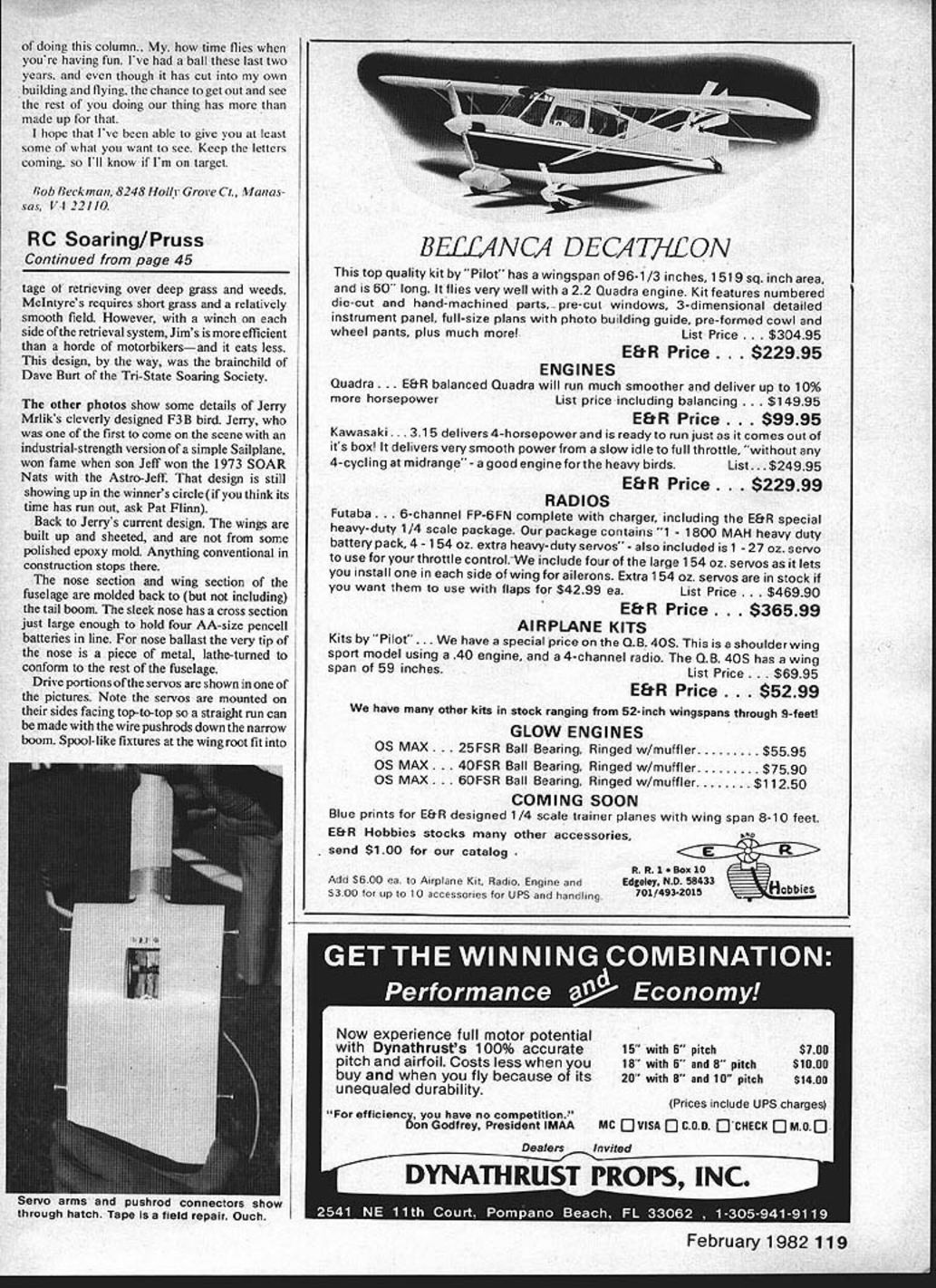
- Servos are mounted on their sides, facing top-to-top so a straight run can be made with the wire pushrods down the narrow boom. Drive portions of the servos are visible in the photos.
- Spool-like fixtures at the wing root fit into the wings and hold them in place.
- Plastic tubing holds the receiver antenna and runs into the right wing.
- Access holes in the wing-like section of the fuselage allow access to servos and receiver.
- A keel-type skid is an integral part of the fuselage mold. A cartwheel landing cracked the nose, but on-the-field repairs kept it flying.
- For a slim boom—slimmer than commonly seen for a model of this type—Jerry used a carbon-fiber golf club shaft. It provides excellent shock resistance and stability under F3B air loads.
- Ballast is contained in the wings: lead slugs fit flush against the wing rib. Holes in several plywood ribs support the slugs, eliminating the use of ballast tubes.
Performance and development:
- The next move is an unkinked (no polyhedral) wing.
- Jeff flew the current version in the F3B Team Selection Finals last September and narrowly missed a team slot (if Distance and Duration had been man-on-man, Jeff would have finished third).
- He also did a Speed run at the same meet in under 11 seconds, a time that still wins contests.
- All that is more impressive considering the model was finished in the eleventh hour with no time for tuning before the meet.
Stick with it, Jerry.
Jack Hiner Record
On October 11, Jack Hiner broke his own declared distance FAI record, which had stood since May 1975. The new record, when homologated, will be 89.6 kilometers (over 55 miles). Lee Fossett was Contest Director, and Jim Slater and Dale Folkening witnessed the flight.
Details:
- Launch started at Batavia, IL and terminated just outside Dixon, IL.
- Two attempts were made. The record flight lasted three hours and twenty-eight minutes.
- Launch was from a 240-meter towline (300 meters is allowed).
- In declared distance the model must land within 500 meters of the intended goal; Jack landed within 2.6 meters.
Well done.
Good lift to all in 1982.
Dan Pruss Rt. 2, Box 49D Plainfield, IL 60544
Transcribed from original scans by AI. Minor OCR errors may remain.

