

Radio Control: Soaring
Dan Pruss
Competition breeds ideas
If competition does nothing else, it breeds new ideas. While some of them might be suitable only for top-notch competitors, others rub off and make Sunday afternoons more enjoyable for us hackers.
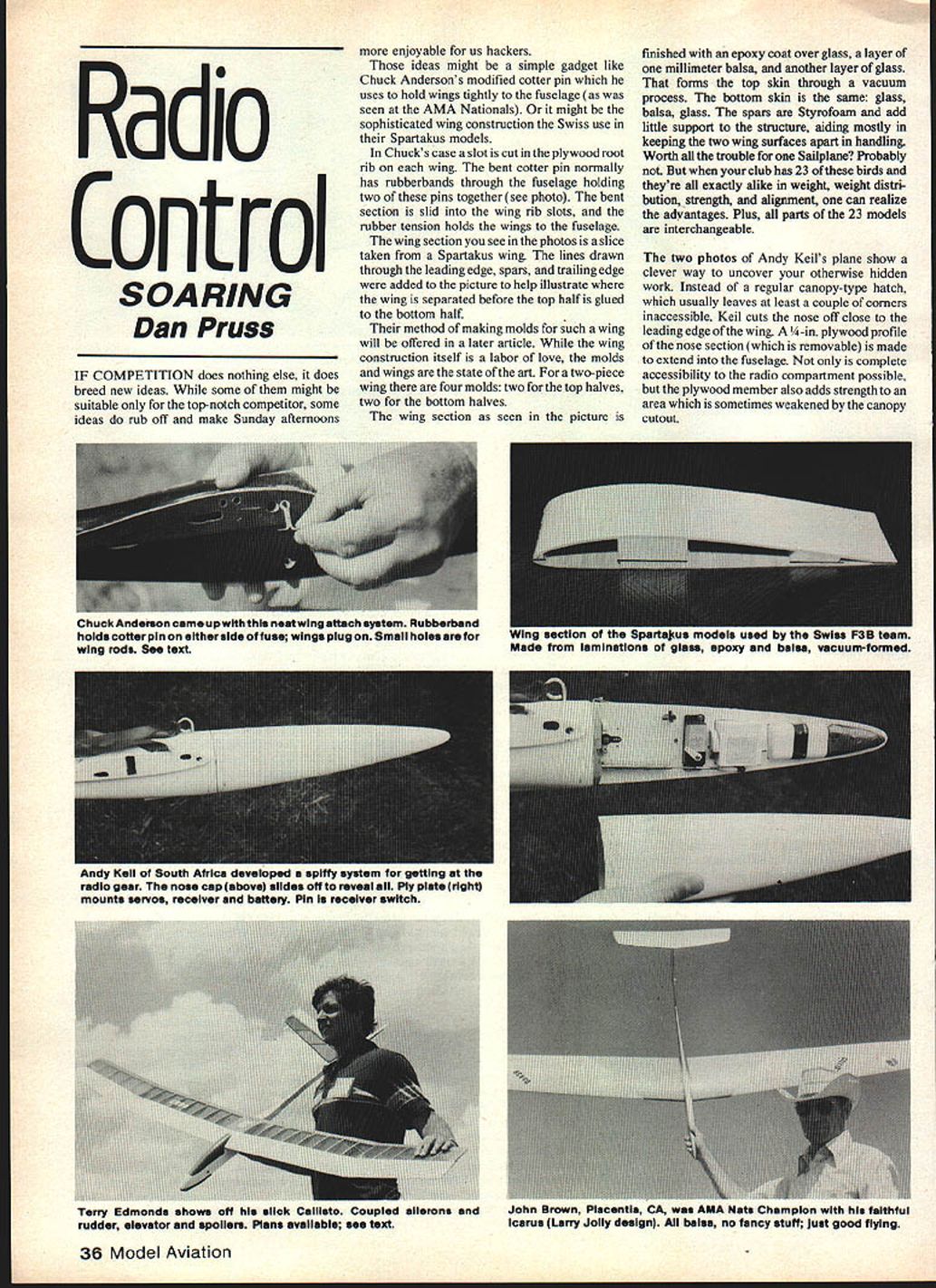
Those ideas might be a simple gadget, like Chuck Anderson's modified cotter pin, which he uses to hold wings tightly to the fuselage (as seen at the AMA Nationals). Or they might be the sophisticated wing construction the Swiss use in their Spartakus models.
Chuck Anderson's wing hold-down
In Chuck's case, a slot is cut in the plywood root rib on each wing. The bent cotter pin normally has rubber bands through the fuselage holding two of these pins together. The bent section is slid into the wing rib slots, and the rubber tension holds the wings to the fuselage.
Spartakus wing construction
The wing section shown in the photos is a slice taken from a Spartakus wing. The lines drawn through the leading edge, spars, and trailing edge were added to the picture to help illustrate where the wing is separated before the top half is glued to the bottom half.
Their method of making molds for such a wing will be offered in a later article. While the wing construction itself is a labor of love, the molds and wings are state of the art. For a two-piece wing there are four molds:
- Two for the top halves
- Two for the bottom halves
The wing section as seen in the picture is finished with an epoxy coat over glass, a layer of one-millimeter balsa, and another layer of glass. That forms the top skin through a vacuum process. The bottom skin is the same: glass, balsa, glass. The spars are Styrofoam and add little support to the structure, aiding mostly in keeping the two wing surfaces apart during handling.
Is it worth all the trouble for one sailplane? Probably not. But when your club has 23 of these birds and they're all exactly alike in weight, weight distribution, strength, and alignment, one can realize the advantages. Plus, all parts of the 23 models are interchangeable.
Andy Keil's removable nose hatch
The two photos of Andy Keil's plane show a clever way to uncover otherwise hidden work. Instead of a regular canopy-type hatch, which usually leaves at least a couple of corners inaccessible, Keil cuts the nose off close to the leading edge of the wing. A 1/4-in. plywood profile of the nose section (which is removable) is made to extend into the fuselage. Not only is complete accessibility to the radio compartment possible, but the plywood member also adds strength to an area sometimes weakened by the canopy cutout.
The ring with the ribbon is the airborne battery pack's safety switch. The switch is on only when the pin is pulled; the long ribbon is an added safety feature.
Callisto — a narrow-gauge model
That narrow-gauge model you see is the Callisto, a design by Terry Edmonds of Iowa City, IA. Construction is standard as are the required building supplies. You know that narrow fuselage can't have three servos side-by-side, but it does have three in line.
Aft of the battery pack (which is made up of four 450 mAh cells mounted in line but standing on end) sits the receiver. Behind it are the servos for elevator, spoilers, and a combined aileron/rudder. Ninety-degree bellcranks are mounted in the first wing rib bay, with one leg of each bellcrank extending into the fuselage. This allows the rudder servo to pick up the aileron linkage in a simple but clever fashion.
Ballast is mounted in the wings.
Designed primarily for F3B contests, Terry has also been flying the ship in regular thermal events. If you're interested in plans they are available from Terry Edmonds, 1 Lakeview Knoll RR 6, Iowa City, IA 52240.
Winners
Sophisticated models that use space-age materials and require hundreds of hours to produce don't necessarily make you a winner. Take the case of the three summertime champions of 1981, who all come from the "balsa is better" school of building. World Champion Dwight Holley and his Gobbler left more than a few of the "glass is class" group wincing back at Sacramento.
Ken Bates won the LSF Tournament with a slightly modified Altronics Sagitta kit, and John Brown not only won the AMA Nationals but beat all comers with his Two-Meter ship, the Icarus (another kit).
Brown's ship couldn't be much simpler. The controls (which usually give a tailrigger fits) are simply made up of Du-Bro ball-links for use on the ruddervators. The ball-links are right in line with the pushrods, which exit through the very rear of the fuselage. Simple and neat.
Over the years we've seen developments and ideas that we now tend to take for granted. Simple things like spar construction strong enough to withstand a runaway winch, tow hooks, and two-piece wings were not all that simple a dozen or so years back. And speaking of winches, who remembers launches before the turnaround came to be? When winches were placed at the upwind end of the launch site and the flier at the downwind end signaled for a tow, that was when spars started to become stronger.
Dan Pruss Rt. 2 Box 49D Plainfield, IL 60544
Transcribed from original scans by AI. Minor OCR errors may remain.

