


Radio Control: Soaring
Dan Pruss
If you thought the bikini-clad lovelies that paraded about the F3B World Championships in Sacramento last summer were the most photographed subjects, you were wrong. They came in second. First place honors went to the 12 winged beauties of the Swiss team—12 beauties with the identical name Spartakus.
Spartakus. Three-view drawings of this model appeared in the April 1981 issue of Model Aviation, and photos were in the October 1981 issue. This month the Spartakus—models you don't see at your average Saturday-afternoon fun fly—weren't seen on any other ships at the World Championships.
Split rudder air brake
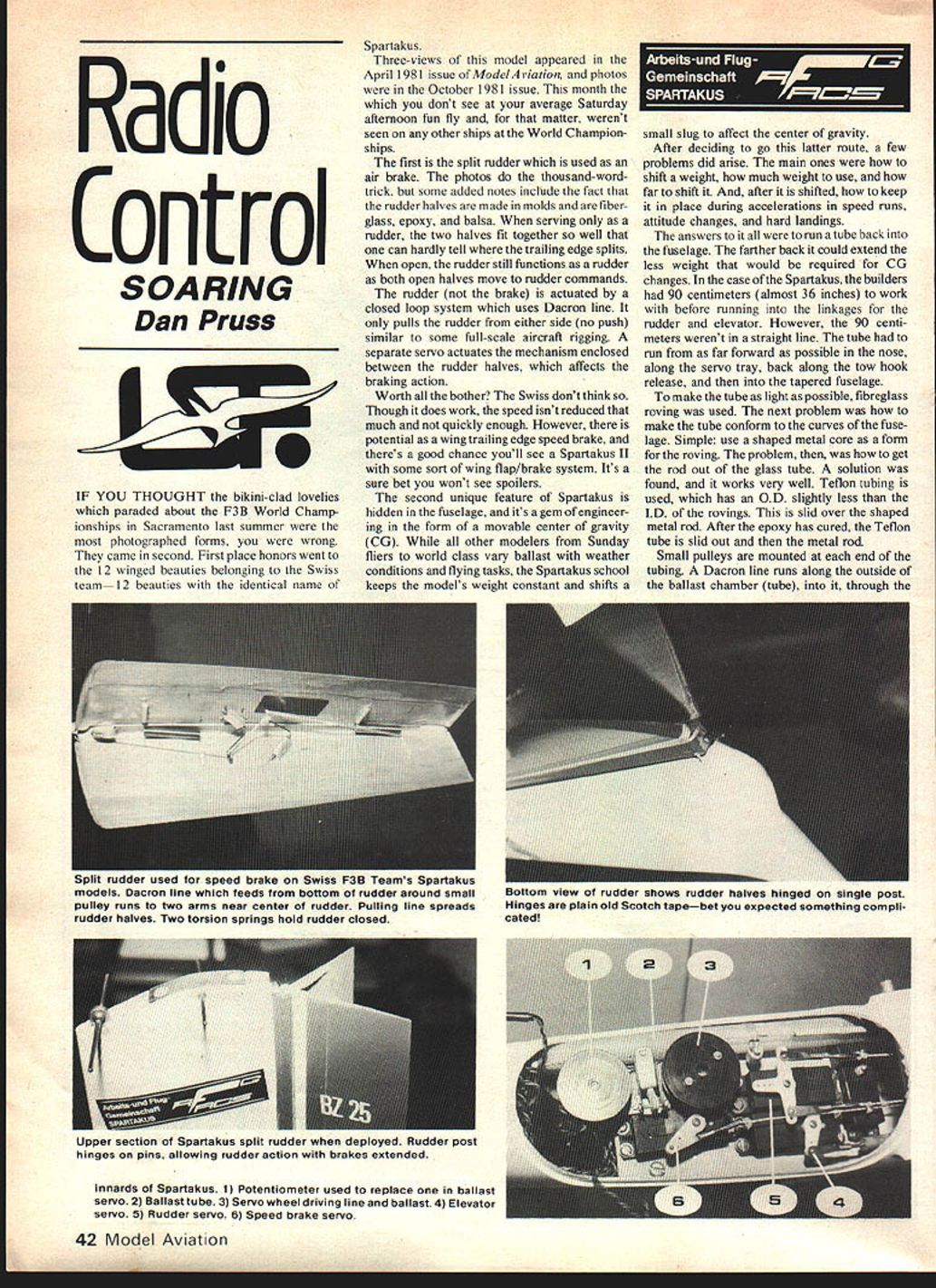
One unique feature is the split rudder used as an air brake. The photos do the thousand-word trick, but a few added notes are useful:
- The rudder halves are molded and built of fiberglass, epoxy, and balsa.
- When serving only as a rudder, the two halves fit together so well the split at the trailing edge is barely visible.
- When opened for braking, the rudder still functions as a rudder: both halves respond to rudder commands.
The rudder (not the brake) is actuated by a closed-loop system using Dacron line. It only pulls the rudder from either side (no push), similar to some full-scale aircraft rigging. A separate servo actuates the mechanism enclosed between the rudder halves to produce the braking action.
Is it worth the bother? The Swiss don't think so. While it does work, speed isn't reduced that much nor quickly enough for their needs. There is potential, however, as a wing trailing-edge speed brake, and there's a good chance you'll see a Spartakus II with some sort of wing flap/brake system. It's a sure bet you won't see spoilers.
Movable center of gravity (CG)
The second unique feature is hidden in the fuselage: a movable center of gravity. While most modelers vary ballast to suit weather and tasks, the Spartakus team keeps the model's total weight constant and shifts a small slug to change the CG.
Design challenges included how to shift the weight, how much weight to use, how far to shift it, and how to keep it in place during accelerations, attitude changes, and hard landings. The solutions:
- A tube runs back into the fuselage; the farther back it extends, the less weight is required for CG changes. On the Spartakus the builders had about 90 centimeters (almost 36 inches) to work with before encountering linkages for the rudder and elevator.
- The tube route is not straight: it runs from as far forward as possible in the nose, along the servo tray, past the tow-hook release, and into the tapered fuselage.
- Fiberglass roving was used to make the tube as light as possible. To make the tube conform to fuselage curves, a shaped metal core was used as a form for the roving.
- To remove the core after curing, a length of Teflon tubing (OD slightly less than the roving ID) is slipped over the shaped metal rod. After the epoxy cures, the Teflon tube slides out and then the metal rod is withdrawn.
- Small pulleys are mounted at each end of the tubing. A Dacron line runs along the outside of the ballast chamber, into it, through the lead weights (segmented and tied together to slide through the curves), and back out around the pulley at the far end.
- A standard servo drives the weights. The servo's potentiometer is removed; the servo motor drives an output wheel around which the Dacron line runs. In place of the servo pot is a 20:1 potentiometer, of which about 30% of the travel is used to shift the weights the full 90 cm.
- The whole unit is mounted to the servo board; the board and four servos (along with the ballast tube) are removable as a unit.
Total ballast required is only 150 grams (about 5.3 ounces). Total CG range, measured at the wing root, is from 32% to 48%. An auxiliary control on the transmitter is indexed, and with prior calculations the pilot knows where the CG will be set for Duration (calm or windy), Distance, and Speed. Horizontal stabilizer incidence settings complement the CG settings.
Is the gadget worth the effort? Absolutely. Now that initial bugs are worked out, it's the only way this particular Swiss group will handle ballast and CG.
Interchangeability, weight savings, and winch brake
All their models—23 in total (only 12 were brought to Sacramento)—are identical with respect to interchangeability of components. To save weight, color was left off the wings and tail of later versions; this reduced the weight of the seven-pound all-white ships to about 6.25 pounds. This answers many questions that arose after the World Championships report.
Their winch brake is simple and effective: the brake arm is fitted with a heavy rubber, crutch-tip–like device used for shock-mounting heavy-duty motors and machinery. When pressed against the drum it has proven as effective as clutch/bicycle-chain systems or the 9½D tennis-shoe method.
Applications
As in auto racing, where competition innovations trickle down to everyday drivers, some modeling ideas can filter to the Sunday flier:
- The split rudder/airbrake system, while not effective enough for the seven-pound, fast-flying Spartakus, could find a place on much lighter duration-only floaters.
- Movable CG can be applied across flying types—from straight duration to LSF cross-country tasks. Fuselages with larger cross sections than most FAI ships make the variable CG idea worth investigating.
- If you've ever had to take gloves off to fiddle with ballast changes in extreme cold, this kind of on-transmitter CG control will be very attractive.
Good lift.
LSF Announcements
- LSF Officers 1982–1983 (recent election results):
- Warren Plohr, president
- Bob Sommers, vice-president
- Ken Bates, secretary
- Cal Sobczinski, treasurer
- LSF Regional Tournaments:
- 1982 regional tournaments will be held August 21–22, 1982. Sites and details to follow.
- Four-color Mylar LSF emblems:
- Self-stick types (not decals), three sheets with three sizes.
- Three-size set: $4.00 plus $0.50 postage.
- Single large emblem only (included in the three-size set): $1.50 each plus $0.50 postage.
- Send orders to: League of Silent Flight, Box 39068, Dept. L, Chicago, IL 60639.
Dan Pruss Rt. 2 Box 49D Plainfield, IL 60544
Transcribed from original scans by AI. Minor OCR errors may remain.

