
Radio Control: Soaring
Dan Pruss
Two-Meter roundup
A couple of years ago all of the different Two-Meter designs wouldn't have filled an LSF Level Two landing circle. Things have changed. Looking at the current listing one wonders if they could all fit in a large airport. The current roster of kits includes:
- Bird of Time — Mark's Models (also available as Three-Meter version)
- Challenger — Great Planes Model Mfg. Co.
- Easy Breezy — Tower Hobby
- Gentle Lady — Carl Goldberg Models
- Habu — Pacific Sailplanes
- Icarus — Midnite Models
- Metrick — Top Flite Models, Inc.
- Prophet — Joe Ruth
- Riser — Sig Manufacturing Co.
- Sagitta 600 — Airtronics (also available in 100-in. version)
- Soar Birdy — Great Planes Model Mfg. Co.
- Soarer — Midwest Products Co.
Chances are by the time you read this a few more will have been added.
Competition classes
Although we speak of Two-Meter as a class of competition, some clubs and groups refer to them only as a size. The Eastern Soaring League and several clubs around the country have disregarded sailplane classes and instead categorize their events based on the flier's experience. Two classes—expert and novice—are most common.
Where sailplane size still determines categories, more often than not a special award is given for "best performance by a Two-Meter." Judging from many newsletters around the country, the Two-Meter birds are coming out with best performance—period.
Performance and recognition
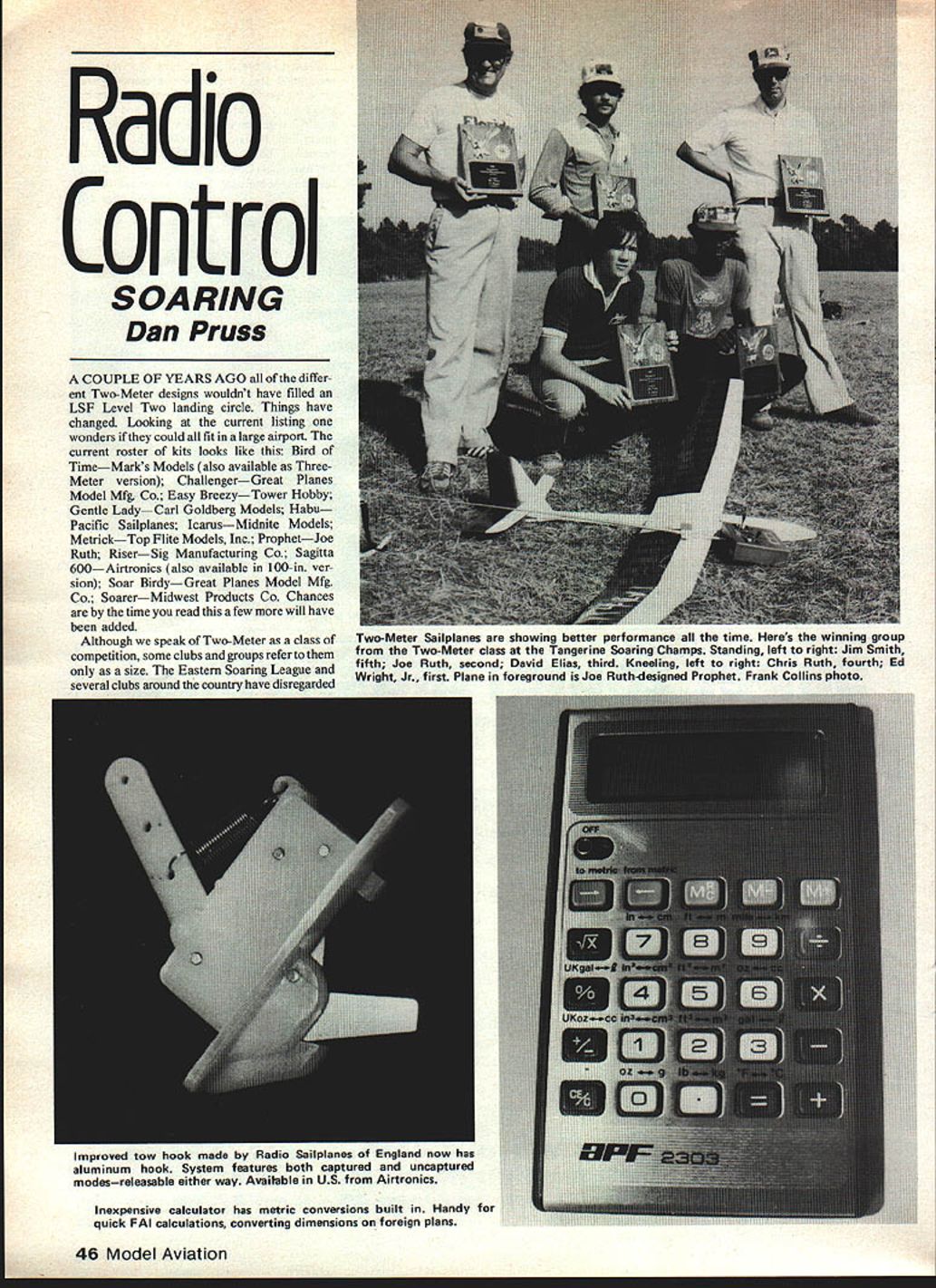
The Nats, as you recall, saw John Brown wax 'em all with his Two-Meter Icarus. More recently, at the 1981 Tangerine Soaring Championships in Orlando, FL, Chris Ruth with a Two-Meter Prophet outpointed all other size classes and was top dog on the second day of the two-day meet.
Maybe it's time we give more recognition—and time—to the Two-Meter birds at our national contests. Surely their numbers and flying quality deserve more than one day out of four.
New items
#### Metric-converter calculator There are probably more pocket calculators on the market than there are pockets, and most of us own at least two. If you're into F3B or read foreign magazines, chances are the measurements and quantities are metric, and conversions take more time than you have.
Stan Watson of Pegasus steered me to a handy converter. It has all the conversions built in and, at the press of a button, converts inches to centimeters, feet to meters, miles to kilometers, square inches to square centimeters, pounds to kilograms, °F to °C, etc. Of course it converts the other way too. It sells for under $15 and is available through the Service Merchandise Company (locations in about 26 states). Model number APF-2303; listed on page 383 in their 1982 catalog. Phone: (800) 251-1212.
#### Tow hook Radio Sailplanes of England had a tow hook on the market a couple of years back which was accepted overnight—until the new technique of zoom launches started flexing the releasable hook and pop-offs shortened many flights to 90 seconds on what should have been a 10-minute flight.
All that has changed. The new version has an aluminum hook that won't flex under the heaviest launching loads. Price will be about $10, and the hook is available through Airtronics.
#### Coverite Micafilm Coverite has a new covering film called Micafilm. It's lighter than Mylar coverings and comes in two weights:
- 3/4 oz. per square yard
- 1-1/2 oz. per square yard
It claims to be up to 700% tougher than Mylar coverings because of its ripstop feature. Available colors: white and translucent red, yellow, and blue. It adheres at 240°F and attains full shrink at 300°F. It can be painted. Roll sizes: 29 x 65 in. and 29 in. x 16.4 ft.
Club records
Nearly every club does its own thing with regard to records. This is healthy for club interest and growth. While the club's aces are setting national and international records, the Sunday-afternoon fliers have something to shoot for. Clubs can establish their own categories for records, and change and add to them at will.
Nearly all clubs have awards for best duration, longest distance, and best speed. The Southern San Joaquin Soaring Society of Bakersfield, CA, has one for most consecutive landings within a 1.5-meter spot. Care to guess what the club record is? Remember—consecutive landings. Clarence Nickel launched and landed, launched and landed—and only the setting of the sun stopped him at 102 consecutive landings!
Do-it-yourself self-launch system
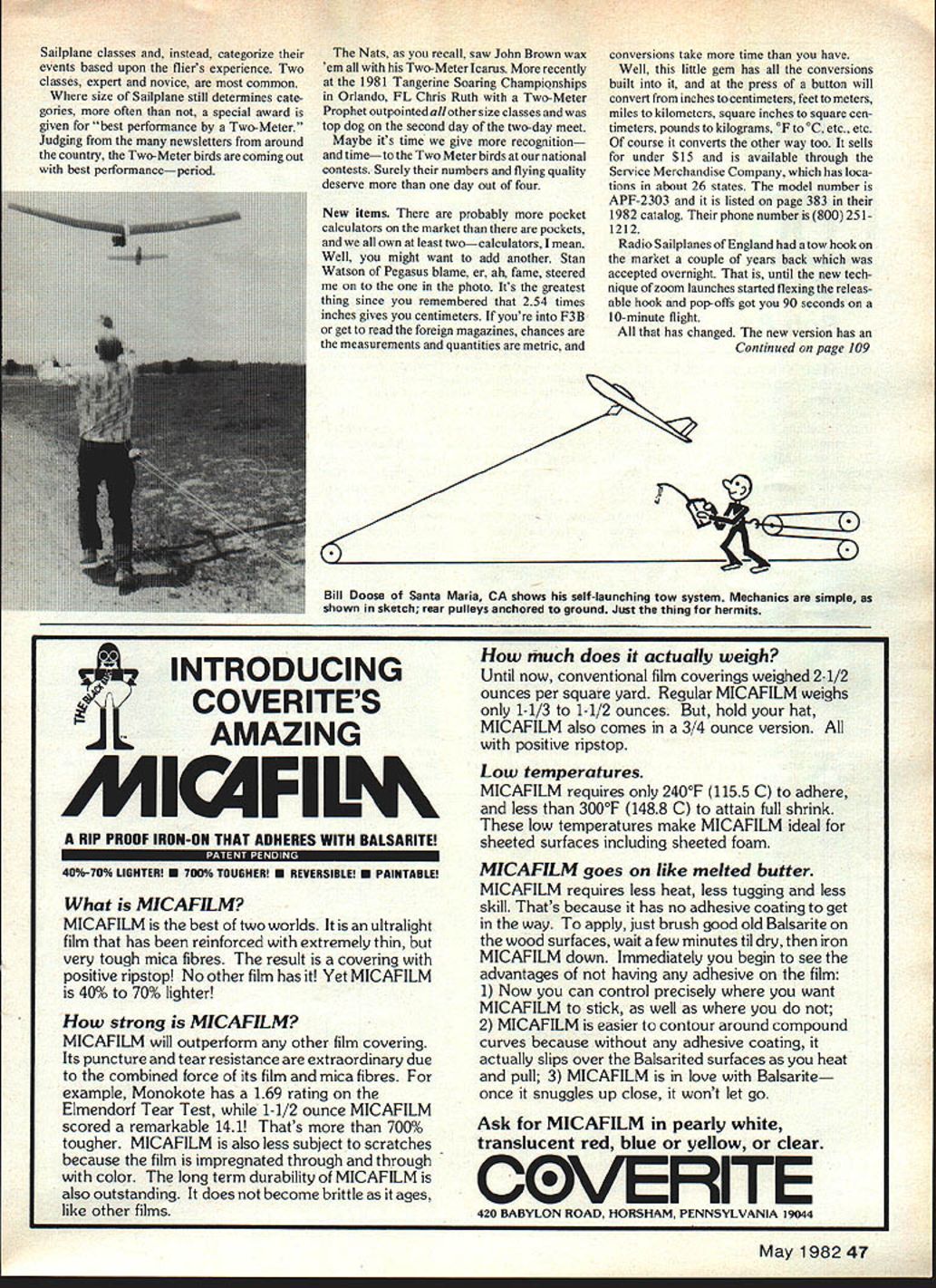
Bill Doose of the Santa Maria Soaring Society (California) shows a self-launch system that should appeal to the solo flier. It beats lugging a 110-pound winch if you have to carry it by yourself. Hand-towing is out if you fly alone (Thornburg will probably find a way to do it with a rear-view mirror on the transmitter antenna). High-starts don't appeal to most fliers except in Denmark.
Bill's system is simple. By hooking the pulley on his belt, his hands are free to handle both plane and transmitter. A mechanical advantage of 3:1 is achieved through the pulley, and a full launch is accomplished with a 50- to 100-ft run depending on the wind. The worst problem he experienced was a tangled line when the chute was retrieved; that problem was solved by putting a drag on the pulley when he removed it from his belt to retrieve the chute.
Good launching and good lift!
Dan Pruss R. 2 Box 49D, Plainfield, IL 60544.
Transcribed from original scans by AI. Minor OCR errors may remain.

