
Radio Control: Soaring
Dan Pruss
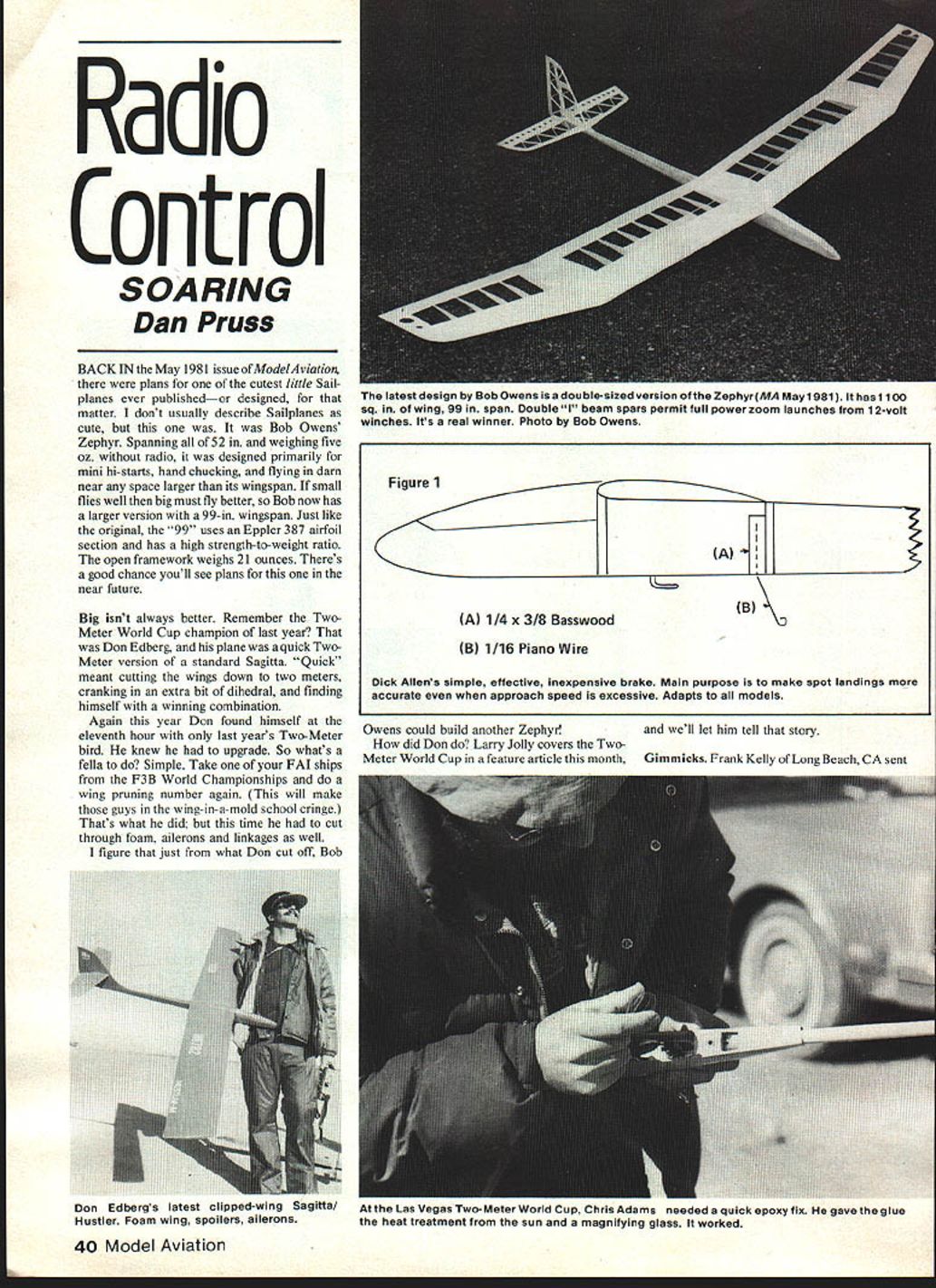
BACK IN the May 1981 issue of Model Aviation were plans for one of the cutest little sailplanes ever published—or designed, for that matter. I don't usually describe sailplanes as cute, but this one was. It was Bob Owens' Zephyr. Spanning 52 in. and weighing five oz. without radio, it was designed primarily for mini hi-starts, hand chucking, and flying in darn near any space larger than its wingspan. If small flies well then big must fly better, so Bob now has a larger version with a 99-in. wingspan. Just like the original, the "99" uses an Eppler 387 airfoil section and has a high strength-to-weight ratio. The open framework weighs 21 oz. There's a good chance you'll see plans for this one in the near future.
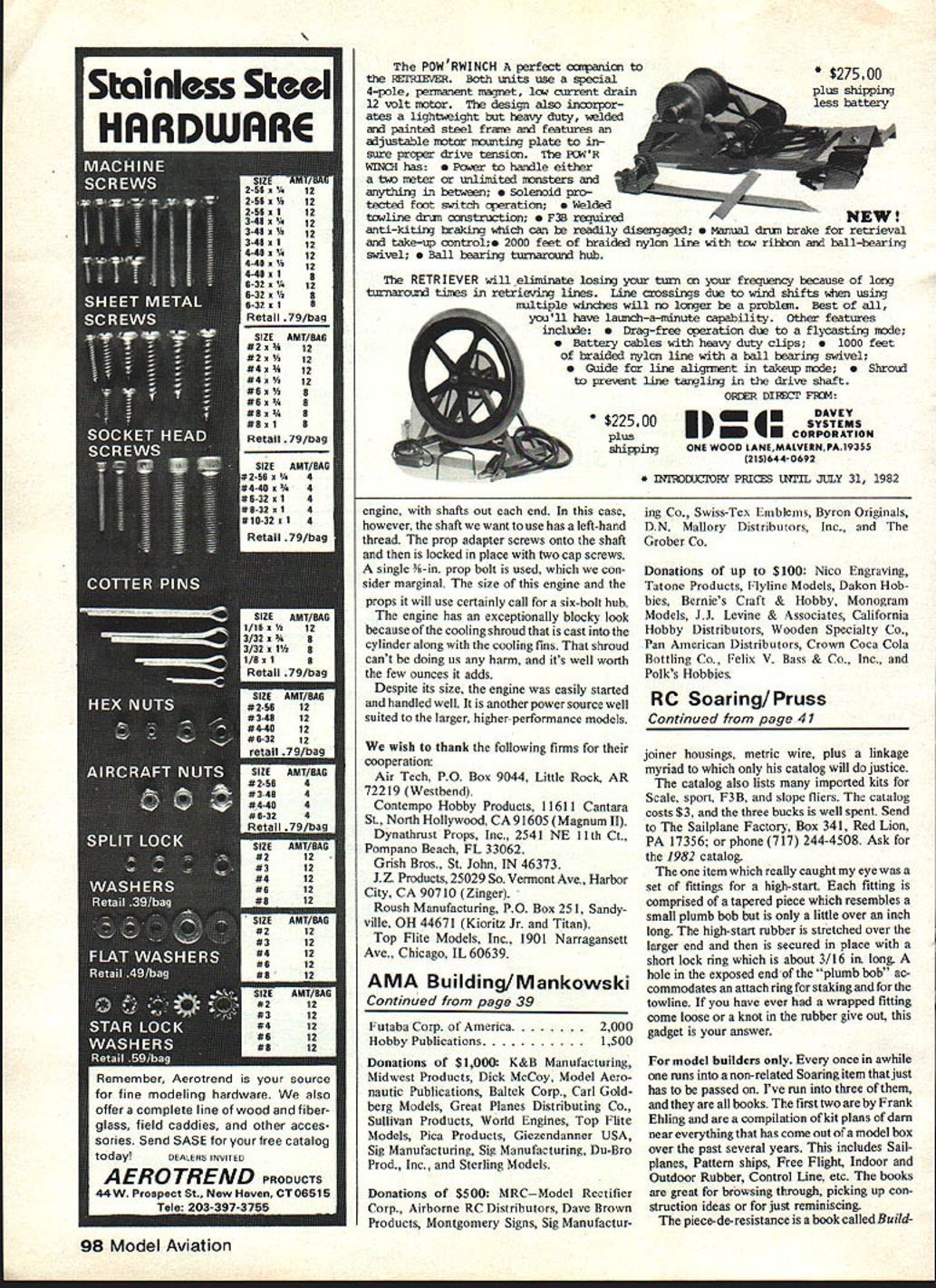
Big isn't always better. Remember the Two-Meter World Cup champion of last year? That was Don Edberg, and his plane was a quick Two-Meter version of a standard Sagitta. "Quick" meant cutting the wings down to two meters, cranking in an extra bit of dihedral, and finding himself with a winning combination.
Again this year Don found himself at the eleventh hour with only last year's Two-Meter bird. He knew he had to upgrade. So what's a fella to do? Simple. Take one of your FAI ships from the F3B World Championships and do a wing-pruning number again. (This will make those guys in the wing-in-a-mold school cringe.) That's what he did; but this time he had to cut through foam, ailerons and linkages as well.
I figure that just from what Don cut off, Bob Owens could build another Zephyr! How did Don do? Larry Jolly covers the Two-Meter World Cup in a feature article this month, and we'll let him tell that story.
Gimmicks and Gear
Frank Kelly, Long Beach, CA, sent to Model Aviation the latest design by Bob Owens—a double-sized version of the Zephyr (MA May 1981). It has about 1,100 sq. in. of wing and a 99-in. span. Double "I" beam spars permit full-power zoom launches from 12-volt winches. It's a real winner.
#### Aquila: camera mounting Frank mounted a Vivitar motorized 110 camera in the canopy of his Aquila. He held the camera in place using rubber bands and added an extra servo, using high throttle to trip the shutter. He has mounted the camera various ways—to shoot forward, side, or aft—and gets optical feedback so he can see the flash go off.
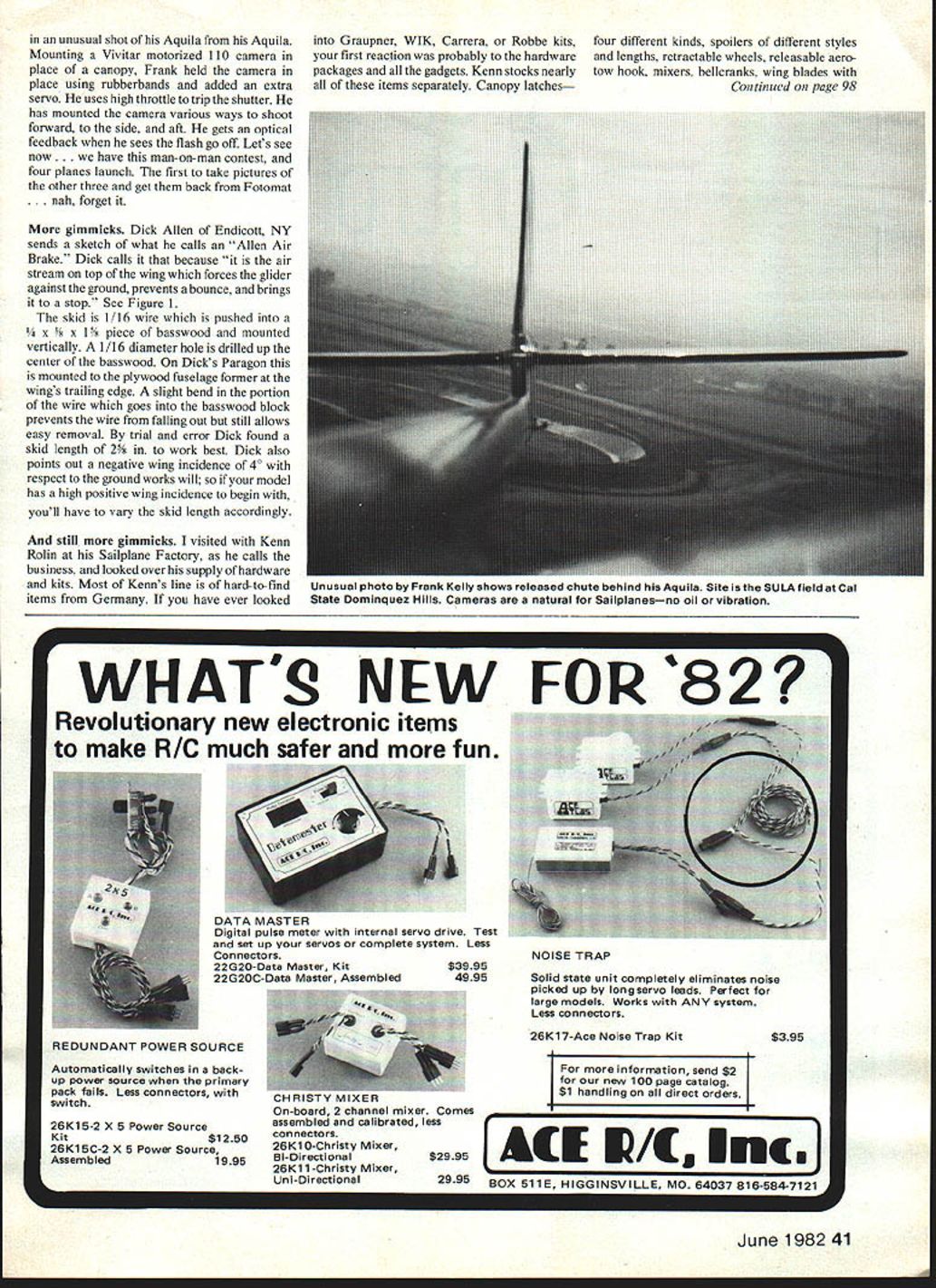
#### Allen Air Brake (Dick Allen, Endicott, NY) Dick Allen sends a sketch of what he calls the Allen Air Brake. He calls it that because the airstream over the top of the wing forces the glider against the ground, preventing bounce and bringing it to a stop.
- Construction: The skid is 1/16 in. wire pushed into a 1/4 x 3/8 x 1 1/8 in. piece of basswood mounted vertically. A 1/16 in. diameter hole is drilled up the center of the basswood. A slight bend in the portion of the wire that goes into the basswood prevents the wire from falling out while still allowing easy removal.
- Mounting: On Dick's Paragon the skid is mounted on a plywood fuselage former at the wing's trailing edge.
- Dimensions and setup: By trial and error Dick found a skid length of about 2.5 in. works best. He also points out that a negative wing incidence of about 4° with respect to the ground works well; if your model has a high positive wing incidence to begin with, you'll have to vary skid length accordingly.
Kenn Rolin Sailplane Factory
I visited Kenn Rolin Sailplane Factory and looked over his supply of hardware and kits. Most of Kenn's line is hard-to-find items from Germany—Graupner, WIK, Carrera, Robbe—and he handles kits, four different kinds of spoilers, and varied styles of hardware. First reaction: this is the place for hardware lengths, retractable wheels, releasable aero packages and gadgets. Kenn stocks nearly everything—tow hooks, mixers, bellcranks, wing blades—items sold separately, plus canopy latches and other details.
The catalog lists many imported kits for Scale, Sport, F3B, and slope fliers. The catalog costs $3, and the three bucks is well spent. Send to The Sailplane Factory, Box 341, Red Lion, PA 17356; or phone (717) 244-4508. Ask for the 1982 catalog.
One item that really caught my eye was a set of fittings for a high-start. Each fitting is a tapered piece resembling a small plumb bob, a little over an inch long. The high-start rubber is stretched over the larger end and secured with a short lock ring about 3/16 in. long. A hole in the exposed end accommodates an attaching ring for stacking and for the towline. If you have ever had a wrapped fitting come loose or a knot in the rubber give out, this gadget is your answer.
For model builders
Every once in a while one runs into non-related Soaring items that just have to be passed on. I've run into three books worth mentioning:
- Two compilations by Frank Ehlings: collections of kit plans of long out-of-production ships, including sailplanes, pattern ships, free flight, indoor and outdoor rubber, control line, etc. Great for browsing, picking up construction ideas, or reminiscing.
- Building and Flying Indoor Model Airplanes by Ron Williams: contains over 200 illustrations and covers everything from simple indoor rubber stick models to sophisticated FAI microfilm jobs. It's a book that argues model building is an art form and is one you'll leave out on the coffee table.
All three books are available from AMA HQ and are listed in the AMA Supply and Service form that comes with your renewed license.
Detroit Sno Fli — 1982
Report from Warren Tiahrt, Contest Director for the twelfth annual winter bash. Sixty-two fliers plowed through the white stuff and hung around for three rounds of 6-, 8-, and 8-minute Precision Duration events. Only six maxes were logged: four of six minutes and two of eight. Warren called the lift "marginal." Freezing rain qualified everybody for next year; temperatures were about 30°+, roughly 10 degrees warmer than the Las Vegas Two-Meter bash a week earlier. Eighteen flew in Unlimited, 40 in Standard, and four Junior-Seniors braved the weekend.
Winners:
- Unlimited Class:
- Ray Hayes, Bird of Time, 1099
- Troy Lawicki, Aquila Grande, 1062
- Gordon Pearson, Sagitta/XC, 1036
- Standard Class:
- Eric Tiahrt, Aquila, 1050
- Jim Bohmer, N.A., 981
- John Humphreys, Drifter, 854
- Best Jr.-Sr.: Steve Rausch, Aquila Grande, 927
John Humphreys' 854 was also the best performance by a Two-Meter sailplane.
Get ready for the big one — LSF Tournament
Warren Plohr, president of the League of Silent Flight, announced details for the Thirteenth Annual LSF Tournament. This will be a year of regional meets again; 13 areas have been selected to date, with two more possible.
Events:
- Precision Duration — six-minute target times for each of the two days, followed by 10-minute targets. Seven rounds total — no throw-aways.
- Landing score: 50 points in-or-out landing.
- Launching: Winches with 200 meters to the turnaround.
- Classes: Unlimited, Two-Meter, and Sport Scale. Entry permitted in Unlimited or Two-Meter, plus Scale.
Sites to date:
- Canfield, OH or Allison Park, PA
- Redmond, WA
- Philadelphia, PA
- Plainfield, IL
- Deseronto, Ontario, Canada
- Anaheim, CA
- Chapel Hill, TN
- Richmond, VA
- Lower Michigan
- Bakersfield, CA
- Fort Worth, TX
- Cape Coral, FL
- Modesto, CA
- Denver, CO (pending)
- Boston, MA (pending)
This is the annual event that supports the LSF. Talk it up. Good lift.
Dan Pruss, Rt. 1, Box 49D, Plainfield, IL 60544.
Transcribed from original scans by AI. Minor OCR errors may remain.

