

Radio Control: Soaring
Dan Pruss
New Altitude Record
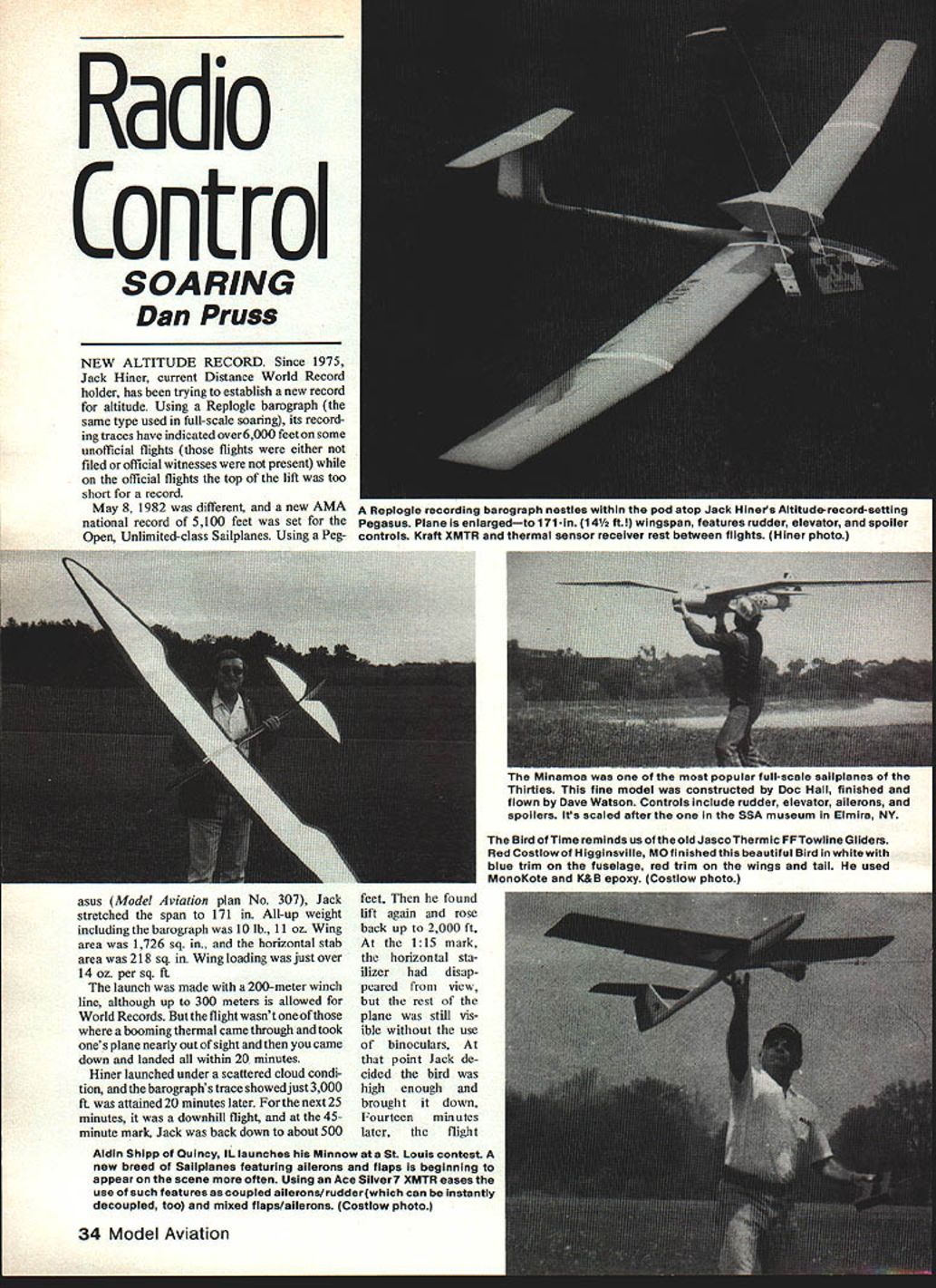
NEW ALTITUDE RECORD. Since 1975, Jack Hiner, current Distance World Record holder, has been trying to establish a new record for altitude. Using a Replogle barograph (the same type used in full-scale soaring), its recording traces have indicated over 6,000 feet on some unofficial flights (those flights were either not filed or official witnesses were not present). On the official flights the top of the lift was too short for a record.
May 8, 1982 was different, and a new AMA national record of 5,100 feet was set for the Open, Unlimited-class sailplanes. Using a Pegasus (Model Aviation plan No. 307), Jack stretched the span to 171 in. All-up weight, including the barograph, was 10 lb. 11 oz. Wing area was 1,726 sq. in., and the horizontal stabilizer area was 218 sq. in. Wing loading was just over 14 oz. per sq. ft.
The launch was made with a 200-meter winch line, although up to 300 meters is allowed for World Records. The flight was not one of those where a booming thermal came through and took the plane nearly out of sight and then you came down and landed all within 20 minutes.
Hiner launched under scattered cloud conditions. The barograph trace showed 3,000 ft. was attained 20 minutes later. For the next 25 minutes the flight descended, and at the 45-minute mark Jack was back down to about 500 feet. Then he found lift again and rose back up to 2,000 ft. At the 1:15 mark the horizontal stabilizer had disappeared from view, but the rest of the plane was still visible without the use of binoculars. At that point Jack decided the bird was high enough and brought it down. Fourteen minutes later the flight ended with the stopwatch showing 1 hr. 30 min. The altitude: 5,100 feet above ground level for a new AMA record.
Sidelights to the Flight
- Jack covers all of his planes with orange MonoKote on the fuselage and the tops of the flying surfaces. Black MonoKote is used on the undersides. He feels that, although white is better against a blue sky, the orange/black combination is best suited for all sky conditions.
- A Thermal Sniffer is a must, not only as a lift-and-sink indicator but from a safety aspect. At high altitudes it's sometimes difficult to judge a plane's attitude or rate of climb, and a well-conditioned ear can recognize an unusual situation quicker than a long-staring eye.
- The barograph was calibrated at the Schweizer Aircraft Company, which is an approved facility for the Soaring Society of America (SSA).
Records and Context
Although the 5,100-foot AMA national record was set, the FAI World Record of 4,988 feet was still intact. Jack did exceed that mark by slightly more than the required 2%, but he felt that since it had stood this long, he'd wait until conditions were somewhat better before trying again. Incidentally, Ray Smith set the existing World Record back on September 2, 1968.
Cross-Country and Distance Flights
The Day's Conditions and Technique
Later in the day the lift was broad but much weaker. Much less time was spent circling in lift than earlier in the flight. Large areas of light lift were flown straight down the road at best sink rate. When the lift became stronger, Jack would make large gentle turns to gain altitude. When the lift stopped, he would speed up a bit and cover some ground, slowing if any lift was encountered.
Altitude became even more important later. Jack knew that if the Pegasus ever got down to 1,000 feet or less, it would be the beginning of the final glide to landing. If altitude was protected, the Pegasus could fly on for another two hours or so. A little over an hour later, at 3:24, the Pegasus was over the goal and up near cloud base. Landing was at 3:31 p.m. for a new FAI World Record of 55.81 miles.
Cross-Country Potential
This flight is only a fraction of the distance that could be covered. Three downwind distance flights of over 40 miles in this area have averaged from a little over 15 mph to over 20 mph. Two of the flights were with Aquila XLs, a rather slow sailplane for cross-country flying. Yet it was an Aquila XL that averaged over 20 mph on a flight of over 40 miles on a day with strong thermals and a brisk tail wind.
None of these flights was flown aggressively. A faster, more efficient sailplane would allow an aggressive flying style and make an average speed of 25 mph or more possible on good days.
With the right weather conditions on a long June day, it is possible to fly an RC sailplane cross-country for seven hours or more in this area. Simple math indicates a possible 100-mile flight with a floater. With a sailplane designed for fast cross-country flying, a 200-mile flight should be within reach.
Modeling and New Designs
Notable Models and Builders
- A beautiful 30-lb, 1/3-scale Christen Eagle has been turned out by modelers.
- Red Costlow, one of Ace RC's right-hand men, decided to go the silent route. His Bird-of-Time looks promising.
- Aldin Shipp's Minnow is a Two-Meter bird that includes flaps and ailerons.
- The Minnow mentioned earlier belongs to Dave Watson of San Diego.
New-Generation Designs
The F3B scene, the Two-Meter World Cup, and the desire to increase sailplane performance (and to tinker) have opened up a whole new breed of designs. While the polyhedral-wing, two-channel ship has dominated the majority of flying fields—and will continue in popularity—there are more and more new-generation types showing up. It's interesting to see the different innovations.
Examples:
- Terry Lucenbach's Two-Meter ship features full-span flaperons. The foam wing is covered with .005 aluminum (normally used in lithography) and then covered with balsa.
- Rick Schramek's Factor is a kit from Great Britain. The design shows clear Dassel influence. The wings are foam with obeche covering. Aileron-equipped, the flying stabilizer, rudder, and canopy air brake take care of four RC channels.
International Faces
From France comes a photo of seven women fliers—all from the same club. All build their own models and participate in mixed competition—no separate categories for them. These Paris ladies have been flying for a few seasons now—at least one of them has won a contest involving 50 or more fliers. (And they can cook, too!)
Full-Scale Minimoa Story
Nine years ago, just days before leaving for Elmira, NY, back when that gang put on an annual bash which drew over 100 fliers to Harris Hill, I got a lead on a full-scale Minimoa which was owned by a Reverend Groom out in Phoenix. Back then several of us were interested in old scale subjects, and it was only a rumor that one Minimoa existed somewhere in the U.S.A. The SSA listed the one in Phoenix, so a call was made.
The Reverend Groom told his own story about the bird: how it was freighted over on the Hindenburg; was owned by Richard DuPont; and how he, Reverend Groom, back in the Thirties, pushed it as a line boy all over Harris Hill. DuPont was killed in an experimental glider accident during the war, and sometime thereafter Reverend Groom sought out the Minimoa and bought it. When asked if we could come and see it, I was told that he had given it away! Asked if it could still be seen anywhere, I was told "probably," but I would have to go to Elmira as it was donated to the SSA museum on Harris Hill.
So a couple of days later, Neil Liptak and I spent an afternoon with notebook, camera, and tape measure in the dusty basement of a hangar on that famous hill. Doc Hall of Glenview, IL, who cut a wide swath in Scale back in the Seventies, saw the material Neil and I compiled and said he'd start building it immediately. He did. After the bird was all framed out, it sat for the longest time and the project was given up to other priorities. Eventually it was sold, and last year Dave Watson rebuilt part of it, finished it, and nine years after that first phone call was made, the Minimoa joined the gulls off Torrey Pines.
Dave promises more pictures later, but I wanted to share a different kind of modeling story with you now.
Good lift.
Dan Pruss 131 E. Pennington Ln. Plainfield, IL 60544.
Transcribed from original scans by AI. Minor OCR errors may remain.

