
Radio Control: Soaring
Dan Pruss
To paraphrase an old song title: June busted out all over. Some events took place in June 1982 which will be highlighted here chronologically. You can determine the order of their impact on RC soaring.
June 5
If this column is reading like a press release for certain folks, it's being read wrong. Anybody who has stared at the sky for over an hour, or has hoped to, will appreciate the following accomplishment and the others mentioned in this report.
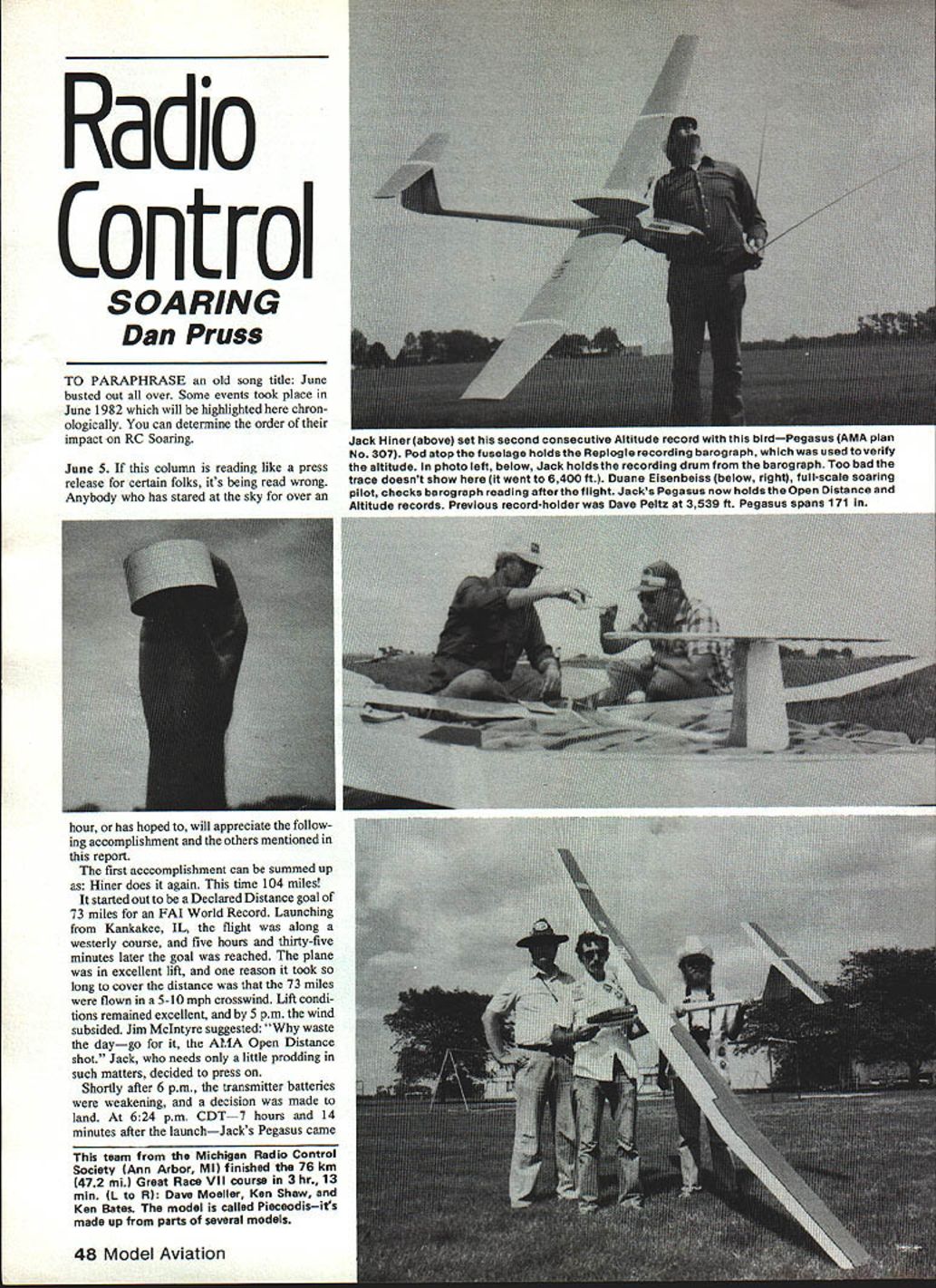
The first accomplishment can be summed up as: Hiner does it again. This time 104 miles! It started out to be a Declared Distance goal of 73 miles for an FAI world record. Launching from Kankakee, IL, the flight was along a westerly course, and five hours and thirty-five minutes later the goal was reached. The plane was in excellent lift, and one reason it took so long to cover the distance was that the 73 miles were flown in a 5–10 mph crosswind. Lift conditions remained excellent, and by 5 p.m. the wind subsided. Jim McIntyre suggested, "Why waste the day — go for it, the AMA Open Distance shot." Jack Hiner, who needs only a little prodding in such matters, decided to press on.
Shortly after 6 p.m., the transmitter batteries were weakening, and a decision was made to land. At 6:24 p.m. CDT — 7 hours and 14 minutes after the launch — Jack's Pegasus came to rest at a point about 20 miles northwest of Peoria, IL, 104 miles away from the start line.
The lift was still excellent, according to Jim Slater, Contest Director, and considering the calm conditions, the cloudless sky since 5 p.m., and the pace of the flight, at least another 30 or 40 miles might have been attained before dark.
If Hiner's accomplishment has earned accolades, then Dave Heafert, one of Jack's witnesses, also deserves a spot on the honor board. I mean, when you walk into the house at 11 o'clock, almost three hours after sunset, on a Saturday night and you're asked by the missus, "Where have you been?" you know that the follow-up of "Out flying with the boys" has got to qualify Dave for the "Smooth Talker of the Year" award. Well done, Jack and Dave.
Sidelights: Maps and Record Documentation
For record attempts, U.S. Geological Survey (USGS) maps are best suited and are available in two scales:
- 1:24,000 — 1 in. to 2,000 ft.
- 1:62,000 — 1 in. to the mile.
Because both of these charts are large-scale references, it would take a bundle of maps for a long record if you wanted to plot a complete course using only those charts — but you don't have to! Any detailed road map with country roads is a help. However, the USGS charts are required for showing the launch point and the point of landing. The two must be part of your documentation.
Availability:
- If you live in Minnesota or are east of the Mississippi River, write to:
U.S. Geological Survey Department, Branch of Distribution, 1200 S. Eads Street, Arlington, VA 22202.
- If you're interested in areas west of the Mississippi, including Alaska and Hawaii, write to:
U.S. Geological Survey Department, Federal Center, Box 25286, Denver, CO 80225.
In writing to either address, ask for a respective state index. The index shows the different charts by number and overlays the entire state. You can determine which charts will be required for your record attempt.
One major concern that ties in with cross-country challenges—especially now that the 100-mile barrier has been broken—is the simple fact that if you fly straight away for over 100 miles, in most cases you have to drive back those same miles, and that takes time.
June 11
That day was scheduled for practice as a prelude to Great Race VII, the 76-kilometer cross-country event. All 15 teams which entered were on hand, and some of the accomplishments that day (if singled out) would have been headlined in most reports a few years ago.
Among them was Noel Rossow of the Greater Detroit Soaring and Hiking Society who flew his LSF Level V Goal‑and‑Return (10 km each way) and also got his two-hour thermal requirement on the same flight.
Troy Lewicki and his team, also from the Detroit area, took a practice cross with the team's Paramount and bumped the 20-mile mark. Skip Miller did the same thing with the FAST team's Sagitta‑XC. Several others tested the lift for flights of one hour plus and got their ships trimmed for Saturday.
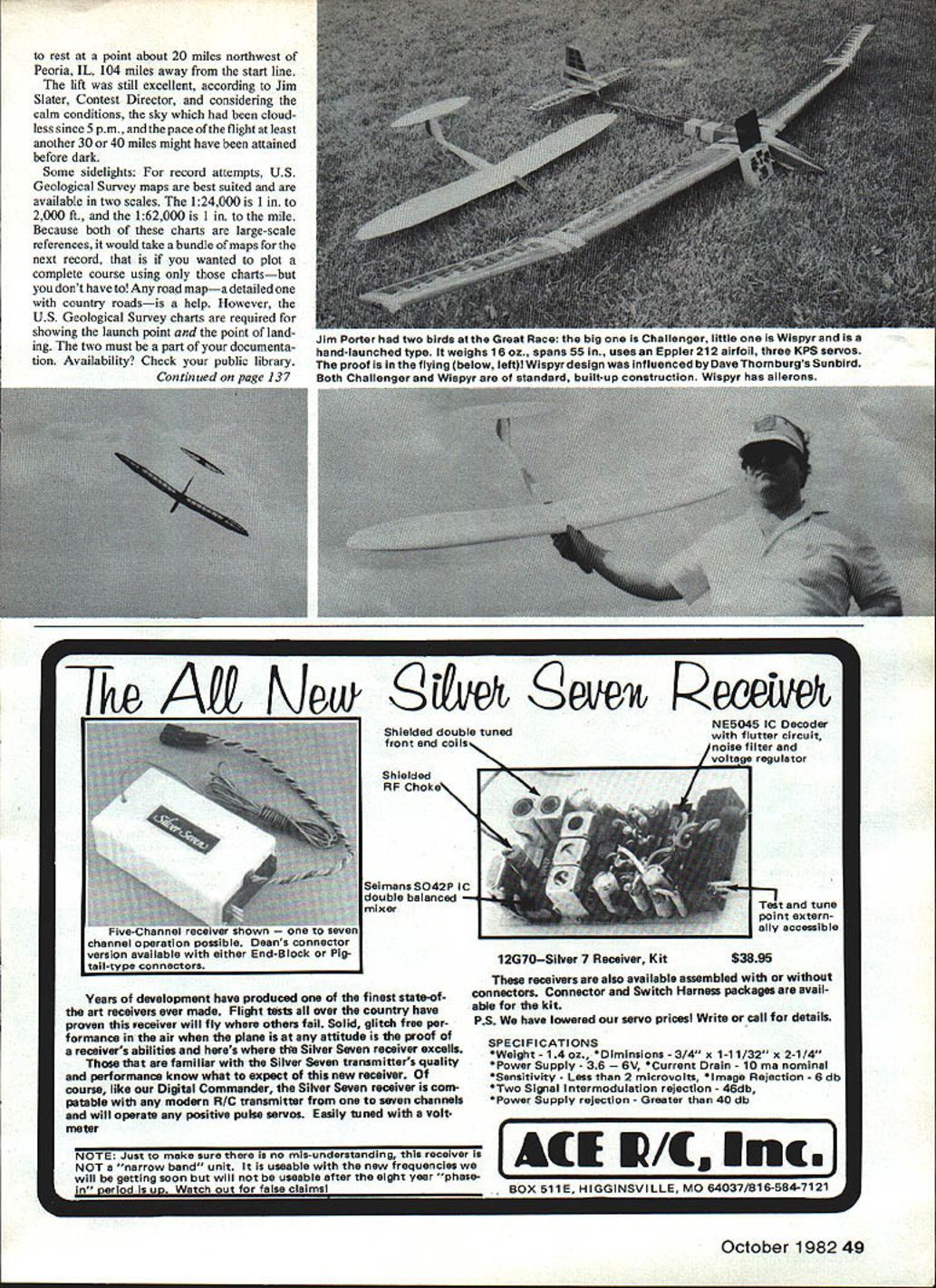
While those no-small-feat flights were being made, Jack Hiner went for a new altitude record (no, this isn't a repeat of last month's column). Launching at 12:28 p.m., the flight lasted until 3 p.m. Observed with the naked eye, it was a situation where if you did look away you never were able to relocate the bird. Tom Kallevang, one of the witnesses, did track it with binoculars as a safety measure. The trace, once the calibration graph was made, registered 6,400 ft. for a new AMA (and possibly FAI) record.
June 12 and 13 — Great Race VII
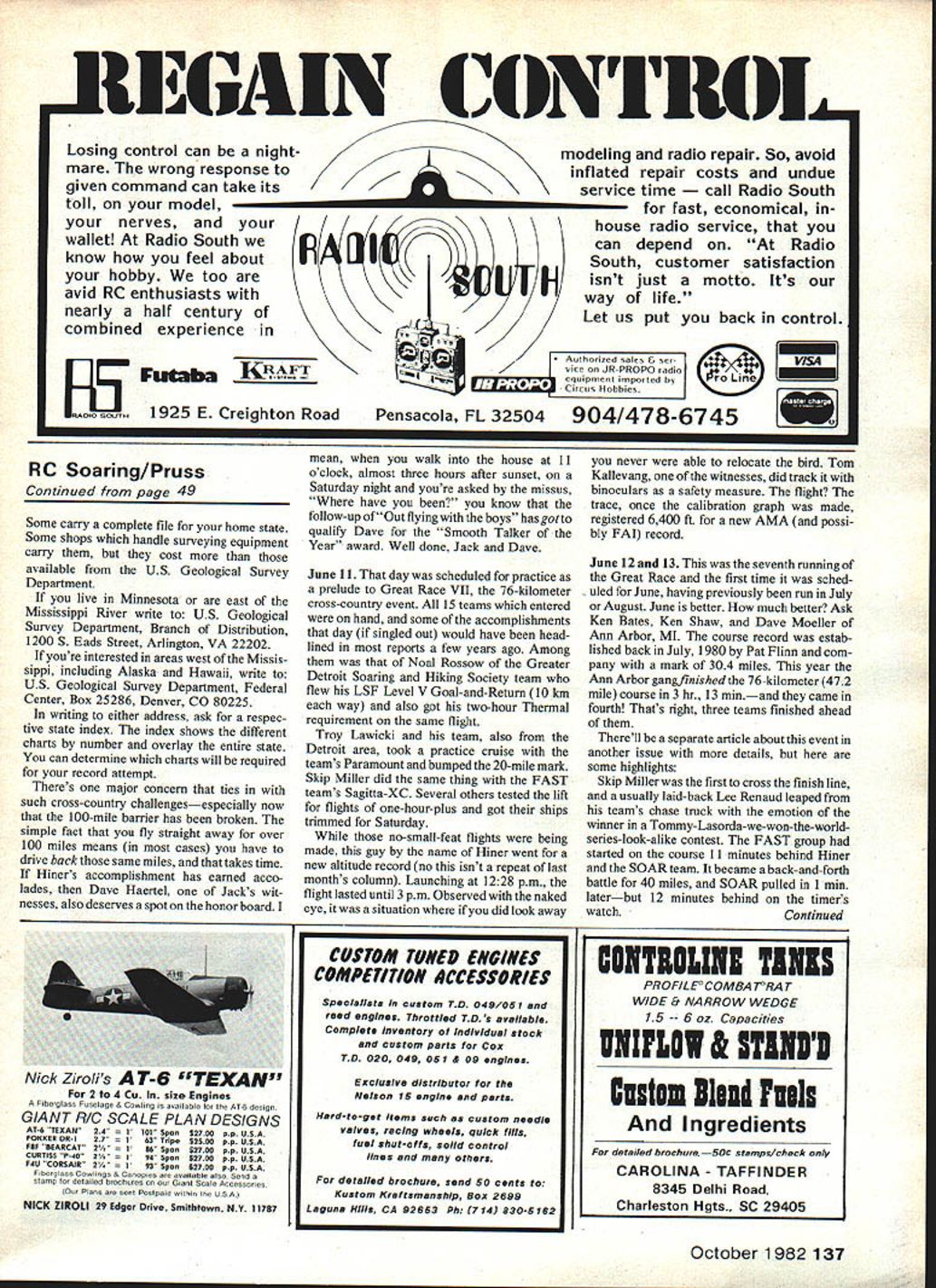
This was the seventh running of the Great Race and the first time it was scheduled for June, having previously been run in July or August. June is better. How much better? Ask Ken Bates, Ken Shaw, and Dave Moeller of Ann Arbor, MI. The course record was established back in July 1980 by Pat Flinn and company with a mark of 30.4 miles. This year the Ann Arbor gang finished the 76-kilometer (47.2 mile) course in 3 hr. 13 min.—and they came in fourth! That's right, three teams finished ahead of them.
Highlights:
- Skip Miller was the first to cross the finish line. A usually laid-back Lee Renaud leaped from his team's chase truck with the emotion of a winner in a "we-won-the-world-series" look-alike celebration. The FAST group had started on the course 11 minutes behind Hiner and the SOAR team. It became a back-and-forth battle for 40 miles, and SOAR pulled in 1 minute later—but 12 minutes behind on the timer.
- The Mid-Ohio Soaring Society team of Jim Bohmer, Don Harris, Warren Plohr, Jack Parry, and Mary Knott landed at 14:10, and 11 minutes later Ken Bates and his crew finished. Only 32 minutes separated landing times for the four finishers, but the MOSS group logged the most important time — 2 hr. 32 min. — to take first place.
- Three other teams came close to finishing. Pat Flinn with Noel Rossow's Astro Jeff fell short of the course at 75 km — 1 km (0.6 of a mile) short of the finish line.
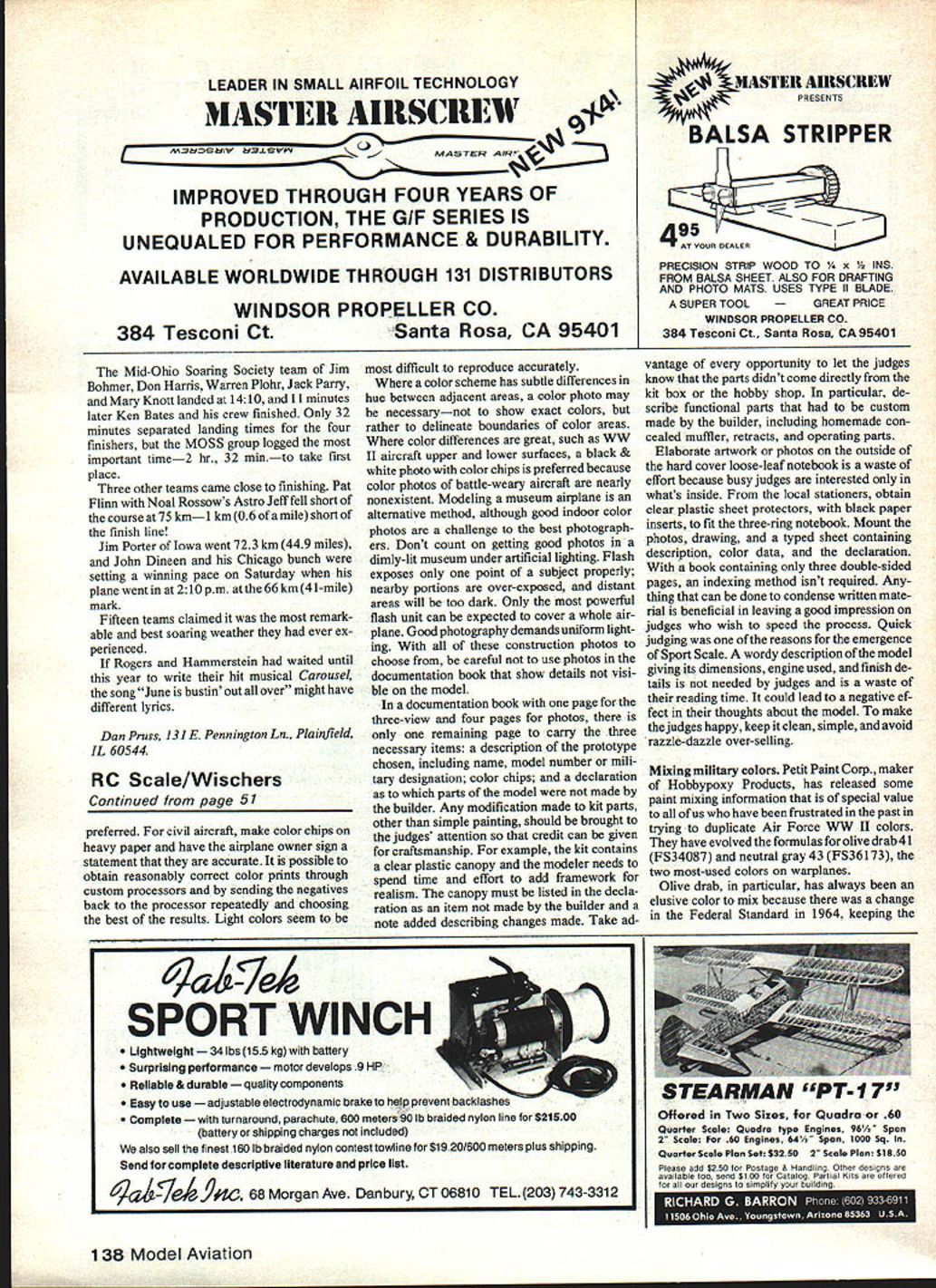
- Jim Porter of Iowa went 72.3 km (44.9 miles).
- John Dineen and his Chicago team were setting a winning pace on Saturday when his plane went in at 2:10 p.m. at the 66 km (41-mile) mark.
Fifteen teams claimed it was the most remarkable and best soaring weather they had ever experienced.
Dan Pruss 131 E. Pennington Ln., Plainfield, IL 60544.
Transcribed from original scans by AI. Minor OCR errors may remain.

