
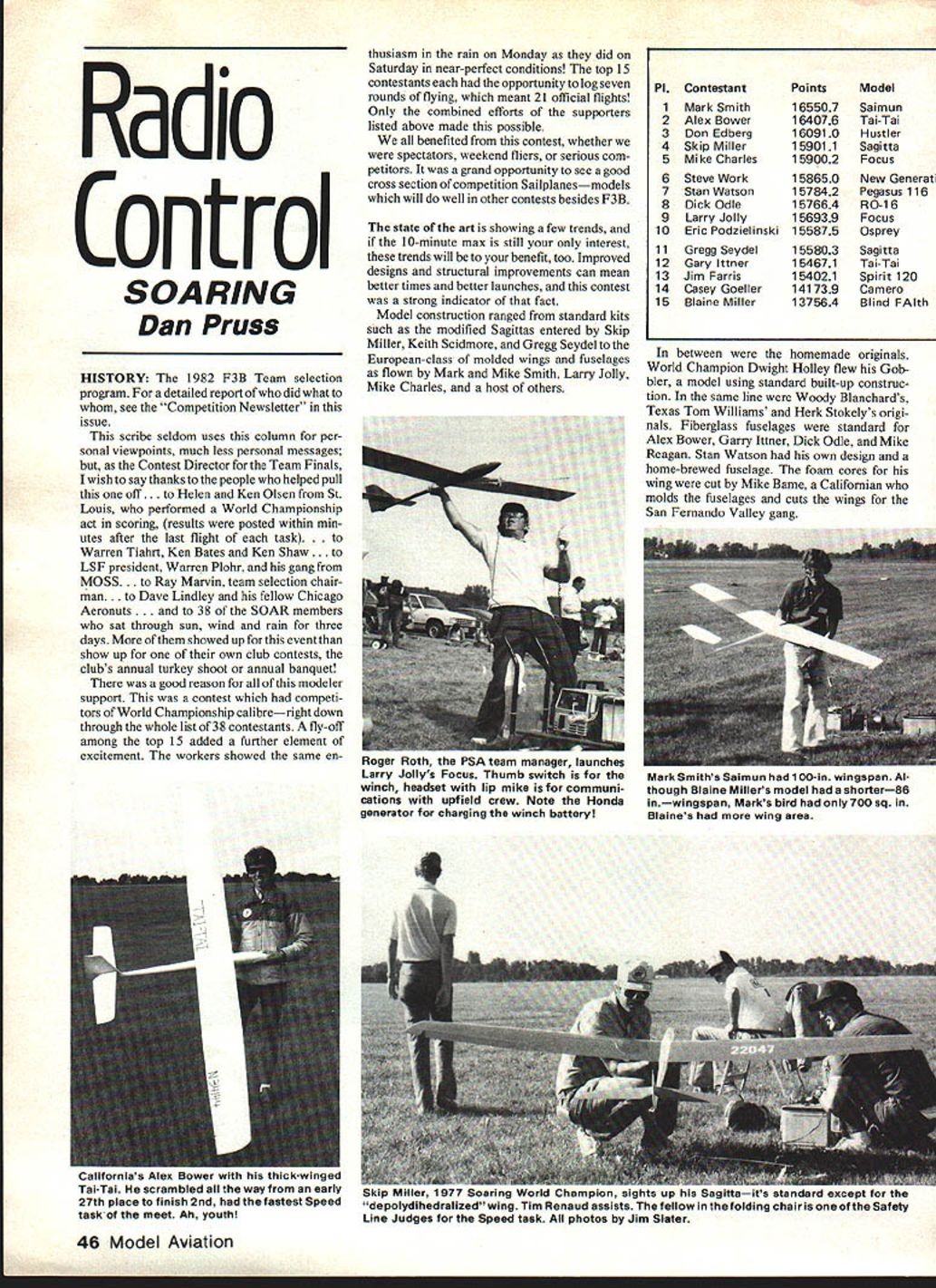
Radio Control SOARING
Dan Pruss
HISTORY:
This was the 1982 F3B Team selection program. For a detailed report of who did what to whom, see the "Competition Newsletter" in this issue.
I seldom use this column for personal viewpoints, much less personal messages; but as the Contest Director for the Team Finals I wish to say thanks to the people who helped pull this one off: Helen and Ken Olsen from St. Louis, who performed a World Championship act in scoring (results were posted within minutes after the last flight of each task); Warren Tiahrt, Ken Bates and Ken Shaw; LSF president Warren Plohr and his gang from MOSS; Ray Marvin, team selection chairman; Dave Lindley and his fellow Chicago Aeronuts; and 38 of the SOAR members who sat through sun, wind and rain for three days. More of them showed up for this event than show up for one of their own club contests, the club's annual turkey shoot or annual banquet!
There was a good reason for all of this modeler support. This was a contest which had competitors of World Championship calibre—right down through the whole list of 38 contestants. A fly-off among the top 15 added a further element of excitement. The workers showed the same enthusiasm in the rain on Monday as they did on Saturday in near-perfect conditions. The top 15 contestants each had the opportunity to log seven rounds of flying, which meant 21 official flights. Only the combined efforts of the supporters listed above made this possible.
We all benefited from this contest, whether we were spectators, weekend fliers, or serious competitors. It was a grand opportunity to see a good cross section of competition sailplanes—models which will do well in other contests besides F3B.
The state of the art is showing a few trends, and if the 10-minute max is still your only interest, these trends will be to your benefit. Improved designs and structural improvements can mean better times and better launches, and this contest was a strong indicator of that fact.
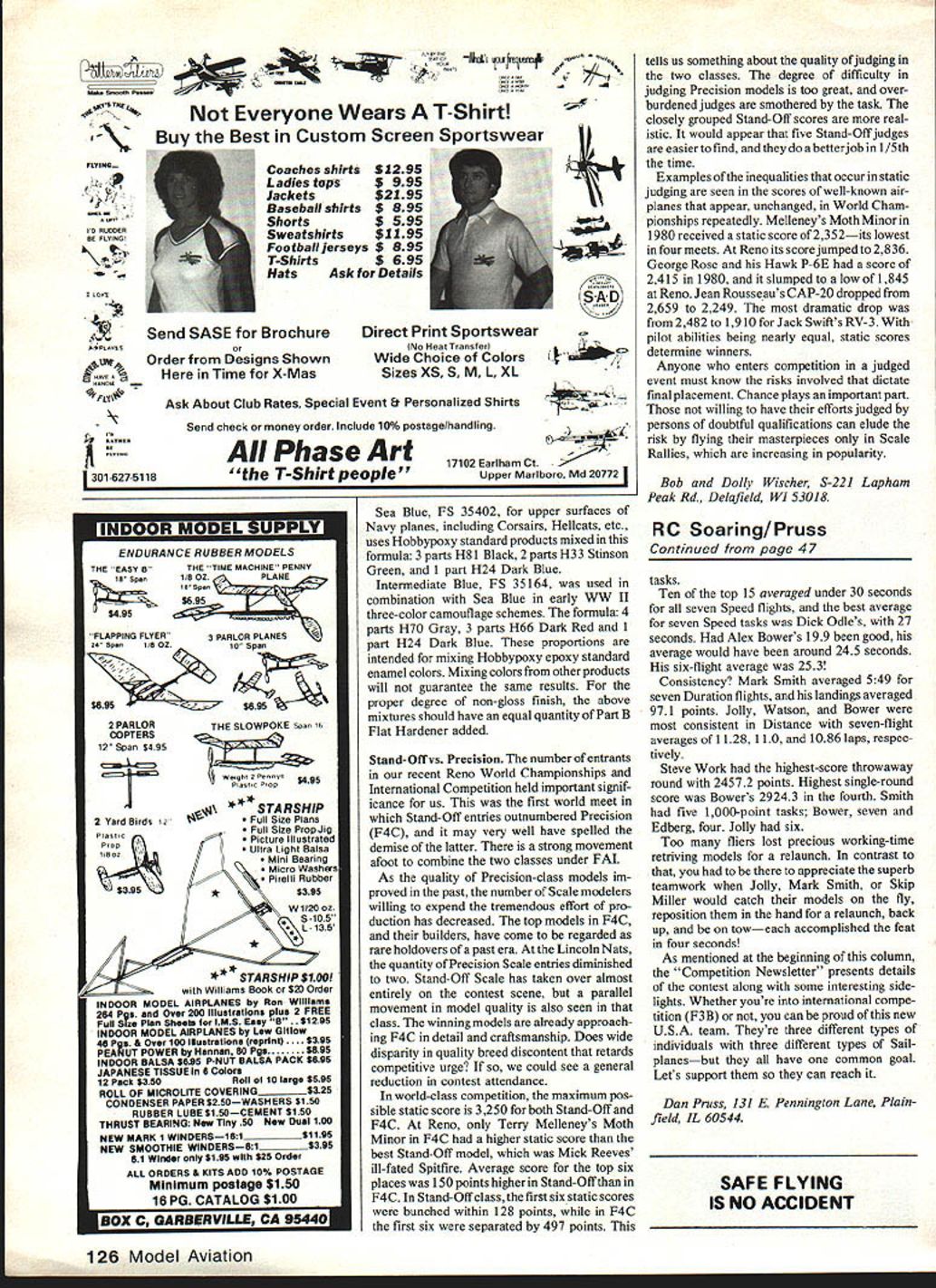
Model construction ranged from standard kits such as the modified Sagittas entered by Skip Miller, Keith Scidmore, and Gregg Seydel to the European class of molded wings and fuselages as flown by Mark and Mike Smith, Larry Jolly, Mike Charles, and a host of others.
Placings:
- 1. Mark Smith — 16,550.7 — Saimun
- 2. Alex Bower — 16,407.6 — Tai-Tai
- 3. Don Edberg — 16,091.0 — Hustler
- 4. Skip Miller — 15,901.1 — Sagitta
- 5. Mike Charles — 15,900.2 — Focus
- 6. Steve Work — 15,865.0 — New Generation
- 7. Stan Watson — 15,784.2 — Pegasus 116
- 8. Dick Odle — 15,766.4 — RO-16
- 9. Larry Jolly — 15,693.9 — Focus
- 10. Eric Podzielinski — 15,587.5 — Osprey
- 11. Gregg Seydel — 15,580.3 — Sagitta
- 12. Gary Ittner — 15,467.1 — Tai-Tai
- 13. Jim Farris — 15,402.1 — Spirit 120
- 14. Casey Goeller — 14,173.9 — Camero
- 15. Blaine Miller — 13,756.4 — Blind Faith
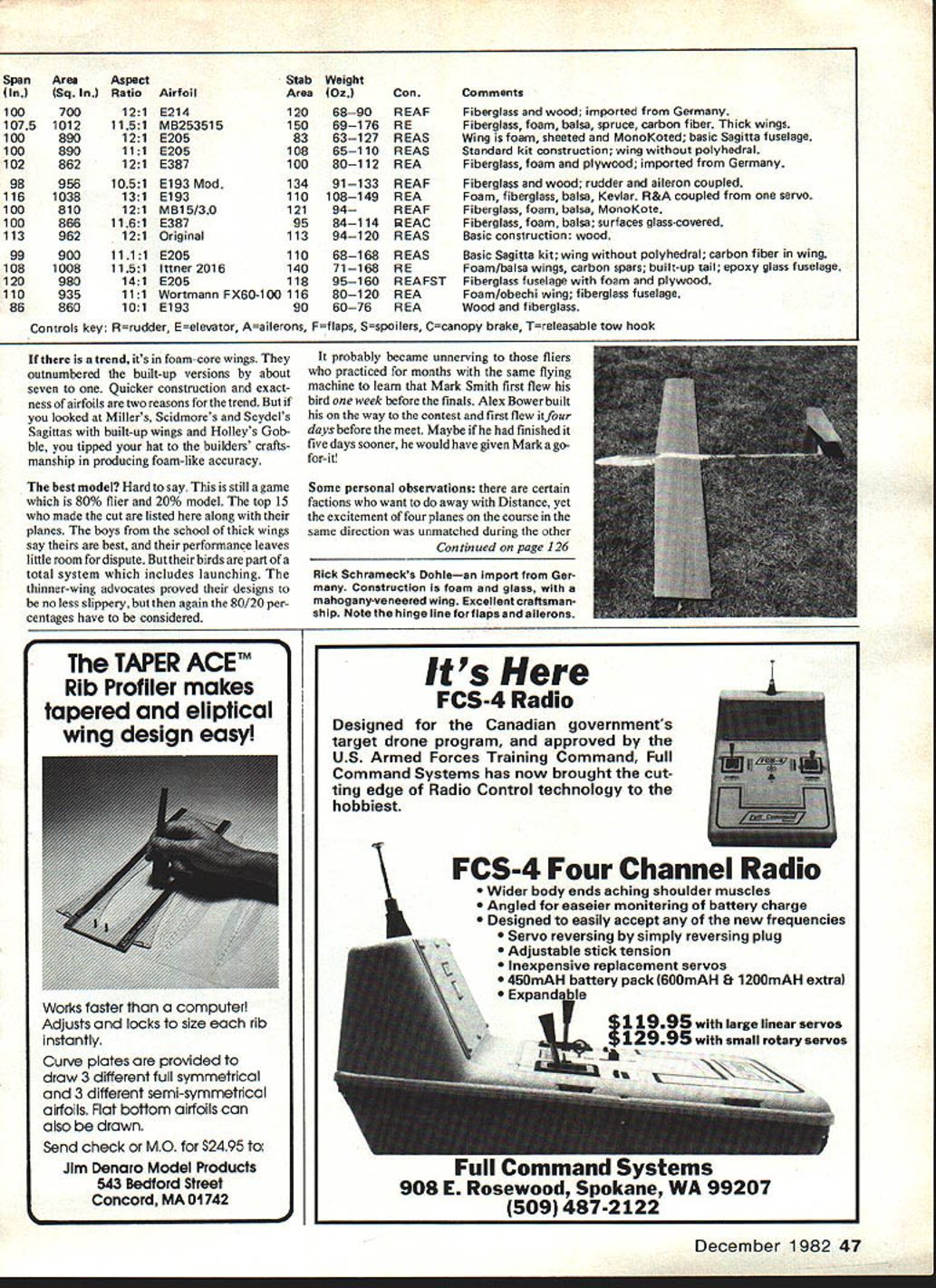
In between were the homemade originals. World Champion Dwight Holley flew his Gobbler, a model using standard built-up construction. In the same line were Woody Blanchard's, Texas Tom Williams' and Herk Stokely's originals. Fiberglass fuselages were standard for Alex Bower, Gary Ittner, Dick Odle, and Mike Reagan. Stan Watson had his own design and a home-brewed fuselage. The foam cores for his wing were cut by Mike Bame, a Californian who molds fuselages and cuts wings for the San Fernando Valley gang.
If there is a trend, it's in foam-core wings. They outnumbered the built-up versions by about seven to one. Quicker construction and exactness of airfoils are two reasons for the trend. But if you looked at Miller's, Scidmore's and Seydel's Sagittas with built-up wings and Holley's Gobbler, you tipped your hat to the builders' craftsmanship in producing foam-like accuracy.
The best model? Hard to say. This is still a game that is about 80% flier and 20% model. The top 15 who made the cut are listed here along with their planes. The boys from the school of thick wings say theirs are best, and their performance leaves little room for dispute. But their birds are part of a total system which includes launching. The thinner-wing advocates proved their designs to be no less slippery, but then again the 80/20 percentages have to be considered.
It probably became unnerving to those fliers who practiced for months with the same flying machine to learn that Mark Smith first flew his bird one week before the finals. Alex Bower built his on the way to the contest and first flew it four days before the meet. Maybe if he had finished it five days sooner, he would have given Mark a go-for-it!
Some personal observations: there are certain factions who want to do away with Distance, yet the excitement of four planes on the course in the same direction was unmatched during the other tasks.
Ten of the top 15 averaged under 30 seconds for all seven Speed flights, and the best average for seven Speed tasks was Dick Odle's, with 27 seconds. Had Alex Bower's 19.9 been good, his average would have been around 24.5 seconds; his six-flight average was 25.3.
Consistency? Mark Smith averaged 5:49 for seven Duration flights, and his landings averaged 97.1 points. Jolly, Watson, and Bower were most consistent in Distance with seven-flight averages of 11.28, 11.0, and 10.86 laps, respectively.
Steve Work had the highest-score throwaway round with 2,457.2 points. Highest single-round score was Bower's 2,924.3 in the fourth. Smith had five 1,000-point tasks, Bower seven and Edberg four. Jolly had six.
Too many fliers lost precious working time retrieving models for a relaunch. In contrast to that, you had to be there to appreciate the superb teamwork when Jolly, Mark Smith or Skip Miller would catch their models on the fly, reposition them in the hand for a relaunch, back up and be on tow—each accomplished the feat in four seconds!
As mentioned at the beginning of this column, the "Competition Newsletter" presents articles of the contest along with some interesting side-lights. Whether you are into international competition (F3B) or not, you can be proud of this U.S.A. team. They are three different types of individuals with three different types of sailplanes—but they all have one common goal. Let's support them so they can reach it.
Dan Pruss 131 E. Pennington Lane Plainfield, IL 60544
Transcribed from original scans by AI. Minor OCR errors may remain.

