
Radio Control: Soaring
Dan Pruss
IF YOU LIVE south of a line that extends east from Dave Thornburg to Rae Fritz, you don't know the joys of flying while wearing a ski mask and a snowmobile suit and trying to find a spot on the field where snow isn't drum-high on a tall winch. We who live north of that line call it the building season.
A prelude to that season took place in October in the form of the Tenth Annual Greater Chicago Radio Controlled Model Show. (Actually, the show is mainly operated for the most part, and for a better name it's simply called Chicago Expo.) The show is similar to the biggie referred to simply as Toledo, but on a smaller scale. There was a new site this year which was excellent. It was large, with ample parking, and it could have accommodated the whole Toledo gang easily. I mention this just in case you're in the area next October. I guess if you live in an area where suntan lotion is standard equipment among your toolbox supplies for 12 months of the year, the timing of a trade show isn't important.
I picked up on a few things at this one which could be timely for everybody, and they might make building, flying, and even life more simple.
CAR Module
If you have an older radio set or a low-priced new one which doesn't include all of the whistles and bells, and if the set doesn't have an override feature when rudder and ailerons are coupled, Jomar Products (2028 Knightsbridge Drive, Cincinnati, OH 45244) has an alternative. They sell a module which is an electronic coupler and mounts in your plane between the servos and receiver. When the rudder stick is centered, the rudder will couple to the aileron channel. But when the rudder stick is moved off center, the rudder and aileron will resume normal, independent operation. All you need to install the coupler are two servo extension cables for your brand of radio—cut the cables and solder them to the terminals on top of the module. Jomar offers a lightweight version for sailplanes, and the unit comes with a 90-day guarantee. (Price: $40.)
Wandit
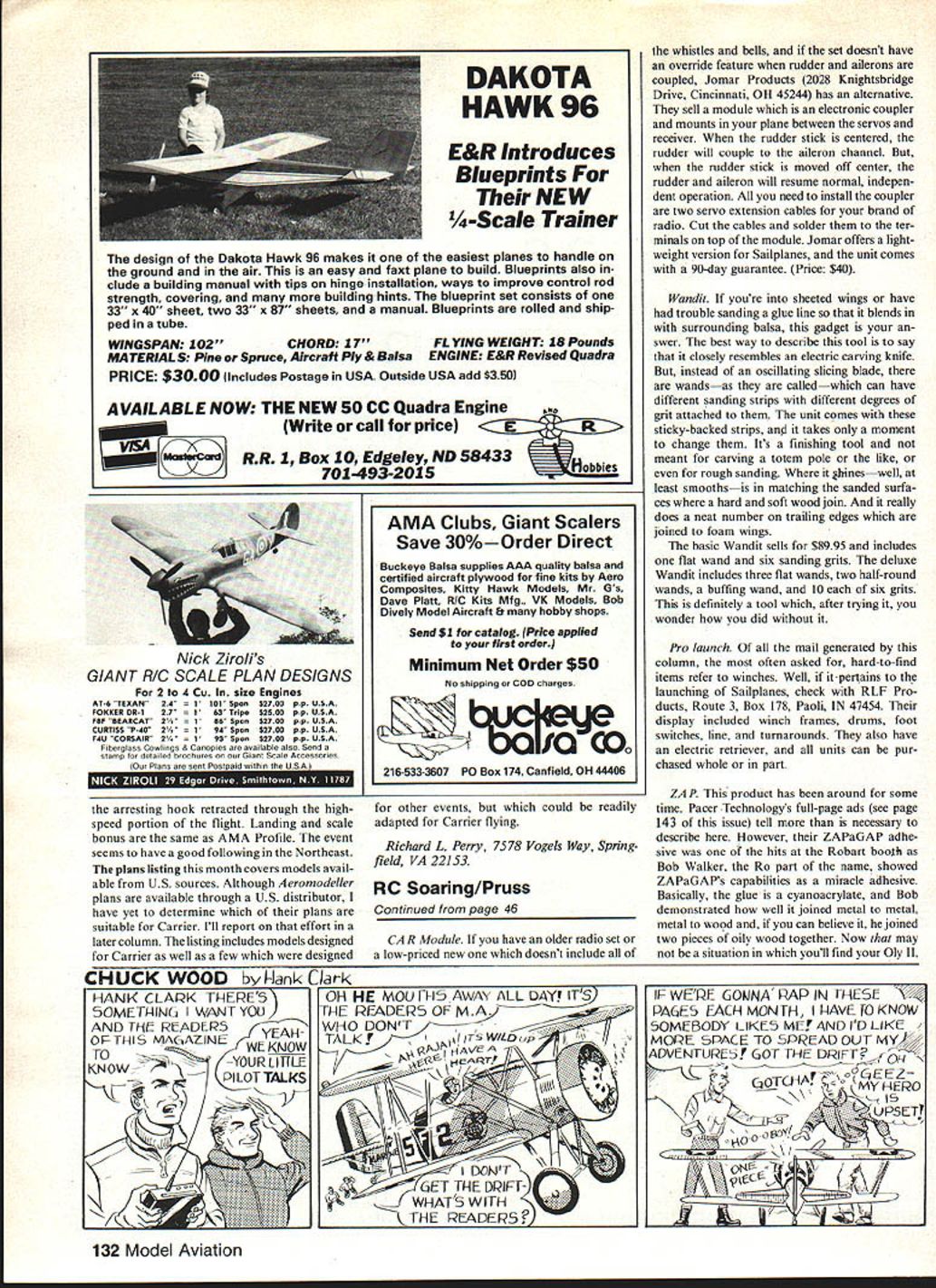
If you're into sheeted wings or have had trouble sanding a glue line so that it blends in with surrounding balsa, this gadget is your answer. The best way to describe this tool is to say that it closely resembles an electric carving knife. But instead of an oscillating slicing blade, there are wands—as they are called—which can have different sanding strips with different degrees of grit attached to them. The unit comes with three sticky-backed strips, and it takes only a moment to change them. It's a finishing tool and not meant for carving a totem pole or the like, or even for rough sanding. Where it shines—well, at least smooths—is in matching the sanded surfaces where a hard and soft wood join. And it really does a neat job on trailing edges which are joined to foam wings.
The basic Wandit sells for $89.95 and includes one flat wand and six sanding grits. The deluxe Wandit includes three flat wands, two half-round wands, a buffing wand, and 10 each of six grits. This is definitely a tool which, after trying it, you wonder how you did without it.
Pro launch
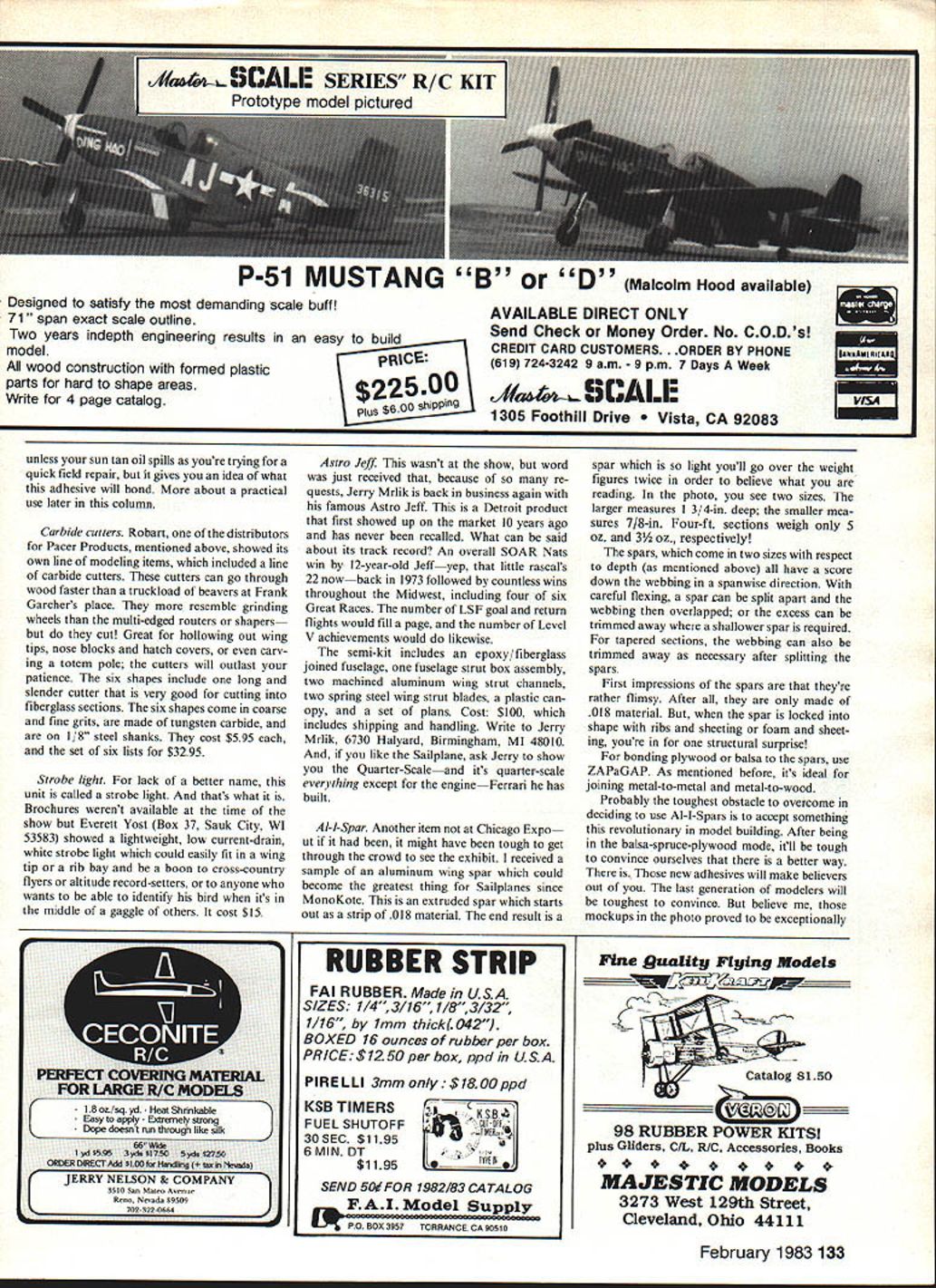
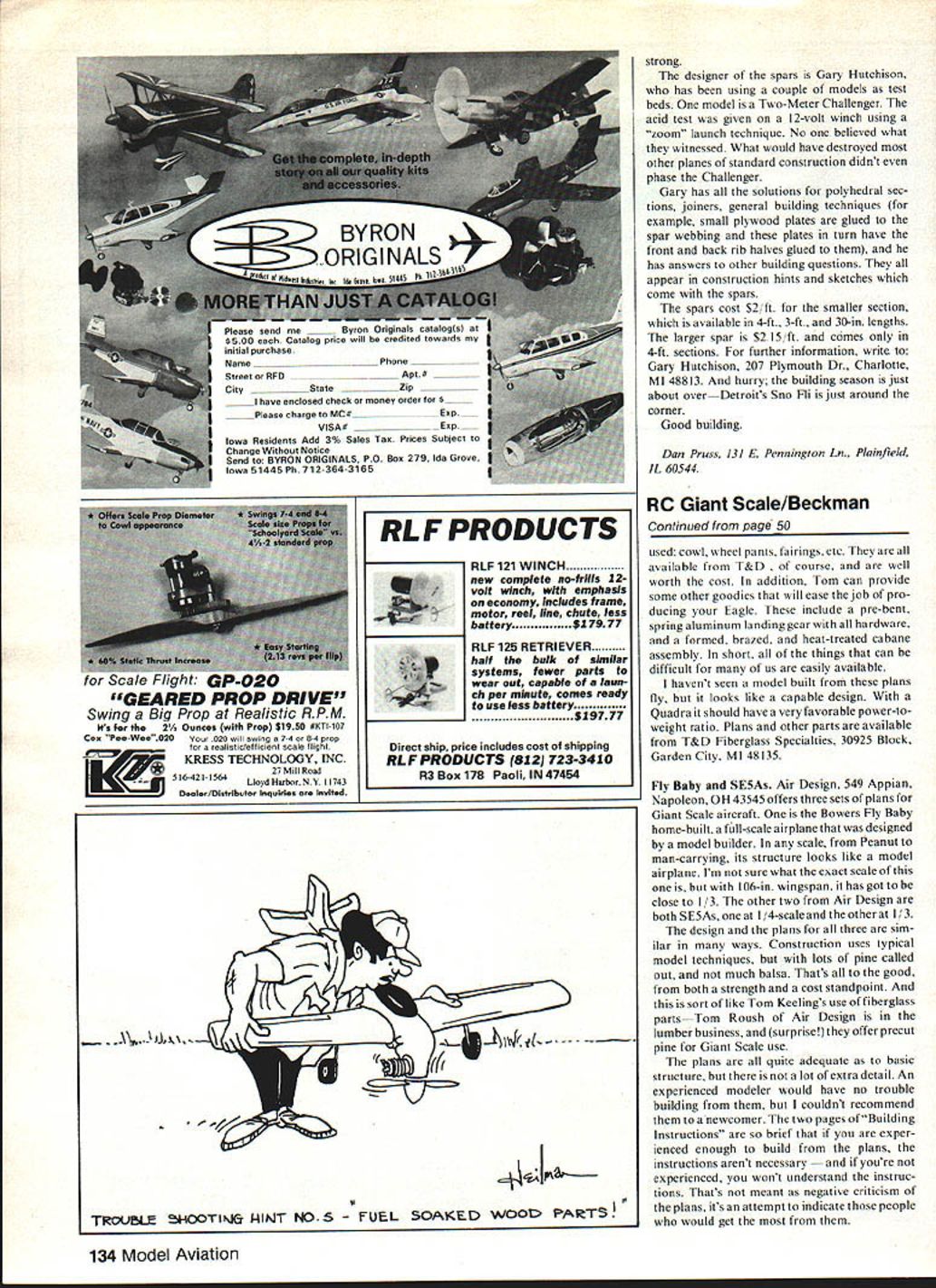
Of all the mail generated by this column, the most often asked-for, hard-to-find items refer to winches. If it pertains to launching sailplanes, check with RLF Products, Route 3, Box 178, Paoli, IN 47454. Their display included winch frames, drums, foot switches, line, and turnarounds. They also have an electric retriever, and all units can be purchased whole or in part.
ZAP
This product has been around for some time. Pacer Technology's full-page ads tell more than is necessary to describe it here. However, their ZAP-A-GAP adhesive was one of the hits at the Robart booth as Bob Walker demonstrated ZAP-A-GAP's capabilities as a miracle adhesive. Basically, the glue is a cyanoacrylate, and Bob showed how well it joined metal to metal, metal to wood, and, believe it or not, two pieces of oily wood together. Now that may not be a situation in which you'll find yourself—unless your suntan oil spills as you're trying a quick field repair—but it gives you an idea of what this adhesive will bond. More about a practical use later in this column.
Carbide cutters
Robart, one of the distributors for Pacer Products, showed its own line of modeling items, which included a line of carbide cutters. These cutters can go through wood faster than a truckload of beavers at Frank Garcher's place. They more resemble grinding wheels than the multi-edged routers or shapers—but do they cut! Great for hollowing out wing tips, nose blocks and hatch covers, or even carving a totem pole; the cutters will outlast your patience. The six shapes include one long and slender cutter that is very good for cutting into fiberglass sections. The six shapes come in coarse and fine grits, are made of tungsten carbide, and are on 1/8" steel shanks. They cost $5.95 each, and the set of six lists for $32.95.
Strobe light
For lack of a better name, this unit is called a strobe light. And that's what it is. Brochures weren't available at the time of the show but Everett Yost (Box 37, Sauk City, WI 53583) showed a lightweight, low current-draw, white strobe light which could easily fit in a wingtip or a rib bay and be a boon to cross-country flyers or altitude record-setters, or to anyone who wants to be able to identify his bird when it's in the middle of a gaggle of others. It cost $15.
Astro Jeff
This wasn't at the show, but word was just received that, because of so many requests, Jerry Mrlik is back in business again with his famous Astro Jeff. This is a Detroit product that first showed up on the market 10 years ago and has never been recalled. What can be said about its track record? An overall SOAR Nats win by 12-year-old Jeff back in 1973 was followed by countless wins throughout the Midwest, including four of six Great Races. The number of LSF goal-and-return flights would fill a page, and the number of Level V achievements would do likewise.
The semi-kit includes an epoxy/fiberglass jointed fuselage, one fuselage strut box assembly, two machined aluminum wing strut channels, two spring steel wing strut blades, a plastic canopy, and a set of plans. Cost: $100, which includes shipping and handling. Write to Jerry Mrlik, 6730 Halyard, Birmingham, MI 48010. And, if you like the sailplane, ask Jerry to show you the Quarter-Scale—and it's quarter-scale everything except for the engine—Ferrari he has built.
Al-I-Spar
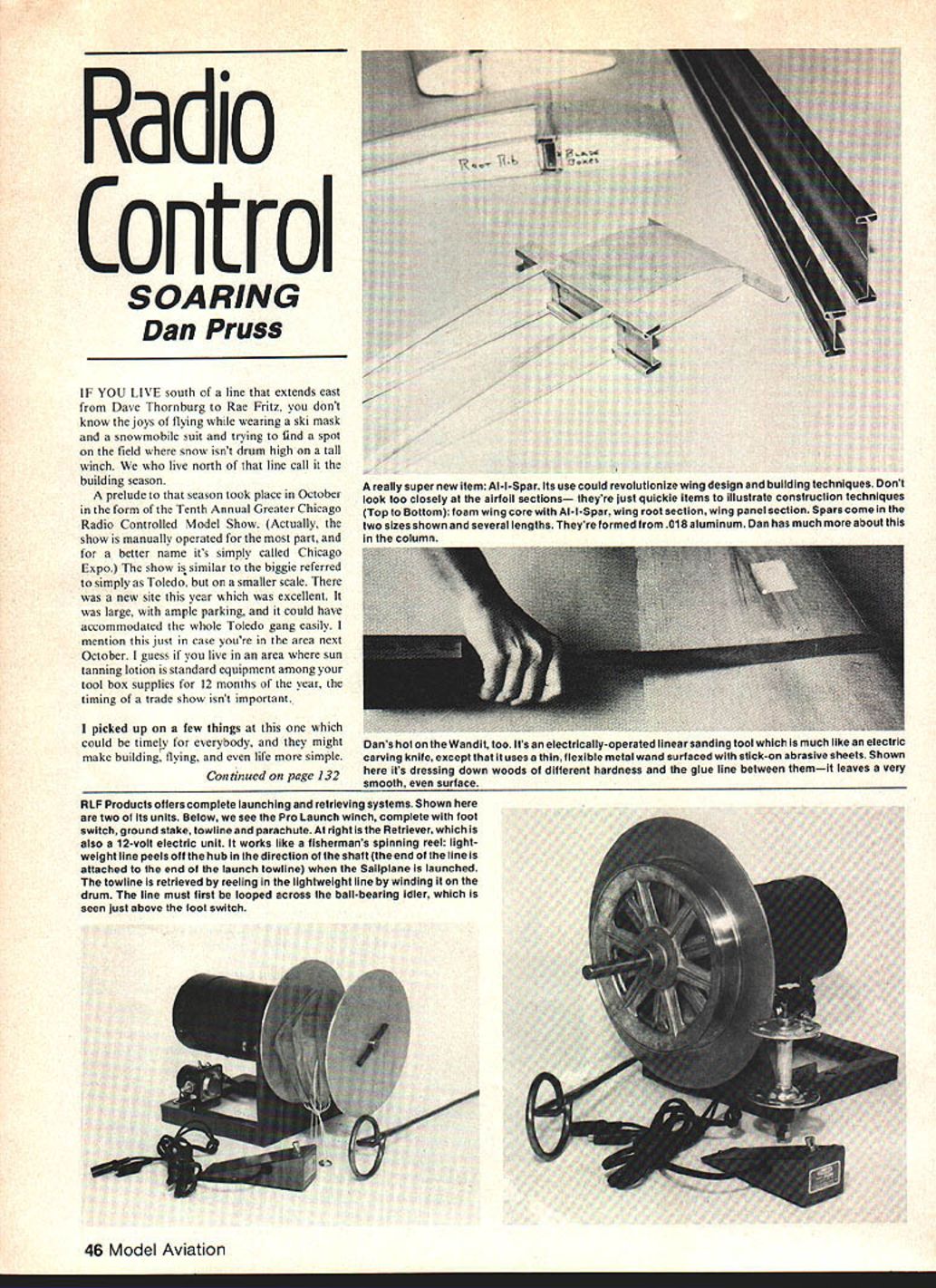
Another item not at Chicago Expo—but if it had been, it might have been tough to get through the crowd to see the exhibit. I received a sample of an aluminum wing spar which could become the greatest thing for sailplanes since Monokote. This is an extruded spar which starts out as a strip of .018 material. The end result is a spar which is so light you'll go over the weight figures twice in order to believe what you are reading. In the photo you see two sizes. The larger measures 1 3/4 in. deep; the smaller measures 7/8 in. Four-foot sections weigh only 5 oz and 3.5 oz, respectively.
The spars, which come in two sizes with respect to depth, all have a score down the webbing in a spanwise direction. With careful flexing, a spar can be split apart and the webbing then overlapped; or the excess can be trimmed away where a shallower spar is required. For tapered sections, the webbing can also be trimmed away as necessary after splitting the spars.
First impressions of the spars are that they're rather flimsy—after all, they are only made of .018 material. But when the spar is locked into shape with ribs and the sheeting or foam and sheeting, you're in for one structural surprise. For bonding plywood or balsa to the spars, use ZAP-A-GAP. As mentioned before, it's ideal for joining metal-to-metal and metal-to-wood.
Probably the toughest obstacle to overcome in deciding to use Al-I-Spars is accepting something this revolutionary in model building. After being in the balsa-spruce-plywood mode, it'll be tough to convince ourselves that there is a better way. There is. Those new adhesives will make believers out of you. The last generation of modelers will be the toughest to convince. But believe me, those mockups proved to be exceptionally strong.
The designer of the spars is Gary Hutchison, who has been using a couple of models as test beds. One model is a Two-Meter Challenger. The acid test was given on a 12-volt winch using a "zoom" launch technique. No one believed what they witnessed. What would have destroyed most other planes of standard construction didn't even phase the Challenger.
Gary has all the solutions for polyhedral sections, joiners, general building techniques (for example, small plywood plates are glued to the spar webbing and these plates in turn have the front and back rib halves glued to them), and he has answers to other building questions. They all appear in construction hints and sketches which come with the spars.
The spars cost $2/ft for the smaller section, which is available in 4-ft, 3-ft, and 30-in lengths. The larger spar is $2.15/ft and comes only in 4-ft sections. For further information, write to: Gary Hutchison, 207 Plymouth Dr., Charlotte, MI 48813. And hurry; the building season is just about over—Detroit's Sno Fli is just around the corner.
Good building.
Dan Pruss, 131 E. Pennington Ln., Plainfield, IL 60544.
Transcribed from original scans by AI. Minor OCR errors may remain.

