
Radio Control: Soaring
Dan Pruss
It never fails. When this column does a feature on one type of model (or a single class of models), there are always a few cries of "foul" from other camps. Either there's too much F3B, not enough Scale, or too much Scale and not enough Two-Meter Cross-country: "We live in the mountains and to go six miles as the crow flies I'll have to drive 16 miles over winding roads."
Twelve-volt winches? "Why don't you write about hi-starts?" "Hi-starts? Where can I get plans on how to build a winch?"
This column does try to cover all bases, so just be patient and keep your suggestions coming. In the meantime, this month has a potpourri of models in the photos, but before we get into them here are a couple of new items which came on the market and can make you a better modeler.
Both new items are from Airtronics, and both are hi-start launching systems. The first is called Super Start and is available as either a standard or a heavy-duty system. The standard system is recommended for models weighing from 16–40 oz.; the heavy-duty unit is for models weighing 40–80 oz.
These are complete systems. By that, I mean you can stop and pick one up at the hobby shop on the way to the field and assemble it with nothing else to add. Super Starts include not only 100 ft. of surgical tubing and 400 ft. of monofilament line, but also a heavy-duty plastic storage reel, parachute, swivels, and tow rings. The tie-down stake is also included, so all you have to provide is a sailplane.
If you were to ask several championship fliers what they considered to be one of their most important aids which helped them achieve a winning status (or is helping them to maintain one), you might be surprised if they said a short hi-start. Airtronics has a version called Quick Start. Variations on this theme have been around for some time, but this one, as in the case of the Super Start, is complete from tow ring to tie-down stake. It has 200 ft. of monofilament line.
Quick Start can help in three ways:
- It's short enough to be used on high school athletic fields — which makes quick practice sessions and means you can practice locally.
- You're working on Level II spot landings; LSF rules require a minimum line length of 75 meters (246.1 ft), but for spot-landing practice you don't need the full winch length.
- If you're getting serious about thermal competition you should also get serious about spot landings. It doesn't do much good to practice thermal flying off a 300-meter winch line, getting 10-minute maxes over manhole covers; on the other hand, by practicing short launches and trying to eke out a six- to ten-minute ride off a small lift you'll develop a keen sense of the lightest lift a distance from the ground. Other fliers, already halfway through the landing approach, have given up the task because what seems to them "no lift" starts them down. For spot landing practice, a shorter tow such as the Quick Start will allow more launches in the amount of time available during a practice session — and that's the thing you're after.
Precision work is the last two minutes. Precision in Duration is the same whether it's a six-minute or a ten-minute contest. Launch practice — getting down to two minutes and nailing the spot — is what you do when you're really serious. A couple of Quick Start mini-practices plus a micro-cassette pocket recorder (Radio Shack sells the Record Series for under $50) will help. The Record Series two-minute countdowns include a few seconds of count-up at the end so you don't get the bird down exactly at zero. Allow a few seconds between two-minute sets. Make the tape play some music while you fly sailplanes and you're set for a meaningful practice session. After tow release, press the play button and wait; the two-minute countdown begins. A few seconds between playbacks isn't critical; the slight variable will add a touch of contest realism.
If you're wondering if the above system really works — it does! I first saw a similar setup back in 1976. The gent who used it practiced daily when he could. That was Skip Miller, and all he did was go on to win a World championship in 1977.
The models
That beautiful bird being tossed out over the water at Torrey Pines is the Doc Hall — Dave Watson's Minamoa. For a background to this most unusual model, see my column in Model Aviation, September 1982. Watson claims it flies most realistically despite its 21-oz. wing loading.
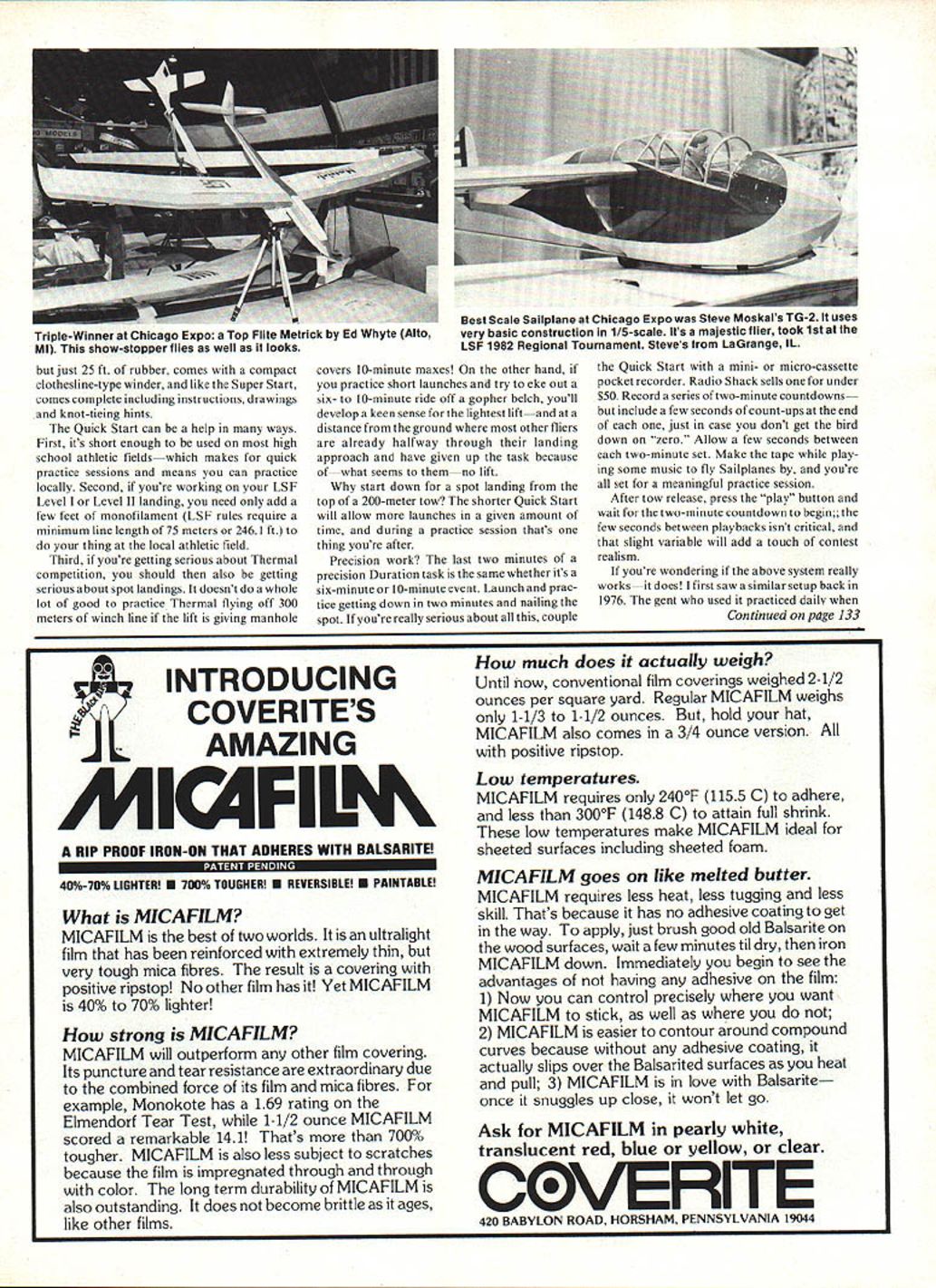
From Chicago Expo come shots of a couple of beauties. The Metric is by Ed Whyte of Alto, MI. All Ed did was win first places in the Best Sailplane, Best MonoKote Sailplane and Best MonoKote Overall events. The colors: orange, yellow, white, and dove grey. And it's a bird that's been flown!
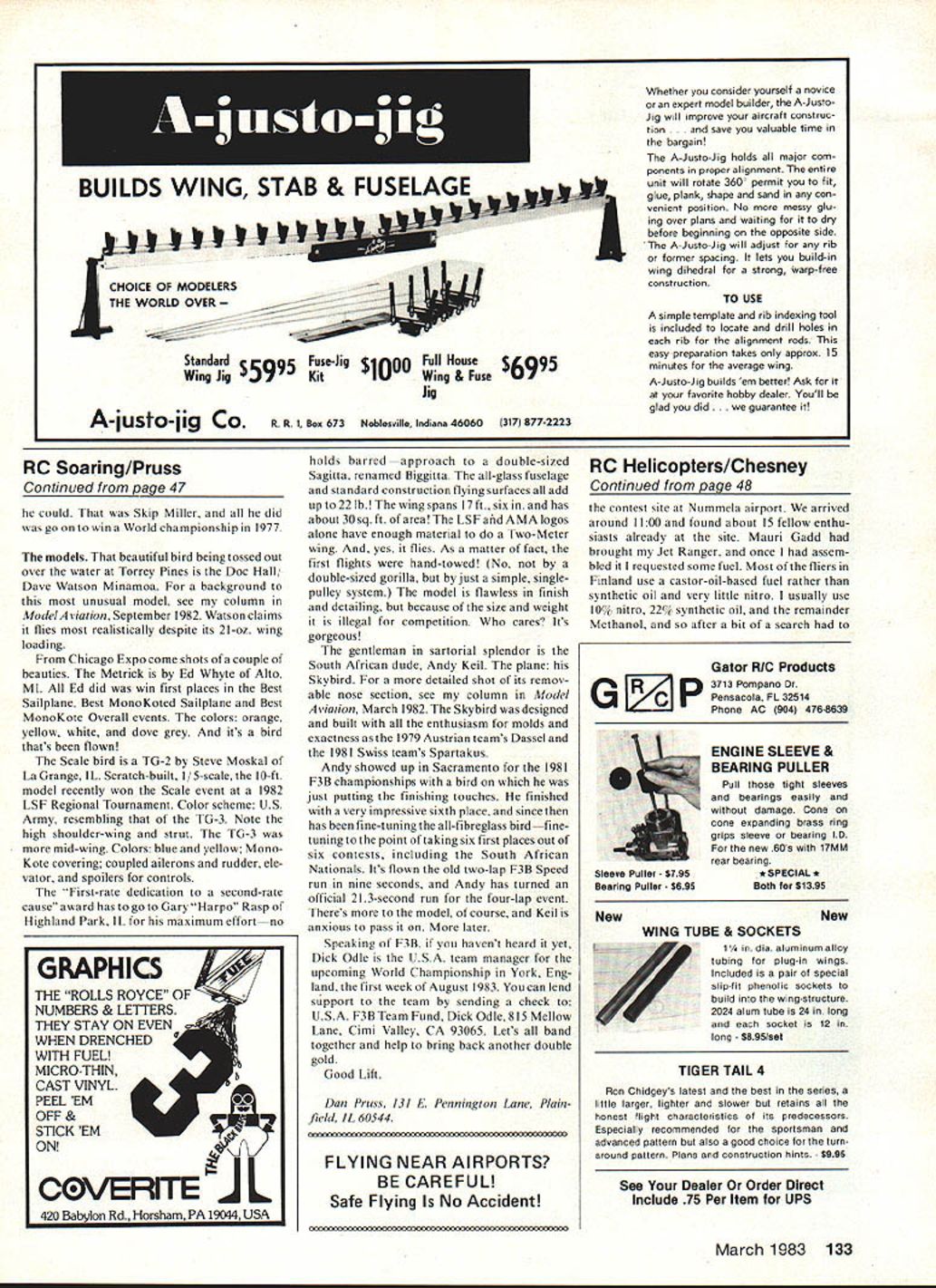
The Scale bird is a TG-2 by Steve Moskal of La Grange, IL. Scratch-built, 1/5 scale, the 10-ft. model recently won the Scale event at a 1982 LSF Regional Tournament. Color scheme: U.S. Army, resembling that of the TG-3. Note the high shoulder-wing and strut; the TG-3 was more mid-wing. Colors: blue and yellow; MonoKote covering; coupled ailerons and rudder, elevator, and spoilers for controls.
The "First-rate dedication to a second-rate cause" award has to go to Gary "Harpo" Rasp of Highland Park, IL, for his maximum-effort — no holds barred — approach to a double-sized Sagitta, renamed Biggita. The all-glass fuselage and standard-construction flying surfaces all add up to 22 lb.! The wing spans 17 ft. 6 in. and has about 30 sq. ft. of area! The LSF and AMA logos alone have enough material to do a Two-Meter wing. And, yes, it flies; as a matter of fact, the first flights were hand-towed! (No, not by a double-sized gorilla, but by just a simple, single-pulley system). The model is flawless in finish and detailing, but because of the size and weight it is illegal for competition. Who cares? It's gorgeous!
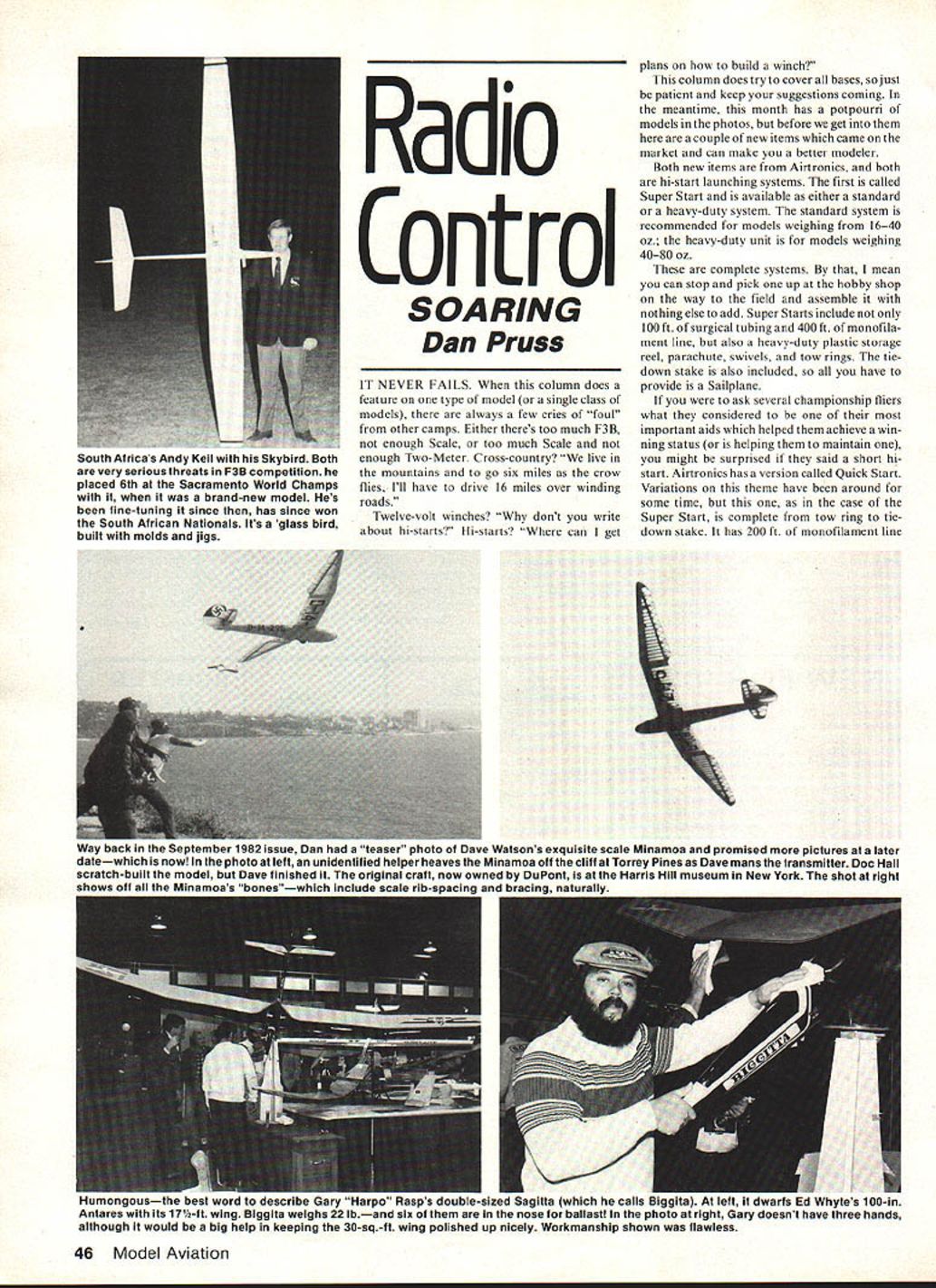
The gentleman in sartorial splendor is the South African dandy, Andy Keil. The plane is Skybird. For a more detailed shot of its removable nose section, see my column in Model Aviation, March 1982. The Skybird was designed and built with all the enthusiasm for molds and exactness as the 1979 Austrian team's Dassel and the 1981 Swiss team's Spartakus.
Andy showed up in Sacramento for the 1981 F3B championships with a bird on which he was just putting the finishing touches. He finished with a very impressive sixth place, and since then has been fine-tuning the all-fiberglass bird — fine-tuning to the point of taking six first places out of six contests, including the South African Nationals. It's flown the old two-flap F3B speed run in nine seconds, and Andy has turned an official 21.3-second run for the four-lap event. There's more to the model, of course, and Keil is anxious to pass it on. More later.
Speaking of F3B, if you haven't heard it yet, Dick Odle is the U.S.A. team manager for the upcoming World Championship in York, England, the first week of August 1983. You can lend support to the team by sending a check to the U.S.A. F3B Team Fund, Dick Odle, 815 Mellow Lane, Simi Valley, CA 93065. Let's all band together and help to bring back another double gold.
Good lift.
Dan Pruss 131 E. Pennington Lane Plainfield, IL 60544
Transcribed from original scans by AI. Minor OCR errors may remain.

