
Radio Control: Soaring
Dan Pruss
Posthumous Letter — February 1, 1983
When I heard of Lee Renaud's unexpected death, I wondered how I might express my thoughts and feelings about this comrade. It seemed to me that the best way was with a posthumous letter.
Dear Lee,
Just thought you would care to know that the last two weeks have been mighty tough on a lot of us. I hope you don't mind being told that through this column.
When the sad news had to be passed on to your many friends, the reactions were like nothing you ever would have expected. First came the disbelief, then came the memories of all the pleasurable moments you and your genius for design had provided for us. Those who didn't know you personally felt they did—like the ones who first started in this sport nearly a generation ago, telling how they welcomed your first efforts and your helping hand in the form of the Olympic 99 (back in 1969). I don't know if you realized it or not, but that kit gave more people a successful start in this sport than anything else at the time.
Then, shortly after, the Grand Esprit made its debut, and there were many of us who felt that design epitomized the beauty of anything that soared. We still feel that way. Next came your Aquila and a World Championship. As a matter of fact, two of your designs helped the U.S.A. to take home double gold victories at the first F3B World Championships. That was 1977. That team's only regret was that it wasn't on hand to see your expression when you received the news.
You then not only gained new friends with the Aquila Grande, but you also started another generation of fliers off with your Olympic II.
Both your old fans and the newer ones applauded you for the Sagitta series. Many realized the 900 helped the worldwide promotion of international competition.
In between all of those designs came other models for those of us with other interests—but those models weren't designed and kitted with any less enthusiasm, nor with any less attention, for us modelers.
Those of us who really felt we knew you, Lee, knew your love for this sport and the modeler extended well beyond the drafting table and shop. Your heart was as big as the sky and your hand went out more times than you would ever have admitted. But, just in case you might have forgotten, we haven't. Those big contests—and small ones, too—and tournaments, and team support programs, and the teams themselves all felt and remembered your generous hand and heart.
Two Swiss Designs: GAMMA and PIRANHA
Last month, reference was made to two interesting models from Switzerland. Both are proven designs, yet each is distinctively different.
GAMMA
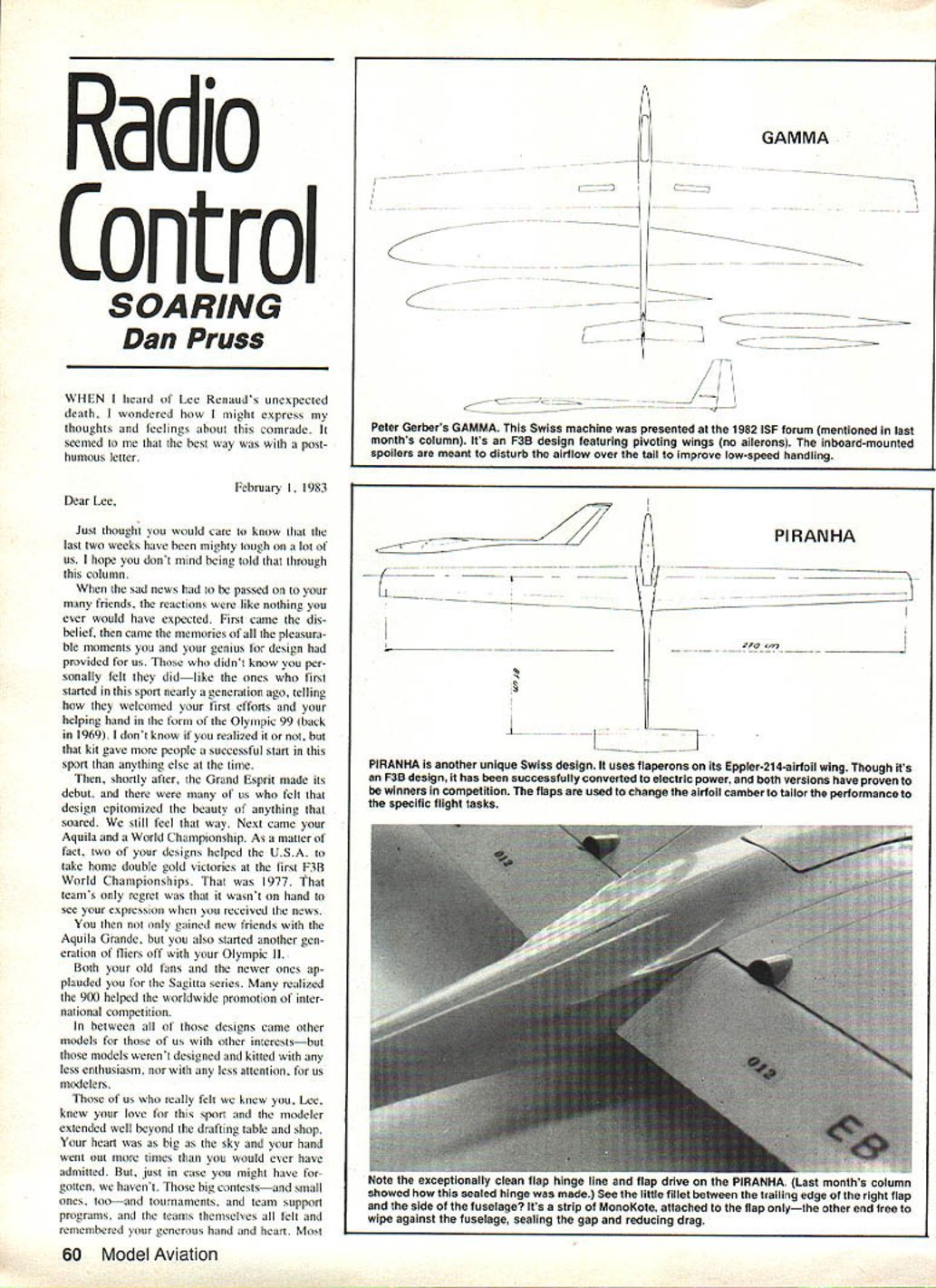
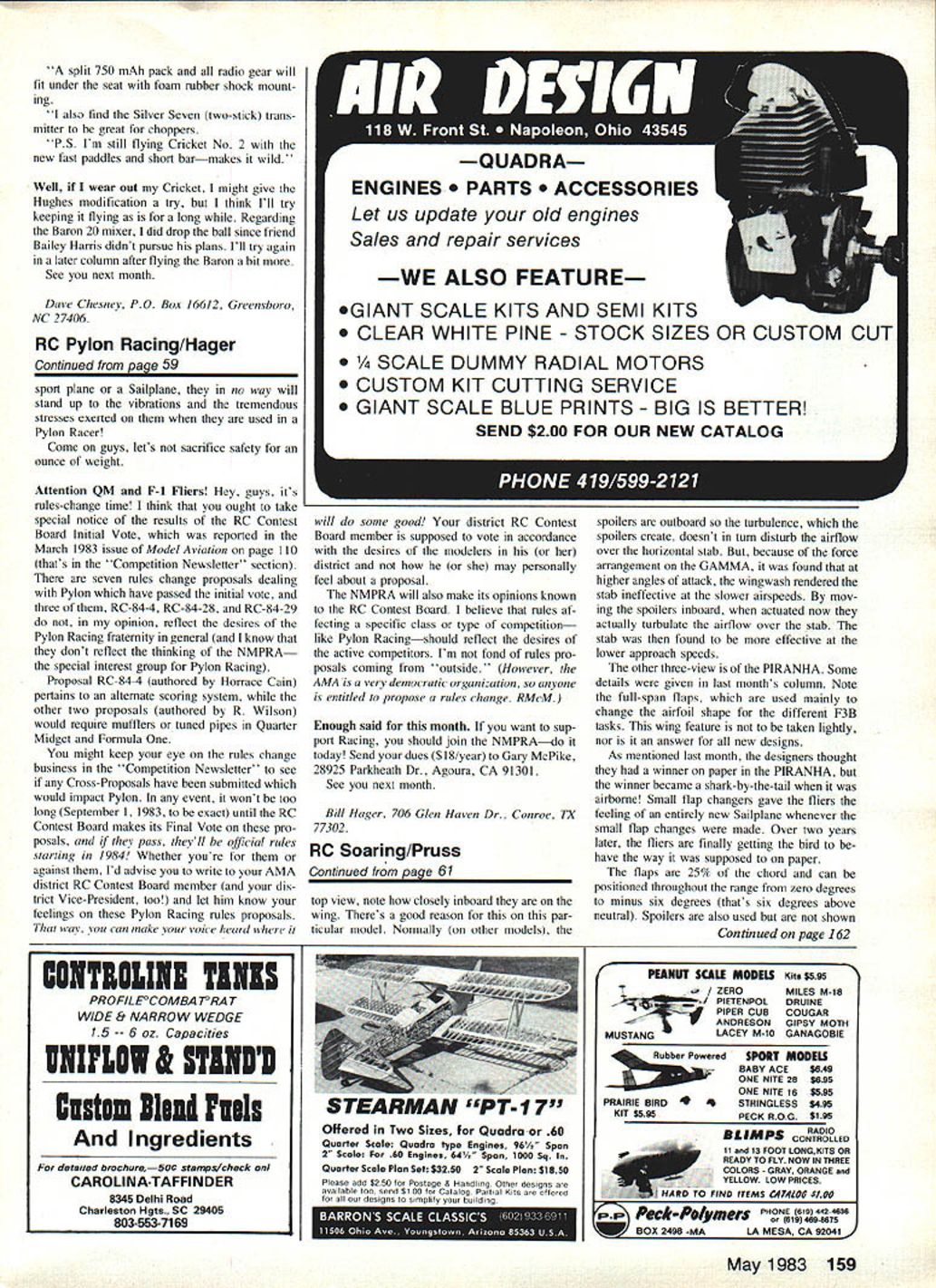
The GAMMA, a design by Peter Gerber, features a pivoting wing system for lateral control instead of ailerons or spoilers. This idea, of course, produces an extremely clean wing design by not having any hinge lines necessary for ailerons or flaps. The basic wing motion (incidence changes) is shown in the simplified sketch. Separate servos drive each wing about the main wing rod. The first model used a 7 mm-diam. rod. Though successful, a 12 mm size is recommended and is now being used.
Back in August 1979, this column featured another pivoting-wing system which was used on an aerobatic slope ship. The photos and drawing presented then might shed more light on the subject, if you're interested.
Back to the GAMMA:
- Wingspan: 2,850 mm
- Airfoil: Gerber's own
- Root chord: 250 mm
- Tip chord: 160 mm
- Horizontal stabilizer root: 100 mm
- Horizontal stabilizer tip: 75 mm
These are the only dimensions available at this time; however, a kitted version of this plane, including all hardware, is available in Switzerland under the name JONATHON.
One interesting note about the spoilers: in the top view, note how closely inboard they are on the wing. There's a good reason for this on this particular model. Normally (on other models), the spoilers are outboard so the turbulence they create doesn't in turn disturb the airflow over the horizontal stab. But, because of the force arrangement on the GAMMA, it was found that at higher angles of attack, the wing wash rendered the stab ineffective at the slower airspeeds. By moving the spoilers inboard, when actuated they actually turbulate the airflow over the stab. The stab was then found to be more effective at the lower approach speeds.
PIRANHA
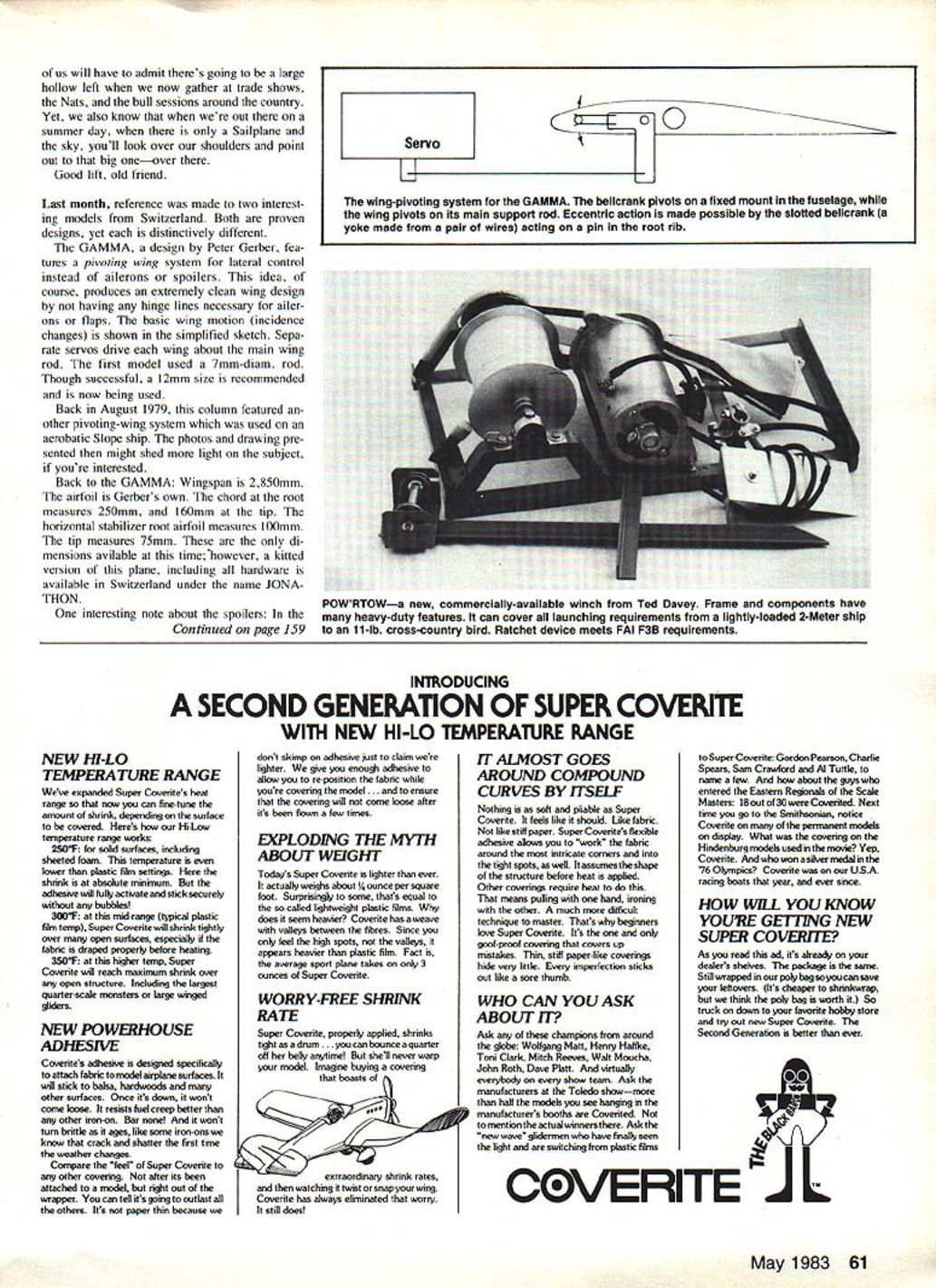
The other three-view is of the PIRANHA. Some details were given in last month's column. Note the full-span flaps, which are used mainly to change the airfoil shape for the different F3B tasks. This wing feature is not to be taken lightly, nor is it an answer for all new designs.
As mentioned last month, the designers thought they had a winner on paper in the PIRANHA, but the winner became a shark-by-the-tail when it was airborne! Small flap changes gave the flier the feeling of an entirely new sailplane whenever the small flap changes were made. Over two years later, the fliers are finally getting the bird to behave the way it was supposed to on paper.
The flaps are 25% of the chord and can be positioned throughout the range from zero degrees to plus six degrees (that's six degrees above neutral). Spoilers are also used but are not shown on the top view. They are, however, mounted in a more conventional location on the wing. The flaps are also mixed to provide aileron action.
Both the PIRANHA and GAMMA have foam wings, wood sheeting, and EconoKote covering, and the workmanship is flawless. More about these birds as information comes in.
Late Items
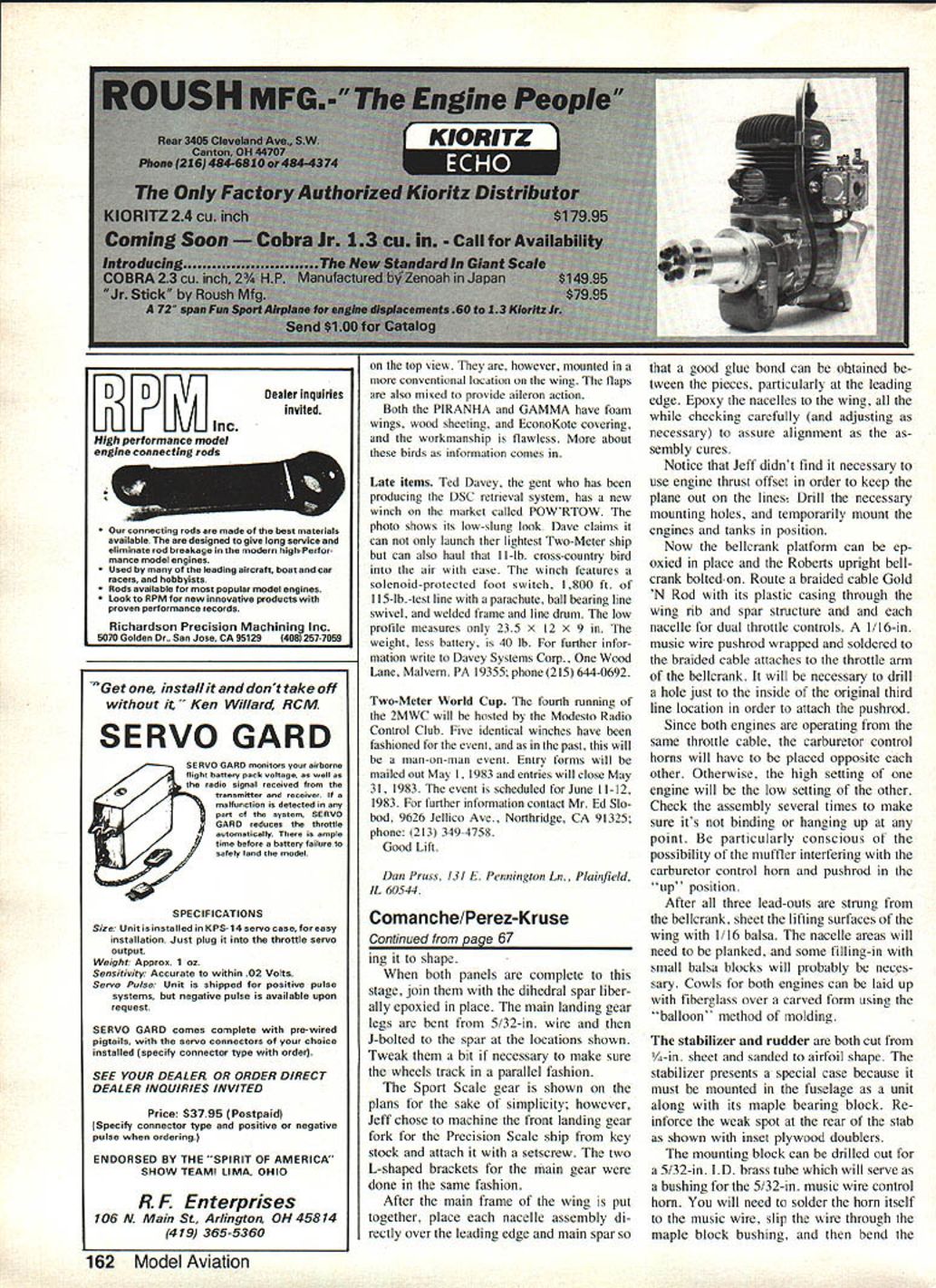
- POWRTOW winch (Davey Systems Corp.): Ted Davey, the gent who has been producing the DSC retrieval system, has a new winch on the market called POWRTOW. Davey claims it can not only launch their lightest Two‑Meter ship but can also haul that 11-lb. cross-country bird into the air with ease. The winch features:
- solenoid-protected foot switch
- 1,800 ft. of 115-lb.-test line with a parachute
- ball bearing line swivel
- welded frame and line drum
- low profile: 23.5 x 12 x 9 in.
- weight (less battery): 40 lb.
For further information write to Davey Systems Corp., One Wood Lane, Malvern, PA 19355; phone (215) 644-0692.
- Two-Meter World Cup (2MWC): The fourth running of the Two-Meter World Cup will be hosted by the Modesto Radio Control Club. Five identical winches have been fashioned for the event, and as in the past, this will be a man-on-man event. Entry forms will be mailed out May 1, 1983, and entries will close May 31, 1983. The event is scheduled for June 11–12, 1983. For further information contact Mr. Ed Slobod, 9626 Jellico Ave., Northridge, CA 91325; phone: (213) 349-4758.
Good lift.
Dan Pruss 131 E. Pennington Ln. Plainfield, IL 60544
Transcribed from original scans by AI. Minor OCR errors may remain.

