
Radio Control: Soaring
Dan Pruss
U.S.A. RC Soaring Forum
In the April column I mentioned the Soar-Tech set of papers available through Herk Stokley and Switzerland's annual International RC Soaring Flight Forum (ISF). Both have stirred the imagination of many U.S. modelers, and there is surely room here for a similar forum.
Al Scidmore (Madison, WI) is formulating plans to hold such a forum the first part of November 1983 (dates not yet firm). The program will depend on contributions and will be based on modelers exchanging ideas — an opportunity not just for gathering information but for helping one another.
Suggested topics include:
- Mold-making and construction techniques
- Foam cutting
- Design theories and airfoil discussions (a good forum for thick-airfoil advocates to debate thin-airfoil scholars)
- Electronics, sport airborne test equipment, telemetering devices
There would be no restrictions on the type of sailplanes presented or on subject matter, though ideas should be cleared through Al Scidmore.
Send ideas to: Al Scidmore 5013 Dorset Dr. Madison, WI 53711, U.S.A.
Forum logistics and related notes
- The forum is intended to be open in scope; subjects may cover Two-Meter, F3B, Scale, Cross-Country and general sailplane topics.
- Ideas for presentations or demonstrations should be coordinated through Al to help assemble the program.
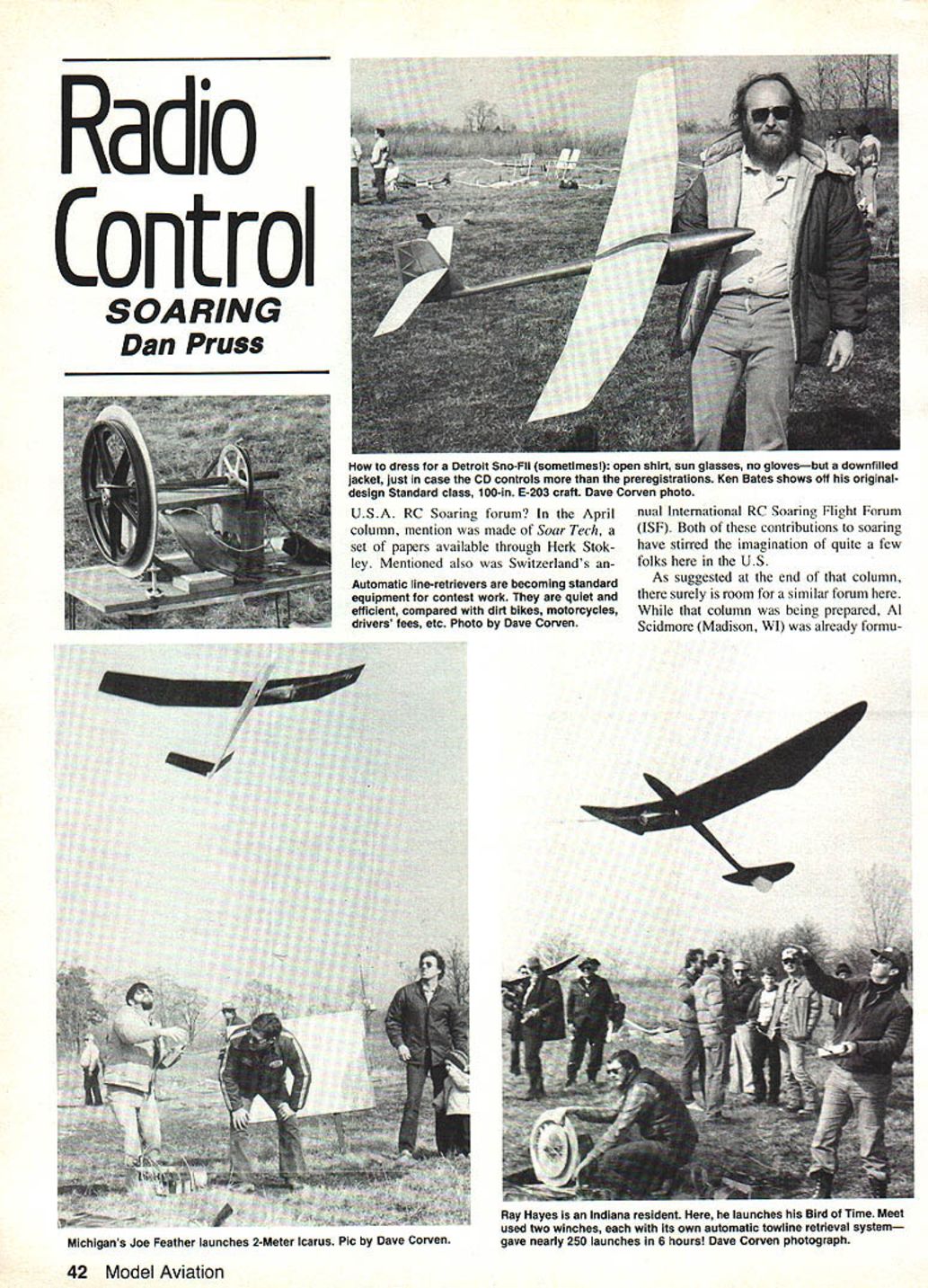
Ray Hayes and "Bird of Time"
A meet using two winches and its own automatic towline retrieval system gave nearly 250 launches in six hours — an example of innovative contest operation and retrieval systems.
Scratch-Building and Scale Modeling
Scratch-building and scale modeling offer great satisfaction but require more time and decision-making than kit building. Consider these points before committing:
- Scratch projects take additional time; be sure you will remain enthusiastic through the longer building period.
- Don’t pick a subject just because it’s unusual; choose something you genuinely like.
- Scale modelers often spend hours over drawings. Beware of drawings that appear simple because necessary details have been omitted — omissions can create confusion and slow progress.
- Compare model drawings with photos and three-views before committing. If building for sport only, simplification can cut building time; for contest work or personal satisfaction, assess required accuracy.
- Avoid changing a design for the sake of change. Assume the designer had reasons; alter only for genuine improvement or correction.
Tools:
- Modelers transitioning from kits will likely have adequate tools for scratch-building.
- A small table saw speeds plywood cutting and improves precision but must be used with respect and caution.
- A drill press is also desirable.
FAI RC Soaring Team Selection Committee
The following list is arranged by AMA district and identifies the F3B Team Selection Committee elected by participants in the 1980 and 1982 programs; they will serve for the 1984 program and act as the clearinghouse for FAI rules proposals to CIAM.
- District I — Dwight Holley, 151 Chestnut Ridge, Bethel, CT 06801
- District II — William Meleskie, 786 Grand Terrace Ave., Baldwin, NY 11510
- District III — Terry Luckenbach, 5460 Colony Dr., Bethlehem, PA 18017
- District IV — Herk Stokley (Chairman), 1504 Horseshoe Circle, Virginia Beach, VA 23451
- District V — Blaine Miller, 4411 Tidewater Dr., Orlando, FL 32806
- District VI — Jack Hiner, 2213 Prentice Creek, Downers Grove, IL 60515
- District VII — Warren Tiahrt, 7647 Twilight Ct., Clarkston, MI 48016
- District VIII — Don Chancey, 1600 Laurel Ln., Plano, TX 75006
- District IX — Skip Miller, 655 Maxwell Ave., Boulder, CO 80302
- District X — Larry Jolly, 5501 W. Como, Santa Ana, CA 92703
- District XI — David W. Johnson, 3526 NE 90, Portland, OR 97220
Deadlines and procedure:
- Proposals cleared by this committee must be returned to the AMA by September 1.
- To allow proper review, submit proposals to the committee in time to meet the September deadline.
- Individual modelers must first send proposals to AMA HQ no later than July 15; AMA HQ then directs proposals to the Team Selection Committee.
- See page 110 in the July 1982 Model Aviation for further details.
RC Glider Net
This is an Amateur Radio Service network (not a new landing device). It operates Monday evenings at 2330Z on 7240 kHz.
- Net control: Bob Summers, WB8BYY (Enon, OH) and Alden Shipp, WB9WAJ (Quincy, IL)
- Alden Shipp reported 11 new check-ins the first week, including participants from Colorado and North Carolina.
Sno-Fli (February 20, 1983)
Despite the lack of snow, the Greater Detroit Soaring and Hiking Society's 13th annual Sno-Fli drew 61 entries — an all-time high. Temperatures over the years have ranged from well below zero to this year's 59°F.
Entry breakdown:
- Unlimited class: 22
- Standard class: 37
- Junior-Senior: 2
A growing trend is allowing smaller ships to compete in larger categories (e.g., Two-Meter in Standard or Unlimited). At this Sno-Fli:
- Four of 19 Two-Meter fliers entered Unlimited; 14 entered Standard.
- Winners: John Hoover (Sagitta 600) won Unlimited with 1,403 points; Ray DeNoble (Gentle Lady) won Standard with 1,404 points.
The success of Two-Meter entries raises the question of whether Unlimited should remain a separate category from Standard — a topic worthy of further study and discussion at a sailplane forum.
South Africa Notes — Andy Keil and the Skybird
Andy Keil’s Skybird, an F3B design, was destroyed and rebuilt the day before he left for Sacramento for the 1981 F3B World Championships. Keil placed sixth — notable for a model crudely spray-painted from an aerosol can in a motel parking lot.
Design highlights:
- Removable nose extending to the leading edge of the wing fillet provides access to servos, receiver, battery, and ballast, all mounted on a fuselage keel that conforms to the removable nose profile.
- Wing halves are joined inside the fuselage for near one-piece wing integrity, similar to Swiss Spartakus practice.
- Horizontal stab assembly uses a Du-Bro ball link: bury the socket portion in one half of the stab during construction to prevent the halves from coming apart without set screws or clips.
Beaudry Pautz and Louis Baendse collaborated with Andy on the Skybird. As this column was finished, word arrived that Keil had won the South African Nationals for the second consecutive year. Keil declined payment for photos and asked that the funds be donated to the U.S.A./F3B Team Fund.
LSF (Legacy Soaring Fund) Notes
- LSF No. 5,000: James Merrill, Werribee, Victoria, Australia.
- Bob Summers, LSF vice-president and Foreign Coordinator, reports nearly 30 countries have interest and members in the LSF program; 17 have Foreign Coordinators.
- Foreign members with a Coordinator should submit records and receive forms through their coordinators. Canada’s coordinator: Dave Henshaw, 2865 Skyline Dr., Windsor, Ontario N9E 3A6.
Contact for LSF coordination: Bob Summers, LSF/3548 81 Fay Dr. Enon, OH 45323, U.S.A.
New LSF Level V
- The first Level V for 1983 (and only the 28th among 5,000 members) is Dr. Walt Good, LSF/603, Port Richey, FL.
- Dr. Good was instrumental about 30 years ago in obtaining license-free radio use for modeling on 27 megacycles and was involved in development of the Thermal Sniffer. Congratulations to Dr. Good for his contributions.
Transcribed from original scans by AI. Minor OCR errors may remain.

