
Radio Control: Soaring
Dan Pruss
I ran across an item that just had to head up a theme for this month's column. It's called simply a Battery Disconnect Switch.
While most winch designs include a shut-off switch between the foot pedal and solenoid, I have yet to see a device which kills the power directly from the battery except, of course, if you're one who relies on yanking a cable from the battery.
While the on/off switch that affects the foot pedal provides some element of safety by not allowing the winch to be energized during retrievals, for example, there usually is no way to stop a runaway winch — which occurs when a solenoid decides to weld its insides together. If you have ever been between the upwind pulley and a winch drum when that has happened and have no battle scars to show for it, consider yourself lucky!
RC Soaring probably has one of the best track records for safety over the past 15 or more years when you consider the number of launches which have been made. Let's see, 5,000-plus LSF members times an average of what, 100, 200 launches? That's between a half and one million launches. Granted that many flights have been via other means than winches, but that million figure probably is still conservative.
I don't know how you regard winch lines and safety, but as a CD for a few fun-flys, this scribe can attest that a line whistling along at just above ankle height can send a chill through your bones on the balmiest of thermal-producing days.
One example of what a winch line could do actually happened with a high-start. This incident occurred out East, about 12 years ago.
Towards the end of an afternoon of flying, a wind shift during a launch caused the line to drift across a road and drape over a barbed-wire fence on the other side. Seconds later, a car came along and the line was caught over the car's hood. While the car was coming to a stop, the line dragged across the hood, the parachute snarled on a fence post, and the high-start rubber stretched beyond its limit and broke with a sound like the crack from a bull whip! Meanwhile, with the chute still caught on the fence post, the nylon line sawed its way through the car's hood as if the line were a 200-ft. band saw blade!
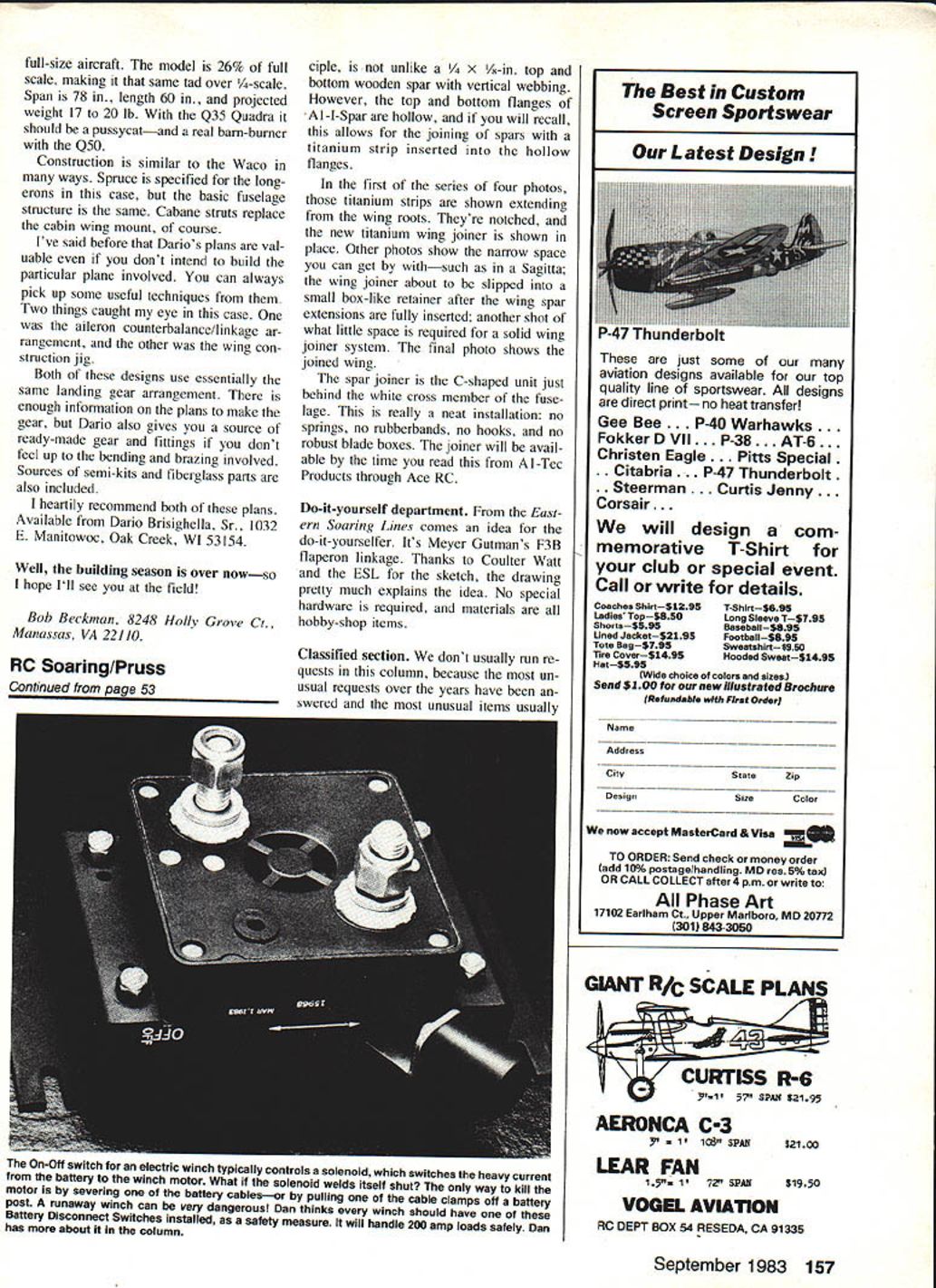
While a battery disconnect switch wouldn't have prevented this incident, the example does indicate the degree of danger present in a runaway tow line. One source of prevention of such an occurrence is the Battery Disconnect Switch shown in the photo. Designed for use in motor coaches, trucks, off-highway vehicles, and auxiliary generators, the unit is just what we've been looking for to shut a winch battery off at the source.
The unit's current rating is 400 amps continuous with a surge current rating of 2,000 amps. It's also rated for 50 volts AC or DC.
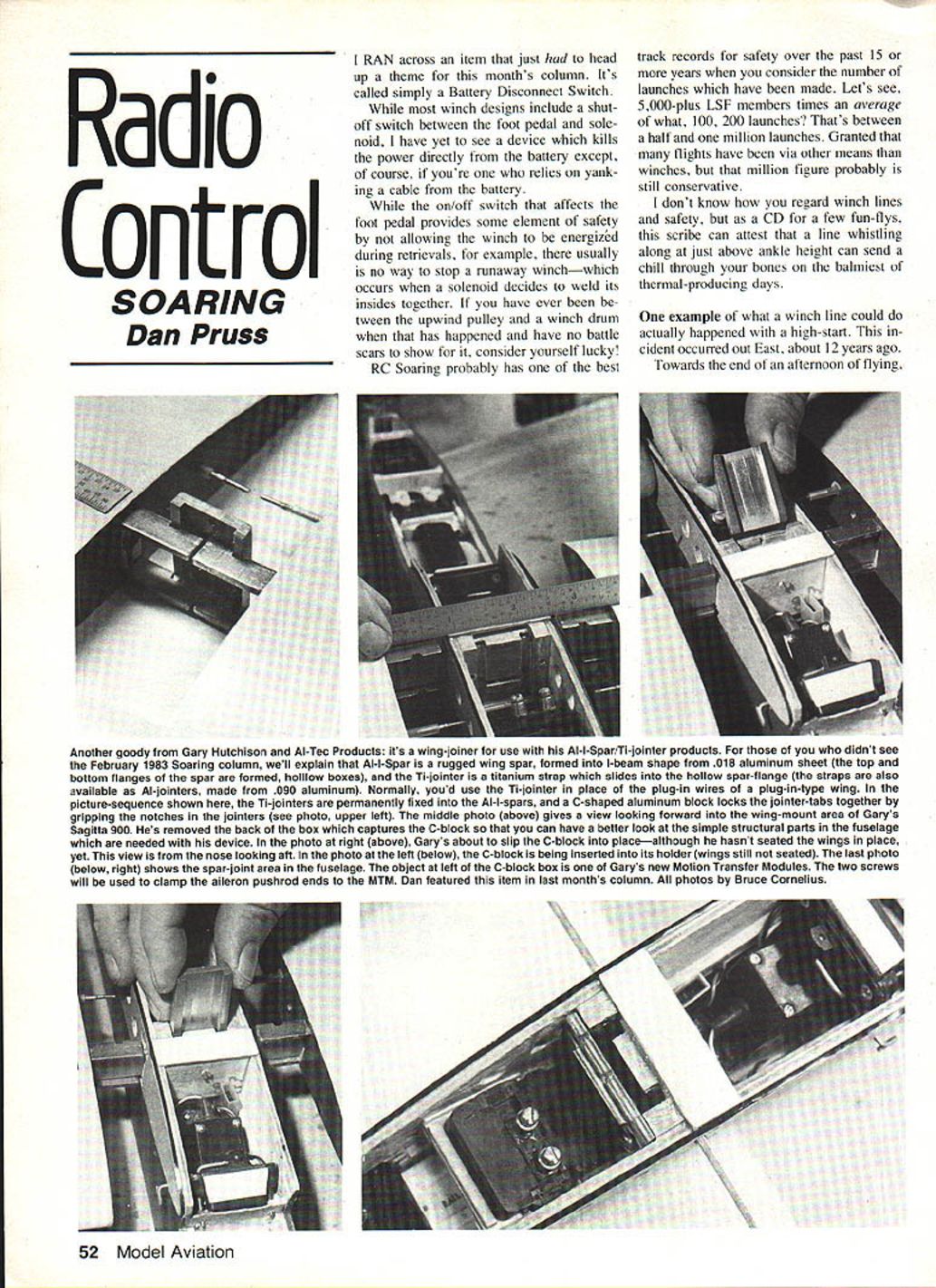
New goody. That guy Gary Hutchison just doesn't stop! Now he has a wing joiner that is like no other. To be used with his Al-I-Spar, this little fitting does the neatest job of joining two wing halves you ever saw. Back in my February 1983 column, the Al-I-Spar was a new-item feature and showed the versatility of the spar design. The spars, if you recall, are formed from a single sheet of aluminum. The shape of the spar resembles an "I" beam and, in principle, is not unlike a 1/4 x 1/2-in. top and bottom wooden spar with vertical webbing. However, the top and bottom flanges of Al-I-Spar are hollow, and this allows for the joining of spars with a titanium strip inserted into the hollow flanges.
In the first of the series of four photos, those titanium strips are shown extending from the wing roots. They're notched, and the new titanium wing joiner is shown in place. Other photos show the narrow space you can get by with—such as in a Sagitta; the wing joiner about to be slipped into a small box-like retainer after the wing spar extensions are fully inserted; another shot of what little space is required for a solid wing joiner system. The final photo shows the joined wing.
The spar joiner is the C-shaped unit just behind the white cross member of the fuselage. This is really a neat installation: no springs, no rubber bands, no hooks, and no robust blade boxes. The joiner will be available by the time you read this from Al-Tec Products through Ace RC.
Do-it-yourself department
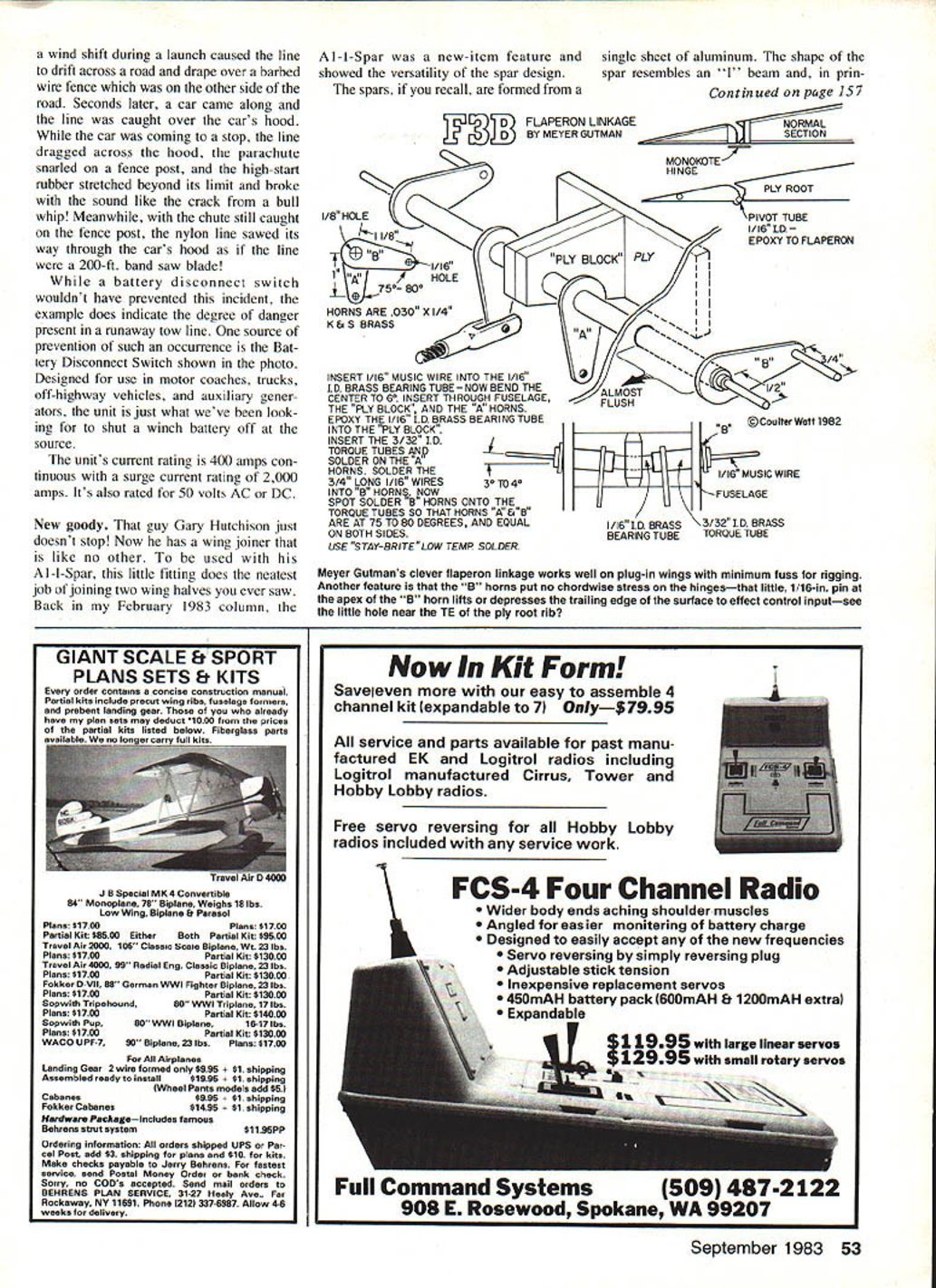
From the Eastern Soaring Lines comes an idea for the do-it-yourselfer. It's Meyer Gutman's F3B flaperon linkage. Thanks to Coulter Watt and the ESL for the sketch; the drawing pretty much explains the idea. No special hardware is required, and materials are all hobby-shop items.
Classified section
We don't usually run requests in this column, because the most unusual requests over the years have been answered and the most unusual items usually have been found. I hit a stumper this month, though. Tony Fiocentino of Pensacola, FL is looking for a 10-ft. Hobie Hawk wing. Yep, there were a few made back in the mid-seventies. At least one set was seen back at the 1976 SOAR Nats. If anyone has a set for sale, contact Tony at 105 South Navy Blvd., Pensacola, FL 32507.
Oops department
Last month's Sno-Fli photo credits went to Dave Corven of Michigan. They should have gone to Warren Tihart. (I gotta remember: Warren's the one with the moustache.)
There's still time ... to support your USA F3B team.
Good lift.
Dan Pruss 131 E. Pennington Ln., Plainfield, IL 60544.
Transcribed from original scans by AI. Minor OCR errors may remain.

