
Radio Control: Soaring
Dan Pruss
Cross-Country
The Michigan RC Society of Ann Arbor, MI won Great Race VIII, and they won it without ever having to look back during the last half of the race. Yet they provided drama for a finish like no other ending in the previous seven years of this sailplane classic.
This year's event was held in memory of Lee Renaud, who helped to establish — and continued to support — the event. For the first time, the race was scheduled for four days. Coupling that with the new RC frequencies, the organizers hoped this contest would be the biggest ever.
It was. Twenty-three teams from 13 states, Canada, and Switzerland preregistered, and 22 teams participated.
Practice Day (Wednesday, June 8)
After 17 weekends of rain out of 18, the forecasters finally promised typical June-like weather. The practice day saw teams enjoying some of the best soaring conditions ever. Some clubs took to the course for LSF goal-and-return tasks. Others did abbreviated on-the-course practice. Many stayed close by to trim out new ships or retrim old ones. At least two teams lost ships due to June-in-Illinois thermals. It was a day when manhole-cover thermals could log 10 minutes. Practice days are usually like that.
Thursday
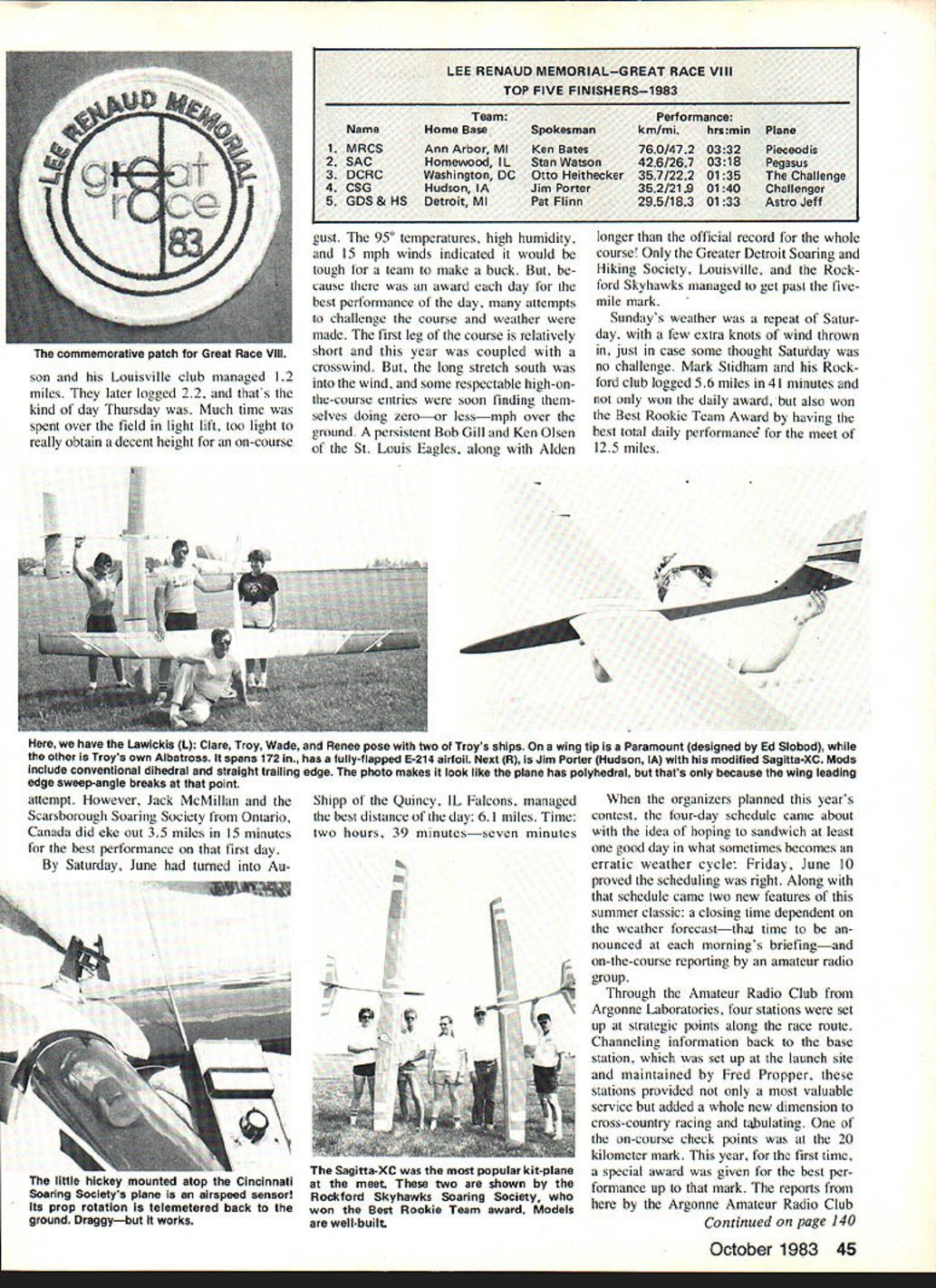
A light drizzle greeted the crowd at the morning briefing, and official flying didn't start until noon. The first officially logged flight didn't come until 2:07 p.m., when Ed Wilf of Virginia's Tidewater Soaring Society flew Bob Champine's unusual Redbird. The Redbird is influenced by both Carl Goldberg and Frank Zaic. Its 4-meter wing features a full-span, camber-changing flap for its E-214 (modified) airfoil and perches atop a pylon mount.
One pilot and his Louisville club managed 1.2 miles early in the day; they later logged 2.2 miles. Much time was spent over the field in light lift, too light to obtain decent height for an on-course attempt. However, Jack McMillan and the Scarborough Soaring Society from Ontario, Canada eked out 3.5 miles in 15 minutes for the best performance on that first official day.
Saturday
By Saturday the weather featured 95°F temperatures, high humidity, and 15 mph winds. Those conditions made it tough for teams to make much ground, yet because there was a daily award many attempts were made. The first leg of the course is relatively short and this year was coupled with a crosswind; the long stretch south was into the wind. Some high-on-course entries recorded zero—or even negative—groundspeed. A persistent Bob Gill and Ken Olsen of the St. Louis Eagles, along with other pilots, flew distances longer than the official record for the whole course. Only the Greater Detroit Soaring and Hiking Society, Louisville, and the Rockford Skyhawks managed to get past the five-mile mark.
Shipp of the Quincy, IL Falcons managed the best distance of the day: 6.1 miles in two hours, 39 minutes — seven minutes longer than the official record for the whole course.
Sunday
Sunday's weather was a repeat of Saturday, with a few extra knots of wind thrown in. Mark Stidham and his Rockford club logged 5.6 miles in 41 minutes, won the daily award, and won the Best Rookie Team Award by having the best total daily performance for the meet at 12.5 miles.
Race Organization and Radio Reporting
When the organizers planned this year's contest, the four-day schedule was intended to sandwich at least one good day into what can be an erratic weather cycle. Along with the schedule came two new features: a closing time dependent on the weather forecast (announced each morning at briefing) and on-the-course reporting by an amateur radio group.
Through the Amateur Radio Club from Argonne Laboratories, four stations were set up at strategic points along the race route. Channeling information back to the base station at the launch site (maintained by Fred Propper), these stations provided a valuable service and added a new dimension to cross-country racing and tabulating. One on-course checkpoint was at the 20-kilometer mark. For the first time a special award was given for the best performance up to that mark. The Argonne Amateur Radio Club's reports were most helpful.
Friday — The Big Day
The author purposely skipped Friday earlier because that was when all of the excitement occurred. Friday's forecast was the thin layer in the four-day weather sandwich. Based on encouraging figures of light winds and average soaring conditions, the shutoff time for the day was set for 6:00 p.m. (Published starting time for each of the four days was 10:00 a.m.)
Troy Lawicki and his group from the Silver Eagles Soaring Society of Michigan were the first on the course at 10:45. Several others followed, but all logged very short flights until about two o'clock. Shortly after that, 17 sailplanes were in the air at the same time and in sight; nine of those were working the same thermal. To see these 14-foot beauties sharing the same sky is a contest director's reward. Between 2:19 and 2:28, 13 teams entered the course, including nine of the top 10 from the previous year.
This event is a test of both sailplane and pilot in purest form: no gimmicks, no trick launch equipment, and no bad-luck protests about the draw. Contestants furnished their own winches so they could launch exactly when they wanted. Once in the air, strategy overshadows luck. Do you bridge thermals from moderate altitude, or trade off for higher altitude to cover more ground? What about higher-altitude winds? And where are those plowed fields you plotted on your course map to seek thermals when you need them most?
Nature offered only a crumb on this day, and it didn't last long. Among the gaggle that entered the course was Jim Rohm and the MOSS club (last year's winners); they landed after only 3.3 miles. Skip Miller and FAST, the first to ever finish the course with an official time, managed a 5.6-mile run, relaunched and logged a 9.9-mile effort for their best of the meet.
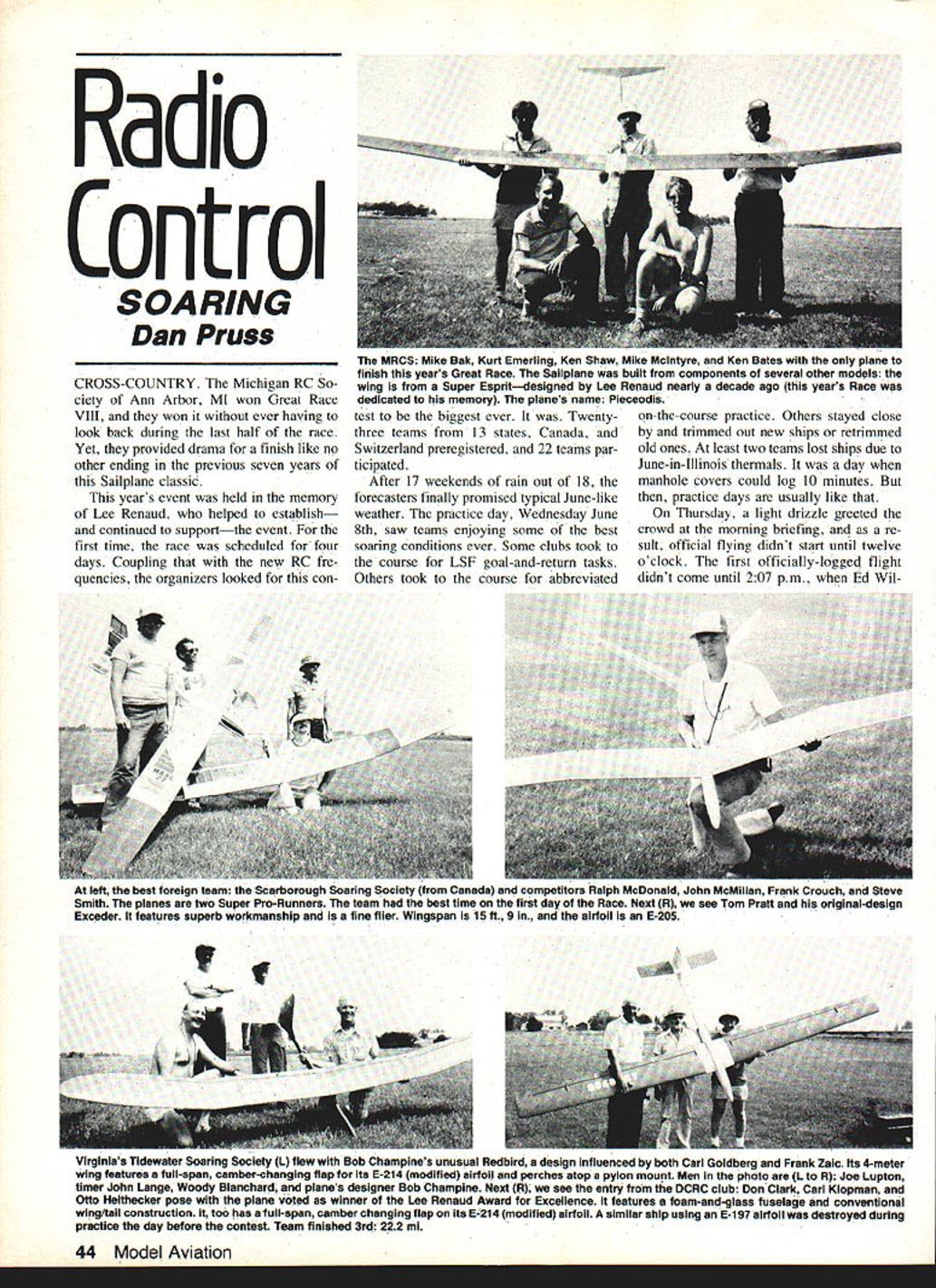
Six teams made it to about the 20-mile mark. Among them were Ken Bates, Kurt Bak, Mike McIntyre and Ken Shaw of MRCS (Ann Arbor, MI). While some of the six played with lift for more altitude before stretching down the long southern course, Bates left the pack with about half the altitude of the highest plane in that group. It looked like a wrong move. After losing altitude down to treetop height, a plowed field gave the plane a nudge upward. Bates played the thermal for new life, made it around the south side of the course, flew westward and was northbound when the forecast winds increased from the south. That provided MRCS with a tailwind for most of the last half of the run. Meanwhile, those on the southerly heading and western leg were coming down, and MRCS suddenly had the course to themselves.
Radio reports tracked the team's progress. There was no question the team was in conditions favorable for completing the course, but the question was: could they beat the clock? They were well past the three-hour mark in the air, and the announced shutoff was nearing. Passing the last radio checkpoint, it became very doubtful whether they could finish in time. The rules state that the distance flown at the time of shutoff will be the official distance and time.
With less than seven minutes to go, there were still six miles to be flown. The radio reports made this as exciting as any Saturday sporting event, with all the drama of a noon-launch countdown. At precisely 7:59:30 on the official watches, MRCS touched down, completing the 76 km / 47.2 mile course in three hours, 32 minutes. It was the second time in two years Bates had carried off Soaring's greatest challenge. It was also the second time they used a makeshift bird—this year a wing from a very old Super Esprit and parts from other planes.
Results (Top Finishers)
- MRCS (Ken Bates, Kurt Bak, Mike McIntyre, Ken Shaw) — 76 km / 47.2 miles in 3 hr. 32 min.
- Suburban Aero Club (Stan Watson, Jim Slatter, Eric Stenson, Dave Haertel) — 42.6 km / 26.7 miles in 3 hr. 18 min.
- DCRC (Otto Heithecker, Don Clark, Carl Klopman) — 35.7 km / 22.2 miles in 1 hr. 35 min.
- Cedar Soaring Group (Iowa, Jim Porter) — 35.2 km / 21.9 miles in 1 hr. 40 min.
Greater Detroit Soaring & Hiking Society (Pat Flinn) — 29.5 km / 18.3 miles in 1 hr. 33 min.; also best performance for the first 20 kilometers with a 1:04 time. Four other teams were within seven minutes of this time.
Bits and Pieces
- The Scarborough Soaring Society (SSS) of Canada won the Best Foreign Team Performance Award. All of their planes except one (a number-three backup ship) used thermal sensors.
- One team, the Cincinnati Soaring Society, used a device that measured airspeed and transmitted it back to the pilot.
- Pickup trucks were the most popular chase vehicles.
- All new RC frequencies worked well—some questionable glitches but no serious gripes.
- MRCS' time was exactly one hour longer than MOSS' winning time in 1982.
- On a practice run on Wednesday, Jack Hiner and Tom Kallevaag of SOAR turned the course in 1:38. In official competition they finished sixth with 28.0 km / 17.4 miles in 2:45.
- All 15 teams from last year returned.
- Otto Heithecker won the Lee Renaud Memorial for Excellence in Design award; this design was selected by a poll among the contestants.
- No one griped about anybody else's winch being too powerful. Nobody even griped.
Copies of the souvenir booklet, which contains three-view drawings of the planes flown along with all pertinent data, can be obtained from: SOAR, 23546 W. Fern, Plainfield, IL 60544, USA. Cost: $2.
Good lift.
Dan Pruss 131 E. Pennington Ln. Plainfield, IL 60544
Transcribed from original scans by AI. Minor OCR errors may remain.

