

Radio Control: Soaring
Dan Pruss
CRAFTSMAN — an artisan or one skilled in the mechanics of his craft (Webster's dictionary).
It's craftsmanship that punctuates the aesthetic quality of any sailplane. Check the top scorers at most major contests, and you'll usually see the artist's touch—whether reflected in the construction, the flying surfaces and the way they are fitted, or in the overall finish itself.
Any top-notch flier knows that gapless joints—such as hinge lines and wing/fuselage junctions—along with overall smooth, uninterrupted surfaces, can pay off in contest points.
The hacker who argues he'd rather spend more time in the air practicing than at the bench building might have the edge in the bush-league circuit; however, when it comes to the big-league contests, those at the top of the standings can usually also put their birds in the front row at any model exposition.
What's the extra work worth? It's hard to measure. But those who spend as much time developing their skills on the field with a flawlessly constructed bird as a comparably skilled flier who compromises at the bench argue it'll show up in the points. An extra-clean sailplane could mean an extra minute in the air in a man-on-man contest. Or, it could mean nearly six minutes in dead air in F3B, an extra lap in Distance, and seconds off a Speed run. Assuming the skill levels of the fliers are about equal, put your money on the ones with the clean machines.
The photos this month show some outstanding examples of craftsmanship. Some examples are mechanical; some are finishing details. All are outstanding examples of the art.
Canopy Brake and Braking Systems
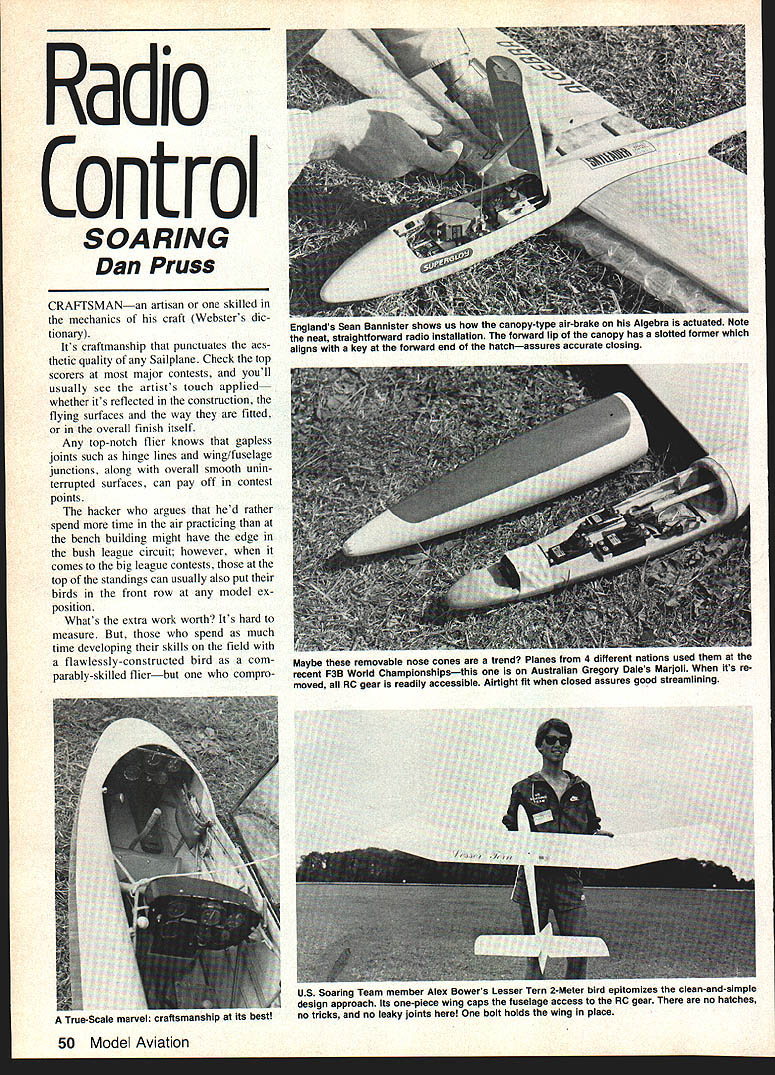
The canopy brake on Sean Bannister's Algebra is featured in one of the pictures. As with most European fliers who believe in keeping the wings clean at all costs, slowing down is sometimes affected by the open canopy. Bannister has been using this type of system for several years on his long series of similar designs.
A side note: some first-time users of such a braking device aren't too pleased with a canopy's slowing-down effectiveness. Some treat the system as slightly better than no brakes at all—but better than dirtying up a wing with spoilers. Most European fliers subscribe to the philosophy of that old wizard, Ed Slobod, who said: "Spoilers are devices that destroy lift when extended . . . and retracted."
Dr. Quaebeck uses the canopy-type speed-brake on his Dohle, and he, too, was less than thrilled with the results until he increased the throw of the canopy. Pretty logical move. However, the increase was only a few degrees toward near-vertical, and the effect of this short movement was critical: Quaebeck claims there is a very narrow range—when the canopy is nearly vertical—where the airspeed drops appreciably. Less than that and the canopy position does not support the answer as yet, but he's working on it. Some seem to think that besides just scooping air and producing drag there is a critical position where the air flows into the canopy and then around in a turbulent fashion which in turn disturbs the flow over the inboard sections of the wing. Whatever the reason, near the 90-degree position is where the effect is appreciably greatest.
Bannister's Algebra
You don't have to be an F3B flier to incorporate these ideas into your own "fly-for-fun" bird. Note the clean execution of the wing-to-fuselage fit: no air gaps and little drag. The in-flight switch is inside the fuselage—one less item in the slipstream—a standard installation among F3B fliers. The canopy, when closed, fits like a boot on a Bentley.
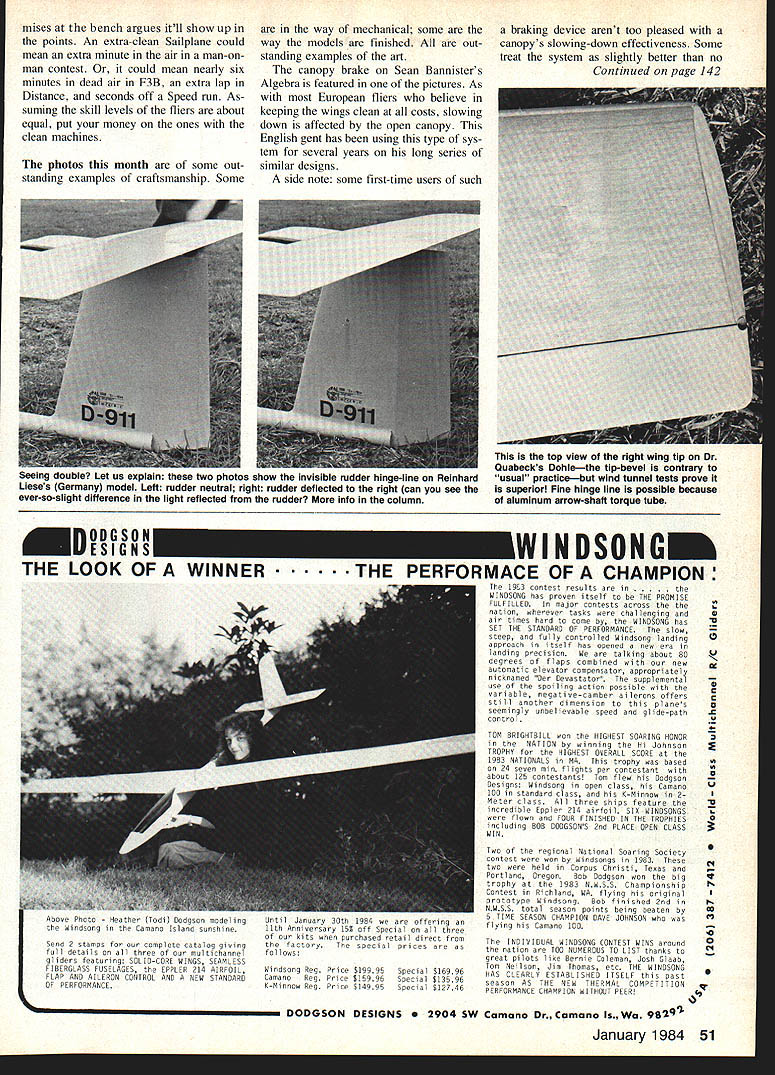
Note also the Australian Marjoli with its nosecone cover which, when removed, provides access to the airborne pack—much like the models of South Africa's Andy Keil and Germany's Ralf Decker. Though ideally suited for fiberglass fuselages, it wouldn't take too much work to modify a wood fuselage to accommodate such a feature.
Fin and Rudder Details
In the photos of the fin and rudder there is no touch-up work—just in case you were looking for the hinge line on the rudder. One photo shows the rudder in neutral, while another shows a right deflection of that rudder, just so you know there is a rudder and a hinge. Another example of outstanding craftsmanship; this one by Reinhard Liese of Germany.
The right side of the fin-and-rudder joint has a very narrow V-groove (how else?) to accept the rudder movement in that direction. To accomplish this now-you-see-it, now-you-don't effect, the vertical fin and rudder are skinned over with lightweight glass cloth and then painted.
Alex Bowers' Lesser Tern — Simplicity and Performance
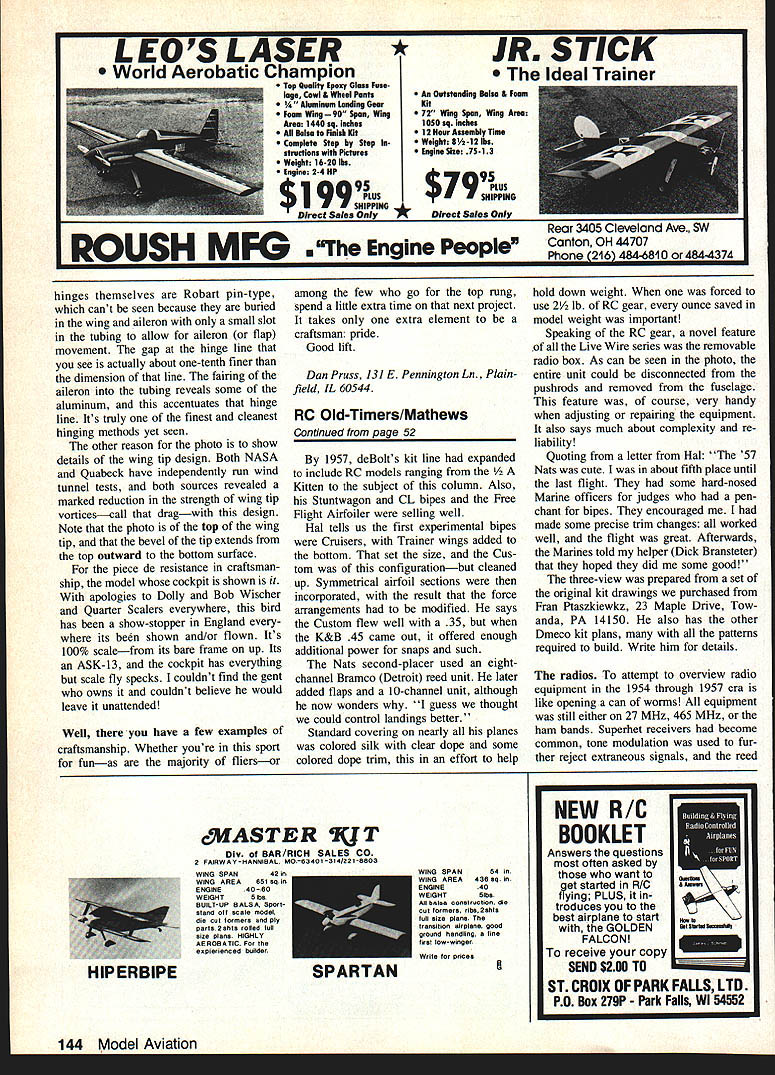
If you are beginning to think that super-clean designs have to be complex, study the photo of Alex Bowers' Lesser Tern. This two-meter design must have—without a doubt—the highest performance-to-simplicity-of-design ratio in the air. While not an overnight project, it does build faster than most kits.
Neat features:
- One-piece wing which tucks into the fuselage at the wing's leading edge, then gets bolted down—secure.
- No canopy hatches or nosecone. The streamlined fiberglass fuselage is uninterrupted except for the wing cutout.
- When the wing is removed—by its one bolt—the radio gear is exposed.
- Rudder and elevator controls only; what could be simpler?
Dr. Quaebeck's Dohle — Aileron Hinging and Wing Tip Design
This picture of the Dohle's right wing tip is here for two reasons. First, it was taken to show details of the aileron hinge line. The ailerons (and flaps) are attached to aluminum tubing. This tubing is very straight, as it's normally used in making arrow shafts. The tip bevel is contrary to usual practice—but wind-tunnel tests prove it superior. A fine hinge line is possible because an aluminum arrow-shaft torque tube is used.
The hinges themselves are Robart pin-type, which can't be seen because they are buried in the wing and aileron with only a small slot in the tubing to allow for aileron (or flap) movement. The visible gap at the hinge line is actually about one-tenth finer than it appears. The fairing of the aileron into the tubing reveals some of the aluminum, and this accentuates that hinge line. It's truly one of the finest and cleanest hinging methods yet seen.
The other reason for the photo is to show details of the wing tip design. Both NASA and Quaebeck have independently run wind-tunnel tests, and both sources revealed a marked reduction in the strength of wing-tip vortices—hence less drag—with this design. Note that the photo is of the top of the wing tip, and that the bevel of the tip extends from the top outward to the bottom surface.
Pièce de Résistance — The ASK-13 Cockpit Model
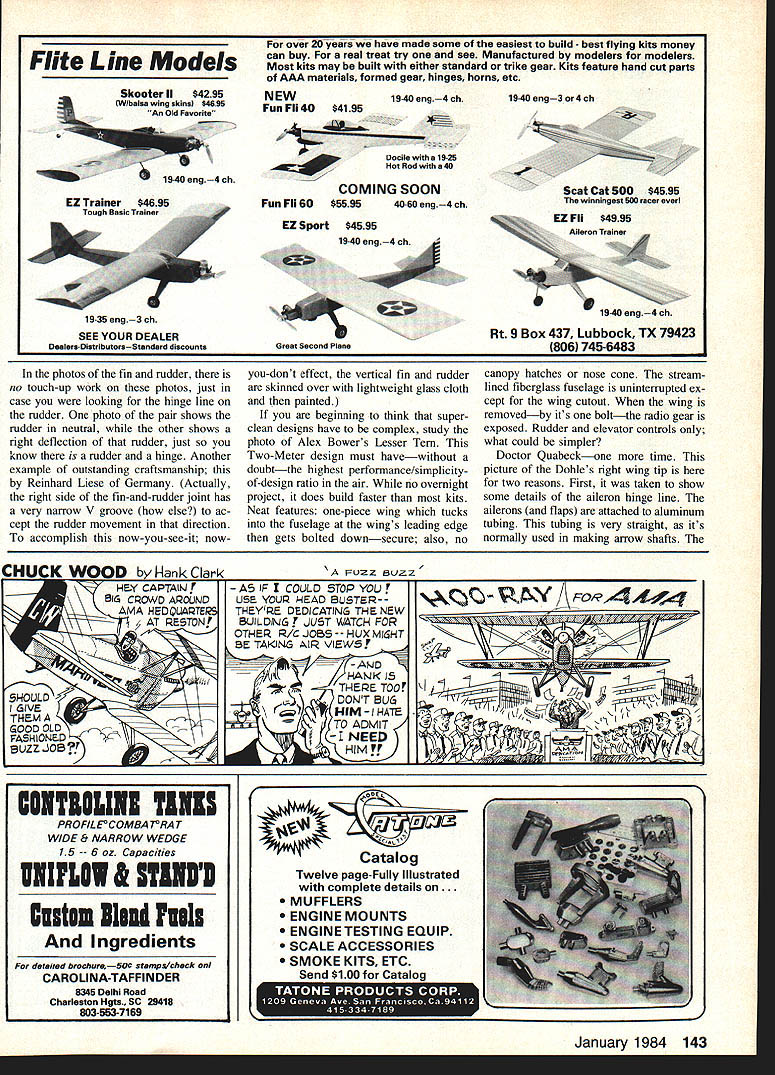
For the pièce de résistance in craftsmanship, the model whose cockpit is shown is it. With apologies to Dolly and Bob Wischer and quarter scallers everywhere, this bird has been a show-stopper in England wherever it's been shown and/or flown. It's 100% scale—from its bare frame on up. It's an ASK-13, and the cockpit has everything but scale flyspecks. I couldn't find the gent who owns it and couldn't believe he would leave it unattended!
Conclusion
Well, there you have a few examples of craftsmanship. Whether you're in this sport for fun—as are the majority of fliers—or among the few who go for the top rung, spend a little extra time on that next project. It takes only one extra element to be a craftsperson's pride.
Good lift.
Dan Pruss 131 E. Pennington Ln. Plainfield, IL 60544.
Transcribed from original scans by AI. Minor OCR errors may remain.

