

Radio Control: Soaring
Dan Pruss
SOAR-CROSS '83
Back in July, the Michigan International Soaring Society held its second annual cross-country race, and it truly was a race. The course, although a formidable challenge, is one which can be completed if the gods of good air cooperate. On Saturday the air didn't cooperate, which is one good reason to schedule such an event for two days or longer.
Sunday proved the planning committee knew what it was doing. Shortly after noon Dennis Chall and the Brighton RC Club were the first team in two years to cross the finish line! They finished the 12.1-mile course in an hour and one minute on their first attempt. Twenty minutes later Ken Bates and the Michigan RC Society—still fresh from their Great Race VIII victory a month earlier—lopped eleven minutes off Chall's time.
But that didn't last long. The Greater Detroit Soaring & Hiking Society's Mark Wencel covered the same 12.1 miles in 31 minutes, 17 seconds.
Rules for this event allow teams to relaunch and fly part or all of the course as often as contest time permits. With one frequency per team, crowded frequencies posed no problem to the contestants or organizers. Chall likes these rules: on his second attempt around the course, he and his Brighton crew did it in the incredible time of 27 minutes, 28 seconds to win Soar-Cross '83.
Soar-Cross '83 — top five finishers (teams — all from Michigan)
- Dennis Chall, Brighton RC Club — 00:27:28
- Mark Wencel, Greater Detroit Soaring & Hiking Society — 00:31:17
- Ken Bates, Michigan RC Society — 00:50:02
- David Weatherup, Michigan International Soaring Society — 00:50:22
- Pat Flinn, Greater Detroit Soaring & Hiking Society — 00:50:42
Winch design (York F3B World Championships / Bob Andrews)
Two issues back this column featured the most-photographed model at the York F3B World Championships. Well, that model's winch was the most-photographed, and the winch belonged to the U.S.A. team and was the handiwork of Bob Andrews (Modesto, CA).
The photo shows some features that have become a trend in winch design. For years, the long-shaft Ford starter motor has been the standard for winches. Its low cost—availability in junkyards for as little as $5 or in auto supply houses for about $30—made the motor affordable. The long shaft was a natural for a winch, since the line drum could be mounted on it.
However, heavier sailplanes and F3B launching techniques can add strain, and some winch designers have gone to the layout seen in the picture. In this case the starter motor is still a Ford, but the shaft has been cut down and the line drum is mounted separately in two pillow blocks. This makes a compact, narrower winch and, importantly, eliminates heavy side loads and bearing wear.
The starter-motor front plate is the heart of the driving mechanism, which is made up of drive pulleys and a belt. Bob used Dayco timing pulleys and a timing belt in a one-to-one ratio. Its chrome-plated winch brake is a bicycle sprocket with a brake lever; a Destaco welding clamp and a small round T-bar (barely seen in the picture) welded to match the spacing of the cogs provide a simple, very effective brake.
Parts alone for this show-stopper came to just under $300. It was a labor of love, and Bob wants it known that he's now going back to building sailplanes. He's not building winches for sale, and plans aren't available, since he didn't have any when he built this one. However, this scribe has the parts list, so if you're interested in trying for Best of Show—Winch Division—at your next meet, send a SASE to the address at the end of this column. The photo and parts list should get you on your way. By the way, this was only the U.S.A. team's backup winch!
Gapless hinge arrangement (from a Dohle sailplane)
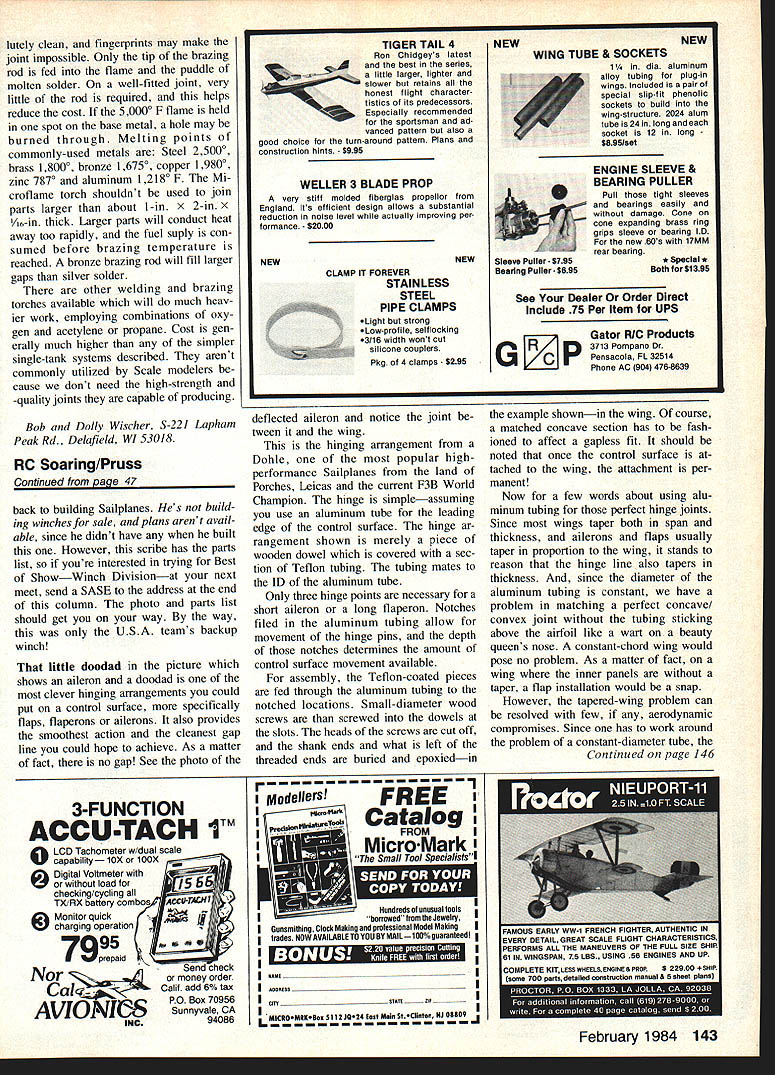
That little doodad in the picture which shows an aileron is one of the most clever hinging arrangements you could put on a control surface—flaps, ailerons, or elevators. It provides the smoothest action and the cleanest gap line you could hope to achieve. As a matter of fact, there is no gap! See the photo of the deflected aileron and notice the joint between it and the wing.
This hinging arrangement comes from a Dohle, one of the most popular high-performance sailplanes from the land of Porsches, Leicas and the current F3B World Champion. The hinge is simple—assuming you use an aluminum tube for the leading edge of the control surface. The hinge itself is merely a piece of wooden dowel covered with a section of Teflon tubing. The tubing mates to the inside diameter of the aluminum tube.
Only three hinge points are necessary for a short aileron or a long flaperon. Notches filed in the aluminum tubing allow for movement of the hinge pins, and the depth of those notches determines the amount of control surface movement available.
For assembly, the Teflon-coated pieces are fed through the aluminum tubing to the notched locations. Small-diameter wood screws are then driven into the dowels at the slots. The heads of the screws are cut off, and the shank ends and remaining threaded portions are buried and epoxied—in the example shown—into the wing. Of course, the matched concave section has to be fashioned to achieve a gapless fit. It should be noted that once the control surface is attached to the wing, the attachment is permanent.
Using aluminum tubing on tapered wings
A word about using aluminum tubing for those perfect hinge joints: most wings taper both in span and thickness, and ailerons and flaps usually taper in proportion to the wing. That means the hinge line also tapers in thickness. Since the diameter of the aluminum tubing is constant, matching a perfect concave/convex joint without the tubing protruding above the airfoil presents a problem. A constant-chord wing would pose no problem; on a wing where the inner panels are without taper, a flap installation would be straightforward.
The tapered-wing problem can be resolved with few, if any, aerodynamic compromises. Because you must work around the constant-diameter tube, consider both the wing and the aileron or flaperon. If you recall the three-views of Decker's model back in the December column, you'll note that although the wing tapers, the flaperon is constant chord. By maintaining a control-surface chord that is constant, the problem is almost solved.
The specification sheet as issued on Decker's bird is misleading. The airfoil listed is an HQ 2.5% modified. True, it's modified, but it really is an HQ 2.5% meaning that the wing starts out as an eight-percent section, then transitions to a nine-percent section at the tip. That change in thickness, along with the constant chord on the flaperon, permitted the use of constant-diameter tubing for that perfect, no-gap, freely moving control surface.
Fin and rudder construction (from the Dohle)
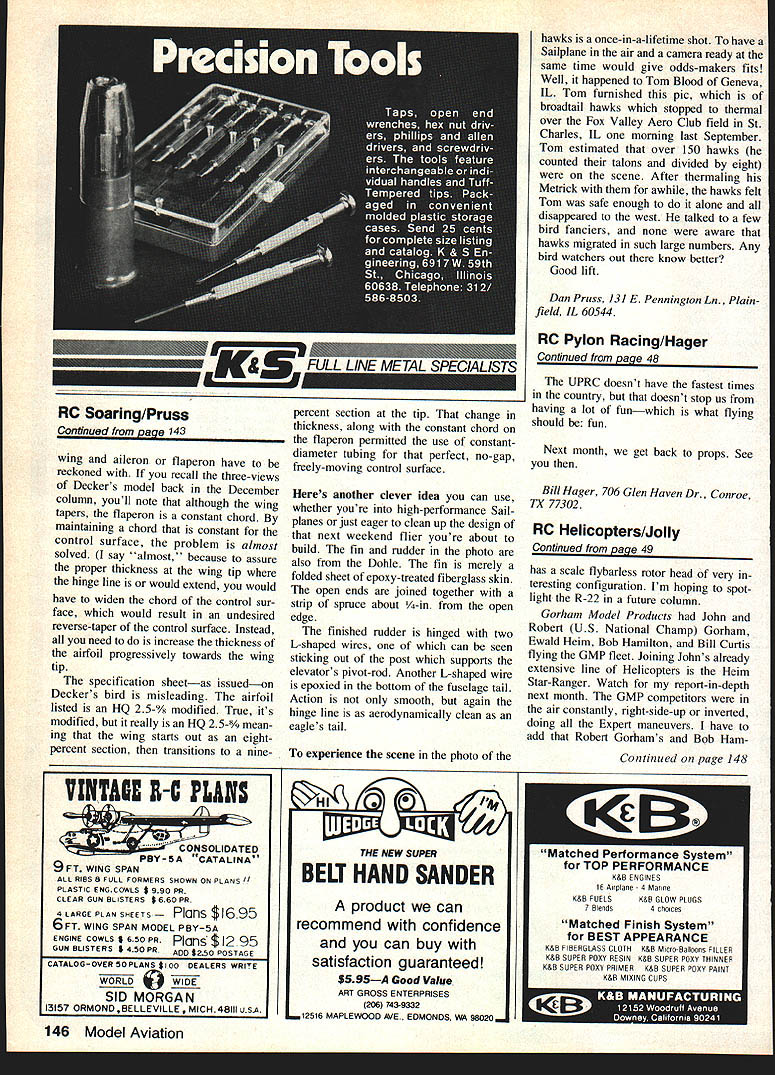
Here's another clever idea you can use whether you're into high-performance sailplanes or just eager to clean up the design of your next weekend flier. The fin and rudder in the photo are also from the Dohle. The fin is merely a folded sheet of epoxy-treated fiberglass skin. The open ends are joined together with a strip of spruce about 1/4 inch from the open edge.
The finished rudder is hinged with two L-shaped wires, one of which can be seen sticking out of the post that supports the elevator's pivot rod. Another L-shaped wire is epoxied in the bottom of the fuselage tail. Action is not only smooth, but the hinge line is as aerodynamically clean as an eagle's tail.
Hawks and thermals
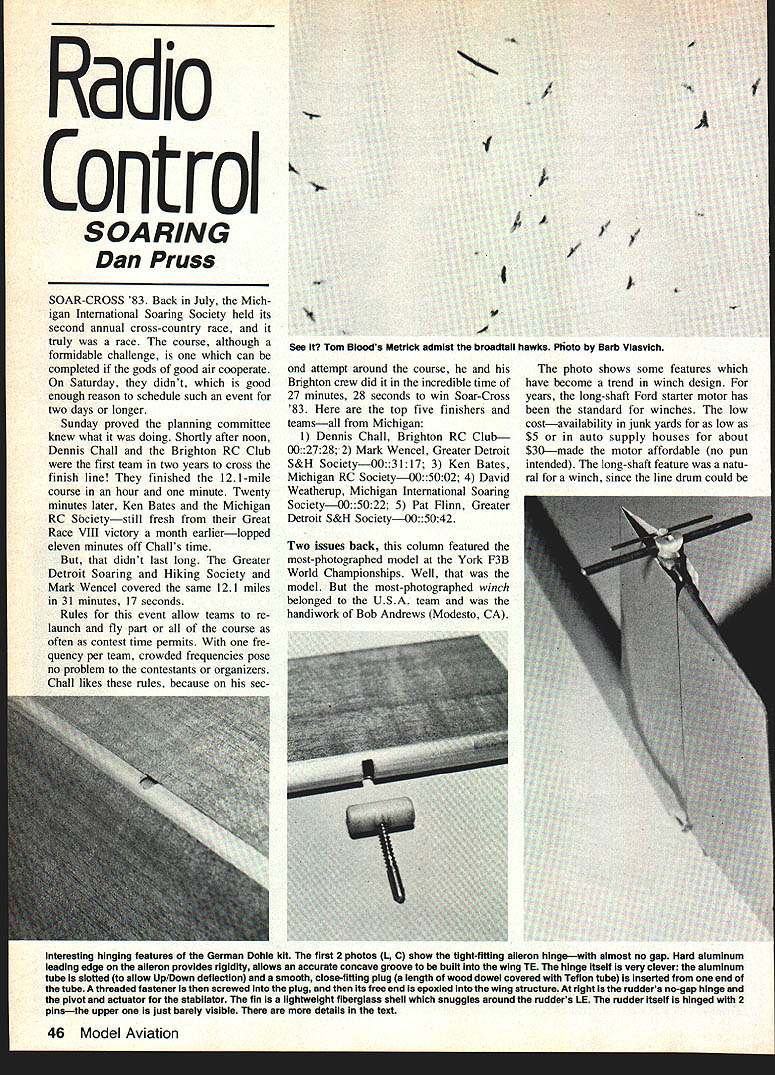
To experience the scene in the photo you have to be on the ground and watch. The hawks shot is a once-in-a-lifetime capture: a sailplane in the air with hawks thermaling nearby. It happened to Tom Blood of Geneva, IL. Tom furnished this picture, which shows broad-tailed hawks that stopped to thermal over the Fox Valley Aero Club field in St. Charles, IL one morning last September. Tom estimated that over 150 hawks were on the scene (he counted talons and divided by eight). After thermaling his Metrick with them for a while, the hawks left. Tom was safe enough to do it alone and all disappeared to the west. He spoke to a few bird fanciers, and none were aware that hawks migrated in such large numbers. Any bird watchers out there know better?
Good lift.
Dan Pruss 131 E. Pennington Ln. Plainfield, IL 60544.
Transcribed from original scans by AI. Minor OCR errors may remain.

