
Radio Control: Soaring
Dan Pruss
MARCS Sailplane Symposium
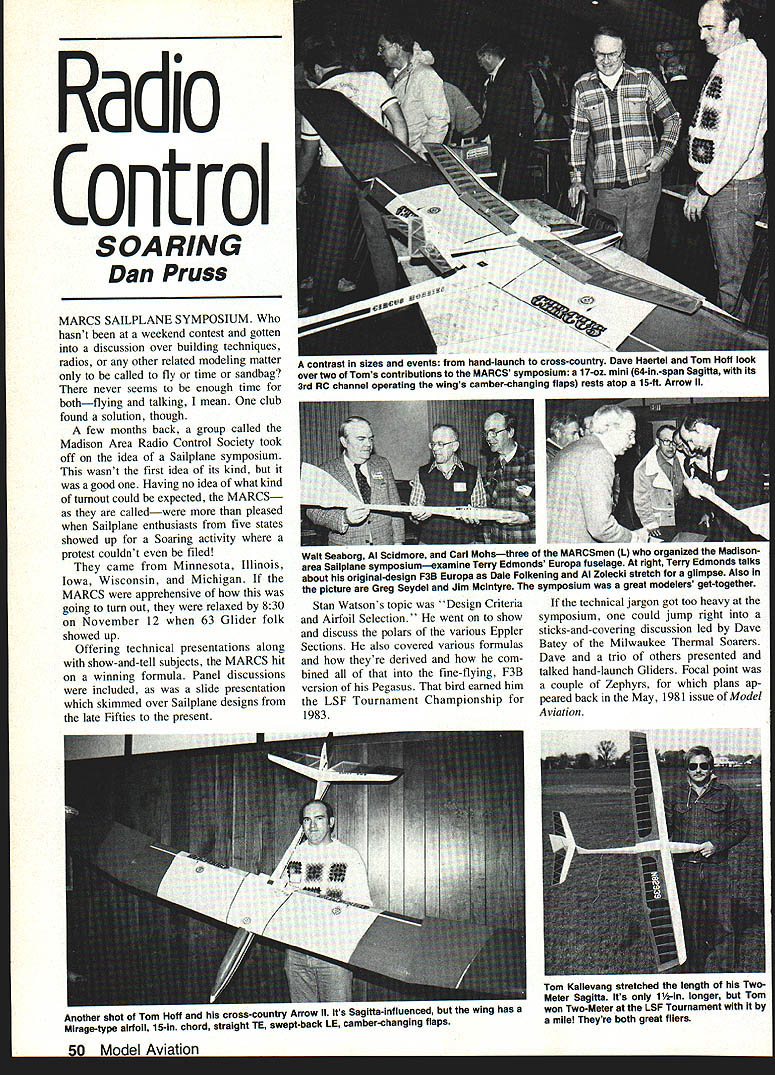
Who hasn't been at a weekend contest and gotten into a discussion over building techniques, radios, or any other related modeling matter only to be called to fly or time or sandbag? There never seems to be enough time for both—flying and talking, I mean. One club found a solution, though.
A few months back, a group called the Madison Area Radio Control Society took off on the idea of a Sailplane Symposium. This wasn't the first idea of its kind, but it was a good one. Having no idea what kind of turnout to expect, the MARCS—as they are called—were more than pleased when sailplane enthusiasts from five states showed up for a soaring activity where a protest couldn't even be filed. They came from Minnesota, Illinois, Iowa, Wisconsin, and Michigan. If the MARCS were apprehensive about how this was going to turn out, they were relaxed by 8:30 on November 12 when 63 glider folk showed up.
Offering technical presentations along with show-and-tell subjects, the MARCS hit on a winning formula. Panel discussions were included, as was a slide presentation that skimmed over sailplane designs from the late fifties to the present.
Stan Watson presented "Design Criteria and Airfoil Selection." He showed and discussed the polars of various Eppler sections, covered formulas and how they're derived, and explained how he combined all of that into the fine-flying F3B version of his Pegasus. That bird earned him the LSF Tournament Championship for 1983.
If the technical jargon got too heavy at the symposium, one could jump right into a sticks-and-covering discussion led by Dave Batey of the Milwaukee Thermal Soarers. Dave and a trio of others presented and discussed hand-launch gliders. The focal point was a couple of Zephyrs, for which plans appeared in the May 1981 issue of Model Aviation.
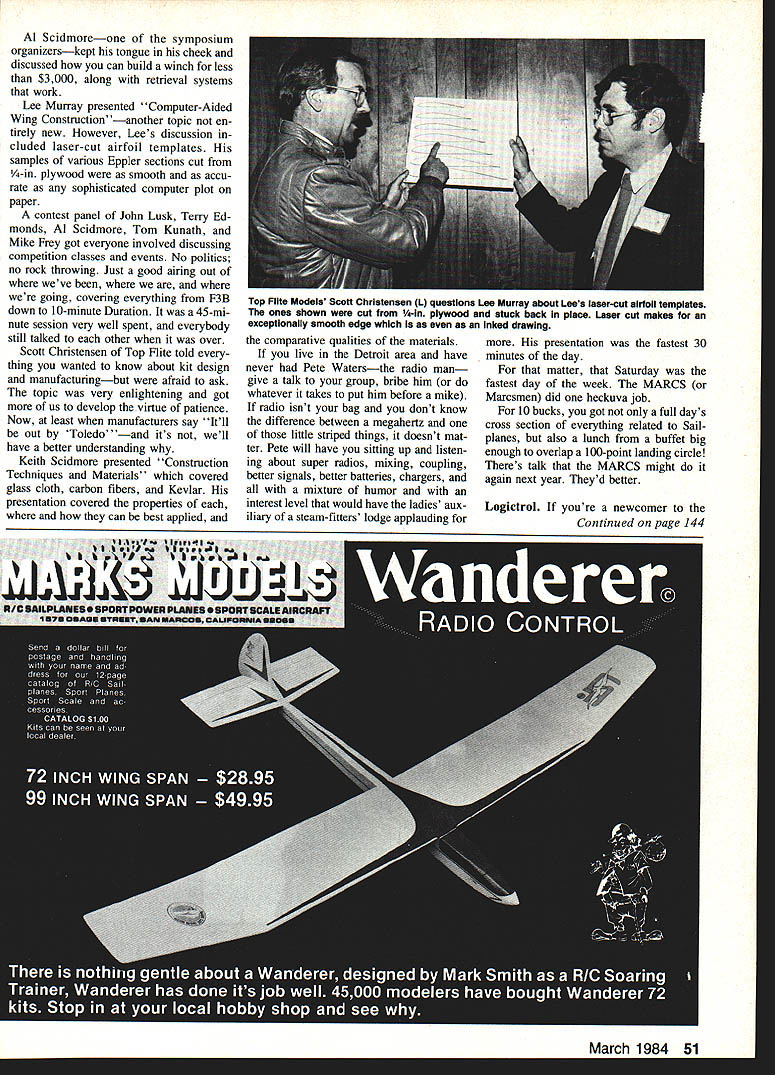
Al Scidmore, one symposium organizer, kept a tongue-in-cheek tone and discussed winches and retrieval systems that work. Lee Murray presented "Computer-Aided Wing Construction," an entirely new topic. Lee's discussion included laser-cut airfoil templates, samples of various Eppler sections, and computer-plotted airfoil shapes.
The contest panel got everyone involved discussing competition classes and events. Panelists included:
- John Lusk
- Terry Edmonds
- Al Scidmore
- Tom Kunath
- Mike Frey
No politics, no rock throwing—just a good airing out of where we're going, covering everything from F3B down to 10-minute Duration. The 45-minute session was very well spent; everybody still talked afterward.
Scott Christensen of Top Flite covered things manufacturers wanted to know about kit design and manufacturing but were afraid to ask. The topic was enlightening and taught the virtue of patience. Now, at least, manufacturers say, "It'll be out."
Keith Scidmore presented "Construction Techniques." Materials covered included glass cloth, carbon fibers, and Kevlar. He discussed material properties, how they can best be applied, and the comparative qualities of each material.
Pete Water—the radio man—gave the group what many had been hoping for. Radio isn't bad; you don't have to know the difference between megahertz and the little striped things to appreciate the talk. Pete had everyone sitting up and listening about super radios, mixing, coupling, better signals, and better batteries and chargers. His mixture of humor and information would have had the ladies' auxiliary applauding.
The MARCS did a heck of a job. Ten bucks got you a full day's cross section of everything related to sailplanes, plus a lunch buffet. There's talk the MARCS might do it again next year. They'd better.
Logictrol
If you're a newcomer to the sport, you're asking: "What's that?" Logictrol was a radio—a dependable radio—that hasn't been on the scene for a few years, but you still see them popping up from time to time. Good news if you still have one and need servicing. Full service and replacement parts are available from:
Full Command Systems 908 E. Rosewood Spokane, WA 99208
Their new catalog tells all.
Davey Systems Corporation
From the folks who came up with a line-retriever that really works, Ted Davey has made sailplane life even simpler.
One of the most often-sought-after winch items is the winch drum. That usually stops most do-it-yourselfers cold. Ted has them available. The drum has a 5/8-in. bore—ideally suited for Ford long-shaft starters—a four-inch center, and four-inch spacing between the eight-inch-diameter plates. It goes for $50, plus $3 for shipping. See DSC's ad in this issue of Model Aviation for his winch and retrieval systems.
Transcribed from original scans by AI. Minor OCR errors may remain.

