
Radio Control: SOARING
Dan Pruss
SHOW TIME
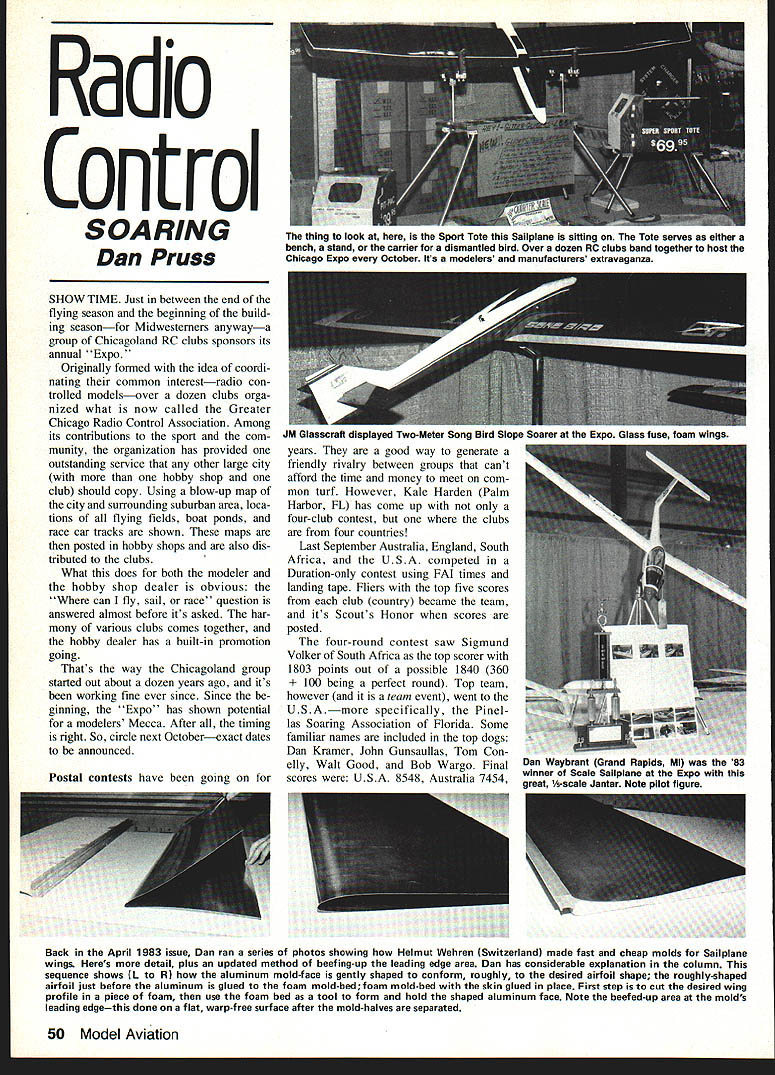
Just between the end of the flying season and the beginning of the building season—for Midwesterners anyway—a group of Chicagoland RC clubs sponsors its annual Expo. Originally formed to coordinate the common interest in radio-controlled models, over a dozen clubs organized what is now the Greater Chicago Radio Control Association. One outstanding service the organization provides (which other large cities with multiple hobby shops and clubs should copy) is a blow-up map of the city and surrounding suburbs showing the locations of all flying fields, boat ponds, and race car tracks. These maps are posted in hobby shops and distributed to the clubs.
The benefit to both modelers and hobby-shop dealers is obvious: the "Where can I fly, sail, or race?" question is answered almost before it's asked. The arrangement promotes harmony among clubs and gives hobby dealers built-in promotion. The Chicagoland group started this about a dozen years ago, and it has worked well ever since. The Expo has become a modelers' Mecca; circle next October — exact dates to be announced.
Postal contests have long been used to generate friendly rivalry between groups that cannot afford the time or money to meet on common turf. Kale Harden of Palm Harbor, FL, has expanded that idea into a four-club contest with clubs from four countries. Last September, Australia, England, South Africa, and the USA competed in a duration-only contest using FAI times and landing tape. The top five scores from each club (country) comprised the team score; posted scores were accepted on the honor system.
The four-round contest saw Sigmund Volker of South Africa top the individual standings with 1,803 points out of a possible 1,840 (360 being a perfect round). The top team was the USA—specifically, the Pinellas Soaring Association of Florida—featuring Dan Kramer, John Gunsaullas, Tom Connelly, Walt Good, and Bob Wargo. Final team scores: USA 8,548; Australia 7,454; South Africa 7,353. England was rained out on its scheduled day.
A rain-out date and a new twist will be added for the next contest, scheduled for the first week of March 1984. A Speed task will be added: Duration/FAI Speed make-up rounds will be used, but the Speed task will have a 20-second cap; being 20 seconds under the cap will score 1,000 points. There will be no ballast changes between tasks within a round—the model weight must remain the same for both Duration and Speed during a given round.
A related rules proposal discussed at Paris CIAM last December was looked upon favorably by several countries but was referred back to a subcommittee for further study. At least one other country indicated it will compete in 1984. If you're interested, contact Kale Harden, 3184 Brunswick Circle, Palm Harbor, FL 33563.
LSF Level V
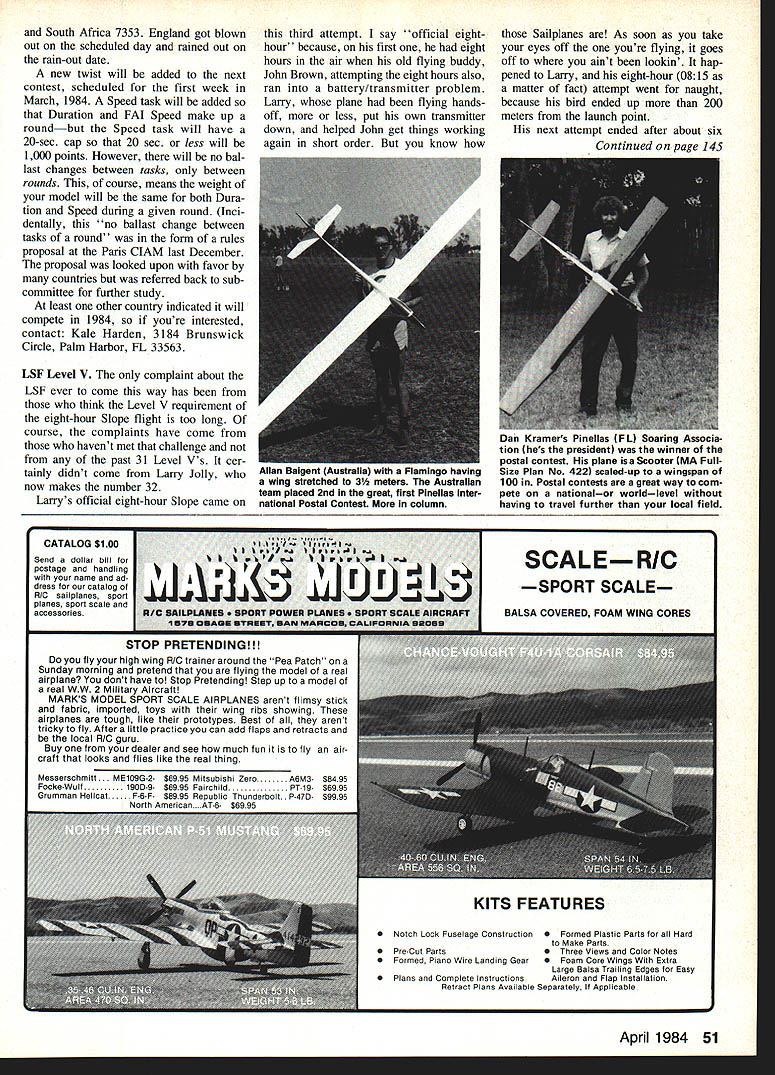
The most frequent complaint about the LSF has been that the Level V requirement—an eight-hour slope flight—is too long. Those complaints typically come from pilots who haven't met the challenge, not from any of the Level V achievers. Larry Jolly became the 32nd LSF Level V after his official eight-hour flight on his third attempt.
On his first attempt he had eight hours in the air, but when his old flying buddy John Brown had a battery/transmitter problem, Larry—whose plane had been flying more or less hands-off—put his transmitter down to help John. As soon as he looked away, the sailplane drifted; his flight ended more than 200 meters from the launch point and did not count (his logged time had reached 8:15). His second attempt ended after about six hours due to a rudder servo failure.
Two months later, with everything back in place, Larry tried again. An early no-wind condition delayed his start until 9:15. Sunset was at 4:55, which meant the last 20 minutes would be in low light—a further challenge because the wind died as the sun went down. At the 7:50 mark the wind was nearly calm, but the extra altitude he had earlier gained paid off: as the plane descended and conditions looked doubtful, the winds picked up at 5:08. At 5:18 Larry Jolly completed the required eight hours and became the 32nd LSF Level V. Congratulations!
Aluminum wing molds
Back in the April 1983 column a photo series showed how to make an aluminum-faced wing mold. The big advantage: a quick, accurate way to build not only one set of true wings but also reusable molds to copy more sets. In an evening one can make at least half of a mold set; epoxy molds take weeks of man-hours.
Here are added tips from Helmut Wehren of Switzerland, the originator of this system:
- Use only pure aluminum sheet; 0.3 mm thickness was found to be perfect.
- After the sheet is initially slightly creased over a sharp table edge, fold the sheet over and gently press the crease and the rest of the aluminum together using a rigid straightedge.
- Cut the desired wing-profile piece from foam. Use a foam-bed tool to form and hold the shaped aluminum face. Note the beefed-up area of the mold's leading edge—this is done flat to provide a warp-free surface after the mold halves are separated.
The leading edge is strengthened by butting a T-bar of aluminum to the overhanging aluminum leading edge, then filling the void between the stem of the T and the foam core with epoxy. This step must be done on a warp-free flat surface. The system has been praised by Alpine builders; Swiss F3B team member Peter Gerber used it to build his Gamma. The aluminum molds are not as indestructible as solid-epoxy molds, but they retain accuracy and save time.
Good lift.
Dan Pruss 131 E. Pennington Ln., Pittsfield, IL 60544
PROTECT YOUR RIGHT TO FLY! Safe Flying Is No Accident!
Transcribed from original scans by AI. Minor OCR errors may remain.

