

Radio Control: Soaring
Dan Pruss
Hutchinson's single-servo spoiler/flap actuation
If Gary Hutchinson comes up with many more ideas, we're going to have to change the name of this column! The latest from Hutch is a new hitch in the actuation of either spoilers or flaps using a single servo. This idea was seen at Toledo—not as an over-the-counter item (even though it was at the Ace R/C booth)—but as an idea to pass along.
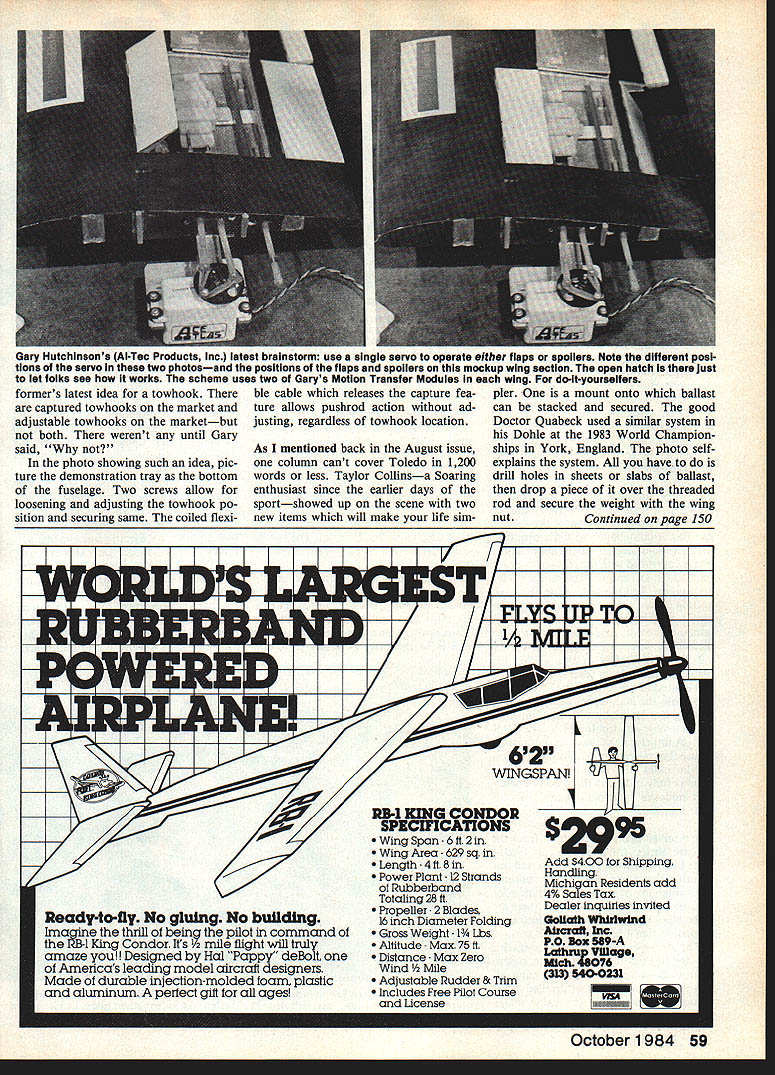
Photos show a wing mock-up demonstrating the single-servo function for spoilers or flaps. The trick is in the linkage and, more importantly, in a modified servo output wheel. The extra cover (or hatch) in the mock-up photo simply exposes the linkage and the two motion modules that transfer pushrod action from the servo to the spoilers and flaps. That part of the system is as straightforward as any conventional installation.
To get that action from a single servo, Gary took a round servo output wheel and cut two slots in an arced pattern just inside the wheel's outer rim. The arcs span about one-quarter of the wheel's circumference in a symmetrical pattern—the white of the servo can be seen through these slotted arcs in the photos. The key to the servo action is this: two Du-Bro-type ball joints are mounted on tiny arms which, in turn, are screwed to the output wheel near its center. These ball joints pivot, and the curved slots in the output wheel match the pattern set by the pivoting ball joints.
A third ball joint is mounted in a neutral position, halfway between the other two and along the outer edge of the output wheel. This ball joint is fixed. Small rubber bands are stretched from one pivoting ball joint around the neutral ball and then to the other pivoting ball joint.
As the servo travels in one direction, the slotted wheel allows the control surface not in demand to be neutralized. When the servo is neutral, both surfaces are neutral.
Taylorcraft ballast-holder and solid towhook
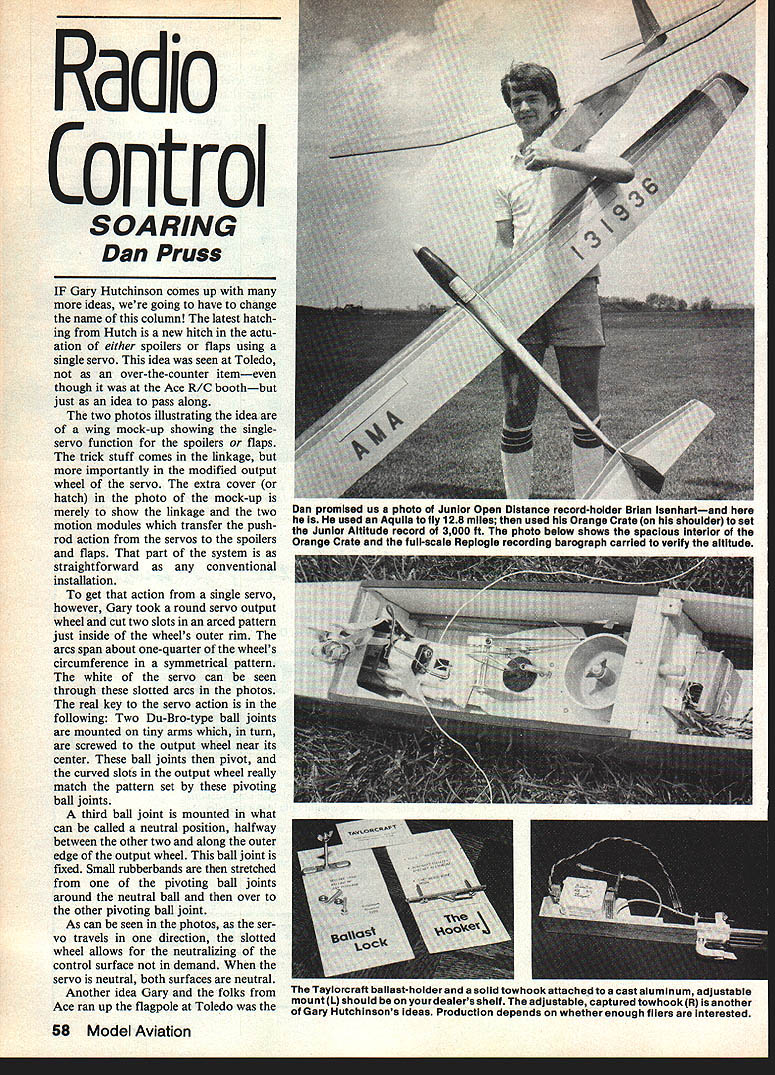
Another idea Gary and the folks from Ace ran up the flagpole at Toledo was a Taylorcraft ballast-holder and a solid towhook. In the photo showing this idea, picture the demonstration tray as the bottom of the fuselage. Two screws allow loosening and adjusting the towhook position and securing it. A coiled flexible cable that releases the capture feature allows pushrod action without adjusting, regardless of towhook location.
Taylor Collins—a soaring enthusiast since the earlier days of the sport—showed two new items that will simplify things. One is a mount onto which ballast can be stacked and secured. Dr. Quabeck used a similar system in his Dohle at the 1983 World Championships in York, England. The system is simple: drill holes in sheets or slabs of ballast, drop a piece of it over the threaded rod, and secure the weight with a wing nut.
Taylor's other idea is a movable (adjustable) towhook. While other adjustable hooks change only the hook itself—and these can pop loose during tow if not secured properly—Taylor's whole assembly adjusts. Loosening two screws allows the entire slotted towhook mount to be shifted fore or aft; tightening the screws secures the assembly. The towhook itself (made of music wire) is rigidly mounted.
Racing news
- Modesto, CA: Because of high winds, the closed-circuit course ended up a downwind dash, but Larry Jolly (with his newly designed and soon-to-be-kitted Comet) outdistanced all. His 12-plus-mile run was enough to win.
- Eastern Iowa: Wind was the story for most of the Midwest over Memorial Day weekend. Strong headwinds kept scores low in Iowa, but the Cedar Soaring group—Jim Porter, Dave DeGroot, and Ed Harris—clicked off eight miles in a two-day event.
- Ann Arbor, MI: Wind again. LSF president Warren Ploh, Jim Bohmer, Jack Parry, and Herb Reindelisch outdistanced others with their Sagitta-XC, modified to a long version, to win the annual Michigan classic.
- Davenport, CA: The longest-running contest for sailplanes celebrated its 18th occurrence in 20 years. The South Bay Soaring Society hosts what is now called the International Slope Race. For five years, Richard Gerrard, Eric Henderson, and others from England have kept the British flag flying; "International" is more than just part of the event's name.
On the first day, winds of 40–50 mph pushed planes over the course in one direction in about four seconds for some 120+ mph flights. Upwind flights were more like 15 seconds. After two days of racing, three-time winner Jerry Arana, Ken Gregory, and Dick Spicer were in a three-way tie. In a fly-off, Gregory flew into a hill, and on the third lap Arana and Spicer were too close to gain an edge. Arana's calmer hand cut a turn; Spicer won going away.
According to the South Bay's Silent Flyer and race descriptions, this could become a premier event in soaring—good for flying or watching. Keep an eye on next year's contest calendar; RC soaring might finally have a spectator event.
Symposium
The MARC symposium, which was a huge success last year, is scheduled for November 3 and 4 this year. If you can plan to attend one or both days, you can be guaranteed time well spent. For further information contact Al Scidmore, 5013 Dorset Dr., Madison, WI 53711.
Papers from the 1983 symposium are available and make a great addition to your library. Topics include:
- "RC Sailplane Speed Events: Why and How," by Stan Watson
- "Can You Afford A Winch?," by Al Scidmore
- "Computer-Aided Wing Construction," by Lee J. Murray
- "Sailplane Kits," by Scott Christensen
- "Radio Systems: Then, Now, and Soon," by Peter Waters
- "Composites for Strength With Low Weight," by Keith Scidmore
- and much more
NSS Sailplane
New president of the National Soaring Society is Don Chancey. Don takes over from Gene Shekley, who served Soaring and the NSS in an excellent manner. Thanks, Gene, and best of luck to Don.
For membership in the NSS and a year's subscription to Sailplane, send $12 to: John Vogel 906 Orchard Park Dr. Gibsonia, PA 15044
By the time this is read, the U.S.A. F3B team selection finals will have been held, involving what was likely the strongest field of finalists in any of the five selection fly-offs. Let's support the U.S.A. team. Contributions can be sent to: Mrs. Helen Olsen 8875 Oviedo Plaza Westminster, CA 92683
Good lift.
Dan Pruss 131 E. Pennington Ln. Plainfield, IL 60544
Transcribed from original scans by AI. Minor OCR errors may remain.

