

Radio Control: Soaring
Dan Pruss
Cross-Country News
Make that great cross-country news. Just as this column was being put together, an announcement came from Andy Keil (South Africa) that a formal proposal is being made to hold the first International F3H cross-country event. Scheduled for November 17–23, 1985, the event would use the provisional F3H rules, which aren't too unlike the current AMA version (they were printed in the October 1984 "Competition Newsletter," R/C M).
Why not a World Championship instead of an International Contest? The current F3H rules were just accepted by the FAI in December of 1983 and, therefore, must be tried and proven ("Provisional" status) before receiving official status. The international level of competition is a step in raising the event to World class.
And, since this is an international contest, countries aren't restricted to just one team. In fact, the organizers are encouraging as many teams as possible to come, since they have nearly 60 frequencies for RC use.
There won't be any formal team selection process in the U.S.A. for this contest, and those who choose to go will have to bear the burden of expenses. However, this would be a great opportunity for clubs to rally around their teams and maybe foot at least part of the bill.
Here are some highlights from Andy concerning the event:
- Time: November provides some of the best soaring conditions in the world — this will be summer in South Africa. Average high temperature at that time: 82 degrees.
- Equipment: winches will be provided. Tents will also be provided.
- Contestants: thermal sniffers will be allowed.
- Frequencies: 53,000–53,800 MHz is license-free in South Africa; expected frequencies will be published, and competitors from certain countries will be cleared to use the event provided sufficient lead time is given to the organizers.
As this was being written (October 1, 1984), the U.S. dollar was doing quite well overseas. In South Africa at the time gasoline cost about $0.37 per liter; a steak salad ran about $6. Car rentals ranged about $26 for a VW Rabbit to about $36 a day for a Toyota pickup.
Granted, it would not be a cheap weekend contest, but with a few teams from the USA planning to go, the trek should be doable. The hospitality is certain — the first USA/F3B team went over in 1977 and returned with rave reports.
Further details can be obtained from: Soaring Cross Country International P.O. Box 283, Bergvlei 2012, Republic of South Africa
Swiss Alps slope soarer
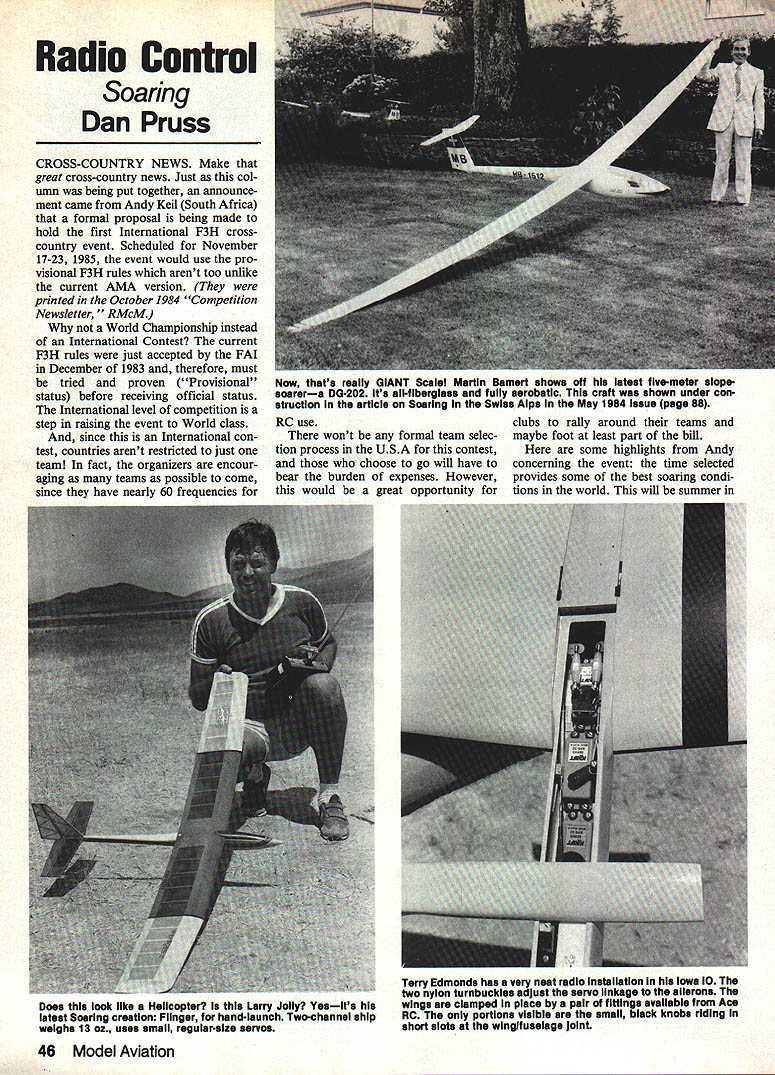
Back in the May 1984 issue, a feature article covered soaring in the Swiss Alps and resulted in more mail and inquiries than any previous article, with the possible exception of coverage of World Championships. One shot of Martin Bamert showed construction of a huge slope soarer taking place in the ski lodge's makeshift workshop, which was converted from part of the dining room.
This month, we're happy to provide a picture of the finished product. The model was flown two days after the picture was taken for the May article. Martin reports that after satisfactory test flights, 2.2 pounds of lead ballast were added to increase performance, bringing the weight of the bird up to 7.5 kg (about 16.5 pounds).
The bird is a DG-202, and the scale is 3.5:1. Span is 5 meters and the fuselage length is 2 meters. Airfoils used in the wing are Wortmann sections and start with an FX61-163, then transition to an FX-140, subsequently changing to an FX60-126. The stabilizer, which measures 0.64 meters, has a NACA 0012 section. Wing area is just under 1 square meter. Birds of this type are designed primarily for slope flying and are fully aerobatic.
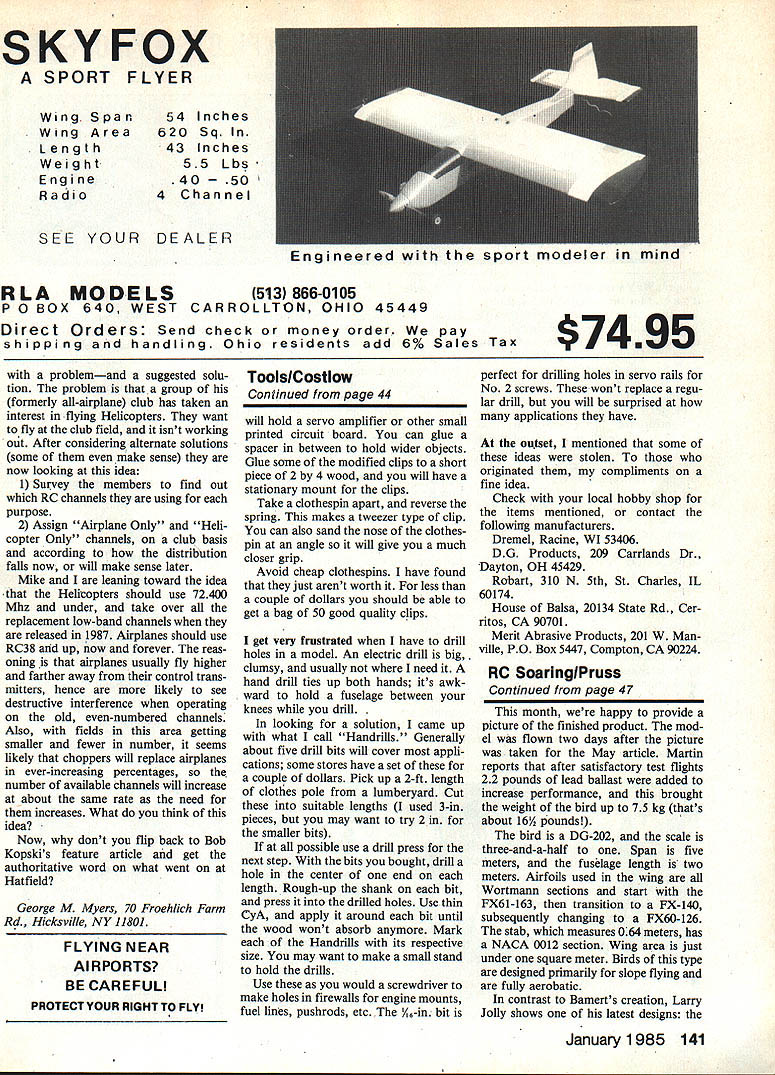
Hand-launched design
In contrast to Bamert's creation, Larry Jolly shows one of his latest designs: a finger hand-launched, two-channel ship. It weighs 13 oz and uses small, regular-size servos.
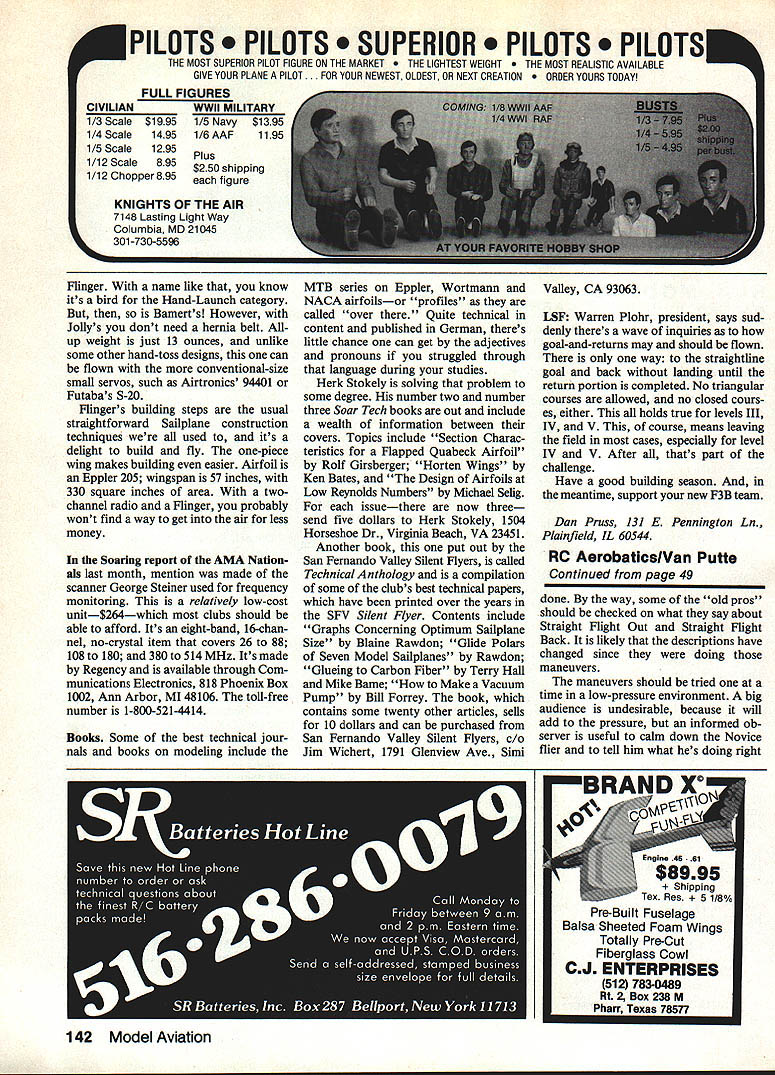
Terry Edmonds has a very neat radio installation; two nylon turnbuckles adjust the servo linkage. Ailerons and wings are clamped in place by a pair of fittings available from Ace R/C. Visible portions are the black knobs riding short slots at the wing/fuselage joint.
Frequency scanner
In the Soaring report of the AMA Nationals last month, mention was made of the scanner George Steiner used for frequency monitoring. This is a relatively low-cost unit — $264 — which most clubs should be able to afford. It's an eight-band, 16-channel, no-crystal item that covers 26–88; 108–180; and 380–514 MHz. It's made by Regency and is available through Communications Electronics, 818 Phoenix Box 1002, Ann Arbor, MI 48106. The toll-free number is 1-800-521-4414.
Books
Some of the best technical journals and books on modeling include the MTB series on Eppler, Wortmann and NACA airfoils — or "profiles" as they are called "over there." Quite technical in content and published in German, there's little chance one can get by the adjectives and pronouns if you struggled through that language during your studies.
Herk Stokely is solving that problem to some degree. His number two and number three Soar Tech books are out and include a wealth of information between their covers. Topics include:
- "Section Characteristics for a Flapped Quabeck Airfoil" by Rolf Griesberger
- "Hornet Wings" by Ken Bates
- "The Design of Airfoils at Low Reynolds Numbers" by Michael Seig
For each issue — there are now three — send $5 to Herk Stokely, 1504 Horseshoe Dr., Virginia Beach, VA 23451.
Another book, put out by the San Fernando Valley Silent Flyers, is called Technical Anthology and is a compilation of some of the club's best technical papers, printed over the years in the SFV Silent Flyer. Contents include:
- "Graphs Concerning Optimum Sailplane Size" by Blaine Rawdon
- "Glide Polar of Seven Model Sailplanes" by Blaine Rawdon
- "Gliding to Carbon Fiber" by Jerry Hall and Mike Bame
- "How to Make a Vacuum Pump" by Bill Forrey
plus some twenty other articles. The book sells for $10 and can be purchased from San Fernando Valley Silent Flyers, c/o Jim Wichert, 1791 Glenview Ave., Simi Valley, CA 93063.
LSF update
Warren Plohr, president, says suddenly there's a wave of inquiries as to how go-and-returns may and should be flown. There is only one way: to the straightline goal and back without landing until the return portion is completed. No triangular courses are allowed, and no closed courses, either. This all holds true for levels II, IV, and V. This, of course, means leaving the field in most cases, especially for level IV and V. After all, that's part of the challenge.
Have a good building season. And, in the meantime, support your new F3B team.
Dan Pruss 131 E. Pennington Ln., Plainfield, IL 60544.
Transcribed from original scans by AI. Minor OCR errors may remain.

