
Radio Control: Soaring
Dan Pruss
OVERCROWDED — In reporting any of the major contests such as the Nats or the F3B Finals, there's never enough space to cover every new idea. The events during 1984 were no exception. Back at the Reno Nats, good ideas weren't confined to the flying field; several manufacturers set up displays in the Reno Convention Center/AMA Headquarters site.
Bob Martin — kits and replacement fuselages
Bob Martin displayed a line of sleek kits, including slope and aerobatic types, and replacement fuselages for standby ships such as the Wanderer, Aquila, Oly II and Paragon. The kit and replacement fuselages are made of Dura-Lene, a material that makes the units very tough — in a landing mishap, these fuselages are unlikely to be the first parts to fail.
- The Wanderer fuselage also accommodates the Soar Bird and any wing with a 7–8 inch chord.
- The Aquila fuselage fits the Grande version.
- The Oly II/Paragon fuselage fits similar wings that have a 10 in. chord.
- Note: these replacement fuselages are original designs intended to complement wing and tail groups rather than exact duplicates of the original namesakes.
For an illustrated catalog, write: Bob Martin RC Models 11178 Penrose St., Unit 4 Sun Valley, CA 91352
A clever canopy-retention idea Bob showed is worth adapting unless you still secure canopies with rubber bands and clay. Instead of screwing through the canopy edge, two screws (one fore, one aft) are mounted on the fuselage and engage slotted holes in a heavier, more flexible canopy. The canopy can be removed quickly by flexing it, and the material resumes its original shape.
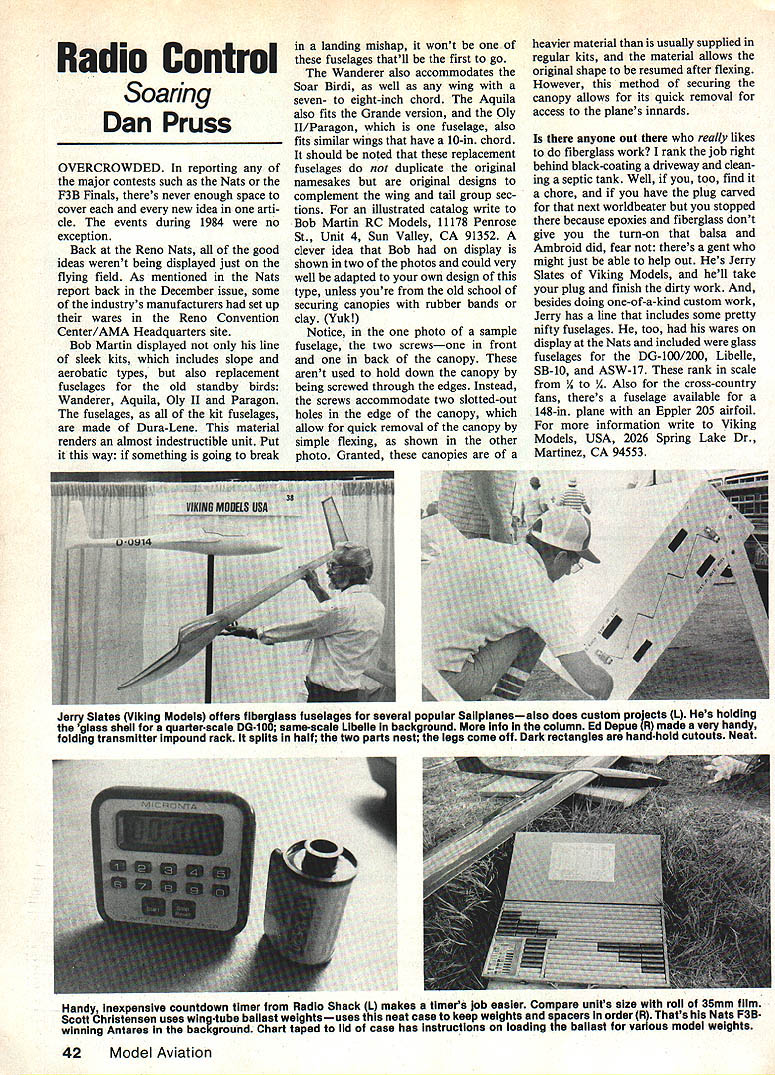
Jerry Slates / Viking Models — fiberglass finishing and fuselages
If fiberglass work is a chore for you, Jerry Slates of Viking Models will finish your plug and do the dirty work. He also produces a line of fiberglass fuselages displayed at the Nats, including models for:
- DG-100/200
- Libelle
- SB-10
- ASW-17
These are offered at scales from roughly 1/8 to 1/4. For cross-country fans, Viking also has a fuselage available for a 148 in. plane using an Eppler 205 airfoil. For information: Viking Models, USA 2026 Spring Lake Dr. Martinez, CA 94553
Scott Christensen — field ideas and hardware tricks
On the flying field, Scott Christensen showed several practical ideas:
- Tow hook: a bolted piece of hardwood on the fuselage bottom. Some pilots use fixed, unreleasable hooks tied up around the wing-rod joiner tube to keep wing and towline secure under load. A custom-made aluminum hook/clamp can be fabricated with basic tools.
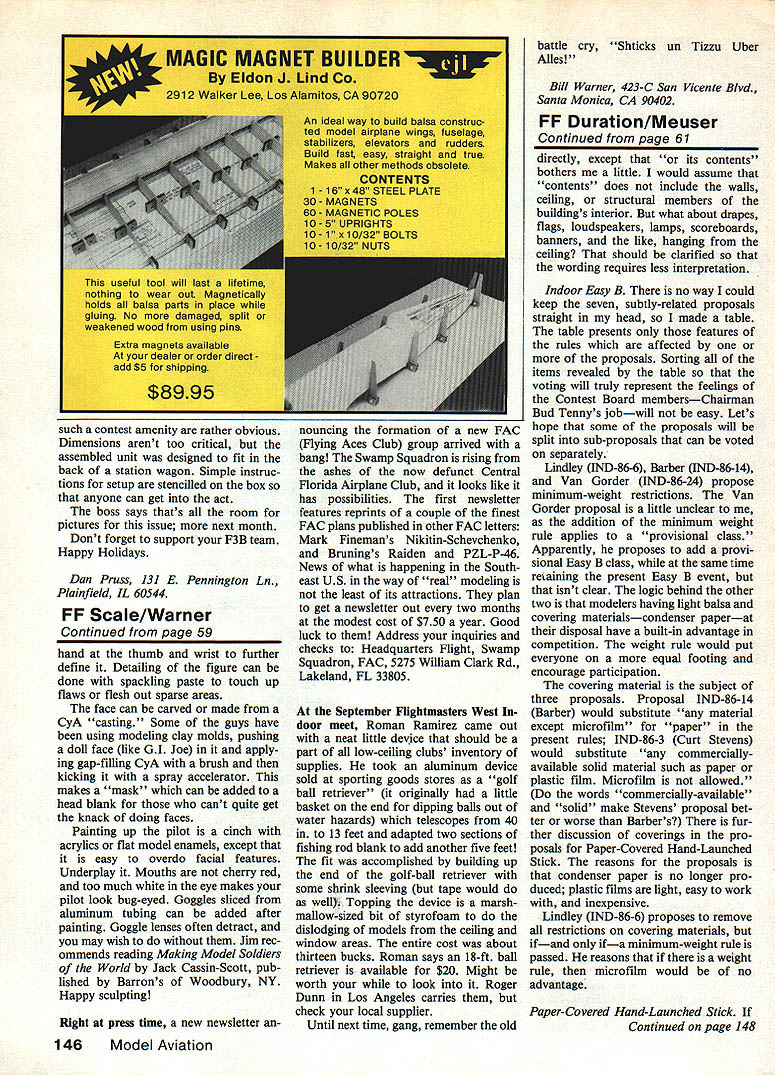
- Ballast system: Scott keeps ballast rods in several-ounce increments in a box with corresponding ballast-tube fillers. For wing ballast, hollow wing-tube sections are filled with wood dowels. He uses a quick-reference chart to determine all-up weights and wing loadings.
Radio Shack gadget — the Microetra countdown timer
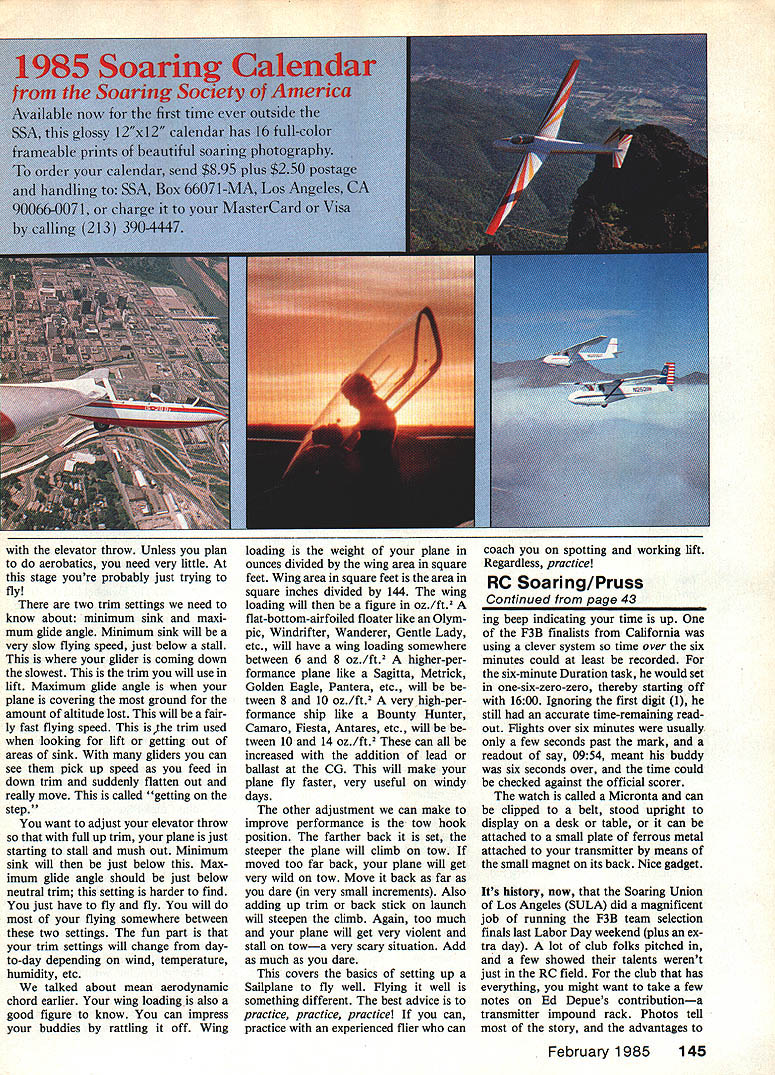
Radio Shack supplies useful switches, jacks and unusual RC hardware. One affordable gadget I noticed was a countdown timer (about $15), useful for timing tasks such as a six-minute max. Features:
- Enter time (e.g., 0600 for six minutes) and press start; the timer counts down so an assistant can read remaining time directly.
- At zero it emits a pulsating beep but does not count up.
- A clever workaround used by an F3B finalist: enter 1600 for six-minute tasks. Ignoring the leading '1' gives an accurate remaining-time display after six minutes — e.g., a readout of 09:54 means 6 seconds over.
- The Microetra clips to a belt, stands upright on a desk, or attaches via a small magnet to a ferrous plate near your transmitter.
SULA and event organization
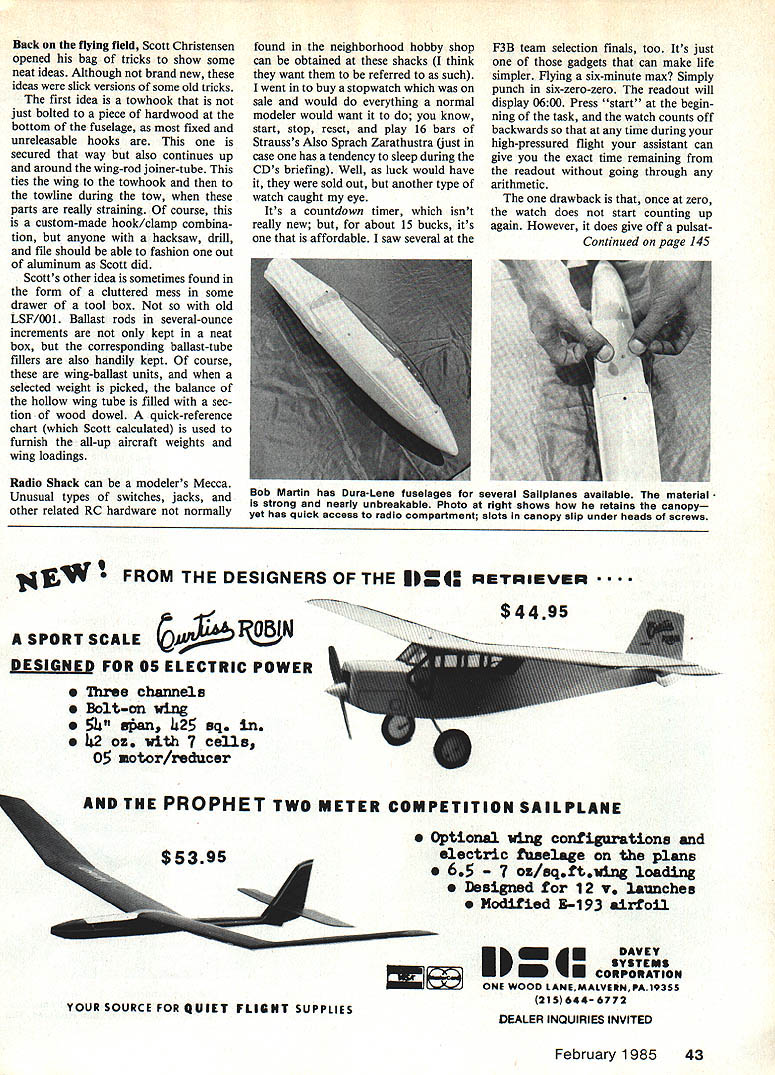
The Soaring Union of Los Angeles (SULA) ran the F3B team selection finals over Labor Day weekend and did a magnificent job. Club members contributed in many ways — one practical contribution was Ed Depue's transmitter impound rack (photos tell most of the story).
Basics of wing loading and tow-hook setup
A few setup basics that affect handling and performance:
- Wing loading calculation:
- Wing area (sq ft) = wing area (sq in) ÷ 144
- Wing loading (oz/ft²) = weight (oz) ÷ wing area (sq ft)
Typical wing-loading ranges:
- Flat-bottom floater (Olympic, Windrider, Wanderer, Gentle Lady, etc.): 6–8 oz/ft²
- Higher-performance ships (Sagitta, Metrik, Golden Eagle, Pantera, etc.): 8–10 oz/ft²
- Very high-performance ships (Bounty Hunter, Camaro, Fiesta, Antares, etc.): 10–14 oz/ft²
Adding ballast (lead at the CG) increases wing loading and makes the plane fly faster — useful in wind.
Tow-hook position:
- Moving the tow hook farther back steepens the climb on tow.
- Move it back in very small increments; too far back and the plane can become wild on tow or stall.
- Adding up trim or back stick at launch also steepens the climb but, again, too much can cause violent behavior or a tow stall.
Closing advice
These notes cover the basics of setting up a sailplane to fly well. Flying it well requires practice — ideally with an experienced flyer who can coach you on spotting and working lift. Practice, practice, practice!
Don't forget to support your F3B team.
Dan Pruss 131 E. Pennington Ln. Plainfield, IL 60544
Transcribed from original scans by AI. Minor OCR errors may remain.

