
Radio Control: Soaring
Dan Pruss
Probably the easiest way to run a contest that extends beyond your own club's boundaries is to let the Post Office do your legwork. I don't know if I would assign them any task as responsible as timing, running the impound area, or retrieving towlines — their department is hard to find on weekends and holidays — but as a Contest Director's sidekick, they can fit right in the scheme of certain events. I'm referring to postal contests.
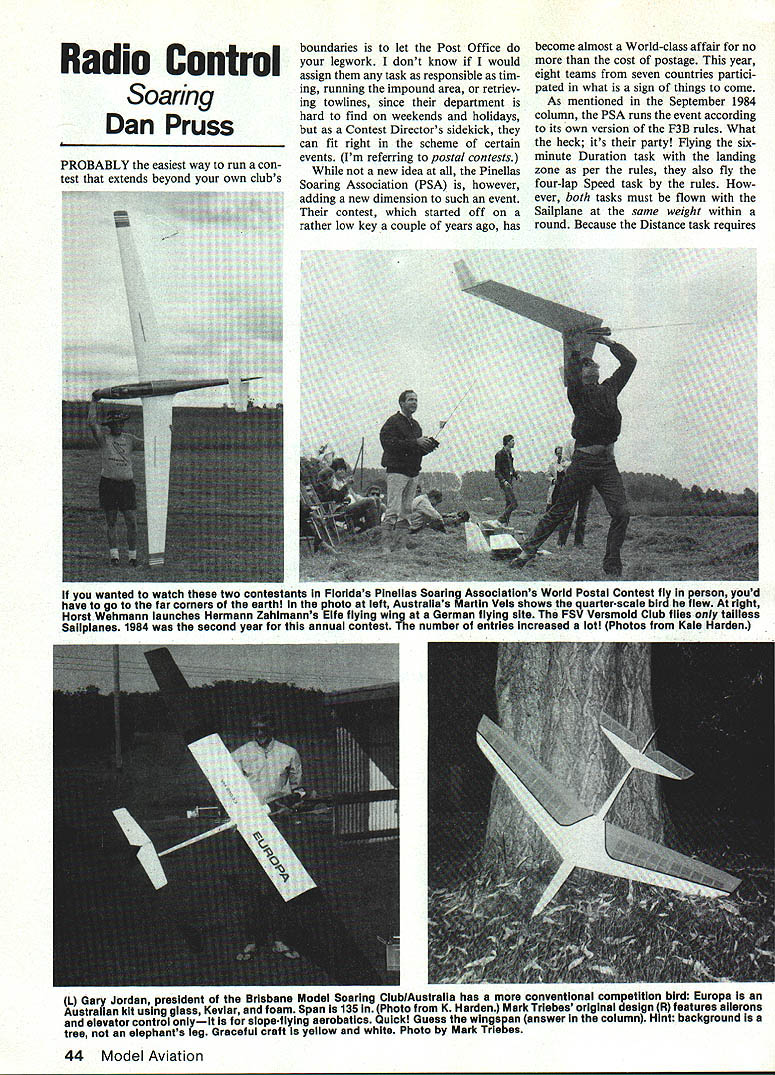
While not a new idea at all, the Pinellas Soaring Association (PSA) is adding a new dimension to such an event. Their contest, which started off rather low-key a couple of years ago, has become almost a world-class affair for no more than the cost of postage. This year, eight teams from seven countries participated in what is a sign of things to come.
As mentioned in the September 1984 column, the PSA runs the event according to its own version of the F3B rules. What the heck; it's their party! They fly the six-minute Duration task with the landing zone as per the rules, and they also fly the four-lap Speed task by the rules. However, both tasks must be flown with the sailplane at the same weight within a round. Because the Distance task requires so much manpower to run, that task isn't flown, and that makes this event even more appealing to smaller clubs.
Top flier this year, at the third running of the event, was Enrico Vetterman of Germany with 7,730 points out of a possible 8,000 for four rounds of flying. He also had the best speed run of 25.0 seconds. John Gunsullus of the PSA finished second with 7,073 points, and third was John Lightfoot of South Africa with 7,068 points.
Teams are each comprised of five fliers. Top teams were:
- Southern Soaring Club of South Africa — 30,800 out of a possible 40,000 points.
- PSA / U.S.A.
- Germany
- Australia
- England
- Chile
- Germany (again — a team that flew only flying wings)
- New Zealand
With an event that is spread around the world, weather is an important factor, and sometimes even a rain date can backfire on a team. But those affected take their lumps, send in their scores, and wait to see how they fared. It's rather refreshing to see an event where protesters could have a field day — instead, a modeler's word in the form of an airmailed score sheet is accepted and rarely questioned.
So, if you or your club would like to compete — just for the fun of it — in a worldwide event without straying too far from your own clubhouse, get in contact with the Pinellas Soaring Association. Write to Kale Harden, 3184 Brunswick Circle, Palm Harbor, FL 33563, U.S.A.
Mariah — a one-meter design
Mark Triebes (Saratoga, CA) sent in a shot of one of a series of his own designs. This one he calls Mariah. And just in case you thought that is a very large tree supporting the Mariah — it's not. The Mariah is a one-meter bird. It weighs only 16 ounces and is very aerobatic on ailerons and elevator, its only control surfaces. It was designed to be flown on a slope. Construction is very basic, using balsa and Airply; covering is MonoKote.
Over the past several months we've covered five-meter birds, a few fours, lots of threes, some twos, and now a one. The next step is obviously a no-meter bird! Send in your best shots of one, and our expert panel will determine the best of class.
Thousand Oaks Soaring Society — Western Great Race
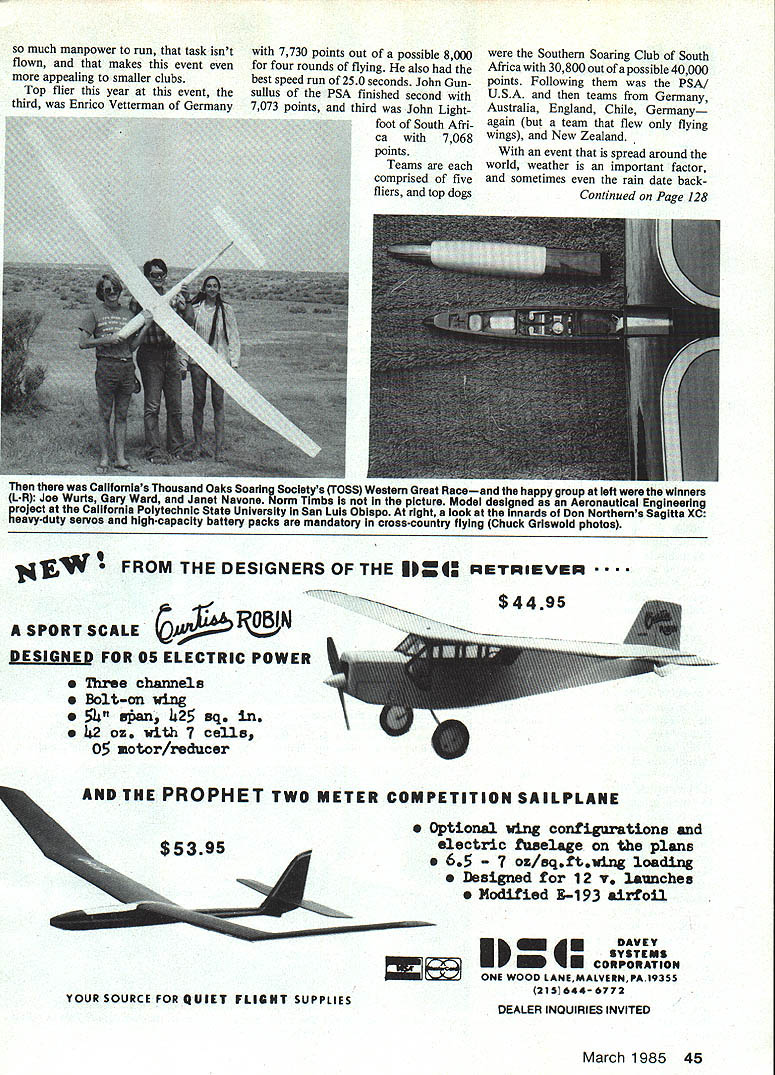
Without a doubt, one of the most successful cross-country events of 1984 was the Thousand Oaks Soaring Society's (TOSS) Western Great Race. Here are some of the things they had going for them:
- The site was Taft — synonymous with Free Flight and its great contests, an area with miles and miles of open country.
- Thirteen teams entered sailplanes which were a cross section of five cross-country flying machines.
Included were Larry Jolly's new design (soon to be kitted) Comet, a bird with a wingspan of nearly 15 feet. The airfoil is the Eppler 205, the fuselage is fiberglass, and it's large enough to carry all your radio gear plus a small lunch.
There were Geminis, modified Sagitta XCs, a Merlyn, and several original designs. A stretched Gemini sported a 12-foot wing with a Mike Bame–designed airfoil. The course was a goal-and-return totaling 20 miles, and six of the 13 teams finished it. If you keep score by airfoils used, reports from TOSS president Chuck Griswold say the Eppler 205 did well but the Eppler 374 did better — make that best of all.
Yes, it was that airfoil on a four-meter wing on a sailplane designed by three Cal Poly aeronautical engineering students that won first place. Norm Timbs, Gary Ward, and Joe Wurts combined their talents, and the three beat all comers. The plane, called the Silent Knight, was flown at the maximum FAI weight limit of five kilograms (11 lb.).
And it truly was a race. The winning team flew its bird over the 20-mile course in 00:44:43, which was only 28 seconds faster than the second-place team of Art Ames, Wayne Meredith, and Ken and Pattie Sinclair of TOSS with their Comet. It took Bob Goldie, Keith Kindrick, and Trent McGee only 00:50:44 to cover the 20 miles with their Gemini, and that was good enough for third place.
Larry Jolly was only a minute and 46 seconds behind, and his Comet finished exactly one minute ahead of John Lewis, Dick Madison, Clarence Nikell, and Vern Oldershaw and their Merlyn. Sixth place went to another TOSS team of Percy Megginson and Bret and Don Northern with their Sagitta XC; their time was 01:04:44.
As one can tell from the times logged, this one had excitement! If you want to be a part of it next summer, contact TOSS for details. Write to Chuck Griswold, TOSS President, Thousand Oaks Soaring Society, P.O. Box 1955, Thousand Oaks, CA 91360.
Support the U.S.A. F3B team
In the meantime, support your U.S.A./F3B team. The contest is on the early side of the year this time. In April, Mike Reagan, Mike Barne, and Steve Neu with team manager Blaine Rawdon will head for Australia. Your contributions will help. For each five dollars contributed, you'll receive a patch you can wear to help show your support. Whether you're a weekend warrior or a contest chaser, you will benefit from your team's efforts. Send your contributions to Ms. Helen Otis, U.S.A./F3B Fund-Raising Manager, 8875 Oveida Plaza, Westminster, CA 92683.
Good lift.
Dan Pruss 131 E. Pennington Ln. Plainfield, IL 60544
Transcribed from original scans by AI. Minor OCR errors may remain.

