
Radio Control: Soaring
Dan Pruss
Computer people, pay attention! Chuck Anderson of Tullahoma, TN sent a letter—too long for reprint here—but worth more than a mere mention. Pictures of Chuck and his models have appeared in this column a few times. A while back he showed a couple of winglet designs; these were at the 1982 AMA Nationals (see Model Aviation, November 1982).
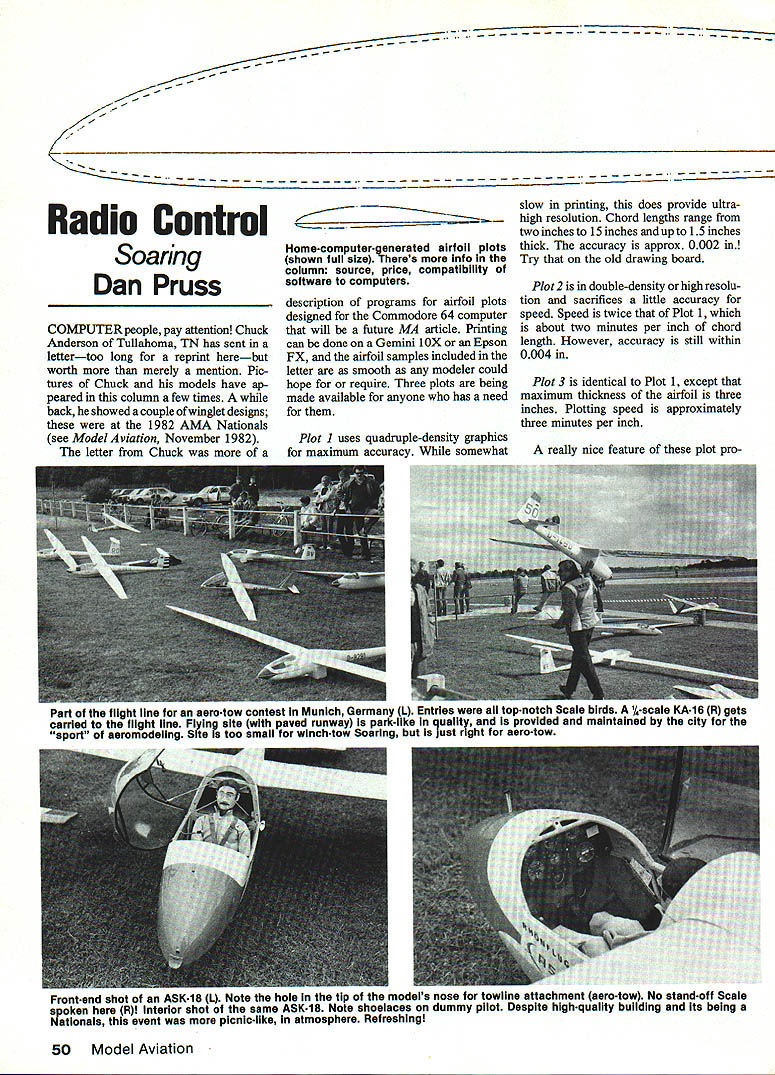
The letter from Chuck described programs for airfoil plots written for the Commodore 64 that will be a future Model Aviation article. Printing can be done on a Gemini 10X or an Epson FX, and the airfoil samples included in the letter are as smooth as any modeler could hope for or require. Three plot options are being made available for anyone who needs them.
Airfoil plot options
- Plot 1: Uses quadruple-density graphics for maximum accuracy. While somewhat slow in printing, this provides ultra-high resolution. Chord lengths range from 2 inches to 15 inches and up to 1.5 inches thick. The accuracy is approximately 0.002 in.
- Plot 2: Uses double-density (high resolution) and sacrifices a little accuracy for speed. Printing speed is twice that of Plot 1 — about two minutes per inch of chord length. Accuracy is still within 0.004 in.
- Plot 3: Identical to Plot 1 except that maximum thickness of the airfoil is 3 inches. Plotting speed is approximately three minutes per inch.
A useful feature of these programs is a selectable skin-thickness option: a dotted line is plotted offset inside the airfoil contour to show skin thickness. This skin feature is reproduced in the figure beginning the column. Data files in the complete package Chuck furnishes include nearly 40 airfoils, among them Eppler and Quabeck series, plus Barnes, Selig, Wortmann and the Clark-Y.
The Airfoil Plot Program package supplied either on disk or tape consists of four programs written in BASIC. Data files and a test pattern of four airfoils are included. The complete package supplied on disk includes 37 airfoils.
- Cost: basic package $10; complete package $20.
- For further information contact: Chuck Anderson, 202 Inglewood Circle, Tullahoma, TN 37388.
Back in the dark ages of RC soaring, when most of us were just spinoffs from power clubs, we usually had to share the flying site. That was long before 10-minute maxes were the norm rather than the exception. There were too few frequencies then to try for an LSF Level II 15-minute-duration flight with some non-glider type pointing his finger at an "air hog"—especially. When a channel or flying field was crowded, thirty-minute flights further reduced any Power/Soaring compatibility to car pools, church picnics, and some trade shows.
Judging from some of the newsletters that come this way, there again might be harmony between the two groups—if you can stand the noise, unadulterated or muffled. With flying fields giving way to high-rises, highways, and hybrid crops, teaming up might be one means of survival. Surely the addition of new frequencies makes it all the more manageable. However, one still might have trouble with an LSF Level V two-hour duration flight on a Sunday afternoon.
Aero-towing in Munich
Last September I witnessed a soaring meet where "teaming up" was the only way to fly, and that lasted for two whole days because it was a national contest. I'm referring to aero-towing.
An event like this is where powered planes tow sailplanes to altitude for release. Although this has been tried in the U.S.A. quite successfully (but only on an experimental or sport level), it is, in at least two countries (France and Germany), a quite popular event.
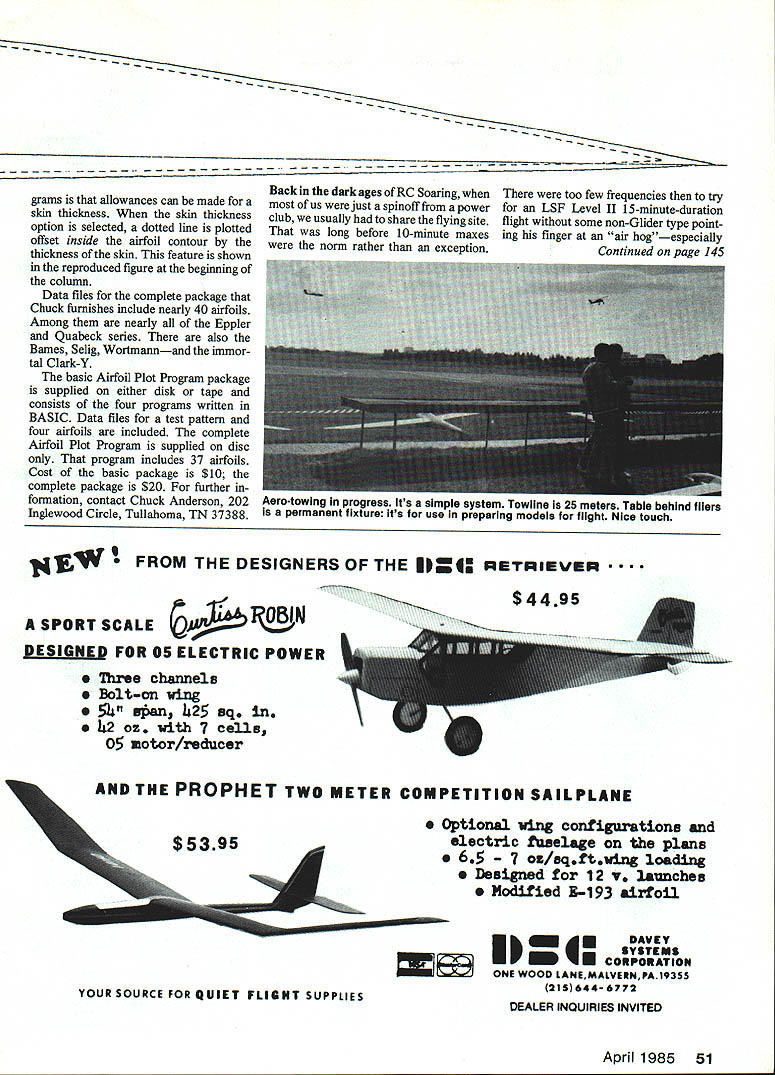
In Munich last September the event featured scale powered aircraft towing scale sailplanes. For the most part the sailplanes were quarter-scale. The powered planes included a Pitts, a Polish Wilga, and several Super Cubs. These tow planes were from a Munich aero club whose flying site is provided by the city.
Although the site is too small for sailplane flying as we know it because of line-length requirements, it's nearly perfect for the aero-tow event. Trimmed grass and a paved runway help, not to mention a well-equipped clubhouse designed very well on the inside for rainy days.
Because of intermittent rain for two days, it was difficult to get all the coverage I had hoped for. Not all the sailplanes were set up at once; at one time there were 18 in the pit area and more in cars, vans, or under plastic sheets.
Launch system and procedures
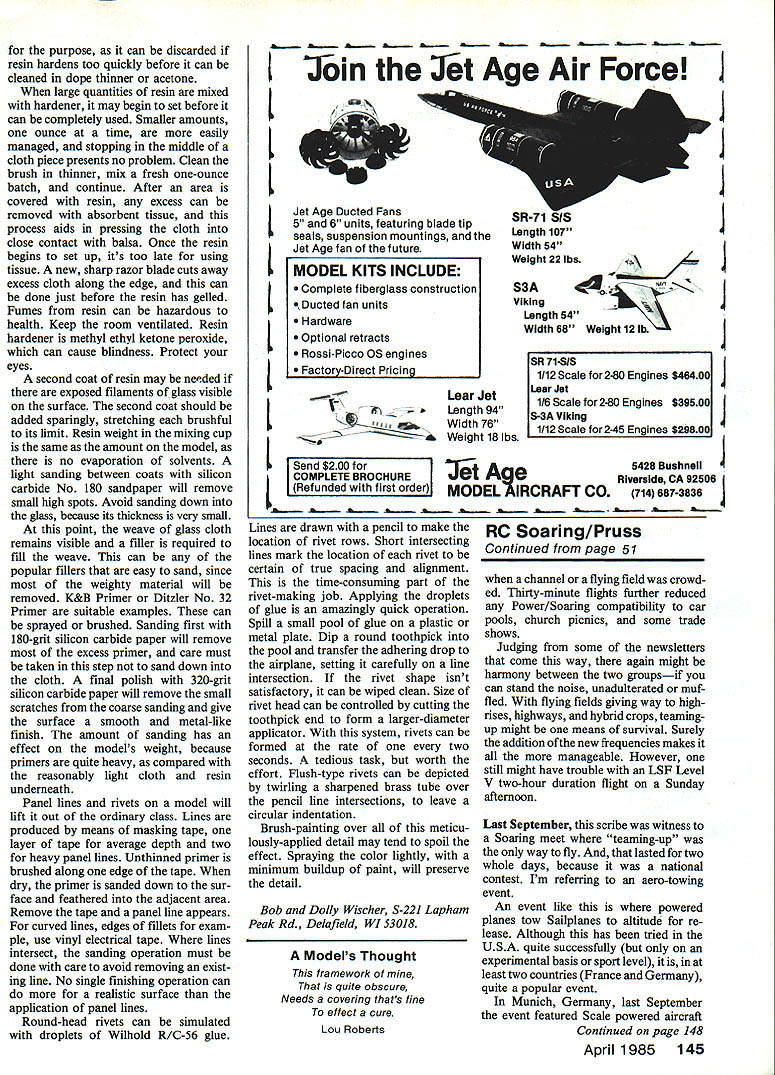
The mechanics of the aero-tow setup and launch procedures were simple and, after a few repetitions, as routine as the 300th launch on your Paragon.
- A 25-meter length of heavy-duty monofilament line was used. This type of line is common to European fliers; 100-lb nylon line would serve quite well.
- All tow planes were equipped with top-mounted wings. A simple servo-operated release mechanism was mounted on top of the wing at the center of gravity, which placed the attach point close to the center of drag.
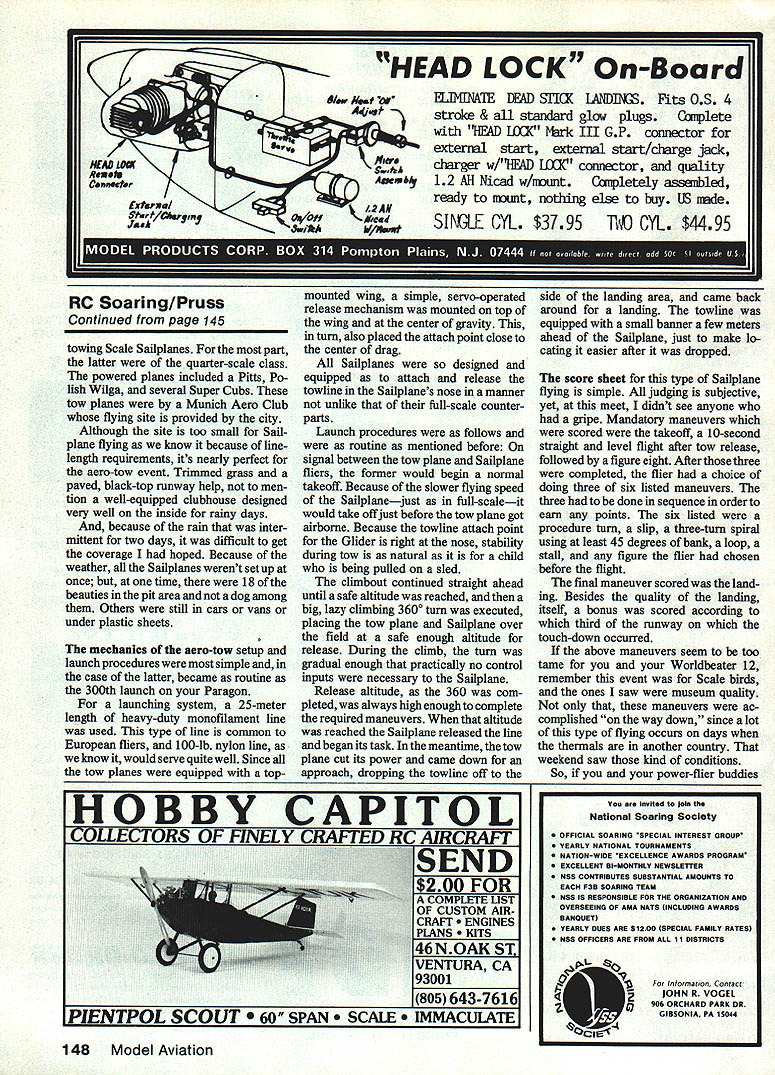
- All sailplanes were equipped to attach and release the towline in the nose, similar to full-scale practice.
Launch procedure:
- On signal between the tow-plane and sailplane pilots, the tow plane began a normal takeoff.
- Because of the sailplane's slower flying speed, it would take off just before the tow plane got airborne.
- Climbout continued straight ahead until a safe altitude was reached, then a big, lazy climbing 360° turn was executed, placing both aircraft over the field at a safe altitude for release.
- During the gentle climb and turn, practically no control inputs were necessary for the sailplane.
- At the completion of the 360°, the sailplane released the line and began its task.
- The tow plane cut power, came down for an approach, dropped the towline off to the side of the landing area, and returned for landing. The towline was equipped with a small banner a few meters ahead of the sailplane to make locating it easier after it was dropped.
Competition scoring and maneuvers
Scoring for this type of sailplane flying is subjective but straightforward. Mandatory maneuvers scored were:
- The takeoff
- A 10-second straight-and-level flight after tow release
- A figure eight
After those three, the pilot chose three of six listed maneuvers. The three chosen had to be done in sequence to earn points. The six listed maneuvers were:
- Combined turns
- A slip
- A three-turn spiral using at least 45 degrees of bank
- A loop
- A stall
- Any figure the pilot had chosen before the flight
The final scored maneuver was the landing. Besides judging the quality of the landing itself, a bonus was awarded according to which third of the runway the touchdown occurred on.
If the above maneuvers seem too tame for you and your Worldbeater 12, remember this event was for scale birds, and the ones I saw were museum quality. Not only that, these maneuvers were accomplished "on the way down," since much of this flying occurs on days when the thermals are lacking. That weekend saw those kinds of conditions.
So, if you and your power-flier buddies want to try something different and exciting for both ends of the towline, try aero-towing. You don't have to start off with any exotic, mega-buck scale bird. Dust off that old floater, rig it with a simple tow release in the nose, and have at it. For a tow bird you want a workhorse rather than some sleek pattern ship. The gents in Munich were using engines with .60 to .90 cu. in. displacements on fifth- to quarter-scale ships. And, if you really want some fun, challenge your launching partner to a spot-landing contest. He has to make it dead stick; after all, you are! You might not get the old flying field back, but you're almost sure to win a free lunch from him.
Notes
In the January column I mentioned some fine publications that were available but gave the wrong price on one of them. The SF/VSF Technical Anthology goes for $12.50, not $10 as was stated.
Have you sent in some money to support your U.S.A. F3B team? Good lift.
Dan Pruss 131 E. Pennington Ln. Plainfield, IL 60544
Transcribed from original scans by AI. Minor OCR errors may remain.

