
Radio Control: Soaring
Dan Pruss
If your club has run all the contests it has CDs for, the awards banquet is behind you, and the building season—call that winter in areas where oranges don't grow—has you suffering from cabin fever, here's a suggestion: host and conduct a symposium.
For the second consecutive year, the Madison Area Radio Control Society (MARCS) did just that, and last November this group outdid the one they conducted a year ago. That earlier event was scheduled for only one day and had everyone clamoring for more. This year, the two-day schedule still had everyone asking for more.
The MARCS Symposium
Judging from various clubs' newsletters, one of the highlights of any club meeting is the show-and-tell portion (or, as some call it, bring-and-brag). This lets any member have the spotlight without needing to be the ace of the base. The MARCS Symposium is much like that: low-key, inclusive, and focused on sharing ideas.
The weekend was all about ideas and thoughts, new models and radio equipment, new events and developments in current ones. Models ranged from hand-launch pixies to 16-foot cross-country giants, from 12-ounce lightweights to 11-pound Titans. More than 80 people from seven states and two countries attended.
Presentations and topics
After a “Welcome Aboard,” Al Scidmore (chief honcho in charge of the program) opened a mix of low-key and technical topics. Highlights included:
- Terry Edmonds (Iowa) — coverage of the AMA Nationals
- Carl Mohs — coverage of Great Britain
- Steve Bowman and Tom Kunath — coverage of Canada
- Professor Roland Stull (University of Wisconsin) — Meteorology and Thermal Soaring
- Tom Gresman — Hand-Launch Gliders
- Al Scidmore — new AMA rules proposals (followed by an hour of discussion and ballots from attendees)
- Lee Murray — Computer Programs and Stability Factors (follow-up to his laser-cut airfoils talk from the prior year)
- Steve Moskal — Scale projects (slide presentation)
These presentations filled the first day.
The Hundred Minute Club
Not everyone is a contest-chaser. Bob Johnson (Wisconsin) presented the Hundred Minute Club, a low-key, seasonal challenge that blends friendly competition with casual flying:
- Meetings are once a week on a weekday evening; flying begins at 6 p.m. or later.
- Objective: accumulate 100 minutes of flight time.
- Level progression:
- Level 1: 100 minutes total, minimum flight 1 minute.
- Level 2: 100 minutes total, minimum flight 2 minutes.
- ...progressing up to Level 5, where the minimum flight is 5 minutes.
- No maximum flight time, no spot landings.
- Eligible period: June 1 to August 31.
- No minimum number of evenings required to attain a level, but you fly only once per week.
A simple, newcomer-friendly format that keeps things honest and fun.
Table clinics and Sunday sessions
Sunday morning featured table clinics and demos with solid, practical content:
- Videotape of Bob Dodgson's sailplanes
- Dave Brown — flight simulator demonstration (the simulator showed surprising humidity effects)
- Radio gear displays from Ace, Airtronics, and Kraft
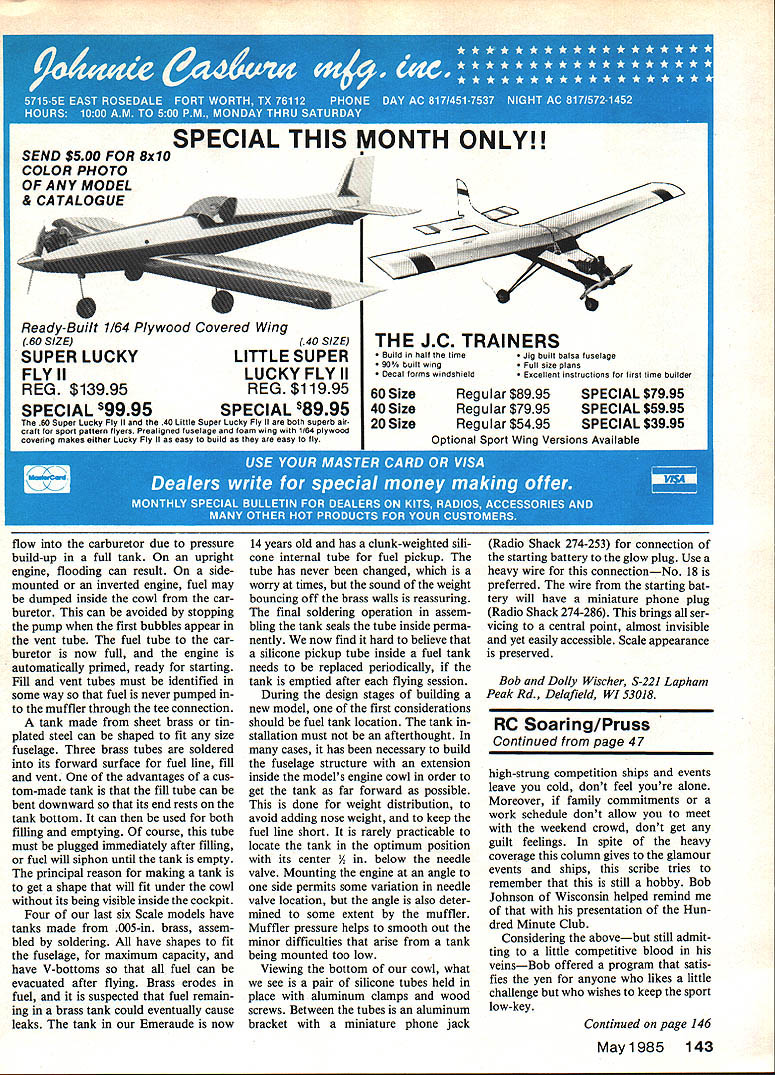
- Bob Sealy (Minnesota) — fiberglass fuselage mold and finished product
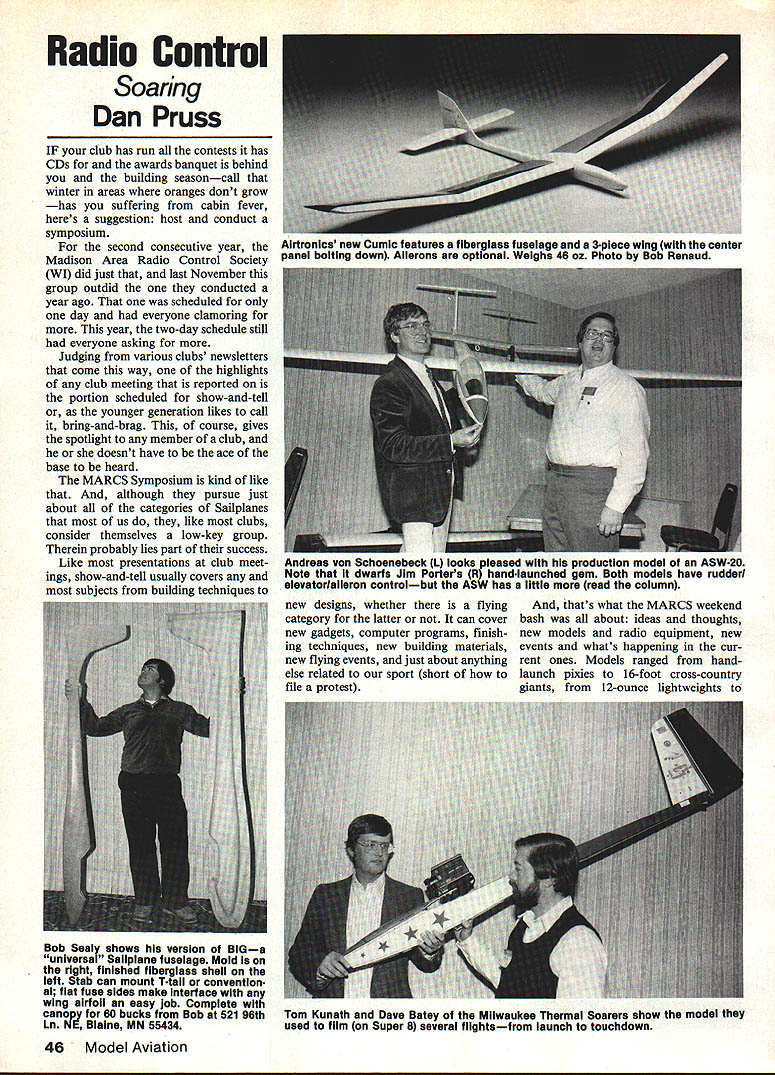
- Bob Renaud — latest Airtronics kits: the Cumic and the Adante
Kits: Cumic and Adante
When something noteworthy in kits appears, it deserves mention. The Cumic and the Adante stand out in Airtronics’ tradition of high-quality kits:
- Cumic: a polyhedral model with a three-piece wing and a top-quality fiberglass fuselage.
- Adante: a two-piece wing with a unique removable small center section; designed for multi-task flying and also with a top-quality fiberglass fuselage. The Adante is not aimed at beginners, but the construction manual is clear and well-illustrated (48 photos accompany the instructions).
Fiberglass scale ships and safety features
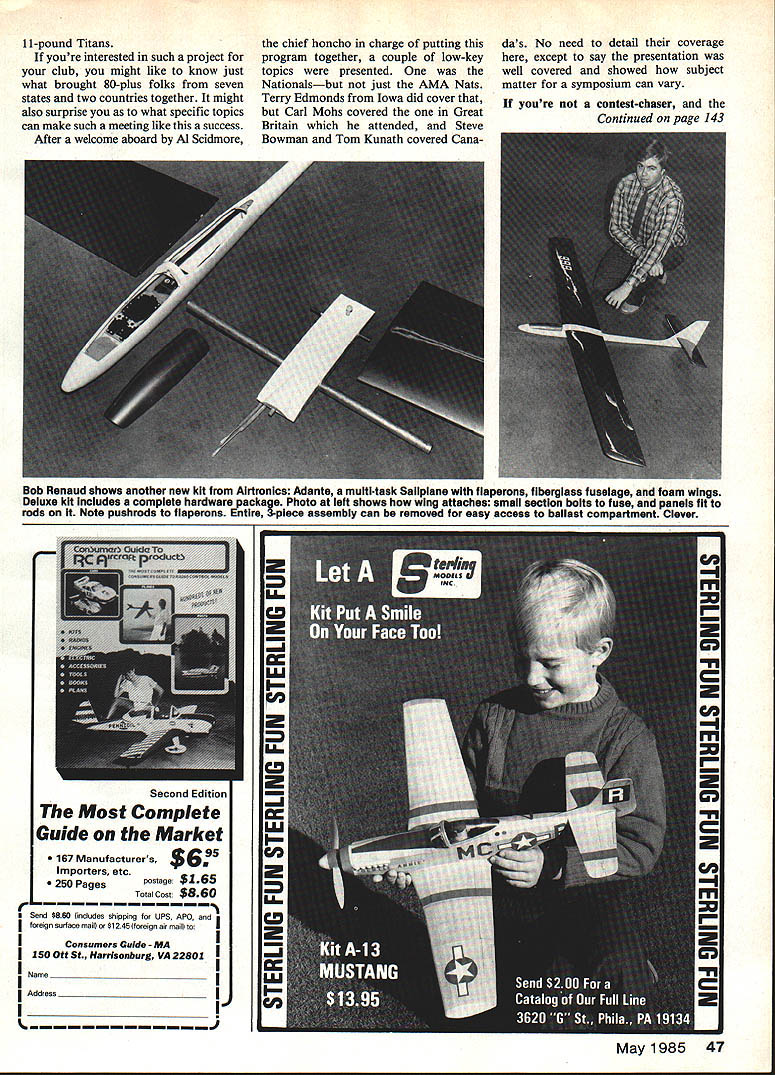
Andreas von Schoenebeck (West Germany) showed several state-of-the-art fiberglass scale ships. His ASW-20 (14.5 feet, about 11 pounds) was a show-stopper: full-house features including a tow-release in the nose for aero-towing, a releasable tow hook, retractable wheel, and a stall sensor. The sensor emitted a loud audio tone when the model approached a stall and was wired to the elevator servo so a small down input was applied automatically to help prevent the stall. These models are not cheap, but they are all-fiberglass with high-quality finishes and represent the upper end of kit construction.
Equipment, safety, and extras
The latest in radio equipment was presented by Paul Holsten, Bob Renaud, and Pete Waters. Mark Stidham discussed safety aspects of cross-country flying, emphasizing the safety of the chase vehicle and its occupants.
Other items of interest:
- An F3B question-and-answer session covered many aspects of the class.
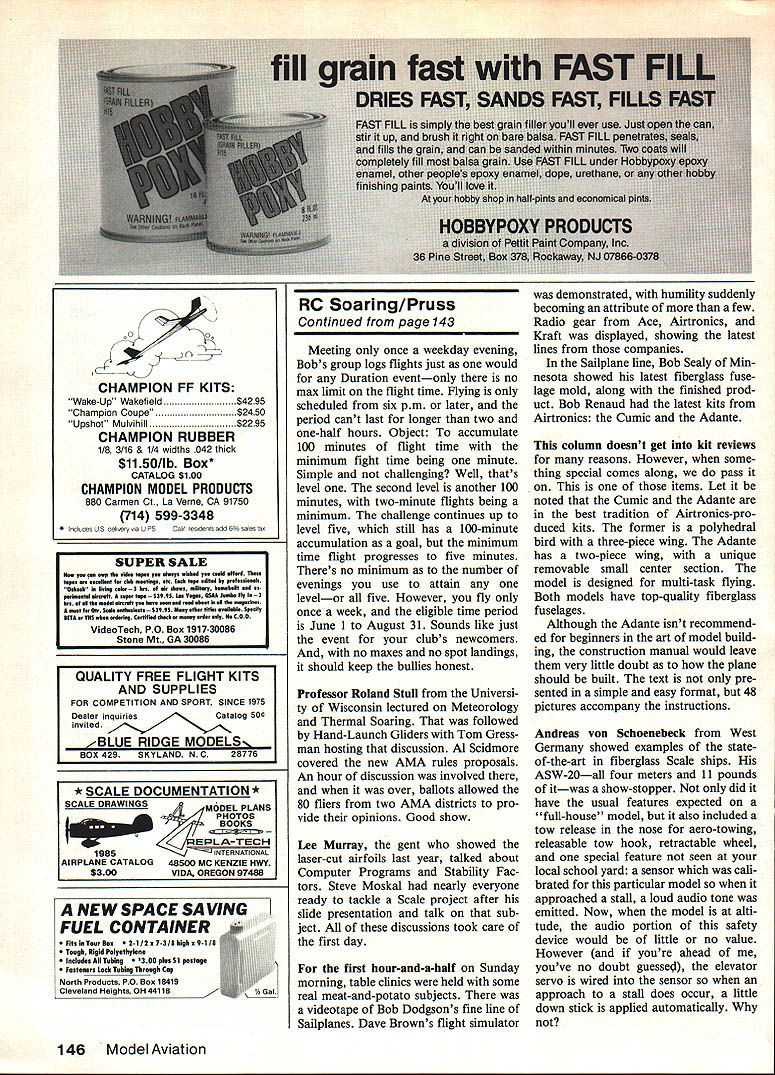
- Dave Batey (Milwaukee Thermal Soarers) showed a very good Super-8 film of thermal soaring, filmed from a camera mounted atop a sailplane.
That rounded out a two-day MARCS-style show-and-tell. It was a weekend well spent.
If your club is looking for a different kind of project, consider what MARCS did. After all, when was the last time 80 modelers got together for two days—and all went home still talking to one another?
Good lift.
Dan Pruss 131 E. Pennington Ln. Plainfield, IL 60544
Transcribed from original scans by AI. Minor OCR errors may remain.

