
Radio Control: Soaring
Dan Pruss
A Memorial to Carl Goldberg
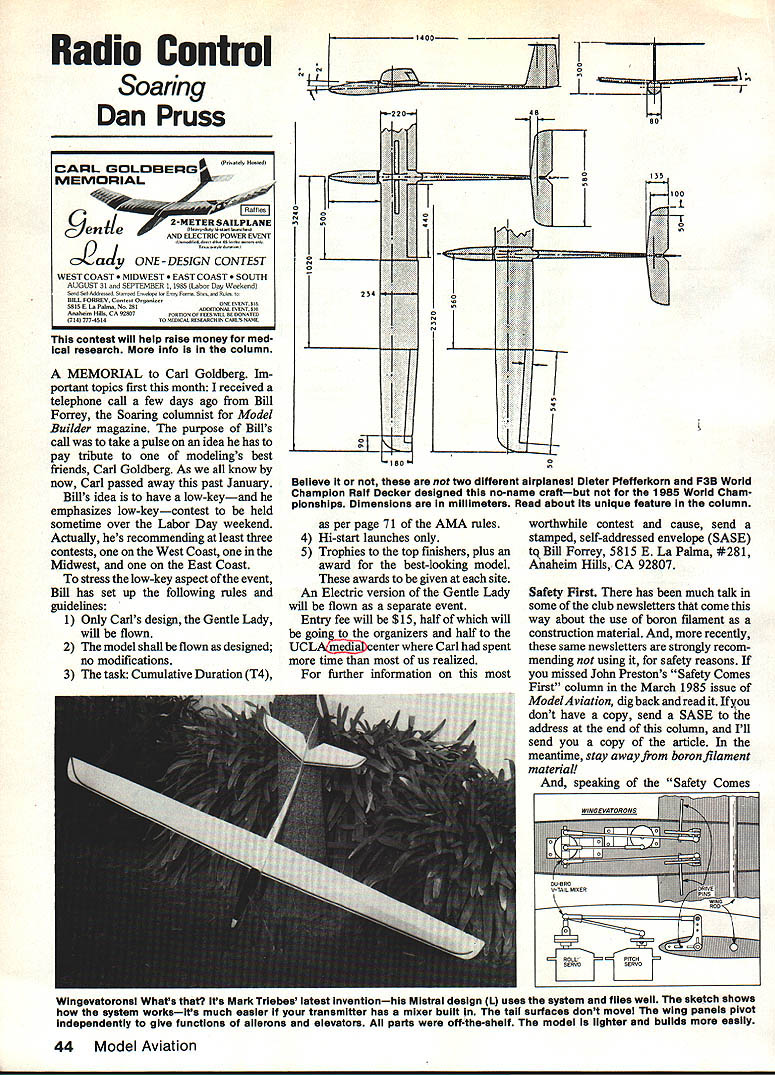
A memorial contest is being proposed to honor Carl Goldberg, who passed away this past January. Bill Forrey, the Soaring columnist for Model Builder magazine, suggests a low-key event over the Labor Day weekend — actually at least three sites (West Coast, Midwest, East Coast).
Contest rules/guidelines:
- Only Carl's design, the Gentle Lady, will be flown.
- The model shall be flown as designed; no modifications.
- The task: Cumulative Duration (T4), per the AMA rules.
- Hi-start launches only.
- Trophies to the top finishers, plus an award for the best-looking model.
- An electric version of the Gentle Lady will be flown as a separate event.
- Entry fee: $15. Half goes to the organizers; half will be donated to the UCLA Medical Center (where Carl spent more time than most of us realized).
For further information, send a stamped, self-addressed envelope (SASE) to: Bill Forrey 5815 E. La Palma, #281 Anaheim Hills, CA 92807
Safety First
There has been much discussion in club newsletters about using boron filament as a construction material. Recent newsletters recommend against it for safety reasons. If you missed John Preston's "Safety Comes First" column in the March 1985 issue of Model Aviation, dig back and read it. If you don't have a copy, send a SASE to the address at the end of this column and I'll send you a copy. In the meantime, stay away from boron filament material.
Note: The "Safety Comes First" column is presented toward the front of the magazine so readers see it early — please read it.
You Ain't Seen Nothin' Yet Department
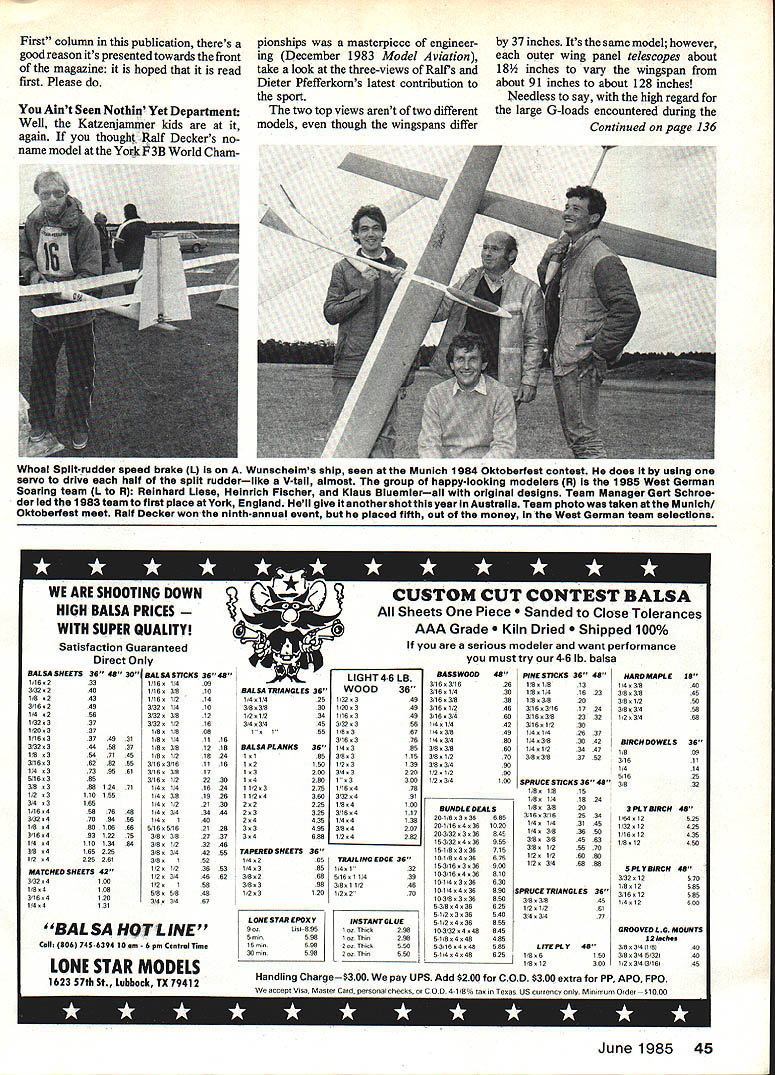
Ralf Decker and Dieter Pfefferkorn have a remarkable new design. Although two top views show different wingspans (a 37-inch difference), it's the same model: each outer wing panel telescopes about 18½ inches, varying overall wingspan from about 91 inches to about 128 inches.
Given the high G-loads encountered during F3B launches and the wing loads during the Speed task, wing safety factors are paramount. The engineering on this telescoping system is masterful. Briefly: imagine an aluminum I-beam spar with ball bearings fitted snugly on each side of the I-beam with shims; the bearings act as guides and provide almost friction-free movement for the outer panels as they telescope. The panels move via a belt-drive system driven by electric motors.
Specifications (approximate):
- Wing area: ~790 to 1,100 in²
- Aspect ratio: ~10.5 to 14.9
- Wing loading: ~1.5 ounces/ft² to ~16 ounces/ft²
More details will follow after the Australian World Championships in April. Don't expect to see this in your dealer's window soon.
Wingevators
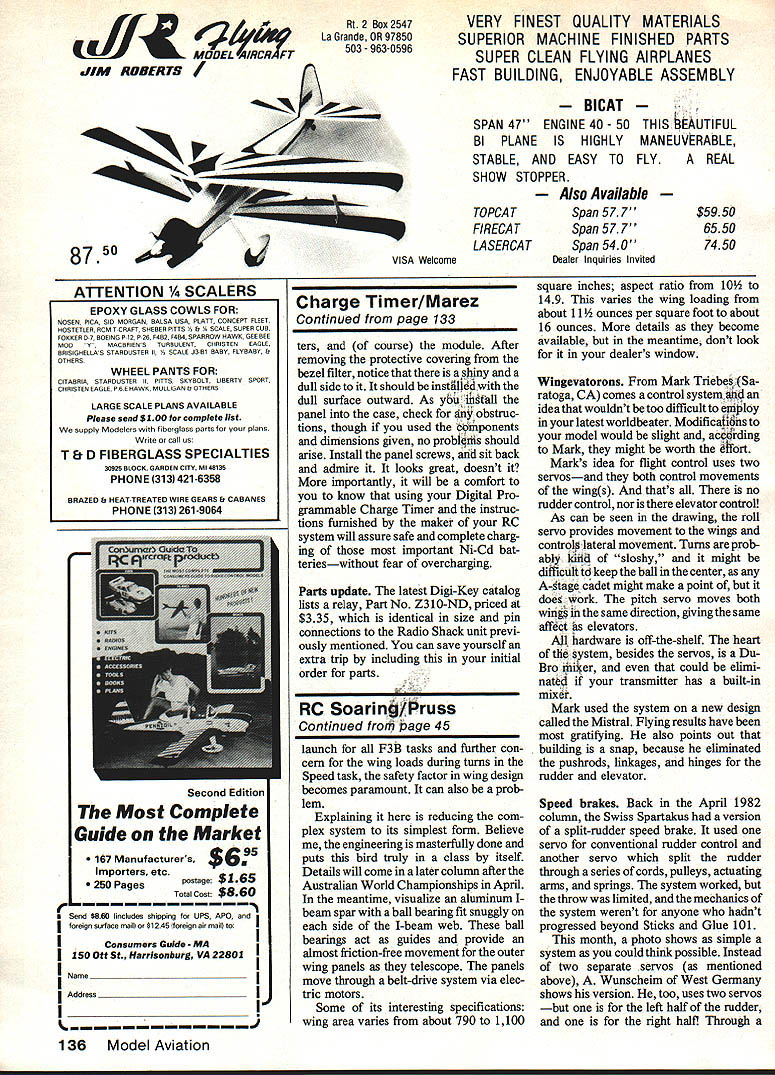
Mark Triebes (Saratoga, CA) offers a simple two-servo control system that uses only wing movement — no rudder or elevator control. One servo provides roll by moving the wings differentially; the other provides pitch by moving both wings together (functioning like elevators).
- All hardware is off-the-shelf.
- The heart of the system is a Dubro mixer, though a transmitter with a built-in mixer can eliminate the external unit.
- Mark used this system on a new design called the Mistral. Flying results have been gratifying.
- Construction is simplified by eliminating pushrods, linkages, and hinges for rudder and elevator.
Turns may feel "sloshy" and require careful ball-centering, but the concept works and is straightforward to implement.
Speed Brakes
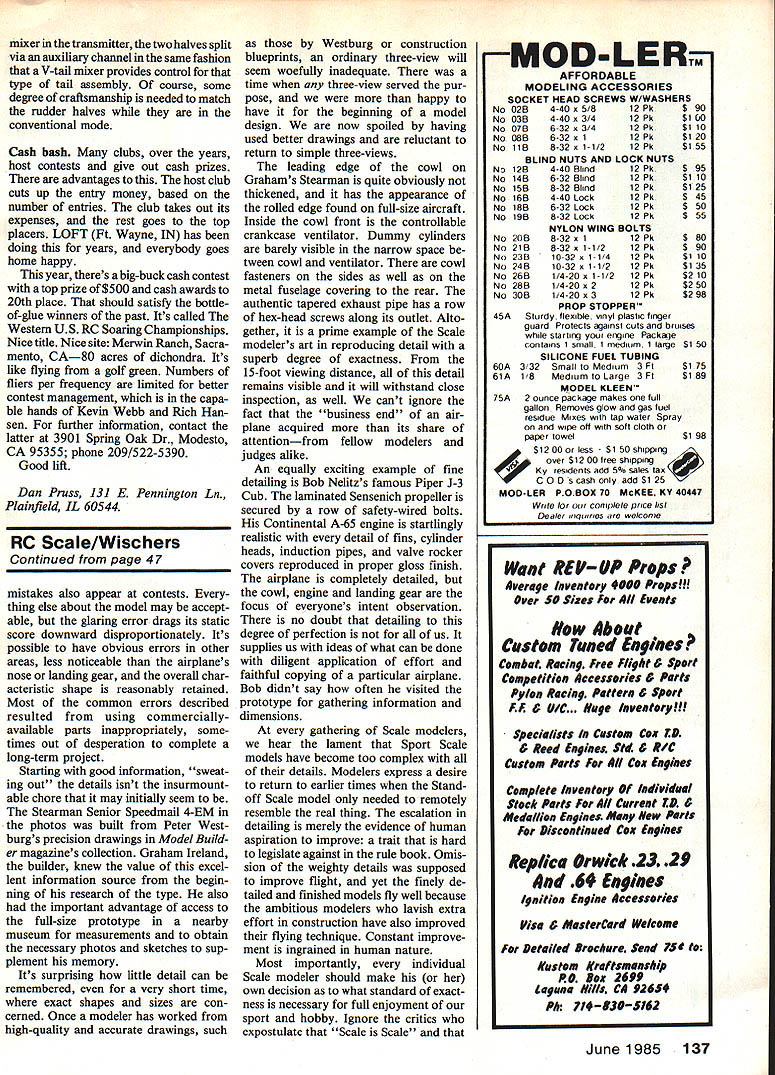
An earlier (April 1982) version on the Swiss Spartakus used a split-rudder speed brake actuated by cords, pulleys, actuating arms, and springs — mechanically complex and not for novice builders.
A simpler approach is shown by A. Wunscheim of West Germany: two servos, one controlling the left half of the rudder and one controlling the right half. Using a mixer in the transmitter and an auxiliary channel, the two halves can be split similarly to how a V-tail mixer operates. Some craftsmanship is required to match the rudder halves to form a conventional whole, but the mechanics are straightforward compared with the earlier system.
Cash Bash
Many clubs give cash prizes at contests; the host club deducts expenses and pays the top placers. LOFT (Ft. Wayne, IN) has done this for years with good results.
This year there's a big cash contest — the Western U.S. RC Soaring Championships — with a $500 top prize and cash awards down to 20th place. Site: Merwin Ranch, Sacramento, CA (80 acres of dichondra — like flying from a golf green). Numbers of fliers per frequency are limited for contest management.
Contest directors: Kevin Webb and Rich Hansen. For information, contact: Rich Hansen 3901 Spring Oak Dr. Modesto, CA 95355 Phone: 209/522-5390
Good lift.
Dan Pruss 131 E. Pennington Ln. Plainfield, IL 60544
(If you want a copy of John Preston's "Safety Comes First" column, send a SASE to the address above.)
Transcribed from original scans by AI. Minor OCR errors may remain.

