
Radio Control: Sport-Aerobatics
Ron VanPutte
AS YOU READ this the Weak Signals R/C Club is gearing up to put on the 22nd Annual Toledo R/C Exposition. The extravaganza will be held April 2, 3 and 4 at the Toledo Sports Arena. As an eager attender for many years when I was stationed near Dayton, Ohio (only 155 miles from Toledo) and near Washington, D.C. (only 500 miles from Toledo), I wish the distance from Florida to Toledo was shorter. For the last four years I've had to wait for the magazine reports to find out about all the things that were shown at the Toledo Exposition. Someday I'll be able to go again and enjoy it as much as you lucky ones who can make it there this year. Enjoy.
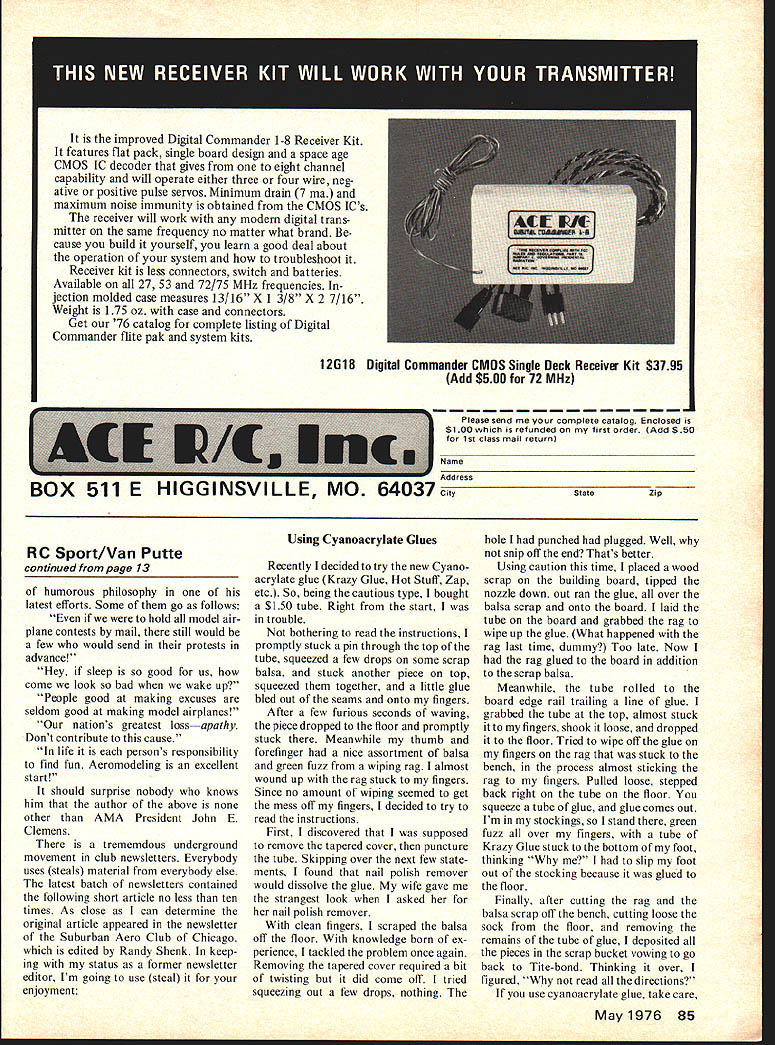
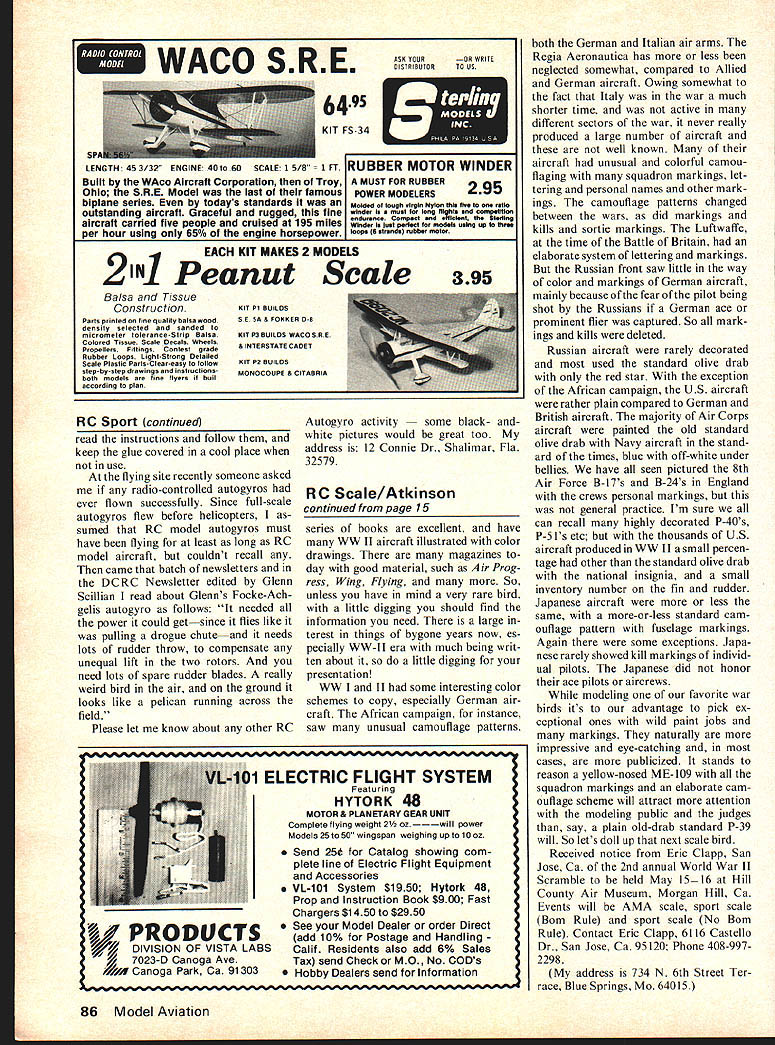
The 8th Annual Tangerine International R/C Championships at Orlando, Florida on December 27-30 proved that the combination of a cold winter up north and a good contest can draw contestants to Florida from far away. More than half the 58 contestants were from outside the state of Florida. The contestant who drove the furthest was probably Bud Weber from Wisc., but he had competition from Charlie Reed, Mo.; Don Lowe, Ohio; Dan Kowallek, Ind.; Jim Whitley, Ala.; Reeves Lippincott, S.C.; Jim Grier, Ill.; Bob Reuther, Tenn.; Ed Izzo, Conn.; Art Schroeder, N.J. and others from as far away as Mich. and Penn.
The contest was characterized by high winds and magnificent flying by the best of the D Expert fliers. I heard several less-competent fliers mumbling about how the wind didn't seem to affect the experts. One of those doing the mumbling was me.
This was the last contest which used the old pattern maneuver schedules. Winners of the pattern events were: D Expert, Whitley; D Novice, Podzlinski; B, Carpenter; A, Stennis.
Don Lowe suffered a tragic loss in Orlando, but the lesson may well save the rest of us unnecessary anguish and expense. Don brought two helicopters to Orlando with him in addition to his two Phoenix 6 competition airplanes. His Heli-Baby and Bell Jet Ranger helicopters were left in his motel room when he and his wife, Clara, went out to do some sightseeing on New Year's Day. When they returned, the helicopters were gone. Whoever got into the room probably used a key since there were no signs of forced entry.
To his dismay Don discovered that a card on the motel door specified that the motel's liability was $100 since he hadn't reported the existence and the value of the helicopters to the front office. If he had reported their existence and value, the motel's liability would have been $500. Any item worth more than $500 should have been safeguarded by being placed in their safe. Can you imagine the response he would have received if he had asked to have his helicopters placed in the safe?
To top off the tragedy, Don is not sure whether his homeowner's insurance will cover the loss.
The lesson is obvious to all of us who take airplanes, radio gear, cameras and other valuables on vacations and to contests: we should read that little card in the motel room and comply with the instructions and be sure that our insurance will cover any loss in excess of the motel's liability.
Several readers have written to ask for more information on the addition of an OS Max 10 R/C carburetor to a TD .049 by Jim Griffin (January 1976 Model Aviation). Jim will be happy to share his experience with you; his address is: 14 Linwood Ave., Fort Walton Beach, Fla. 32548.
The U.S. Mail brought me a huge shipment of R/C oriented newsletters from across the country this month and I'd like to share parts of some of them with you. J. Fred Simmons, editor of the newsletter for the Central Virginia Radio Control Association, included several tidbits.
RC Sport/Van Putte
of humorous philosophy in one of his latest efforts. Some of them go as follows:
"Even if we were to hold all model airplane contests by mail, there still would be a few who would send in their protests in advance!"
"Hey, if sleep is so good for us, how come we look so bad when we wake up?"
"People good at making excuses are seldom good at making model airplanes!"
"Our nation's greatest loss—apathy. Don't contribute to this cause."
"In life it is each person's responsibility to find fun. Aeromodelling is an excellent start!"
It should surprise nobody who knows him that the author of the above is none other than AMA President John E. Clements.
There is a tremendous underground movement in club newsletters. Everybody uses (steals) material from everybody else. The latest batch of newsletters contained the following short article no less than ten times. As close as I can determine the original article appeared in the newsletter of the Suburban Aero Club of Chicago, which is edited by Randy Shenk. In keeping with my status as a former newsletter editor, I'm going to use (steal) it for your enjoyment.
Using Cyanoacrylate Glues
Recently I decided to try the new Cyanoacrylate glue (Krazy Glue, Hot Stuff, Zap, etc.). So, being the cautious type, I bought a $1.50 tube. Right from the start, I was in trouble.
Not bothering to read the instructions, I promptly stuck a pin through the top of the tube, squeezed a few drops on some scrap balsa, and stuck another piece on top, squeezed them together, and a little glue bled out of the seams and onto my fingers.
After a few furious seconds of waving, the piece dropped to the floor and promptly stuck there. Meanwhile my thumb and forefinger had a nice assortment of balsa and green fuzz from a wiping rag. I almost wound up with the rag stuck to my fingers. Since no amount of wiping seemed to get the mess off my fingers, I decided to try to read the instructions.
First, I discovered that I was supposed to remove the tapered cover, then puncture the tube. Skipping over the next few statements, I found that nail polish remover would dissolve the glue. My wife gave me the strangest look when I asked her for her nail polish remover.
With clean fingers, I scraped the balsa off the floor. With knowledge born of experience, I tackled the problem once again. Removing the tapered cover required a bit of twisting but it did come off. I tried squeezing out a few drops, nothing. The hole I had punched had plugged. Well, why not snip off the end? That's better.
Using caution this time, I placed a wood scrap on the building board, tipped the nozzle down, out ran the glue, all over the balsa scrap and onto the board. I laid the tube on the board and grabbed the rag to wipe up the glue. (What happened with the rag last time, dummy?) Too late. Now I had the rag glued to the board in addition to the scrap balsa.
Meanwhile, the tube rolled to the board edge, trailing a line of glue. I grabbed the tube at the top, almost stuck it to my fingers, shook it loose, and dropped it to the floor. Tried to wipe off the glue on my fingers on the rag that was stuck to the bench, in the process almost sticking the rag to my fingers. Pulled loose, stepped back right on the tube on the floor. You squeeze a tube of glue, and glue comes out. I'm in my stockings, so I stand there, green fuzz all over my fingers, with a tube of Krazy Glue stuck to the bottom of my foot, thinking "Why me?" I had to slip my foot out of the stocking because it was glued to the floor.
Finally, after cutting the rag and the balsa scrap off the bench, cutting loose the sock from the floor, and removing the remains of the tube of glue, I deposited all the pieces in the scrap bucket vowing to go back to Tite-bond. Thinking it over, I figured, "Why not read all the directions?"
If you use cyanoacrylate glue, take care.
RC Sport (continued)
read the instructions and follow them, and keep the glue covered in a cool place when not in use.
At the flying site recently someone asked me if any radio-controlled autogyros had ever flown successfully. Since full-scale autogyros flew before helicopters, I assumed that RC model autogyros must have been flying for at least as long as RC model aircraft. But I couldn't recall anyone who had been flying one. Then came that batch of newsletters and in the DCRC Newsletter edited by Glenn Scillian I read about Glenn's Focke-Achgelis autogyro as follows: "It needed all the power it could get—since it flies like it was pulling a drogue chute—and it needs lots of rudder throw, to compensate any unequal lift in the two rotors. And you need lots of spare rudder blades. A really weird bird in the air, and on the ground it looks like a pelican running across the field."
Please let me know about any other RC Autogyro activity—some black-and-white pictures would be great too. My address is: 12 Connie Dr., Shalimar, Fla. 32579.
Transcribed from original scans by AI. Minor OCR errors may remain.

