
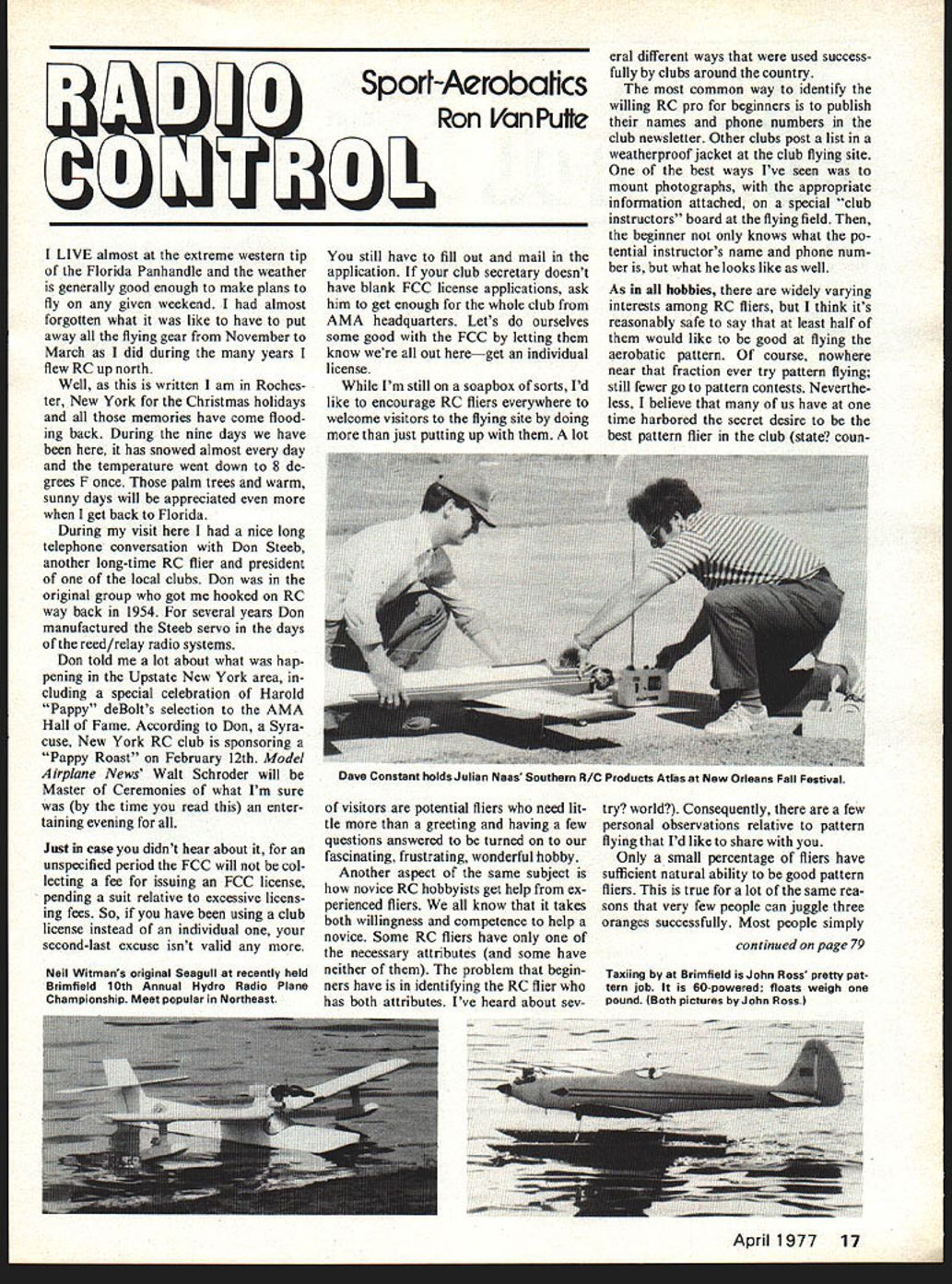
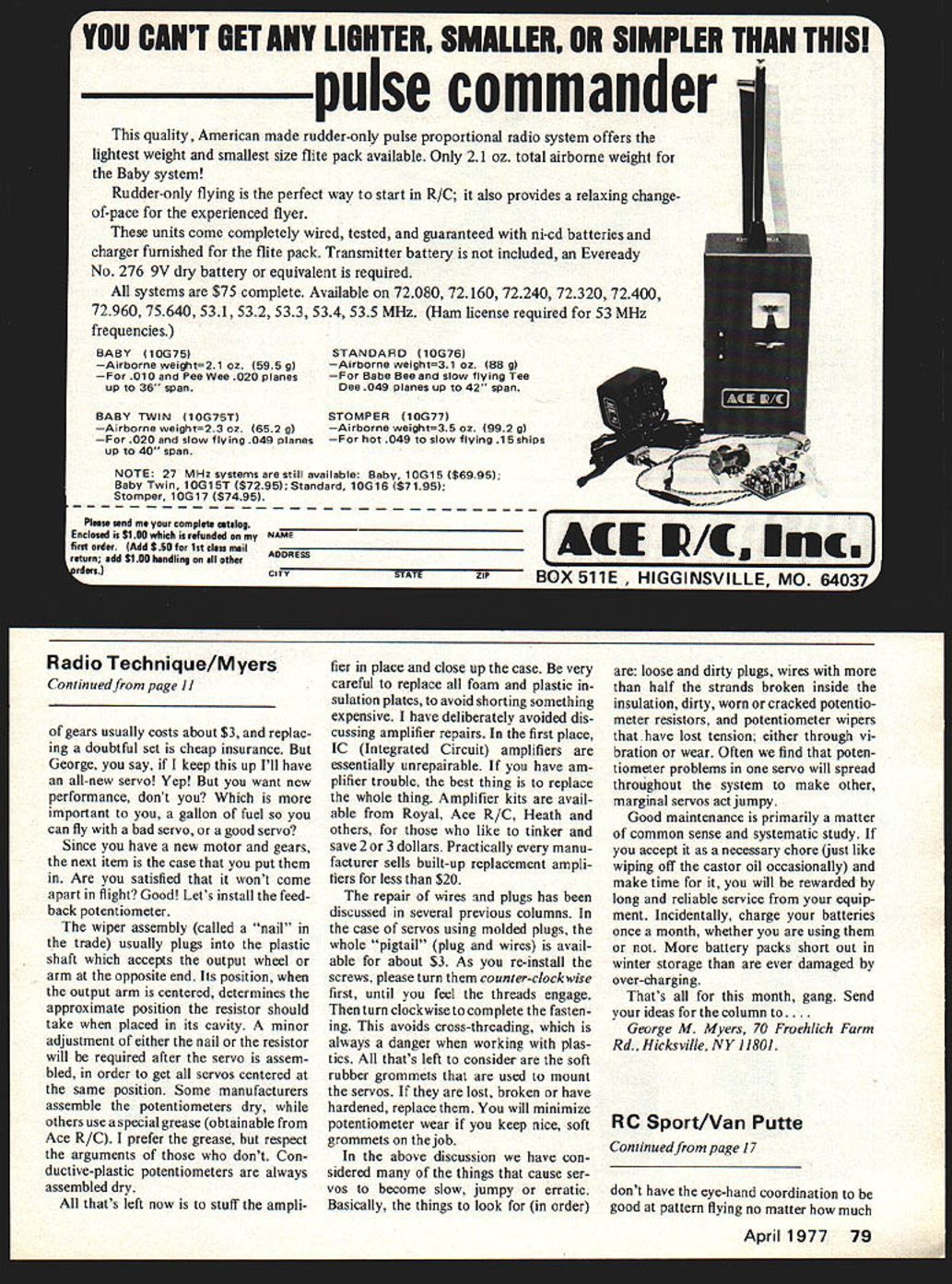
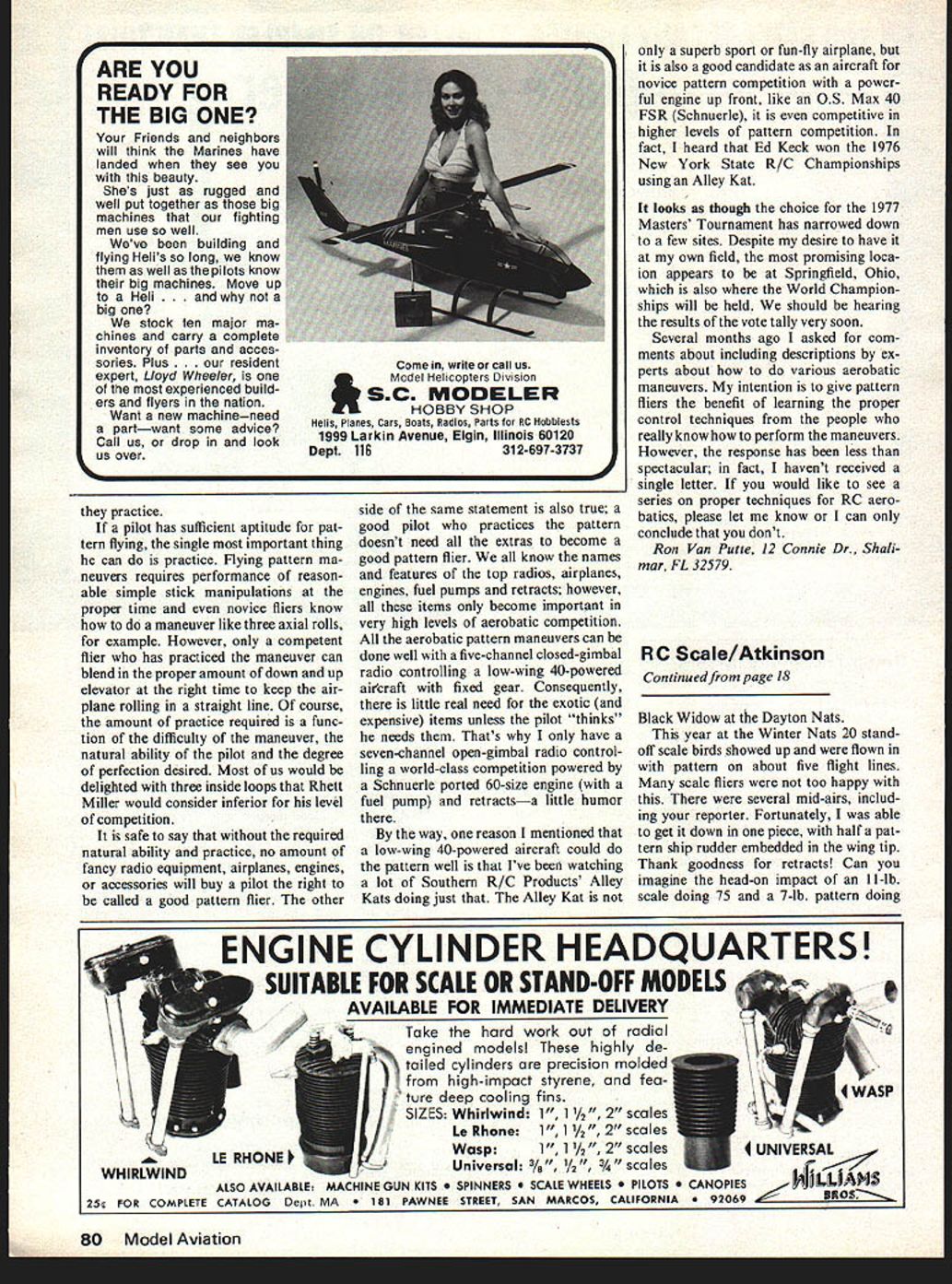
Radio Control: Sport-Aerobatics
Ron Van Putte
I live almost at the extreme western tip of the Florida Panhandle and the weather is generally good enough to make plans to fly on any given weekend. I had almost forgotten what it was like to have to put away all the flying gear from November to March as I did during the many years I flew RC up north.
Well, as this is written I am in Rochester, New York for the Christmas holidays and all those memories have come flooding back. During the nine days we have been here, it has snowed almost every day and the temperature went down to 8 degrees F once. Those palm trees and warm, sunny days will be appreciated even more when I get back to Florida.
During my visit here I had a nice long telephone conversation with Don Steeb, another long-time RC flier and president of one of the local clubs. Don was in the original group who got me hooked on RC way back in 1954. For several years Don manufactured the Steeb servo in the days of the reed/relay radio systems.
Don told me a lot about what was happening in the Upstate New York area, including a special celebration of Harold "Pappy" deBolt's selection to the AMA Hall of Fame. According to Don, a Syracuse, New York RC club is sponsoring a "Pappy Roast" on February 12th. Model Airplane News' Walt Schroder will be Master of Ceremonies of what I'm sure was (by the time you read this) an entertaining evening for all.
Just in case you didn't hear about it, for an unspecified period the FCC will not be collecting a fee for issuing an FCC license, pending a suit relative to excessive licensing fees. So, if you have been using a club license instead of an individual one, your second-last excuse isn't valid any more. You still have to fill out and mail in the application. If your club secretary doesn't have blank FCC license applications, ask him to get enough for the whole club from AMA headquarters. Let's do ourselves some good with the FCC by letting them know we're all out here—get an individual license.
While I'm still on a soapbox of sorts, I'd like to encourage RC fliers everywhere to welcome visitors to the flying site by doing more than just putting up with them. A lot of visitors are potential fliers who need little more than a greeting and having a few questions answered to be turned on to our fascinating, frustrating, wonderful hobby.
Another aspect of the same subject is how novice RC hobbyists get help from experienced fliers. We all know that it takes both willingness and competence to help a novice. Some RC fliers have only one of the necessary attributes (and some have neither of them). The problem that beginners have is in identifying the RC flier who has both attributes. I've heard about several different ways that were used successfully by clubs around the country.
The most common way to identify the willing RC pro for beginners is to publish their names and phone numbers in the club newsletter. Other clubs post a list in a weatherproof jacket at the club flying site. One of the best ways I've seen was to mount photographs, with the appropriate information attached, on a special "club instructors" board at the flying field. Then, the beginner not only knows what the potential instructor's name and phone number is, but what he looks like as well.
As in all hobbies, there are widely varying interests among RC fliers, but I think it's reasonably safe to say that at least half of them would like to be good at flying the aerobatic pattern. Of course, nowhere near that fraction ever try pattern flying; still fewer go to pattern contests. Nevertheless, I believe that many of us have at one time harbored the secret desire to be the best pattern flier in the club (state? country? world?). Consequently, there are a few personal observations relative to pattern flying that I'd like to share with you.
Only a small percentage of fliers have sufficient natural ability to be good pattern fliers. This is true for a lot of the same reasons that very few people can juggle three oranges successfully. Most people simply Most people simply don't have the eye‑hand coordination to be good at pattern flying no matter how much practice they get. If a pilot has sufficient aptitude for pattern flying, the single most important thing he can do is practice. Flying pattern maneuvers requires performance of reasonably simple stick manipulations at the proper time and even novice fliers know how to do a maneuver like three axial rolls, for example. However, only a competent flier who has practiced the maneuver can blend in the proper amount of down and up elevator at the right time to keep the airplane rolling in a straight line. Of course, the amount of practice required is a function of the difficulty of the maneuver, the natural ability of the pilot and the degree of perfection desired. Most of us would be delighted with three inside loops that Rhett Miller would consider inferior for his level of competition.
It is safe to say that without the required natural ability and practice, no amount of fancy radio equipment, airplanes, engines, or accessories will buy a pilot the right to be called a good pattern flier. The other side of the same statement is also true; a good pilot who practices the pattern doesn't need all the extras to become a good pattern flier. We all know the names and features of the top radios, airplanes, engines, fuel pumps and retracts; however, all these items only become important in very high levels of aerobatic competition. All the aerobatic pattern maneuvers can be done well with a five-channel closed-gimbal radio controlling a low-wing 40-powered aircraft with fixed gear. Consequently, there is little real need for the exotic (and expensive) items unless the pilot "thinks" he needs them. That's why I only have a seven-channel open-gimbal radio controlling a world-class competition ship powered by a Schnuerle-ported 60-size engine (with a fuel pump) and retracts — a little humor there.
By the way, one reason I mentioned that a low-wing 40-powered aircraft could do the pattern well is that I've been watching a lot of Southern R/C Products' Alley Kats doing just that. The Alley Kat is not only a superb sport or fun-fly airplane, but it is also a good candidate as an aircraft for novice pattern competition with a powerful engine up front, like an O.S. Max 40 FSR (Schnuerle), it is even competitive in higher levels of pattern competition. In fact, I heard that Ed Keck won the 1976 New York State R/C Championships using an Alley Kat.
It looks as though the choice for the 1977 Masters' Tournament has narrowed down to a few sites. Despite my desire to have it at my own field, the most promising location appears to be at Springfield, Ohio, which is also where the World Championships will be held. We should be hearing the results of the vote tally very soon.
Several months ago I asked for comments about including descriptions by experts about how to do various aerobatic maneuvers. My intention is to give pattern fliers the benefit of learning the proper control techniques from the people who really know how to perform the maneuvers. However, the response has been less than spectacular; in fact, I haven't received a single letter. If you would like to see a series on proper techniques for RC aerobatics, please let me know or I can only conclude that you don't.
Ron Van Putte, 12 Connie Dr., Shalimar, FL 32579.
Transcribed from original scans by AI. Minor OCR errors may remain.

