
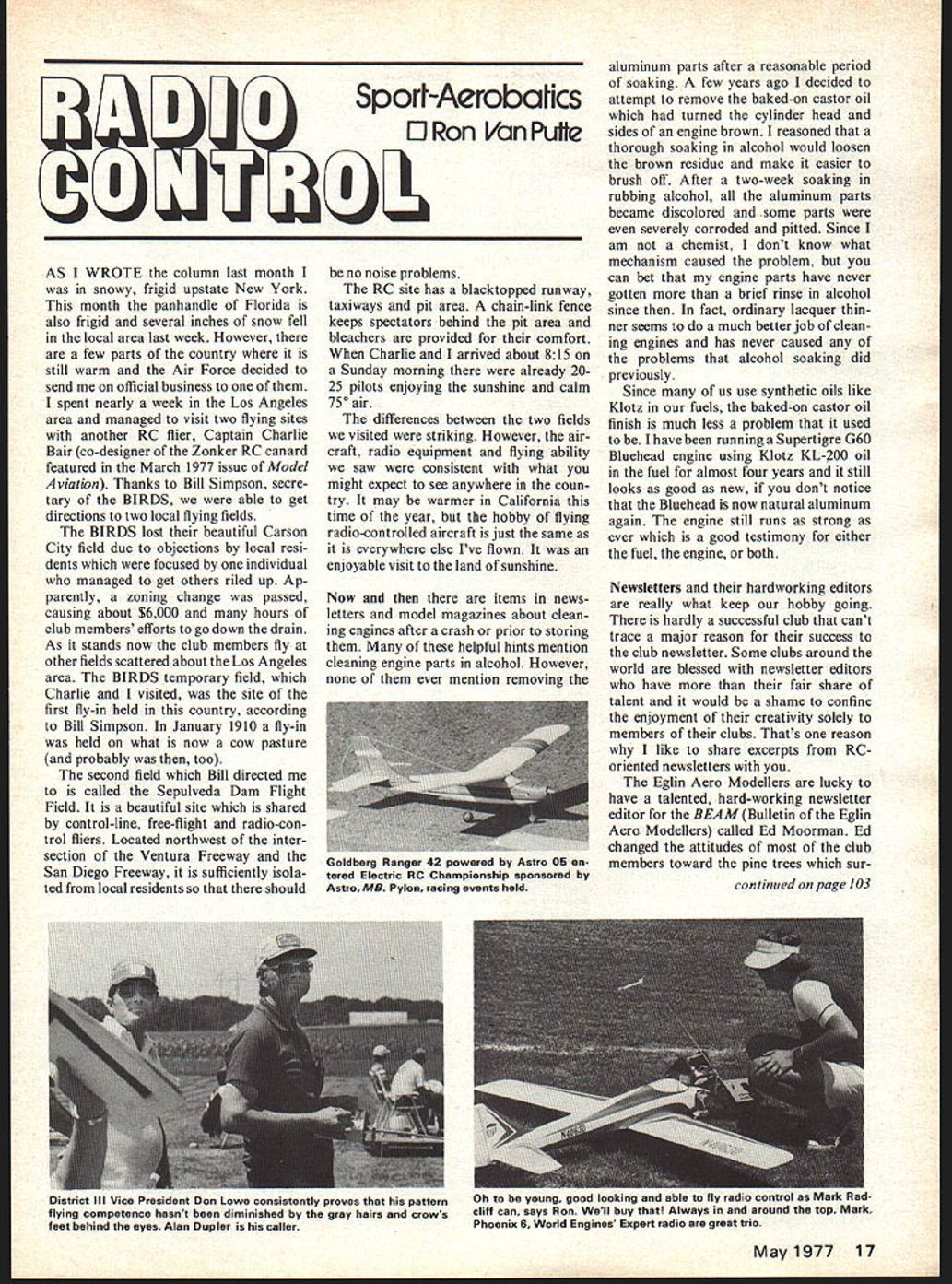
Radio Control: Sport-Aerobatics
Ron Van Putte
AS I WROTE the column last month I was in snowy, frigid upstate New York. This month the panhandle of Florida is also frigid and several inches of snow fell in the local area last week. However, there are a few parts of the country where it is still warm and the Air Force decided to send me on official business to one of them. I spent nearly a week in the Los Angeles area and managed to visit two flying sites with another RC flier, Captain Charlie Bair (co-designer of the Zonker RC canard featured in the March 1977 issue of Model Aviation). Thanks to Bill Simpson, secretary of the BIRDS, we were able to get directions to two local flying fields.
The BIRDS lost their beautiful Carson City field due to objections by local residents which were focused by one individual who managed to get others riled up. Apparently, a zoning change was passed, causing about $6,000 and many hours of club members' efforts to go down the drain. As it stands now the club members fly at other fields scattered about the Los Angeles area. The BIRDS temporary field, which Charlie and I visited, was the site of the first fly-in held in this country, according to Bill Simpson. In January 1910 a fly-in was held on what is now a cow pasture (and probably was then, too).
The second field which Bill directed me to is called the Sepulveda Dam Flight Field. It is a beautiful site which is shared by control-line, free-flight and radio-control fliers. Located northwest of the intersection of the Ventura Freeway and the San Diego Freeway, it is sufficiently isolated from local residents so that there should be no noise problems.
The RC site has a blacktopped runway, taxiways and pit area. A chain-link fence keeps spectators behind the pit area and bleachers are provided for their comfort. When Charlie and I arrived about 8:15 on a Sunday morning there were already 20-25 pilots enjoying the sunshine and calm 75° air.
The differences between the two fields we visited were striking. However, the aircraft, radio equipment and flying ability we saw were consistent with what you might expect to see anywhere in the country. It may be warmer in California this time of the year, but the hobby of flying radio-controlled aircraft is just the same as it is everywhere else I've flown. It was an enjoyable visit to the land of sunshine.
Now and then there are items in newsletters and model magazines about cleaning engines after a crash or prior to storing them. Many of these helpful hints mention cleaning engine parts in alcohol. However, none of them ever mention removing the aluminum parts after a reasonable period of soaking. A few years ago I decided to attempt to remove the baked-on castor oil which had turned the cylinder head and sides of an engine brown. I reasoned that a thorough soaking in alcohol would loosen the brown residue and make it easier to brush off. After a two-week soaking in rubbing alcohol, all the aluminum parts became discolored and some parts were even severely corroded and pitted. Since I am not a chemist, I don't know what mechanism caused the problem, but you can bet that my engine parts have never gotten more than a brief rinse in alcohol since then. In fact, ordinary lacquer thinner seems to do a much better job of cleaning engines and has never caused any of the problems that alcohol soaking did previously.
Since many of us use synthetic oils like Klotz in our fuels, the baked-on castor oil finish is much less a problem than it used to be. I have been running a Supertigre G60 Bluehead engine using Klotz KL-200 oil in the fuel for almost four years and it still looks as good as new, if you don't notice that the Bluehead is now natural aluminum again. The engine still runs as strong as ever which is a good testimony for either the fuel, the engine, or both.
Newsletters and their hardworking editors are really what keep our hobby going. There is hardly a successful club that can't trace a major reason for their success to the club newsletter. Some clubs around the world are blessed with newsletter editors who have more than their fair share of talent and it would be a shame to confine the enjoyment of their creativity solely to members of their clubs. That's one reason why I like to share excerpts from RC-oriented newsletters with you.
The Eglin Aero Modellers are lucky to have a talented, hard-working newsletter editor for the BEAM (Bulletin of the Eglin Aero Modellers) called Ed Moorman. Ed changed the attitudes of most of the club members toward the pine trees which sur-
RC Sport/Van Putte
round the 200 X 4500 ft. runway we fly from with the following article that he published several months ago.
"I was out at the field during the week last month. It was one of those lonely afternoons when I was the only one flying. As I was packing up to go I heard this voice from the runway say, 'Hey, fella, come over here.' I looked over there and didn't see anyone so I returned to cleaning up my plane. 'Over here, dummy, and I'll tell you how I got that Eyeball.' Now that got my attention so I walked over. The voice called again and I followed it about a hundred yards or so into the woods. I still didn't see anyone. 'Where are you?' I called. 'Right here,' replied a voice behind me. I spun around and found myself staring at a large pine tree. 'Who, who, who,' I stammered. 'You sound like an owl. I'm the tree and I don't usually talk to people, but I've just made ace as your fighter pilots call it.'
"I was still speechless. 'Pine is the name, Florida Pine, but the boys call me Slash. That's because I slash up those models.' 'You mean you...' I managed to get out. 'That's right, modeller, what you think is wind is my friends and me flexing our limbs. We hold them up real low and just when you think you've got it made, swish, up they go and grab a plane.' 'I just can't believe...' 'Don't believe, huh, how about when you were trying to get Mike Crane's Falcon back to the runway dead stick? Remember how it wouldn't turn? Well, we were just breathing to suck him into us. We've got our eyes on him; he's escaped too often. Now, as I said, I'm an ace, five planes to my credit. That nice Eyeball was the fifth. He was showing off down low and I just stuck up a limb and... POW!' 'Er, Slash, how many trees like you are there?' 'Plenty, pilot, plenty, and we mostly live in the triangle between the three runways. You've got your own Devil's Triangle, ha,' "The sun was going down and all I wanted was to be in a haunted woodland after dark. 'I'd better be going, Slash.' 'They'll never believe this, kid, and they'll keep flying low, ho, ho, ho.'
"As I walked back across the runway I heard a murmur from the woods, 'We're waiting for you, RC flier, we wait and wait and we'll get yoooooooou.'
"Slash was right. No one will believe me."
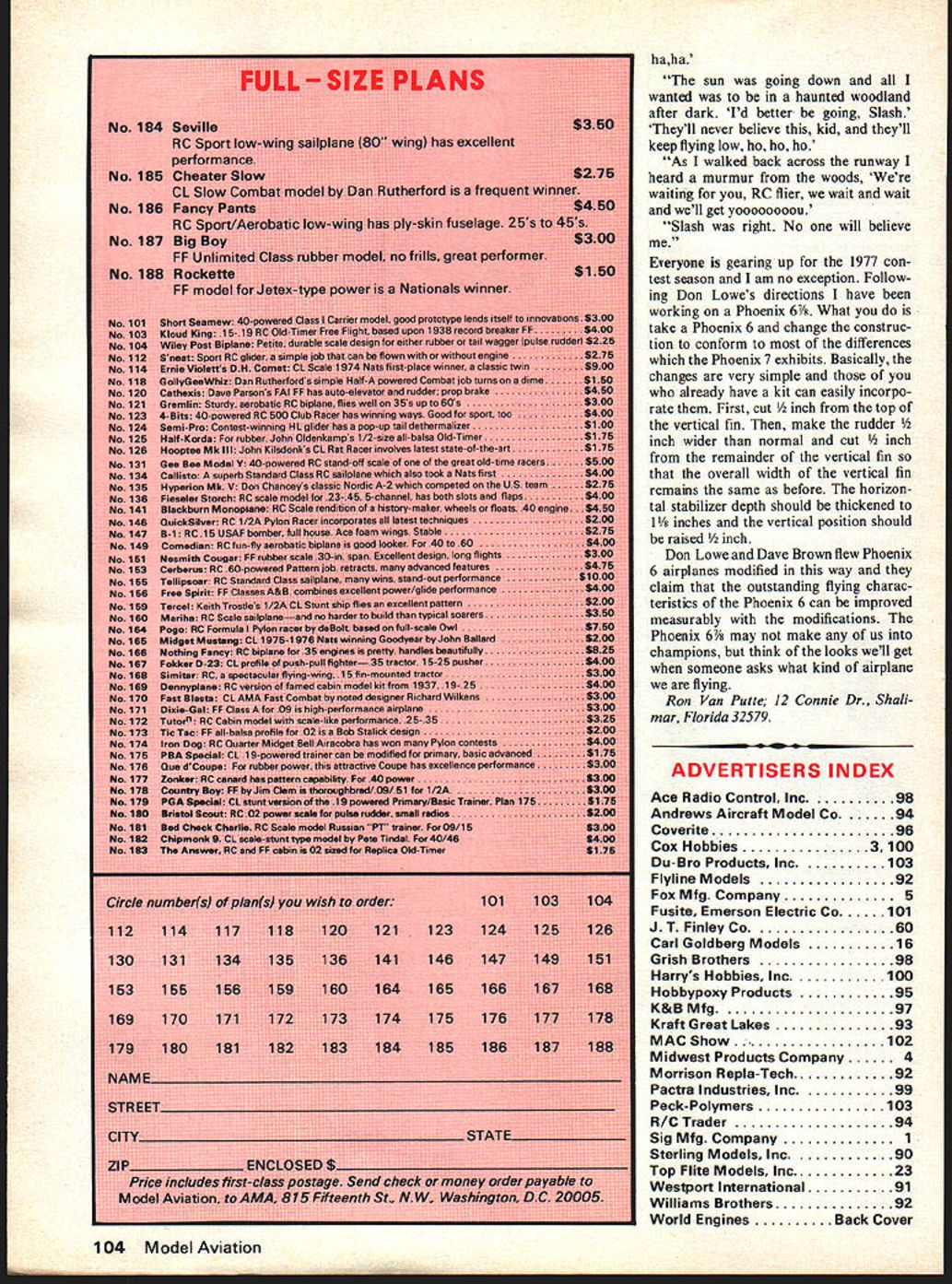
Everyone is gearing up for the 1977 contest season and I am no exception. Following Don Lowe's directions I have been working on a Phoenix 6 7/8. What you do is take a Phoenix 6 and change the construction to conform to most of the differences which the Phoenix 7 exhibits. Basically, the changes are very simple and those of you who already have a kit can easily incorporate them. First, cut 1/2 inch from the top of the vertical fin. Then, make the rudder 1/2 inch wider than normal and cut 1/16 inch from the remainder of the vertical fin so that the overall width of the vertical fin remains the same as before. The horizontal stabilizer depth should be thickened to 1 1/8 inches and the vertical position should be raised 1/2 inch.
Don Lowe and Dave Brown flew Phoenix 6 airplanes modified in this way and they claim that the outstanding flying characteristics of the Phoenix 6 can be improved measurably with the modifications. The Phoenix 6 7/8 may not make any of us into champions, but think of the looks we'll get when someone asks what kind of airplane we are flying.
Ron Van Putte; 12 Connie Dr., Shalimar, Florida 32579.
Transcribed from original scans by AI. Minor OCR errors may remain.

