
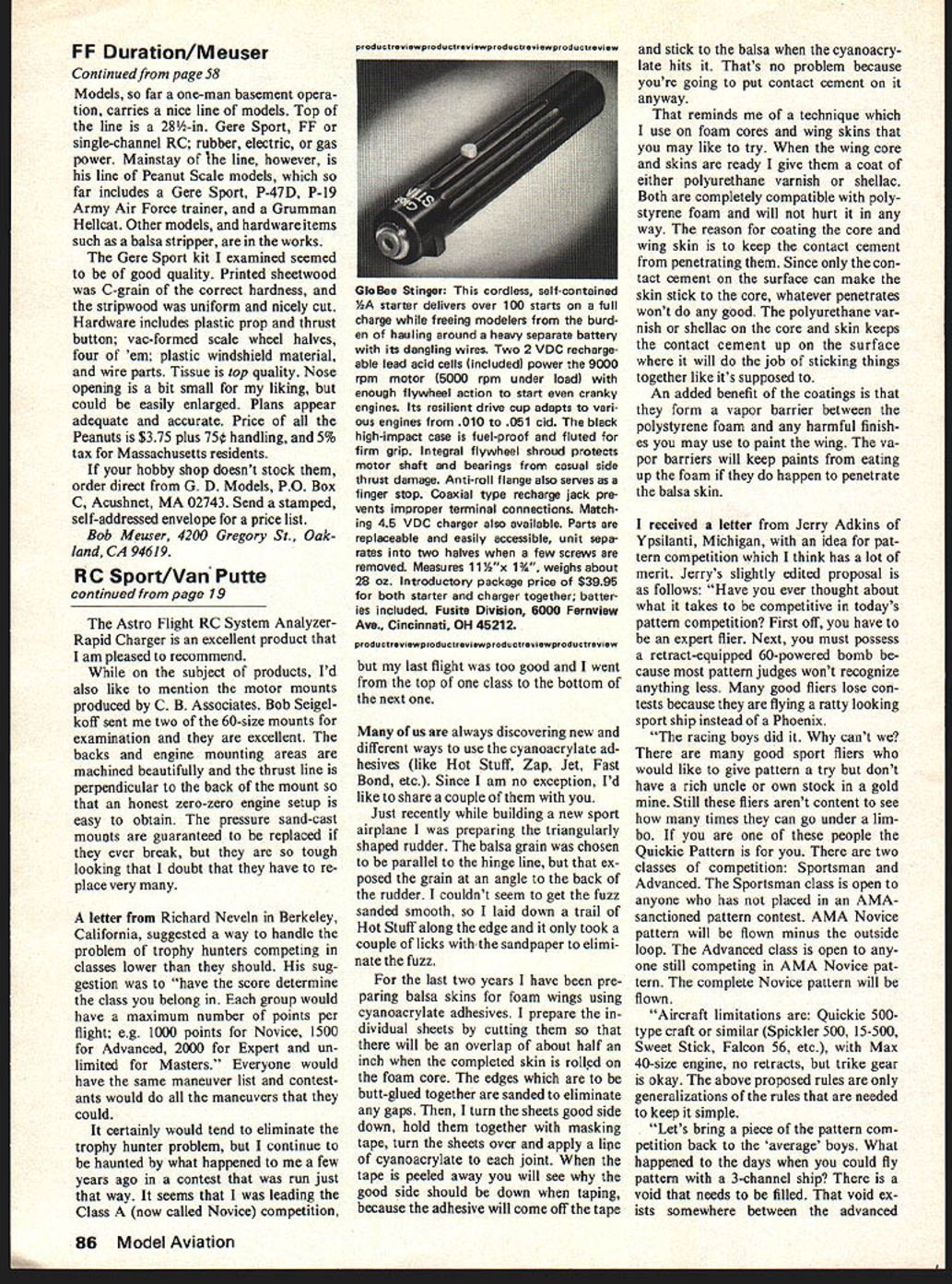
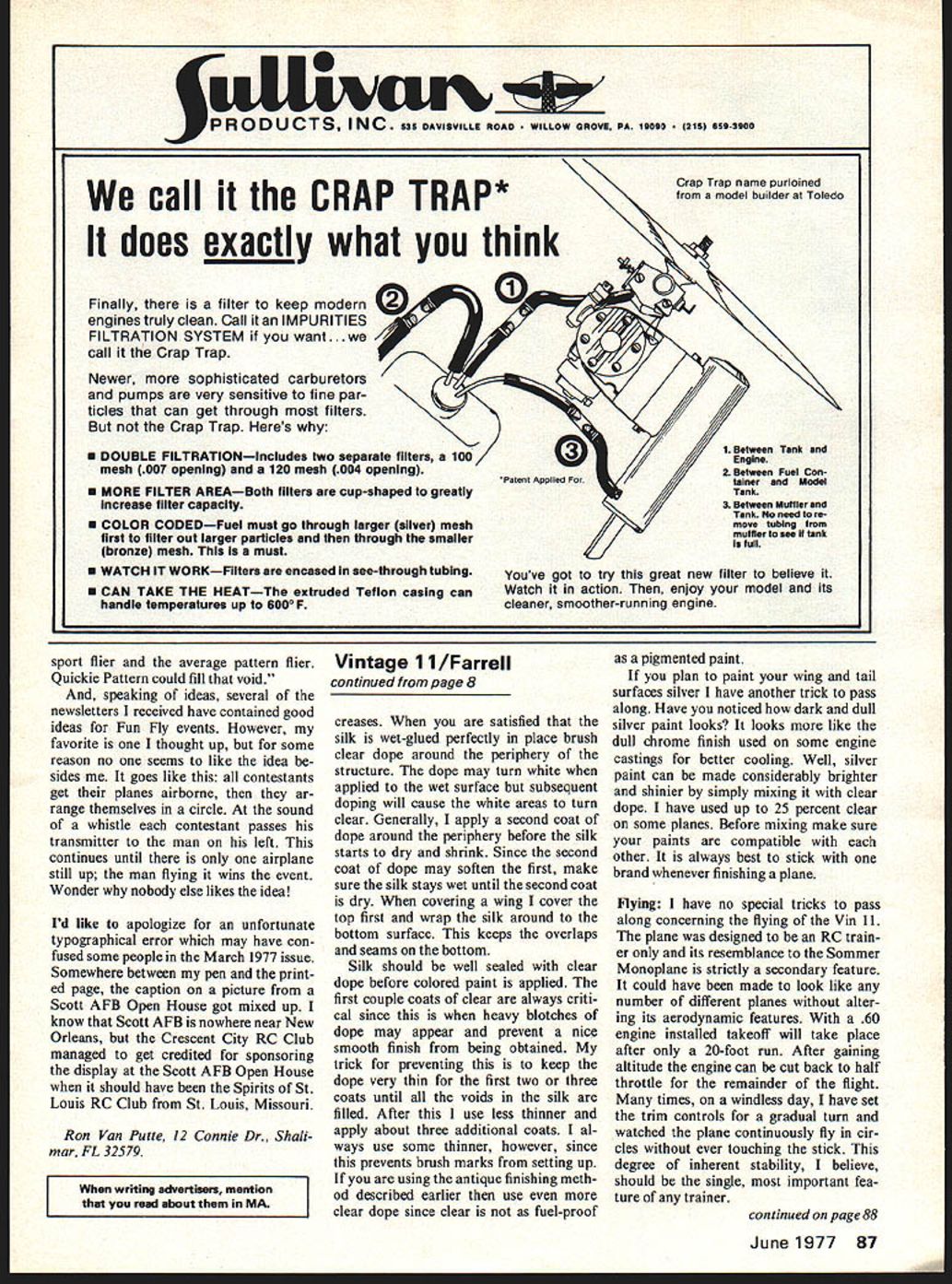
Radio Control: Sport-Aerobatics
Ron Van Putte
THE WARM WEATHER just hit the panhandle of Florida; the sunshine, blue skies and gentle breezes have me thinking about being out at the flying field when I'm not and enjoying every bit of it when I am. Even though you will be reading this more than two months after it is written, much of the country will probably still be trying to shake off the effects of Winter. Hang in there!
When the weather begins to improve in the Spring, my competitive juices begin to flow again and I look forward to the first contest of the season. For this part of the country it means looking toward Huntsville, Alabama, in early May. This year the Rocket City RC Club will hold their 17th annual contest on May 7th and 8th.
Last year's contest featured an efficient flight line arrangement in which four flight circles were set up in convenient proximity. Two circles were on a runway at the old Huntsville Airport while two more were on a parallel taxiway. Contest management and parking were placed on the grass median between the runway and the taxiway. Everyone liked being in the center of the action.
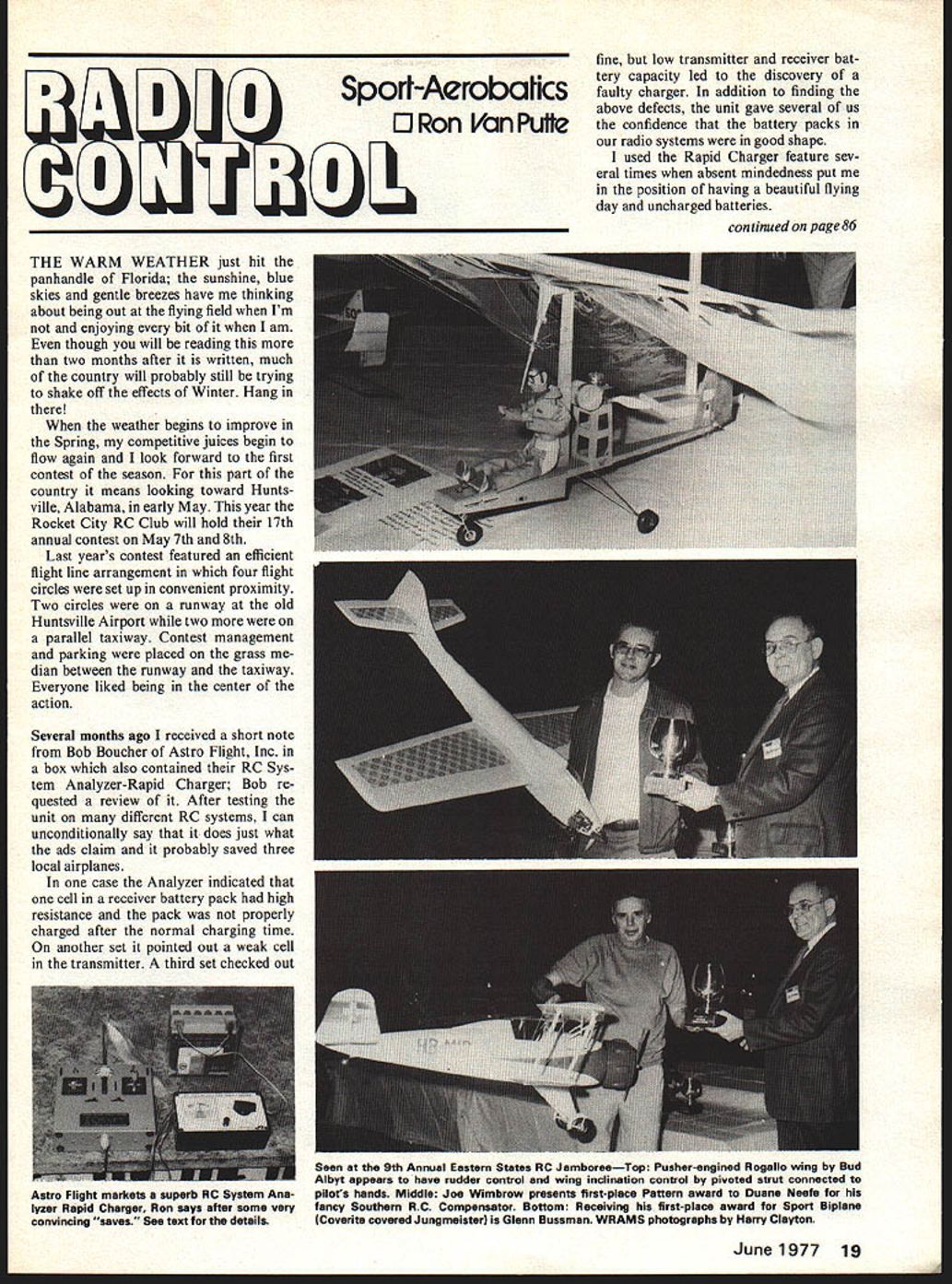
Several months ago I received a short note from Bob Boucher of Astro Flight, Inc. in a box which also contained their RC System Analyzer-Rapid Charger; Bob requested a review of it. After testing the unit on many different RC systems, I can unconditionally say that it does just what the ads claim and it probably saved three local airplanes.
In one case the Analyzer indicated that one cell in a receiver battery pack had high resistance and the pack was not properly charged after the normal charging time. On another set it pointed out a weak cell in the transmitter. A third set checked out fine, but low transmitter and receiver battery capacity led to the discovery of a faulty charger. In addition to finding the above defects, the unit gave several of us the confidence that the battery packs in our radio systems were in good shape.
I used the Rapid Charger feature several times when absent mindedness put me in the position of having a beautiful flying day and uncharged batteries.
Radio Control: Sport-Aerobatics
The Astro Flight RC System Analyzer-Rapid Charger is an excellent product that I am pleased to recommend.
While on the subject of products, I'd also like to mention the motor mounts produced by C. B. Associates. Bob Seigelkoff sent me two of the 60-size mounts for examination and they are excellent. The backs and engine mounting areas are machined beautifully and the thrust line is perpendicular to the back of the mount so that an honest zero-zero engine setup is easy to obtain. The pressure sand-cast mounts are guaranteed to be replaced if they ever break, but they are so tough looking that I doubt that they have to replace very many.
A letter from Richard Neveln in Berkeley, California, suggested a way to handle the problem of trophy hunters competing in classes lower than they should. His suggestion was to "have the score determine the class you belong in. Each group would have a maximum number of points per flight; e.g. 1000 points for Novice, 1500 for Advanced, 2000 for Expert and unlimited for Masters." Everyone would have the same maneuver list and contestants would do all the maneuvers that they could.
It certainly would tend to eliminate the trophy hunter problem, but I continue to be haunted by what happened to me a few years ago in a contest that was run just that way. It seems that I was leading the Class A (now called Novice) competition, but my last flight was too good and I went from the top of one class to the bottom of the next one.
Many of us are always discovering new and different ways to use the cyanoacrylate adhesives (like Hot Stuff, Zap, Jet, Fast Bond, etc.). Since I am no exception, I'd like to share a couple of them with you.
Just recently while building a new sport airplane I was preparing the triangularly shaped rudder. The balsa grain was chosen to be parallel to the hinge line, but that exposed the grain at an angle to the back of the rudder. I couldn't seem to get the fuzz sanded smooth, so I laid down a trail of Hot Stuff along the edge and it only took a couple of flicks with the sandpaper to eliminate the fuzz.
For the last two years I have been preparing balsa skins for foam wings using cyanoacrylate adhesives. I prepare the individual sheets by cutting them so that there will be an overlap of about half an inch when the completed skin is rolled on the foam core. The edges which are to be butt-glued together are sanded to eliminate any gaps. Then, I turn the sheets good side down, hold them together with masking tape, turn the sheets over and apply a line of cyanoacrylate to each joint. When the tape is peeled away you will see the good side should be joined when taping, because the adhesive will come off the tape and stick to the balsa when the cyanoacrylate hits it. That's no problem because you're going to put contact cement on it anyway.
That reminds me of a technique which I use on foam cores and wing skins that you may like to try. When the wing core and skins are ready I give them a coat of either polyurethane varnish or shellac. Both are completely compatible with polystyrene foam and will not hurt it in any way. The reason for coating the core and wing skin is to keep the contact cement from penetrating them. Since only the contact cement on the surface can make the skin stick to the core, whatever penetrates won't do any good. The polyurethane varnish or shellac on the core and skin keeps the contact cement up on the surface where it will do the job of sticking things together like it's supposed to.
An added benefit of the coatings is that they form a vapor barrier between the polystyrene foam and any harmful finishes you may use to paint the wing. The vapor barriers will keep paints from eating up the foam if they do happen to penetrate the balsa skin.
I received a letter from Jerry Adkins of Ypsilanti, Michigan, with an idea for pattern competition which I think has a lot of merit. Jerry's slightly edited proposal is as follows: "Have you ever thought about what it takes to be competitive in today's pattern competition? First off, you have to be an expert flier. Next, you must possess a retract-equipped .60-powered bomb because most pattern judges won't recognize anything less. Many good fliers lose contests because they are flying a ratty looking sport ship instead of a Phoenix.
"The racing boys did it. Why can't we? There are many good sport fliers who would like to give pattern a try but don't have a rich uncle or own stock in a gold mine. Still these fliers aren't content to see how many times they can go under a limbo bar. If you are one of these people the Quickie Pattern is for you. There are two classes of competition: Sportsman and Advanced. The Sportsman class is open to anyone who has not placed in an AMA-sanctioned pattern contest. An AMA Novice pattern will be flown minus the outside loop. The Advanced class is open to anyone still competing in an AMA Novice pattern. The complete Novice pattern will be flown.
"Aircraft limitations are: Quickie 500-type craft or similar (Spickler 500, 15-500, Sweet Stick, Falcon 56, etc.), with a max 40-size engine, no retracts, but trike gear is okay. The above proposed rules are only generalizations of the rules that are needed to keep it simple.
"Let's bring a piece of the pattern competition back to the 'average' boys. What happened to the days when you could fly pattern with a 3-channel ship? There is a void that needs to be filled. That void exists somewhere between the advanced sport flier and the average pattern flier. Quickie Pattern could fill that void."
And, speaking of ideas, several of the newsletters I received have contained good ideas for Fun Fly events. However, my favorite is one I thought up, but for some reason no one seems to like the idea besides me. It goes like this: all contestants get their planes airborne, then they arrange themselves in a circle. At the sound of a whistle each contestant passes his transmitter to the man on his left. This continues until there is only one airplane still up; the man flying it wins the event. Wonder why nobody else likes the idea!
I'd like to apologize for an unfortunate typographical error which may have confused some people in the March 1977 issue. Somewhere between my pen and the printed page, the caption on a picture from a Scott AFB Open House got mixed up. I know that Scott AFB is nowhere near New Orleans, but the Crescent City RC Club managed to get credited for sponsoring the display at the Scott AFB Open House when it should have been the Spirits of St. Louis RC Club from St. Louis, Missouri.
Ron Van Putte, 12 Connie Dr., Shalimar, FL 32579.
Transcribed from original scans by AI. Minor OCR errors may remain.

