
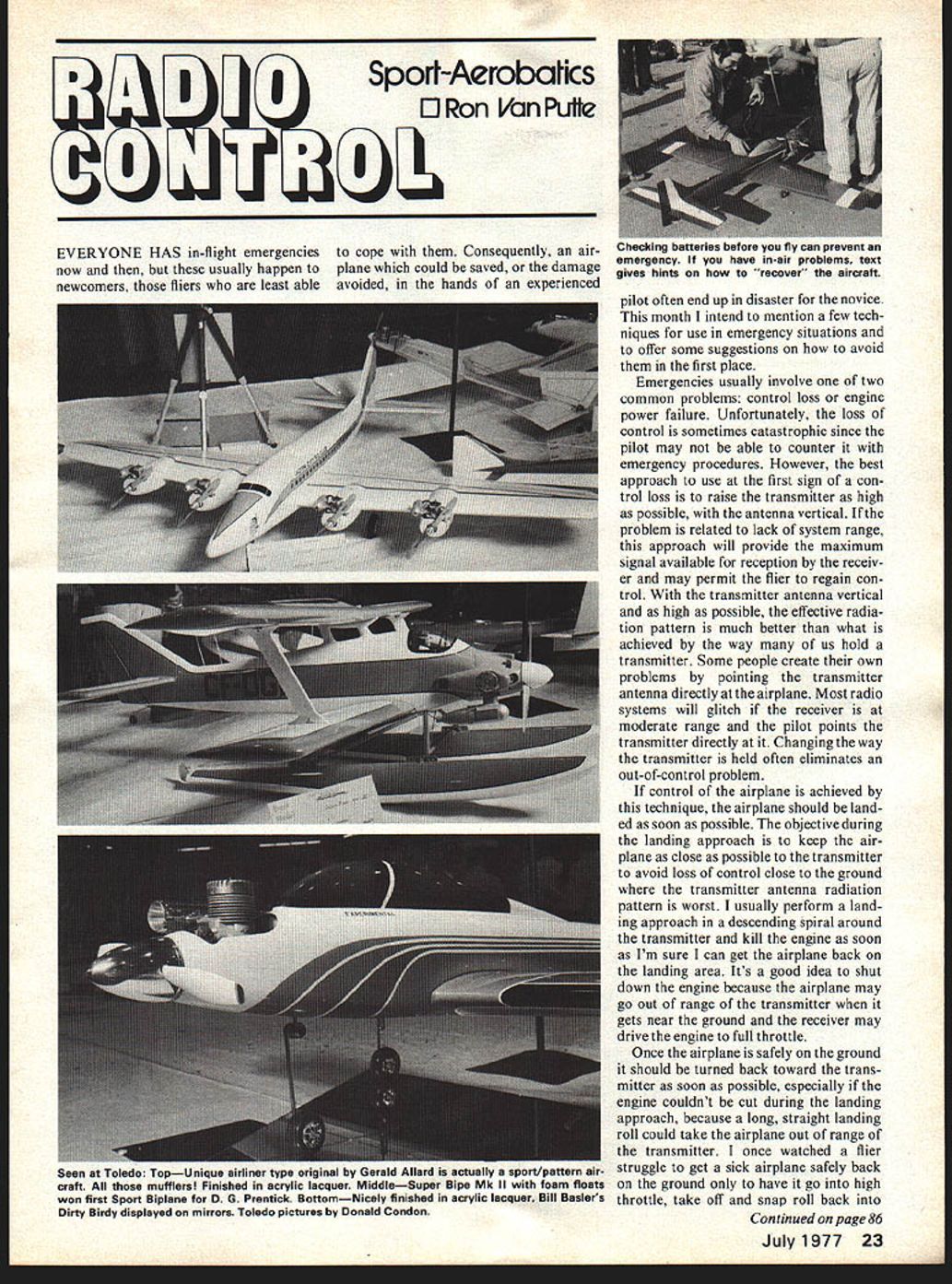
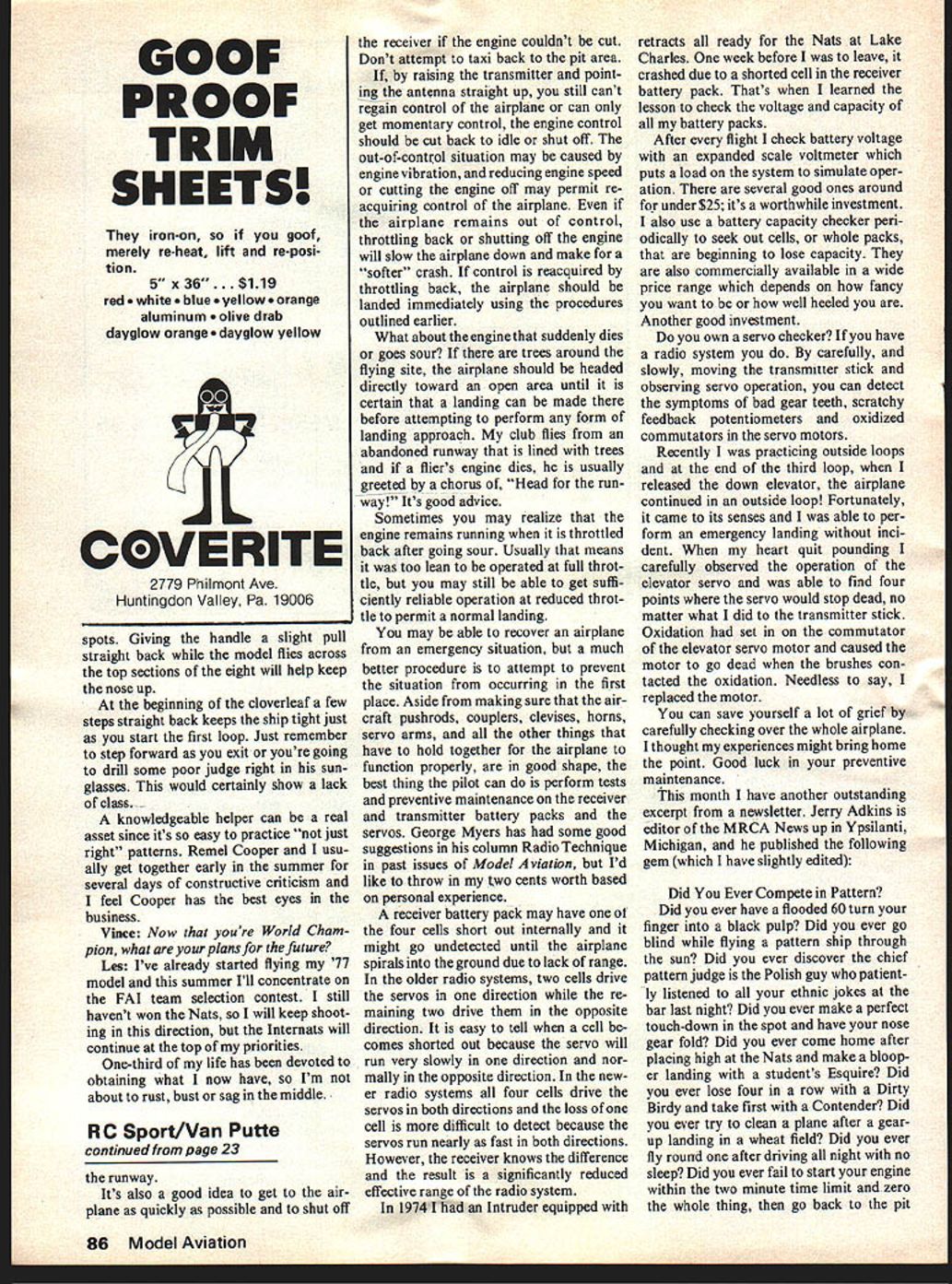
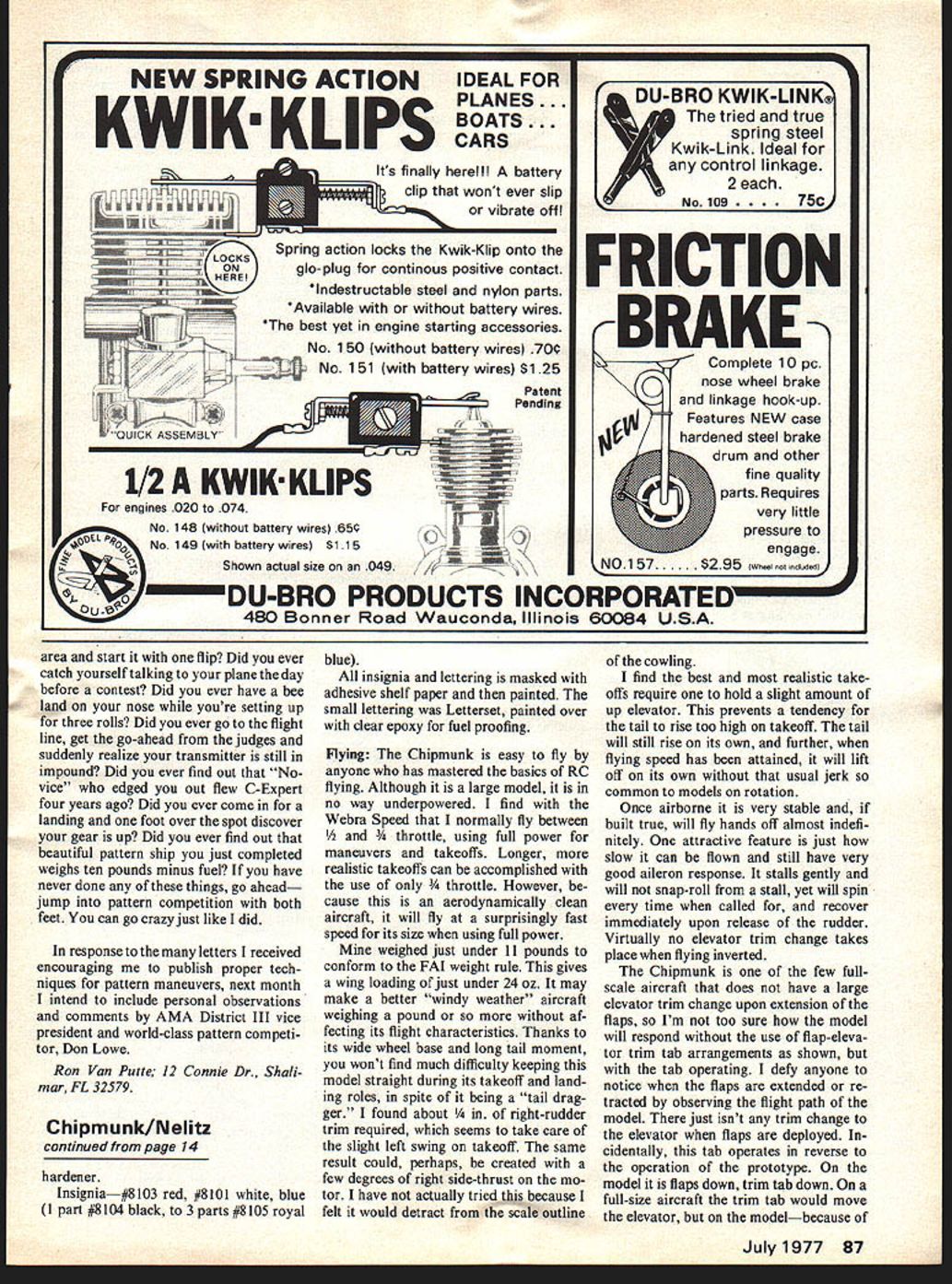
Radio Control: Sport-Aerobatics
Ron VanPutte
EVERYONE HAS in-flight emergencies now and then, but these usually happen to newcomers, those fliers who are least able to cope with them. Consequently, an airplane which could be saved, or the damage avoided, in the hands of an experienced pilot often ends up in disaster for the novice. This month I intend to mention a few techniques for use in emergency situations and to offer some suggestions on how to avoid them in the first place.
Emergencies usually involve one of two common problems: control loss or engine power failure. Unfortunately, the loss of control is sometimes catastrophic since the pilot may not be able to counter it with emergency procedures. However, the best approach to use at the first sign of a control loss is to raise the transmitter as high as possible, with the antenna vertical. If the problem is related to lack of system range, this approach will provide the maximum signal available for reception by the receiver and may permit the flier to regain control. With the transmitter antenna vertical and as high as possible, the effective radiation pattern is much better than what is achieved by the way many of us hold a transmitter. Some people create their own problems by pointing the transmitter antenna directly at the airplane. Most radio systems will glitch if the receiver is at moderate range and the pilot points the transmitter directly at it. Changing the way the transmitter is held often eliminates an out-of-control problem.
If control of the airplane is achieved by this technique, the airplane should be landed as soon as possible. The objective during the landing approach is to keep the airplane as close as possible to the transmitter to avoid loss of control close to the ground where the transmitter antenna radiation pattern is worst. I usually perform a landing approach in a descending spiral around the transmitter and kill the engine as soon as I'm sure I can get the airplane back on the landing area. It's a good idea to shut down the engine because the airplane may go out of range of the transmitter when it gets near the ground and the receiver may drive the engine to full throttle.
Once the airplane is safely on the ground it should be turned back toward the transmitter as soon as possible, especially if the engine couldn't be cut during the landing approach, because a long, straight landing roll could take the airplane out of range of the transmitter. I once watched a flier struggle to get a sick airplane safely back on the ground only to have it go into high throttle, take off and snap roll back into the receiver if the engine couldn't be cut. Don't attempt to taxi back to the pit area.
If, by raising the transmitter and pointing the antenna straight up, you still can't regain control of the airplane or can only get momentary control, the engine control should be cut back to idle or shut off. The out-of-control situation may be caused by engine vibration, and reducing engine speed or cutting the engine off may permit re-acquiring control of the airplane. Even if the airplane remains out of control, throttling back or shutting off the engine will slow the airplane down and make for a "softer" crash. If control is reacquired by throttling back, the airplane should be landed immediately using the procedures outlined earlier.
What about the engine that suddenly dies or goes sour? If there are trees around the flying site, the airplane should be headed directly toward an open area until it is certain that a landing can be made there before attempting to perform any form of landing approach. My club flies from an abandoned runway that is lined with trees and if a flier's engine dies, he is usually greeted by a chorus of, "Head for the runway!" It's good advice.
Sometimes you may realize that the engine remains running when it is throttled back after going sour. Usually that means it was too lean to be operated at full throttle, but you may still be able to get sufficiently reliable operation at reduced throttle to permit a normal landing.
You may be able to recover an airplane from an emergency situation, but a much better procedure is to attempt to prevent the situation from occurring in the first place. Aside from making sure that the aircraft pushrods, couplers, clevises, horns, servo arms, and all the other things that have to hold together for the airplane to function properly, are in good shape, the best thing the pilot can do is perform tests and preventive maintenance on the receiver and transmitter battery packs and the servos. George Myers has had some good suggestions in his column Radio Technique in past issues of Model Aviation, but I'd like to throw in my two cents worth based on personal experience.
A receiver battery pack may have one of the four cells short out internally and it might go undetected until the airplane spirals into the ground due to lack of range. In the older radio systems, two cells drive the servos in one direction while the remaining two drive them in the opposite direction. It is easy to tell when a cell becomes shorted out because the servo will run very slowly in one direction and normally in the opposite direction. In the newer radio systems all four cells drive the servos in both directions and the loss of one cell is more difficult to detect because the servos run nearly as fast in both directions. However, the receiver knows the difference and the result is a significantly reduced effective range of the radio system.
In 1974 I had an Intruder equipped with retracts all ready for the Nats at Lake Charles. One week before I was to leave, it crashed due to a shorted cell in the receiver battery pack. That's when I learned the lesson to check the voltage and capacity of all my battery packs.
After every flight I check battery voltage with an expanded scale voltmeter which puts a load on the system to simulate operation. There are several good ones around for under $25; it's a worthwhile investment. I also use a battery capacity checker periodically to seek out cells, or whole packs, that are beginning to lose capacity. They are also commercially available in a wide price range which depends on how fancy you want to be or how well heeled you are. Another good investment.
Do you own a servo checker? If you have a radio system you do. By carefully, and slowly, moving the transmitter stick and observing servo operation, you can detect the symptoms of bad gear teeth, scratchy feedback potentiometers and oxidized commutators in the servo motors.
Recently I was practicing outside loops and at the end of the third loop, when I released the down elevator, the airplane continued in an outside loop! Fortunately, it came to its senses and I was able to perform an emergency landing without incident. When my heart quit pounding I carefully observed the operation of the elevator servo and was able to find four points where the servo would stop dead, no matter what I did to the transmitter stick. Oxidation had set in on the commutator of the elevator servo motor and caused the motor to go dead when the brushes contacted the oxidation. Needless to say, I replaced the motor.
You can save yourself a lot of grief by carefully checking over the whole airplane. I thought my experiences might bring home the point. Good luck in your preventive maintenance.
This month I have another outstanding excerpt from a newsletter. Jerry Adkins is editor of the MRCAC News up in Ypsilanti, Michigan, and he published the following gem (which I have slightly edited):
Did You Ever Compete in Pattern?
Did you ever have a flooded 60 turn your finger into a black pulp? Did you ever go blind while flying a pattern ship through the sun? Did you ever discover the chief pattern judge is the Polish guy who patiently listened to all your ethnic jokes at the bar last night? Did you ever make a perfect touch-down in the spot and have your gear fold? Did you ever come home after placing high at the Nats and make a booger landing with a student's Esquire? Did you ever lose four in a row with a Dirty Birdy and take first with a Contender? Did you ever try to clean a plane after a gear-up landing in a wheat field? Did you ever fly round once after driving all night with no sleep? Did you ever fail to start your engine within the two minute time limit and zero the whole thing, then go back to the pit I could not find any portion of the article "Radio Control: Sport-Aerobatics" (Ron Van Putte) on the scanned page you provided. The visible content on this page is an advertisement at the top and a continuation of the "Chipmunk/Nelitz" article (with captions/ads), not the Sport-Aerobatics text.
Please provide:
- the correct scanned page that contains page 3 of 3 for "Radio Control: Sport-Aerobatics", or
- a higher-resolution crop of the column/area you believe contains the Sport-Aerobatics continuation,
and I will extract and correct the article text.
Transcribed from original scans by AI. Minor OCR errors may remain.

