
Radio Control: Sport-Aerobatics
Ron Van Putte
I WAS DELIGHTED to see Hal deBolt's article on the autogiro in the April 1977 Model Aviation. About a year ago I mentioned that there should be radio-controlled autogiros around since they were basically simpler to design and fly than a helicopter, and RC helicopters have been flown successfully for several years. Like many people, I was too busy to get involved with autogiros and was content to let someone else do the research and development. Then, along comes Hal deBolt, one of the busiest guys around, with an article on his autogiros. So, since he has already done most of the development work for the rest of us, if you're like me you're looking forward to a construction article. Come on Hal! (It will appear in MAN — Ed.)
The USA Team Selection and World Championships scheduled for June 25 through July 4 is rapidly approaching. I plan to attend the competition and report on it for Model Aviation. Although I reported on the 1975 Team Selection, this will be my first coverage of an international competition and I'm looking forward to seeing all the foreign fliers. This is also a good chance for a large percentage of this country's RC fliers to watch our team in competition with the best fliers from the rest of the world. I hope many of you take advantage of the opportunity.
Unfortunately, the fliers from almost all countries except ours use the 27-MHz frequency band. If I were them, I'd hate to try to fly on a frequency band here that is loaded with so many "smokey reports," "distance checks," and other trash conversations. However, preliminary reports from the Springfield, Ohio area indicate that the interference problem there is much less severe than in many other parts of the country. Let's hope that none of our foreign visitors has interference problems here after going to all the effort and expense to attend the world championships.
Recently I discovered a simple servo tester in an old (February 1976) issue of the DCRC Newsletter (Washington, D.C.) which is edited by Glenn Scillian. Hugh Shoemaker designed the servo tester to use components that are cheap and easily obtainable from a local Radio Shack store. The tester works so well and is so simple to put together for a nonexpert in electronics like me, that I have written to George Myers, who writes the Radio Technique column, and suggested that either he or I publish it in a column. The obvious reason why I am not including it immediately in this column is that the item really belongs in the Radio Technique column and I don't want to step on George's toes. You will see it soon.
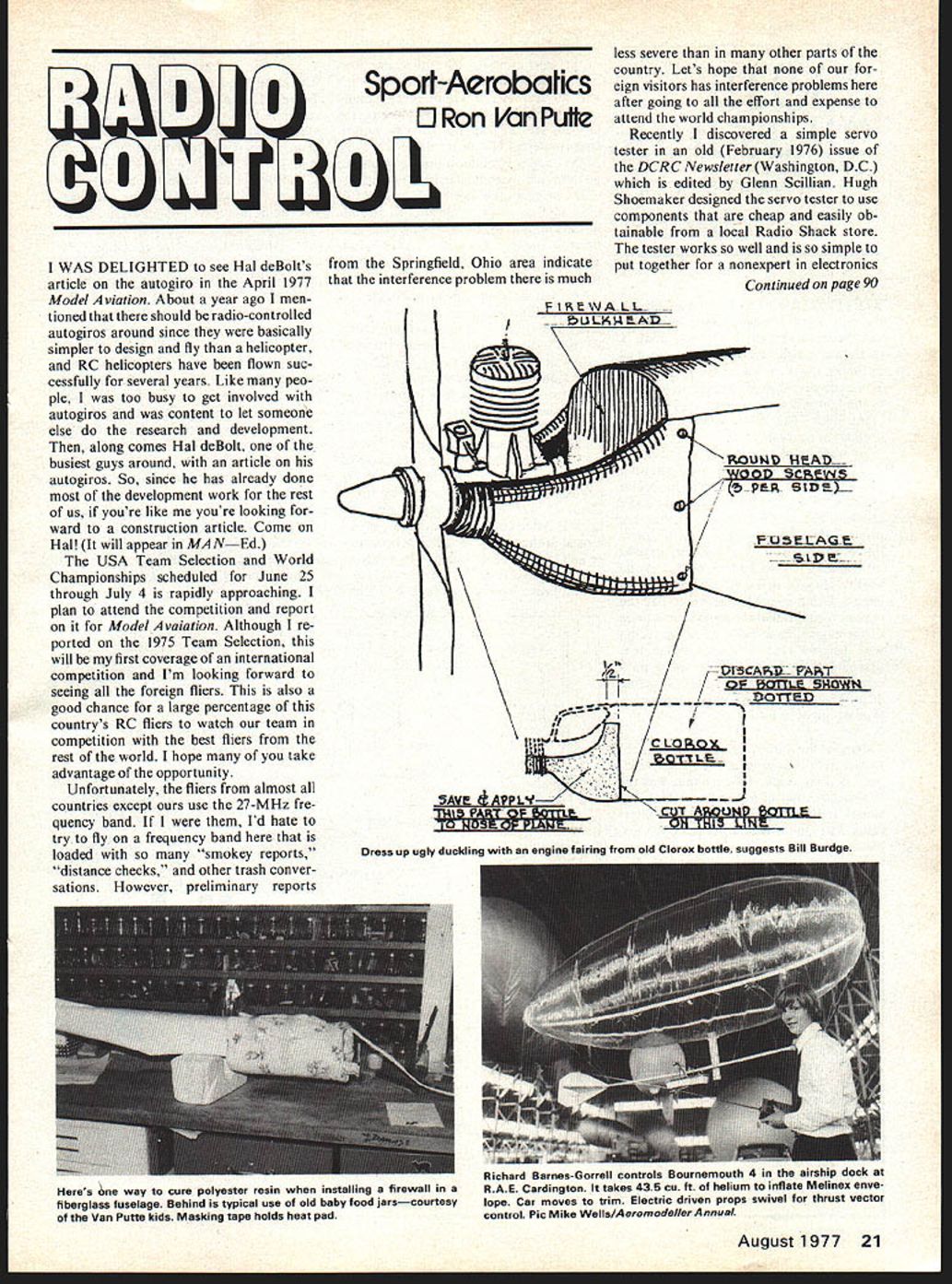
Modelers continue to see things from other people. Bill Burdge looked at a Clorox bottle and saw more than the obvious; he saw an engine fairing. In his own words Bill explains, "At present I am using a special fairing around and under an OS Max 45 on an original-design cabin biplane and it looks quite nice. The trick is to select an appropriate size Clorox bottle, which is fairly easy to do. If one cannot find an empty bottle around home, there is always the trash barrel at the nearest laundromat. Since most Clorox bottles are white, if one desires to paint the fairing a color to match the model, it is a good idea to rub the bottle vigorously with steel wool. This will both clean the material and provide a better surface for the dope or other paint."
Don Lowe is a world class flier who always willingly shares his flying secrets and provides assistance to fliers less gifted than himself. The following is an edited version of a taped conversation between Don and Dick McGraw, former NSRCA K-Factor editor. The tape was made at last year's Toledo Exposition and they gave me permission to use it.
"You will generally find that many pattern airplanes, which are set up with control surface throws to fly a good pattern, may give some difficulty in the spin maneuver and you've got to be careful about it. What you do is to 'milk' the nose up to some reasonable attitude above the horizon and make sure the airplane stalls straight ahead, not letting it dive into the maneuver. If it flies or dives into the maneuver, you won't get into a spin.
"Generally speaking, I've found that the higher the nose is pulled above the horizon and into a really deep stall, the easier it is to make the airplane spin. It may sound strange, but if you get the nose up at an exaggerated attitude, the airplane will spin easier than if you get it very flat. In a flat entry, the airplane often doesn't stall completely, and it may slide or dive into the spin and come out of it.
"You want to start raising the nose when the airplane still has speed enough for the nose to be pulled up. Since the engine will be idling, it won't help much in entering the spin. If you let the airplane slow down too much, the nose just isn't going to come up. I start raising the nose right away, bringing it up to the attitude I want the airplane to stall at, feeding up elevator in as it slows down until it stalls. Then I hold up elevator and feed in everything else I've got, including aileron.
"Generally, most airplanes spin easier to the right, which may also sound strange. You might think that going in the direction of engine torque would make it easier to make an airplane spin, but it is exactly opposite. I personally prefer spinning the airplane to the left because it seems to snap out of the spin easier. However, if an airplane is particularly difficult to spin to the left, trying a spin to the right may solve the problem.
"There is another trick which works on some airplanes. Dropping the landing gear makes some airplanes spin easier. It adds drag and shifts the vertical center of gravity. Beyond that I'm really not sure just what it does, but it does work on some airplanes. I had a Phoenix 5 that didn't spin easily and I always dropped the landing gear to make it spin and there's nothing in the rules that says you can't do that.
"One insurance policy to get any pattern-type airplane, which has been properly set up for the other maneuvers, into a spin is to add a dual rate to the elevator which will give you additional elevator control for the spin.
"Of course, another insurance policy to obtain easy spin entry is to get a Phoenix 7, because the changes which were made between the Phoenix 6 and Phoenix 7 were done to improve the spin entry."
In the June column I made a tongue-in-cheek suggestion about a Fun Fly event involving contestants passing transmitters to one another. Norm Schini from Nappanee, Indiana, took up the challenge and wrote, "Your idea for the Fun Fly event is great. The only thing you forgot is to schedule an auction."
Norm went on to mention that his club, the Sky Knights, had a Fun Fly coming up for which he will be the contest director and he welcomed some ideas for events.
My ideas for Fun Fly events involve those that are both fun and safe for the airplane, pilot and spectators. Too often the events are geared to the best fliers in the club and they end up as "plane breakers," dangerous events for the average flier. Events should be designed so that average pilots, flying average airplanes, can have safe fun competing against each other. If you have some ideas that meet my criteria for events, I'd like to hear from you so that they can be shared via this column. In the meantime, here are a few I like:
Le Mans Start: The pilot removes the prop nut and prop and goes to the starting line. On a signal, a watch is started and he runs to his airplane carrying the prop with the prop nut balanced on it. He installs the prop nut, starts the engine and takes off the airplane. Time stops when the airplane leaves the ground. Of course, minimum time wins.
Transcribed from original scans by AI. Minor OCR errors may remain.

