
Radio Control: Sport-Aerobatics
Ron VanPutte
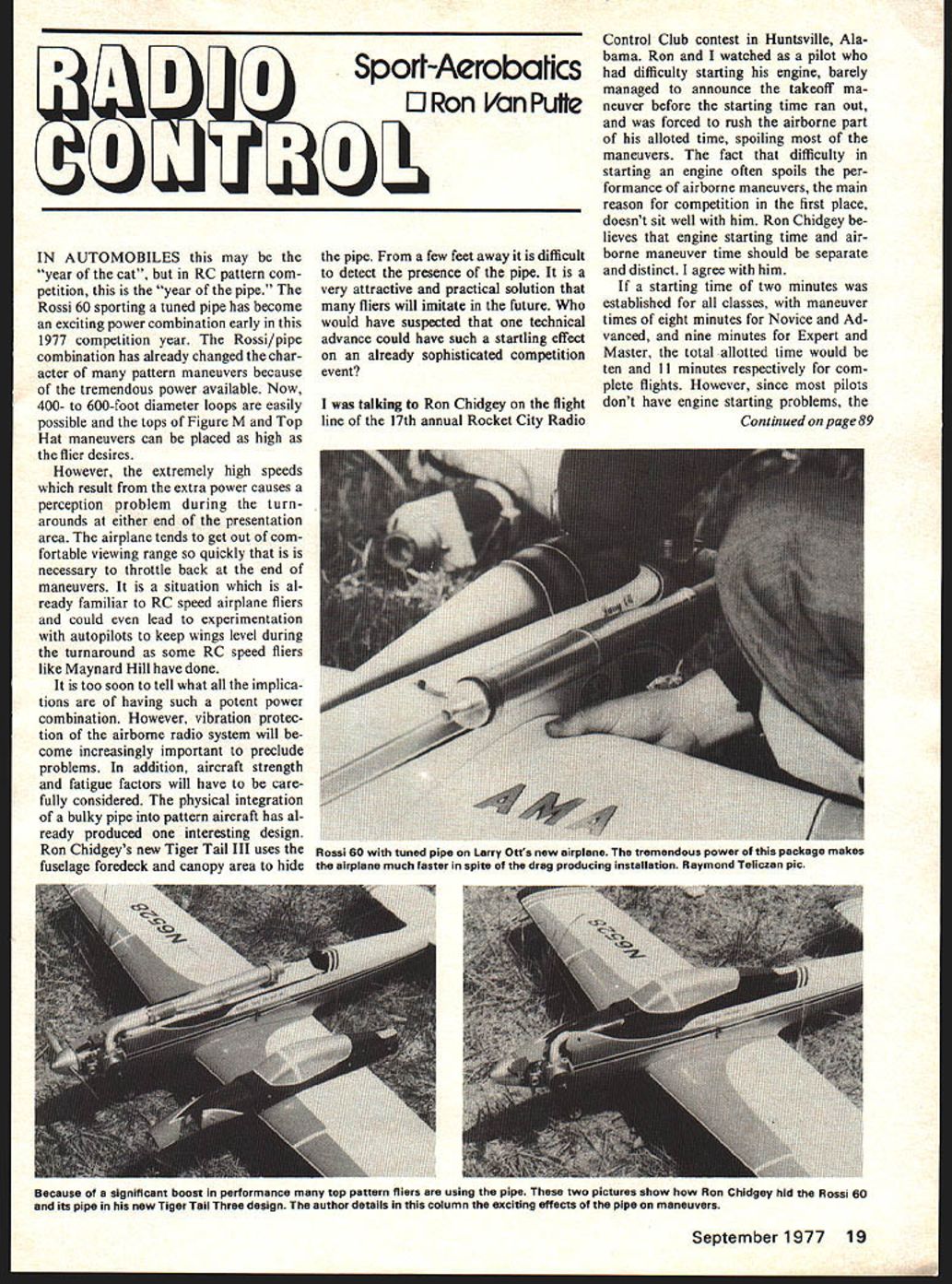
IN AUTOMOBILES this may be the "year of the cat", but in RC pattern competition, this is the "year of the pipe." The Rossi 60 sporting a tuned pipe has become an exciting power combination early in this 1977 competition year. The Rossi/pipe combination has already changed the character of many pattern maneuvers because of the tremendous power available. Now, 400- to 600-foot diameter loops are easily possible and the tops of Figure M and Top Hat maneuvers can be placed as high as the flier desires.
However, the extremely high speeds which result from the extra power causes a perception problem during the turnarounds at either end of the presentation area. The airplane tends to get out of comfortable viewing range so quickly that it is necessary to throttle back at the end of maneuvers. It is a situation which is already familiar to RC speed airplane fliers and could even lead to experimentation with autopilots to keep wings level during the turnaround as some RC speed fliers like Maynard Hill have done.
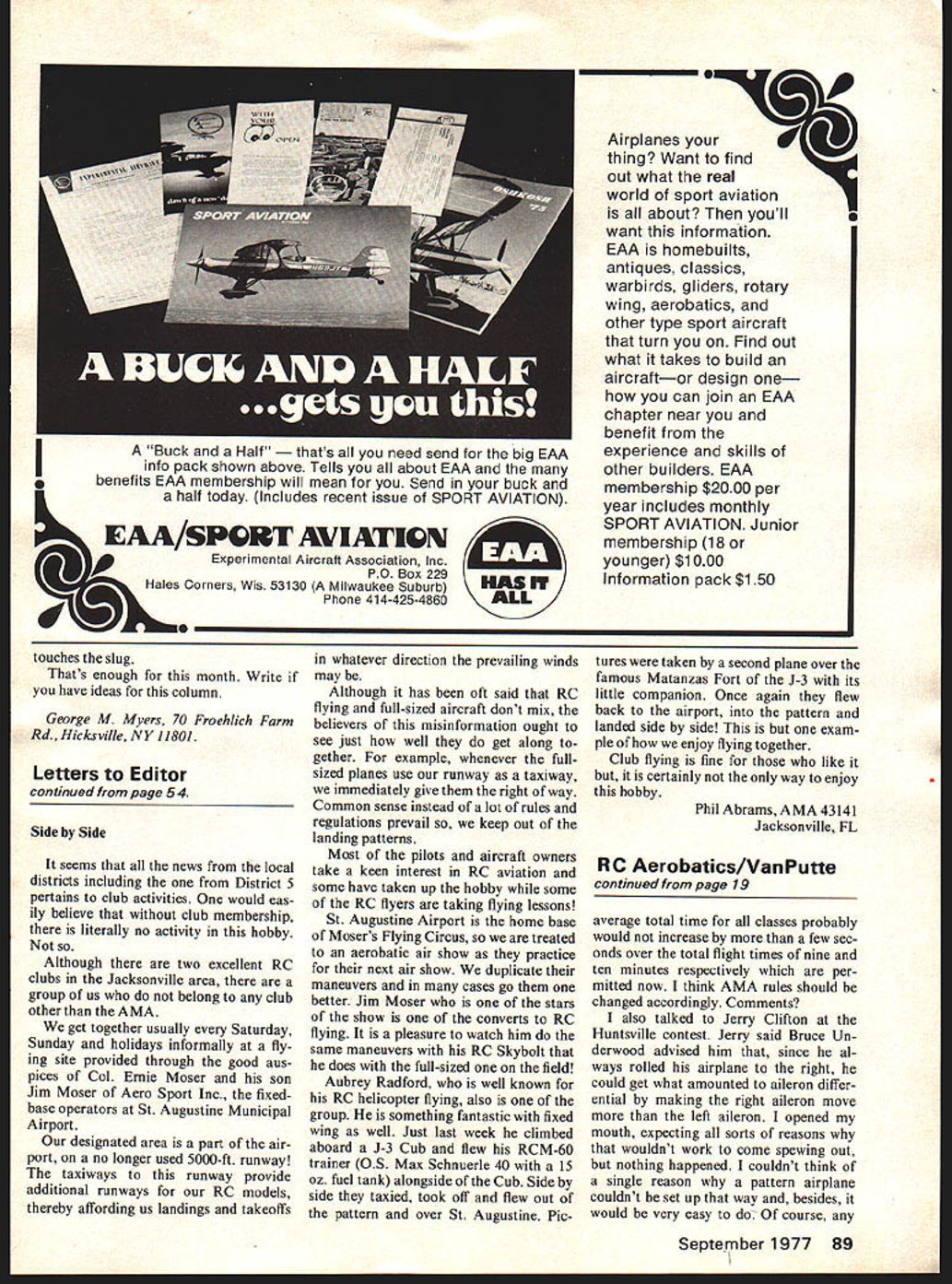
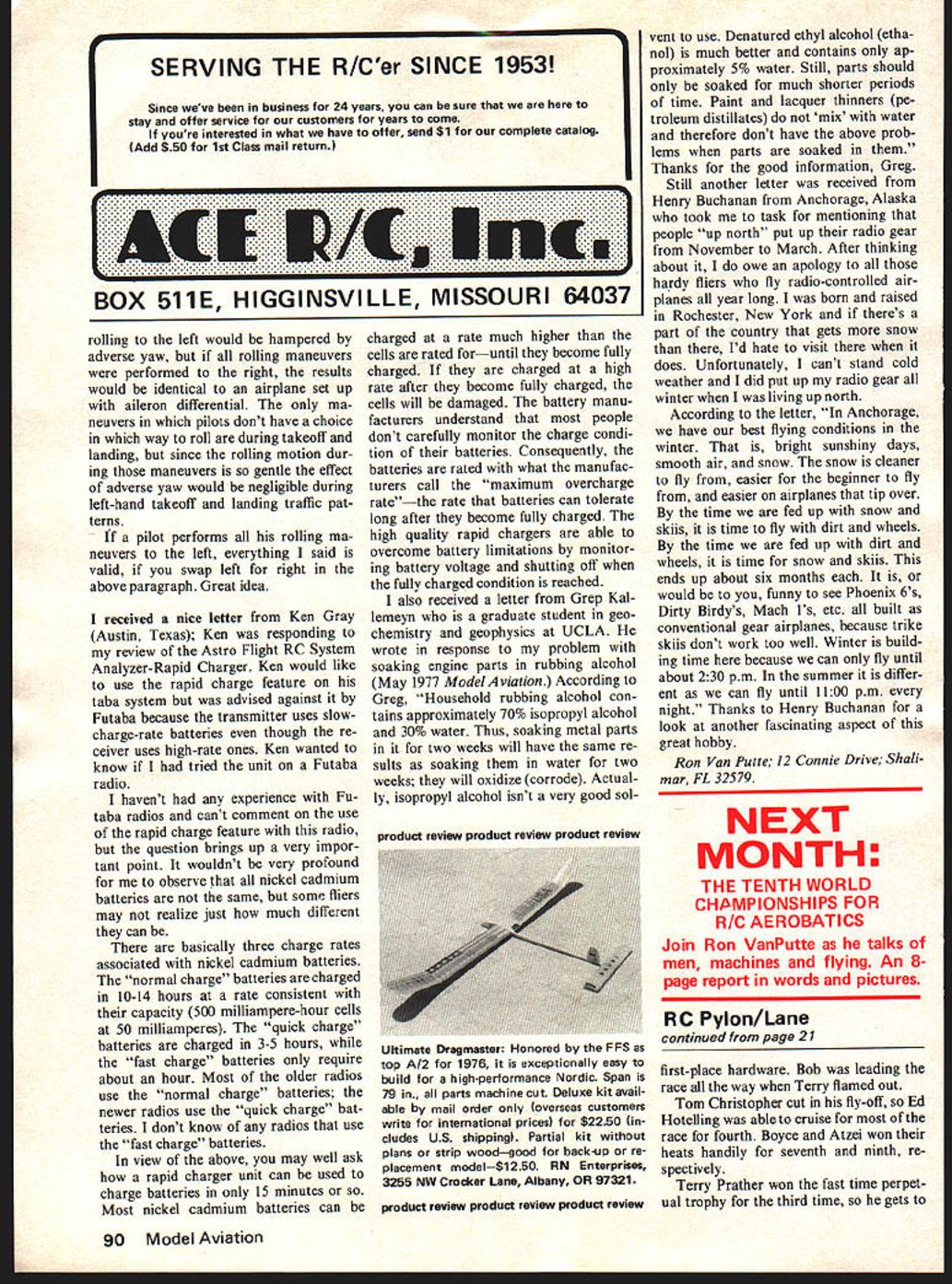
It is too soon to tell what all the implications are of having such a potent power combination. However, vibration protection of the airborne radio system will become increasingly important to preclude problems. In addition, aircraft strength and fatigue factors will have to be carefully considered. The physical integration of a bulky pipe into pattern aircraft has already produced one interesting design. Ron Chidgey's new Tiger Tail III uses the fuselage foredeck and canopy area to hide the pipe. From a few feet away it is difficult to detect the presence of the pipe. It is a very attractive and practical solution that many fliers will imitate in the future. Who would have suspected that one technical advance could have such a startling effect on an already sophisticated competition event?
I was talking to Ron Chidgey on the flight line of the 17th annual Rocket City Radio Control Club contest in Huntsville, Alabama. Ron and I watched as a pilot who had difficulty starting his engine, barely managed to announce the takeoff maneuver before the starting time ran out, and was forced to rush the airborne part of his allotted time, spoiling most of the maneuvers. The fact that difficulty in starting an engine often spoils the performance of airborne maneuvers, the main reason for competition in the first place, doesn't sit well with him. Ron Chidgey believes that engine starting time and airborne maneuver time should be separate and distinct. I agree with him.
If a starting time of two minutes was established for all classes, with maneuver times of eight minutes for Novice and Advanced, and nine minutes for Expert and Master, the total allotted time would be ten and 11 minutes respectively for complete flights. However, since most pilots don't have engine starting problems, the average total time for all classes probably would not increase by more than a few seconds over the total flight times of nine and ten minutes respectively which are permitted now. I think AMA rules should be changed accordingly. Comments?
I also talked to Jerry Clifton at the Huntsville contest. Jerry said Bruce Underwood advised him that, since he always rolled his airplane to the right, he could get what amounted to aileron differential by making the right aileron move more than the left aileron. I opened my mouth, expecting all sorts of reasons why that wouldn't work to come spewing out, but nothing happened. I couldn't think of a single reason why a pattern airplane couldn't be set up that way and, besides, it would be very easy to do. Of course, any major change would require much checking and modification of stick movements until one became accustomed to the new set-up. I received a nice letter from Ken Gray (Austin, Texas): Ken was responding to my review of the Astro Flight RC System Analyzer–Rapid Charger. Ken would like to use the rapid charge feature on his Futaba but was advised against it by Futaba because the transmitter uses slow-charge-rate batteries even though the receiver uses high-rate ones. Ken wanted to know if I had tried the unit on a Futaba radio.
I haven't had any experience with Futaba radios and can't comment on the use of the rapid charge feature with this radio, but the question brings up a very important point. It wouldn't be very profound for me to observe that all nickel cadmium batteries are not the same, but some fliers may not realize just how much different they can be.
There are basically three charge rates associated with nickel cadmium batteries. The "normal charge" batteries are charged in 10-14 hours at a rate consistent with their capacity (500 milliampere-hour cells at 50 milliamperes). The "quick charge" batteries are charged in 3-5 hours, while the "fast charge" batteries only require about an hour. Most of the older radios use the "normal charge" batteries; the newer radios also use the "quick charge" batteries. I don't know of any radios that use the "fast charge" batteries.
In view of the above, you may well ask how a rapid charger unit can be used to charge batteries in only 15 minutes or so. Most nickel cadmium batteries can be charged at a rate much higher than the cells are rated for—until they become fully charged. If they are charged at a high rate after they become fully charged, the cells will be damaged. The battery manufacturers understand that most people don't carefully monitor the charge condition of their batteries. Consequently, the batteries are rated with what the manufacturers call the "maximum overcharge rate"—the rate that batteries can tolerate long after they become fully charged. The high quality rapid chargers are able to overcome battery limitations by monitoring battery voltage and shutting off when the fully charged condition is reached.
I also received a letter from Greg Kalemeyn who is a graduate student in geochemistry and geophysics at UCLA. He wrote in response to my problem with soaking engine parts in rubbing alcohol (May 1977 Model Aviation). According to Greg, "Household rubbing alcohol contains approximately 70% isopropyl alcohol and 30% water. Thus, soaking metal parts in it for two weeks will have the same results as soaking them in water for two weeks; they will oxidize (corrode). Actually, isopropyl alcohol isn't a very good solvent to use. Denatured ethyl alcohol (ethanol) is much better and contains only approximately 5% water. Still, parts should only be soaked for much shorter periods of time. Paint and lacquer thinners (petroleum distillates) do not 'mix' with water and therefore don't have the above problems when parts are soaked in them." Thanks for the good information, Greg.
Still another letter was received from Henry Buchanan from Anchorage, Alaska who took me to task for mentioning that people "up north" put up their radio gear from November to March. After thinking about it, I do owe an apology to all those hardy fliers who fly radio-controlled airplanes all year long. I was born and raised in Rochester, New York and if there's a part of the country that gets more snow than there, I'd hate to visit there when it does. Unfortunately, I can't stand cold weather and I did put up my radio gear all winter when I was living up north.
According to the letter, "In Anchorage, we have our best flying conditions in the winter. That is, bright sunshiny days, smooth air, and snow. The snow is cleaner to fly from, easier for the beginner to fly from, and easier on airplanes that tip over. By the time we are fed up with snow and skis, it is time to fly with dirt and wheels. By the time we are fed up with dirt and wheels, it is time for snow and skis. This ends up about six months each. It is, or would be to you, funny to see Phoenix 6's, Dirty Birdy's, Mach 1's, etc., all built as conventional gear airplanes, because trike skis don't work too well. Winter is building time here because we can only fly until about 2:30 p.m. In the summer it is different as we can fly until 11:00 p.m. every night." Thanks to Henry Buchanan for a look at another fascinating aspect of this great hobby.
Ron Van Putte; 12 Connie Drive; Shalimar, FL 32579.
Transcribed from original scans by AI. Minor OCR errors may remain.

