
Sport-Aerobatics
Ron Van Putte
Since the last two months have been taken up with special events, this regular monthly column will involve catching up with things which happened in the interim, in addition to the items I normally cover.
At the annual Saturday night banquet for the Jim Kirkland Memorial contest, AMA's District 5 Vice President Jim McNeill startled everyone by presenting an AMA Superior Service Award to the Eglin Aero Modelers. The award was presented to the club for the outstanding example the club members demonstrated to other AMA clubs by the way they support the Jim Kirkland Memorial Contest. Each year the club members enthusiastically work on this widely-known contest despite the fact that only two club members fly in RC pattern contests. This year, 54 of 65 club members worked directly on the contest, a participation rate of more than 80%. I'm proud to be associated with this fine group of modelers.
The Nats just finished as this is written and I'm looking forward to reading the RC Pattern report by Bill Simpson. Bill is well known by newsletter editors as the former editor of the BIRD'S Eye Views, newsletter of the BIRDS of Long Beach, Calif., one of the largest AMA chartered clubs. Bill always wrote an interesting newsletter and I'm sure his Nats report will demonstrate his talents to this much larger reading audience.
From early reports, the participation in RC Pattern was way down, less than half the number from the 1976 Nats at Dayton, Ohio. If that was the case and other events showed a similar reduction in competitors, the west coast competitors will probably have to wait a long time before hosting another Nats.
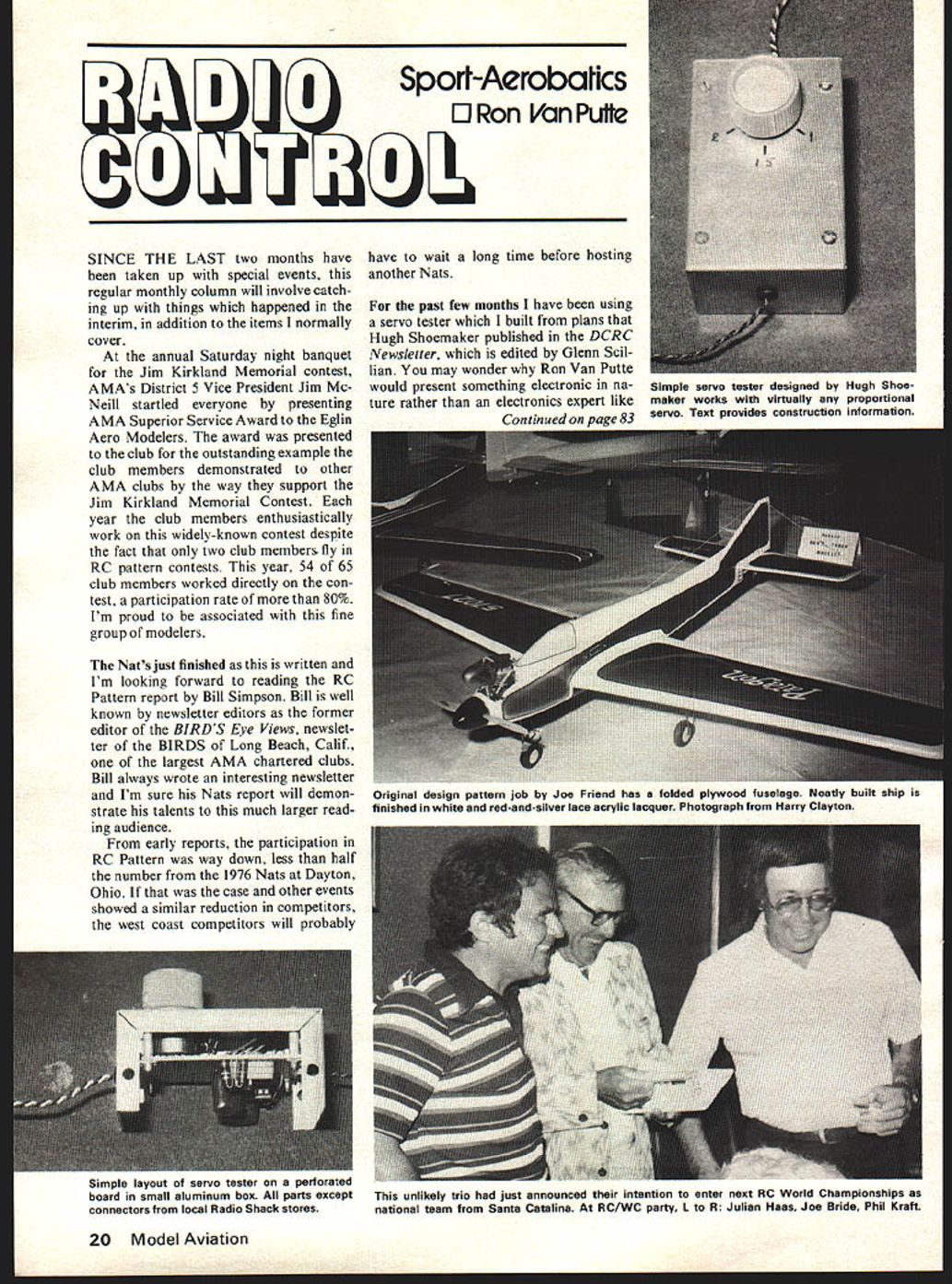
For the past few months I have been using a servo tester which I built from plans that Hugh Shoemaker published in the DCRC Newsletter, which is edited by Glenn Scillian. You may wonder why Ron Van Putte would present something electronic in nature rather than an electronics expert like
RC Aerobatics/Van Putte continued from page 20
George Myers, who writes Radio Technique. One reason is that, since the servo tester is so easy to build that a non-expert like me had no trouble with the construction, you might be encouraged to try it yourself. Another reason is that George Myers didn't indicate an interest in publishing the servo tester when I wrote to him about it.
Why should you be interested in the servo tester? Let me quote from Hugh Shoemaker's article:
"Servos tend to get the toughest beating of any of our airborne hardware. Consequently they also seem to be the most prone to failure, with broken teeth the largest casualty. After a couple of years the servo motors (and potentiometers—RVP) also have a tendency to become erratic. The servo checker acts in the place of a transmitter and receiver by simulating an output pulse just as would those units. By varying the control on the servo checker you can simulate movement of your transmitter control and observe movement of the servo. The most common check is to slowly move the control and watch for jerky movements, most often attributable to a broken gear tooth (or a scratchy potentiometer—RVP). Another check is to look for a bad spot on the motor armature by very slowly rotating the control and observing any dead spots in the servo movement."
I bought all the parts, except for the battery and servo connectors, from the local Radio Shack for less than $8. Here is the parts list:
- R1 100K 271-045
- R2 15K 271-036
- R3 10K pot. 271-1715
- R4 4.7K 271-030
- C1, C2 0.22µF 272-1070
- IC1 555 276-1723
- IC2 74121 276-1814
- Aluminum box (approx. 3/4" x 2-1/4" x 1/2"), knob (for potentiometer), perforated board (to fit box), connectors (to fit the battery and servo connectors).
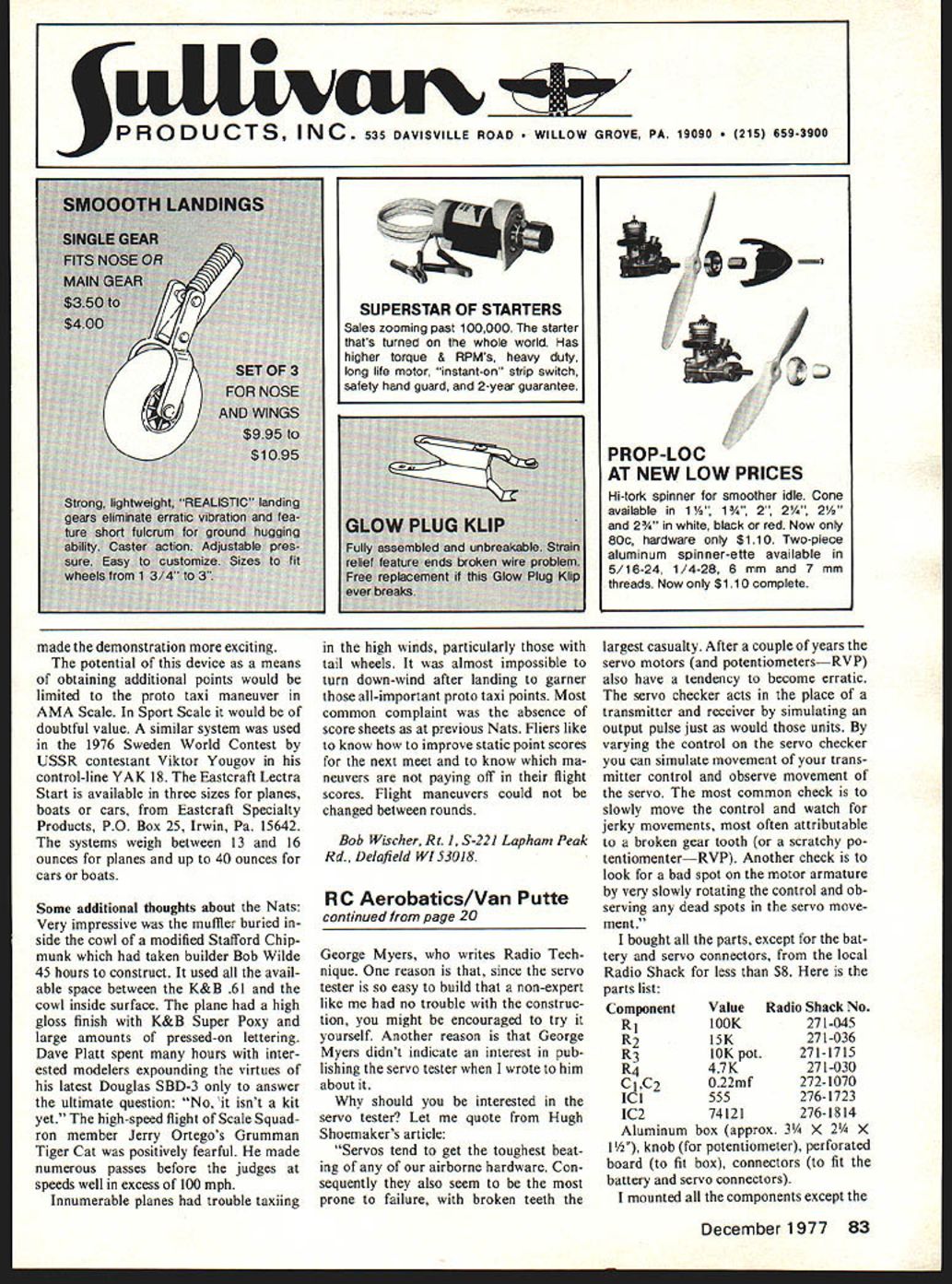
I mounted all the components except the battery and servo connectors on the perforated board and installed the board in the aluminum box. The potentiometer was mounted on the box with the shaft sticking out the top.
The checker works with 4-wire servos or servos requiring positive or negative pulses. Again quoting from Hugh Shoemaker, "You will notice that IC2 puts out both a positive (Pin 6) and a negative (Pin 1) pulse. If you have Kraft, Heath, Ace or Royal servos, use the positive output. For Proline servos, use the negative output. The red and black servo wires (and white wire if you have a 4-wire servo) should be connected to the same color wires on the battery pack."
One way to calibrate the servo checker is by using a good servo. Simply rotate the potentiometer shaft until the servo arm is in neutral and tighten the nut on the potentiometer which mounts it in the box. Without turning the potentiometer shaft, mount the knob to point to a convenient neutral reference point and tighten the screw locking the knob to the potentiometer shaft.
Of course, if you have access to an oscilloscope, you can also compare the servo checker output pulse with a standard 1.5 millisecond pulse by rotating the potentiometer shaft until they match. Either way will give you satisfactory calibration.
My servo checker has been used to check many local servos and I have been successful in diagnosing the presence of several faults which would have caused an airplane to crash. However, on one occasion my Phoenix 6 competition aircraft had a bad spot on the armature of the elevator servo motor. The airplane stayed in an outside loop when I released the down elevator control and it was fortunate that engine vibration shook the motor sufficiently to drive the servo off the bad spot, so I saved the airplane. Later, the servo checker could duplicate the failure every time. I hope your servo checker will enable you to discover servo problems early enough so you don't have to rely on luck like I did.
One of the problems every club seems to face is getting members to come to meetings. Of course, improving the program which follows the business meeting is an obvious way to approach the objective, but even that sometimes isn't enough. From the many club newsletters which AMA headquarters forwards to me I have gleaned a few ideas which may help your club get a few more members out.
One club purchases an aircraft kit every three or four months and holds a drawing after a regular meeting. The winner is obligated to build the kit within a reasonable time and provide a written report for publication in the club's newsletter. The local aspect of the kit review is valuable to club members and the newsletter editor usually welcomes contributions because they make his job easier.
Another idea is for the club to purchase a popular kit, engine or accessory and sell enough raffle tickets to just pay for the item and raffle it off at a club meeting. Raffle tickets are available only to club members who attend meetings.
One of the old, but good, ways to get people to come to meetings is to have a show and tell of new airplanes or other projects. The club members attending the meeting get the benefits of hearing how other modelers do things involved with the hobby. A vote is held to determine the best presentation, with the winner awarded a useful prize that was purchased by the club.
If your club has a special way to encourage meetings attendance, I'm sure other club leaders would like to hear about them. Send me a note describing your club's idea and I'll be glad to see that it gets published.
Ron Van Putte, 12 Connie Dr., Shalimar, FL 32579.
Transcribed from original scans by AI. Minor OCR errors may remain.

