
Radio Control: Sport-Aerobatics
Ron VanPutte
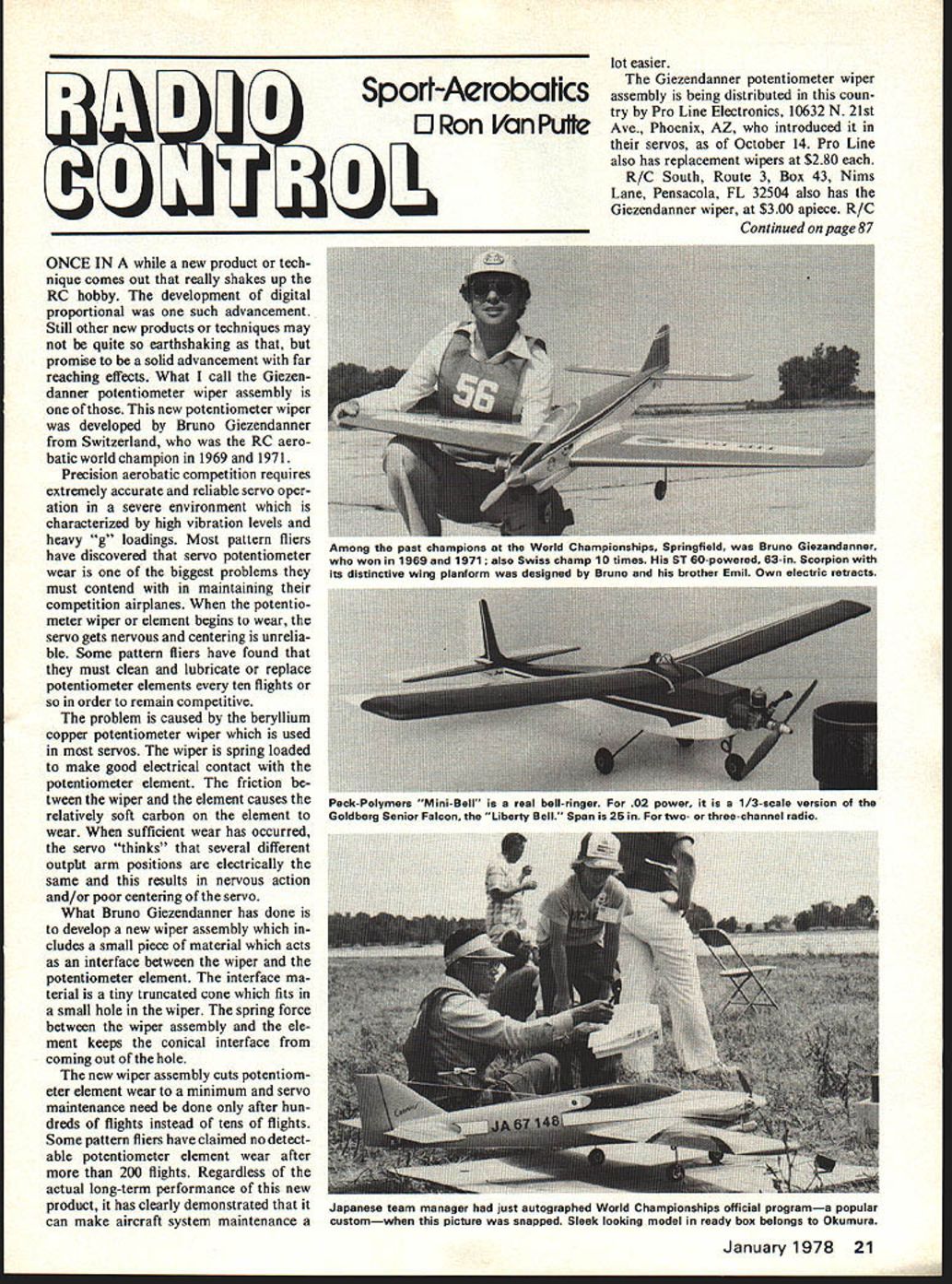
ONCE IN A while a new product or technique comes out that really shakes up the RC hobby. The development of digital proportional was one such advancement. Still other new products or techniques may not be quite so earthshaking as that, but promise to be a solid advancement with far reaching effects. What I call the Giezendanner potentiometer wiper assembly is one of those. This new potentiometer wiper was developed by Bruno Giezendanner from Switzerland, who was the RC aerobatic world champion in 1969 and 1971.
Precision aerobatic competition requires extremely accurate and reliable servo operation in a severe environment which is characterized by high vibration levels and heavy "g" loadings. Most pattern fliers have discovered that servo potentiometer wear is one of the biggest problems they must contend with in maintaining their competition airplanes. When the potentiometer wiper or element begins to wear, the servo gets nervous and centering is unreliable. Some pattern fliers have found that they must clean and lubricate or replace potentiometer elements every ten flights or so in order to remain competitive.
The problem is caused by the beryllium copper potentiometer wiper which is used in most servos. The wiper is spring loaded to make good electrical contact with the potentiometer element. The friction between the wiper and the element causes the relatively soft carbon on the element to wear. When sufficient wear has occurred, the servo "thinks" that several different output arm positions are electrically the same and this results in nervous action and/or poor centering of the servo.
What Bruno Giezendanner has done is to develop a new wiper assembly which includes a small piece of material which acts as an interface between the wiper and the potentiometer element. The interface material is a tiny truncated cone which fits in a small hole in the wiper. The spring force between the wiper assembly and the element keeps the conical interface from coming out of the hole.
The new wiper assembly cuts potentiometer element wear to a minimum and servo maintenance need be done only after hundreds of flights instead of tens of flights. Some pattern fliers have claimed no detectable potentiometer element wear after more than 200 flights. Regardless of the actual long-term performance of this new product, it has clearly demonstrated that it can make aircraft system maintenance a lot easier.
The Giezendanner potentiometer wiper assembly is being distributed in this country by Pro Line Electronics, 10632 N. 21st Ave., Phoenix, AZ, who introduced it in their servos, as of October 14. Pro Line also has replacement wipers at $2.80 each. R/C South, Route 3, Box 43, Nims Lane, Pensacola, FL 32504 also has the Giezendanner wiper, at $3.00 apiece. with the fundamental items.
Transmitter Tests:
First, we do the obvious. Try every switch, knob, pushbutton, control stick, and trim lever, to find out if it is doing what it should. Then take the system outside and perform the range check described in the manual that came with the system. In general, I dislike range checks that cover less than about 50 feet of ground range, because it's too hard to detect changes in shorter ranges. If you have one of those systems that calls for a 9- or 10-foot ground range, test it with the antenna on the transmitter, but collapsed as much as possible. If the antenna disappears inside the transmitter case, test with the first section pulled all of the way out. Measure ground range in terms of paces (the length of your stride when walking normally). See last month's column for additional details.
Next, charge the transmitter pack fully, then extend the antenna full length, note the time, and turn on the transmitter. Do this at night, when you won't be shooting someone down, or when it's raining or snowing. Note the output meter reading. Now go do something else for a while. Check the output meter every hour. Note the time when it falls to half-scale, and calculate elapsed time. If a new system operates 4 hours, you can expect a moderately-used system to drop to about 3 hours after 5 years.
When that happens, buy yourself a new transmitter battery pack. If the time shortens that much in less than 5 years, you probably have at least one shorted cell in the pack, which should be replaced.
Recharge the transmitter, and set it aside.
Receiver and Servo Tests:
While you were testing the transmitter, you should have noticed if any of the servos were jumping, sticking, or running noticeably slower than the others. If you find any, mark a piece of tape with a description of the problem and stick it on the servo. Try swapping the servos around to prove that the trouble is in the servo and not in the transmitter or receiver.
If you have a servo tester, it can help you to pinpoint troubles. Repairs are a matter of deciding who's going to do it—you, the factory, or the local service center.
In the event that you are convinced that the receiver needs retuning (which it might), check the circuit to discover which two coils are on the output end of the circuit. These are the ones most likely to need adjustment. The antenna coils rarely shift enough to warrant readjustment. Make a tuning wand like that described in page 12 of the September 1977 column and tune for best ground range.
One very important point about retuning! There is no value in attempting to retune a receiver that is being disturbed by a noisy servo. If you have a jittery servo, the most probable cause is a loose or dirty wiper on the potentiometer on the feedback potentiometer. The electrical noise which results from such a condition can easily cut your ground range in half. Without getting technical about it, the reason for the range reduction is AGC (Automatic Gain Control) action within the receiver, in response to the servo noise. Therefore, use only good servos when tuning.
Receiver Battery Tests:
This subject has been done to death in recent years. Buy or borrow a battery analyzer and test every battery pack. If performance is 25% below normal, find out why, and fix or replace the pack. A new battery pack is the cheapest insurance you can buy for continued happy flying.
Summary:
This discussion has been deliberately kept very simple, just to convince you that you can do it. If you will perform the simple maintenance chores described above, I guarantee that you will fly longer and better next year, and have more fun doing it. You don't have to be an electronics technician to take proper care of your equipment. Do it.
George Myers, 70 Froehlich Farm Rd., Hicksville, N.Y. 11801. Kraft (where he ran the Signature Series production line). His initial shipment of 300 wipers probably is gone by now, but I am sure he will have more on the way.
FELLOW EGLIN AERO MODELLER and editor of the club newsletter, Ed Moorman, is one guy who refuses to fly in pattern contests; he claims they are boring. Instead, he has developed techniques for doing "hot dog" maneuvers. The October 1977 Radio Control Modeler magazine contains an article on some of his techniques. Compared to most fliers, Ed's flying is very exciting; for example, he almost always performs a roll immediately after takeoff and often does a split-S to a landing.
Recently, he was practicing low inverted flying and got a tad too low, just touching the tip of the vertical fin on the runway. Since there's no way to recover from that situation, his airplane proceeded to settle down on the runway and ended up with a thoroughly sanded canopy and engine head fins. Undaunted, he mounted a small wheel on the tip of the vertical fin and a nose gear on top of the fuselage, just behind the engine. When the vertical fin touches the runway now, the airplane rolls to a stop. Ed is working on extending the nose gear so that he can perform inverted touch-and-go maneuvers! An interesting sidelight of his experience is that he claims to have lost his fear of flying inverted low to the ground and he finds that it is very easy to maintain less than a foot ground clearance for long distances down the runway. It still scares me.
I heard about an interesting pattern contest that the Huntington County (Indiana) Modelers sponsored in August. Contest Director Pat Shuttleworth reported that they had a Beginner Pro-Am event for first-time contest fliers that went like this: "Beginners drew a Masters flier's name from a hat and he became the caller-coach for the Beginner. The Beginners flew a round and all mistakes were blamed on the coach, naturally. Then, the Masters flew the Beginner's airplanes for a round. Everyone really enjoyed watching and participating. The winners were selected by adding the Beginner's best of two scores to the coach's best of two scores." It sounds like fun, but I wonder how they got enough Masters level fliers to go around. Many contests around the country are now offering Beginner events and they have proved to be very popular.
NOTICE . NOTICE . NOTICE
In the December issue, a schematic for the Hugh Shoemaker servo tester—described in Ron VanPutte's column Sport-Aerobatics—was inadvertently omitted. This schematic will be printed in the February issue.
NOTICE . NOTICE . NOTICE
My sometimes malicious sense of humor was recently tickled by an anonymous inventor who offered a new device for fliers who still believe that a steady wind actually affects the flight of an aircraft. His invention is based on the "fact" that one often hears at the flying field: namely, "when an airplane turns upwind it climbs and when it turns downwind it dives." The inventor proposed a device which senses aircraft rate of climb and transmits a signal to the ground-based flier. When the device detects the maximum positive rate of climb, the airplane is heading directly into the wind and when a maximum negative rate of climb is indicated, the airplane is heading directly downwind. By carefully flying in a steady turn the flier can tell from which direction the wind is blowing. I love it. The inventor is also working on a perpetual motion machine.
Since mentioning Fun Fly events in a couple of columns I have received several letters from readers with suggested events and would like to share some of them with you.
Don Jenkins from Indianapolis, Indiana sent me a letter which was typed single spaced on both sides of a piece of paper; that's a lot of words. He described his model activity since starting during the 1930's and went on to present some low key events his club (The Hamilton R/C Modelers) uses because, "a goodly number are junior/senior or muddles like me. We have a real knowledgeable board of directors who have set up some very basic events.
1) Timed Flight: Timer tells the entrant how long he must stay in the air, without aid of watch or someone counting off seconds. Time starts as wheels leave ground and stops when wheels touch down. It is usually a flight between 45 seconds and two minutes, depending on wind and weather conditions. Closest to stated time wins.
2) Power Flight vs. Glide Flight: Entrant picks the time he wants to climb under power, then cuts the engine and glides as long as possible. Best glide to power ratio wins.
3) Bomb Drop: You described the drop, but since we have been using spools or worn out batteries, I hope someone else sees your suggestion of using tiny flour bags. I have advocated this for a long time, because the hard objects bounce and roll and the flour bomb explodes! Makes it easier to determine the closest drop.
4) Figure Eight, Touch and Go: Take off, fly to end of area, around pylon, touch and go, fly to opposite end of area, around pylon, etc., until amount of laps has been completed. Best elapsed time wins."
By the way, Don is "looking for another O&R 19 to replace the old one that has finally run out. If you know any engine collector who would trade a 'runner' for a per-
Radio Control: Sport-Aerobatics
Once in a while a new product or technique comes out that really shakes up RC hobby development. Digital proportional was such an advancement. Still other new products and techniques may promise solid, far-reaching effects. What we call the Giezendanner potentiometer wiper assembly is one of these.
A new potentiometer wiper was developed by Bruno Giezendanner of Switzerland, RC aerobatic world champion 1969 and 1971. Precision aerobatic competition requires extremely accurate, reliable servo operation in a severe environment characterized by high vibration levels and heavy g-loadings. Most pattern fliers have discovered servo potentiometer wear is one of the biggest problems they must contend with in maintaining competition airplanes. As the potentiometer wiper element begins to wear, the servo gets nervous and centering becomes unreliable. Some pattern fliers have found they must clean, lubricate or replace potentiometer elements every ten flights in order to remain competitive.
The problem is caused by the beryllium-copper potentiometer wiper used in servos. The wiper, spring-loaded to make good electrical contact with the potentiometer element, through friction causes the relatively soft carbon element to wear. After sufficient wear has occurred, the servo "thinks" several different output arm positions are electrically the same; the results are nervous action and/or poor centering of the servo.
What Bruno Giezendanner has done is develop a new wiper assembly which includes a small piece of material that acts as an interface between the wiper and the potentiometer element. The interface material is a tiny truncated cone that fits a small hole in the wiper. Spring force between the wiper assembly element keeps the conical interface from coming out of the hole. The new wiper assembly cuts potentiometer element wear to a minimum; servo maintenance need be done after hundreds of flights instead of tens of flights. Some pattern fliers have claimed no detectable potentiometer element wear after 200 flights. Regardless of actual long-term performance, the new product has clearly demonstrated it can make aircraft system maintenance a lot easier.
The Giezendanner potentiometer wiper assembly is being distributed in this country by Pro Line Electronics, 10632 N. 21st Ave., Phoenix, AZ. Pro Line introduced the servos October 14. Pro Line also has replacement wipers, $2.80. R/C South, Route 3 Box 43, Nims Lane, Pensacola, FL 32504, also has the Giezendanner wiper, $3.00 apiece.
Transmitter Tests
First, obvious: try the switches, knobs, pushbuttons, control sticks and trim levers to find out what they are doing. Then take the system outside and perform the range check described in the manual. I generally dislike range checks that cover less than about 50 feet ground range because it is too hard to detect changes at shorter ranges. Some manuals call a 9–10-foot ground-range test. With the antenna of the transmitter collapsed as much as possible (antenna disappears inside the transmitter case), test with the first section pulled way out. Measure ground range in terms of paces (length of your stride walking normally). See last month's column for additional details.
Next, charge the transmitter pack fully, extend the antenna full length, note the time, turn the transmitter on at night (you won't be shooting someone down if it's raining or snowing) and note the output meter reading. Now go do something else. Check the output meter an hour later. Note the time it falls to half-scale and calculate elapsed time. If a new system operates four hours, you can expect a moderately used system to drop to about three hours; after five years this happens — buy yourself a new transmitter battery pack. Time shortens much less than five years; you probably have at least one shorted cell — the pack should be replaced. Recharge the transmitter and set it aside.
Receiver/Servo Tests
When testing the transmitter you should have noticed servos jumping, sticking or running noticeably slower than others. Find and mark the offending servos with a piece of tape and note their symptoms for further inspection.
Transcribed from original scans by AI. Minor OCR errors may remain.

