
Radio Control: Sport-Aerobatics
Ron Van Putte
THIS COLUMN is a potpourri of various items, most of which are about activities at the flying site. RC clubs are usually similar as far as general operation is concerned. Of course, there are exceptions due to differences in the flying sites, the interests of club members and the size of the club, but what applies for one club flying site usually applies to most of them.
In reading through RC-oriented newsletters, one item that comes up very often is the list of flying site rules. Usually, the discussions involve making, changing or enforcing a list of rules. It is amazing how long it takes and how strong the arguments get when flying site rules are discussed.
It seems to me that if flying site rules were prepared as extensions of the golden rule, we'd have no difficulty in preparing a workable set of rules. Since I've been flying at RC sites all around the country for over 20 years and have seen many sets of rules in operation, let me propose a set of flying site rules for you to consider as a starting point for your own field rules:
- All aircraft which are not in operation should be in the pit area.
- All pilots actually flying should stand in a designated area.
- Engine starts are permitted in the pit area, but prolonged engine running must be conducted in a test area.
- All pilots will comply with the method of frequency control.
- All take-offs and landings will be in the same direction.
- The first turn after take-off will be in the direction away from the pit and spectator area.
- No flying is permitted over the pit and spectator area.
- Deadstick landings have priority, but must be announced to other fliers.
- Deliberately unsafe flying is not permitted.
The reasons for the various rules are as follows, rule by rule:
- If fliers know where the other airplanes are, they are less likely to run into them, even in an emergency.
- Again, if the flier knows where the other fliers are, they are less likely to run into them, too.
- We all tolerate engine noise, but there's no reason to put up with someone running-in an engine in the pit area.
- Obvious.
- There is less chance of collisions if all aircraft are moving in the same direction on or near the ground.
6 and 7. If airplanes are kept away from the pit and spectator areas, an out-of-control aircraft is less likely to crash there. 8 and 9. Obvious.
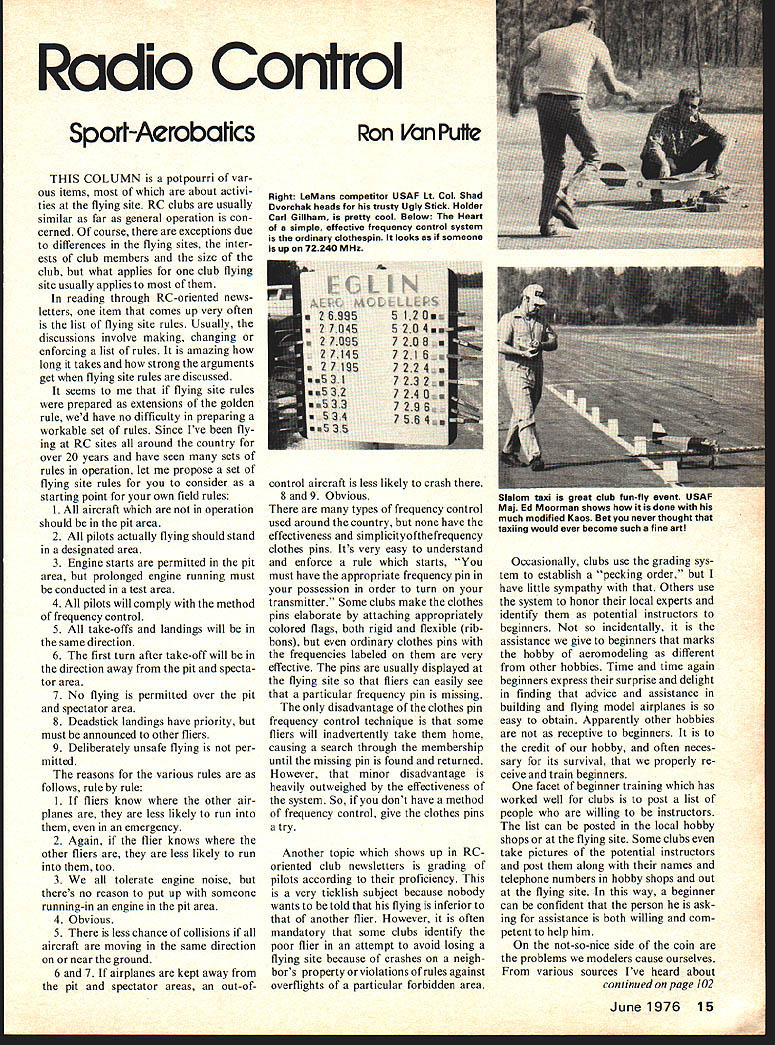
There are many types of frequency control used around the country, but none have the effectiveness and simplicity of the frequency clothes pins. It's very easy to understand and enforce a rule which starts, "You must have the appropriate frequency pin in your possession in order to turn on your transmitter." Some clubs make the clothes pins elaborate by attaching appropriately colored flags, both rigid and flexible (ribbons), but even ordinary clothes pins with the frequencies labeled on them are very effective. The pins are usually displayed at the flying site so that fliers can easily see that a particular frequency pin is missing.
The only disadvantage of the clothes pin frequency control technique is that some fliers will inadvertently take them home, causing a search through the membership until the missing pin is found and returned. However, that minor disadvantage is heavily outweighed by the effectiveness of the system. So, if you don't have a method of frequency control, give the clothes pins a try.
Another topic which shows up in RC-oriented club newsletters is grading of pilots according to their proficiency. This is a very ticklish subject because nobody wants to be told that his flying is inferior to that of another flier. However, it is often mandatory that some clubs identify the poor flier in an attempt to avoid losing a flying site because of crashes on a neighbor's property or violations of rules against overflights of a particular forbidden area.
Occasionally, clubs use the grading system to establish a "pecking order," but I have little sympathy with that. Others use the system to honor their local experts and identify them as potential instructors to beginners. Not so incidentally, it is the assistance we give to beginners that makes the hobby of aeromodeling different from other hobbies. Time and time again beginners express their surprise and delight in finding that advice and assistance in building and flying model airplanes is so easy to obtain. Apparently other hobbies are not as receptive to beginners. It is to the credit of our hobby, and often necessary for its survival, that we properly receive and train beginners.
One facet of beginner training which has worked well for clubs is to post a list of people who are willing to be instructors. The list can be posted in the local hobby shops or at the flying site. Some clubs even take pictures of the potential instructors and post them along with their names and telephone numbers in hobby shops and out at the flying site. In this way, a beginner can be confident that the person he is asking for assistance is both willing and competent to help him.
On the not-so-nice side of the coin are the problems we modelers cause ourselves. From various sources I've heard about difficulties with flying site neighbors, with fellow RC fliers and with other aeromodelers.
Most flying sites have neighbors who are close enough to be bothered by some of the things we do. Certain problems we can do nothing about, but we can alleviate some potential clashes with neighbors.
Mufflers do work and the relatively small expense and performance degradation incurred by using mufflers certainly is offset in the face of a flying site loss due to excessive noise.
Invasions of a neighbor's property have caused problems for many clubs. Airplanes do crash for reasons beyond our control, but we certainly don't have to go tramping through a neighbor's bean field to retrieve the airplane without his permission. The airspace above the neighbor's property belongs to him too and several flying sites have been shut down due to repeated violations of the airspace above a neighbor's property.
On the lighter side, have you ever considered having a Club Records Day? There are all sorts of possibilities for records involving RC airplanes. Most of them involve speed or duration, but the events can be tailored to fit a wide spectrum of aircraft types. Let me suggest a few events for your consideration; I'm sure you can come up with many more.
- Maximum Speed: Two passes in opposite directions are made through a speed trap. The average speed is determined by adding the two elapsed times and dividing it into twice the distance for one pass. Break down the competition into engine classes.
- Endurance: This one is easy; all you need is a watch and a patient timer. By the way, I once flew a Phoenix V powered by an OS 50 Goldhead and started with 12 ounces of fuel for 38 minutes and 4 seconds from take-off to touch-down!
- Handicapped Endurance: Each airplane gets 6 ounces of fuel per cubic inch of engine displacement (a .60 gets 3.6 ounces, a .40 gets 2.4 ounces and so on). Be prepared for some long times here, too. My Supertroupe S.T. 60-powered Bar Fli once flew for over 19 minutes on 3.6 ounces of fuel!
Once your club has tried a Records Day, you will make it an annual event, as my club did—it's a ball.
The contest season is about to start in earnest and all those great contests you hear about every year are getting ready to make their 1976 debut. Why don't you try a few on for size? I hope to see many of you out at a contest this year. Look me up, I'll be under the yellow and green dining fly with the Eglin flag on top.
My address is: 12 Connie Drive, Shalimar, FL 32579.
Transcribed from original scans by AI. Minor OCR errors may remain.

