
Radio Control: Sport-Aerobatics
Ron VanPutte
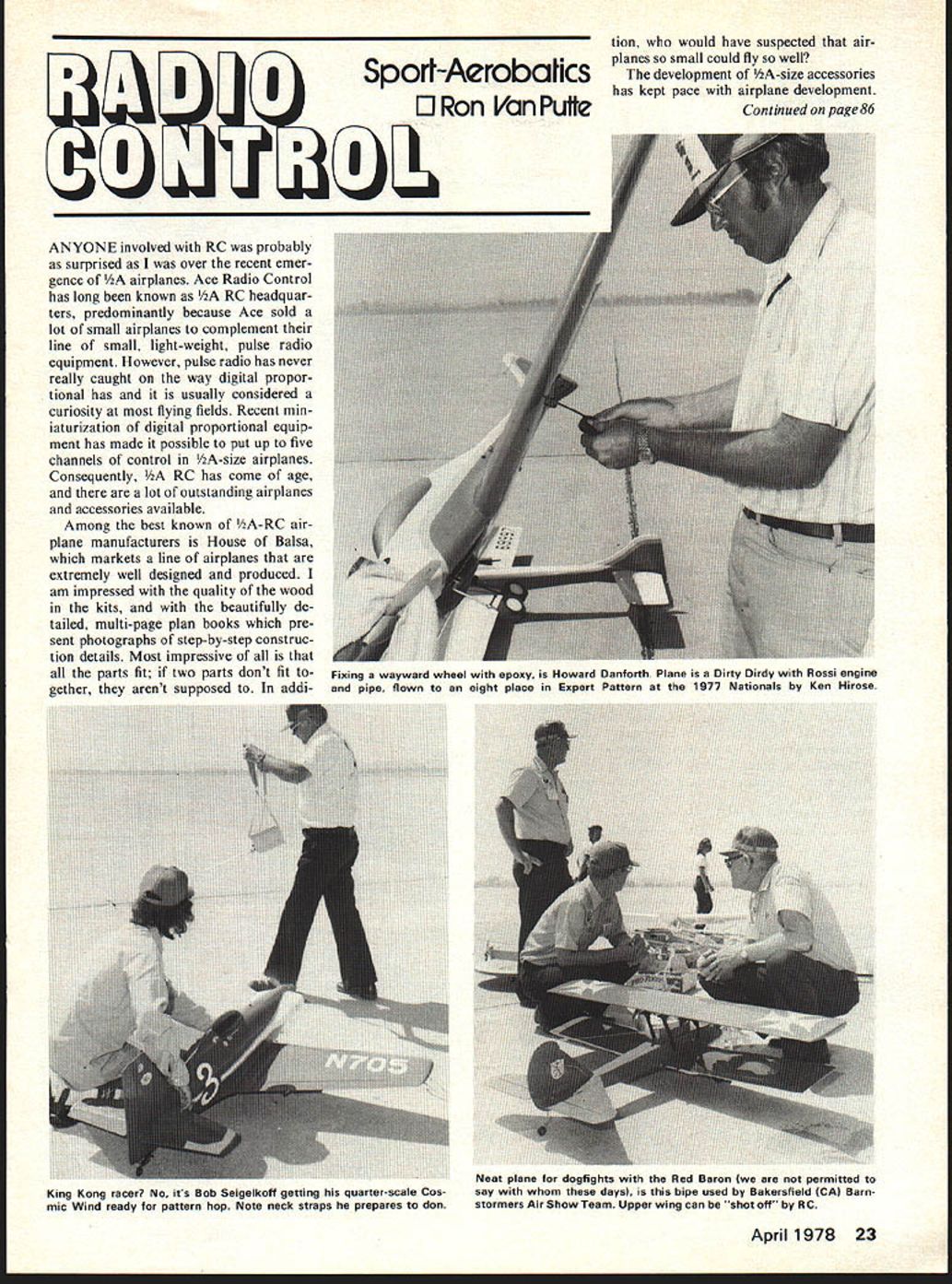
ANYONE involved with RC was probably as surprised as I was over the recent emergence of 1/2A airplanes. Ace Radio Control has long been known as 1/2A RC headquarters, predominantly because Ace sold a lot of small airplanes to complement their line of small, light-weight, pulse radio equipment. However, pulse radio has never really caught on the way digital proportional has and it is usually considered a curiosity at most flying fields. Recent miniaturization of digital proportional equipment has made it possible to put up to five channels of control in 1/2A-size airplanes. Consequently, 1/2A RC has come of age, and there are a lot of outstanding airplanes and accessories available.
Among the best known of 1/2A-RC airplane manufacturers is House of Balsa, which markets a line of airplanes that are extremely well designed and produced. I am impressed with the quality of the wood in the kits, and with the beautifully detailed, multi-page plan books which present photographs of step-by-step construction details. Most impressive of all is that all the parts fit; if two parts don't fit together, they aren't supposed to. In addition, who would have suspected that airplanes so small could fly so well?
The development of 1/2A-size accessories has kept pace with airplane development.
RC Aerobatics/VanPutte
While I have only seen the products of a few manufacturers, several of them are particularly outstanding. The miniature carburetor designed by Ben Tarnofsky for the Cox Tee Dee 049/051 is a good example. The 1/4A Tarno carburetor has the Tee Dee slow down to a real purr, especially when used with a muffler. Davis Diesel Development has a diesel conversion kit for use with any Cox 049/051 engine. The conversion requires only the simple replacement of the glow head with the diesel conversion head. I wonder if anyone has tried a Tee Dee 049/051 with a Tarno carburetor and a Davis diesel head?
To me, the most surprising new accessory to be developed for 1/2A airplanes is retractable landing gear. Robart, A-justo-jig and Flight Dynamics, Inc., market 1/2A main gear retracts, and Robart also offers a three gear set. They are all beautifully finished. made and should take a lot of abuse (that some fliers call landings).
Of course, there's also the Robart 1/2A Super Pumper and the 1/2A engine starters sold by Fusite and Astro Flight to be included in an aircraft system.
I would have thought they were "bonkers" if someone had told me a couple of years ago that it would soon be possible to start the throttled Tee Dee 049 on a 1/2A-size P-47 with a specially made starter, taxi the airplane out to the end of the runway, take off, retract the landing gear and fly most of the AMA pattern maneuvers. It's a beautiful hobby.
Several Months Ago I included hints on how to do successful spins. The hints were the result of a taped interview at the Toledo R/C Exposition with world class pattern competitor and AMA District III Vice President Don Lowe by my perennial contest companion, Dick McGraw. This month I have another excerpt from that tape, this time on how to perform a safe landing, without crashing.
"The first thing I instruct new fliers on how to land is to do nothing very quickly. Control inputs should be applied as carefully and slowly as the airplane will allow the pilot to do them. The pilot should get used to the speed of the airplane and how quickly it responds before attempting a landing.
"The landing approach should begin over the landing spot at a modest altitude, say 150 feet. Then a slow descending turn, probably to the left, should be performed. Most fliers seem to find it easier to turn to the left. Of course, one must learn to land in both directions eventually, but the first landings should be done from the direction that is most comfortable.
"The power should be gradually reduced during the slow, descending turn. Make sure that the aircraft doesn't get into any unusual attitudes which can't be recovered from easily. Perform the descending turn smoothly and carefully; try not to have to do anything quickly.
"Don't be afraid to use the throttle if the airplane gets too slow. It is best to adjust airplane speed by using the throttle instead of using the elevator. The elevator should be used to adjust the attitude of the airplane while the throttle is used to change the speed and descent rate. If it looks like the airplane will land short, add power smoothly and carefully. Obviously, if the airplane is too high, the throttle should be reduced (smoothly and carefully).
"Complete the approach by rolling out the airplane at an altitude of 50 to 75 feet so that the wings are level, and the final can be done straight in from about 200 feet out. Use only minimal controls to get the job done and try not to get 'behind' the airplane by doing things in a rush so that the airplane gets into unusual attitudes and you have to do something very quickly.
"The fliers must learn how much power is needed and what the attitude of the airplane should be in order to have a comfortable landing speed of the airplane. Most airplanes should come in on final with the nose on or slightly above the horizon. Once the proper attitude of the airplane is achieved, it should be held and not varied. The speed and descent rate should be adjusted by using the throttle, not the elevator.
"As the airplane approaches to within a few feet from the ground, the airplane should be flared (smoothly and carefully) with the elevator, so that the airplane will touch down nose high without touching the nose gear. And there you have a safe landing without crashing."
You must have noted that Don used the phrase "smoothly and carefully" a lot of times. He did it intentionally and it characterizes the way he flies. Thanks to "Groovy" Don Lowe for some hints that can help all of us.
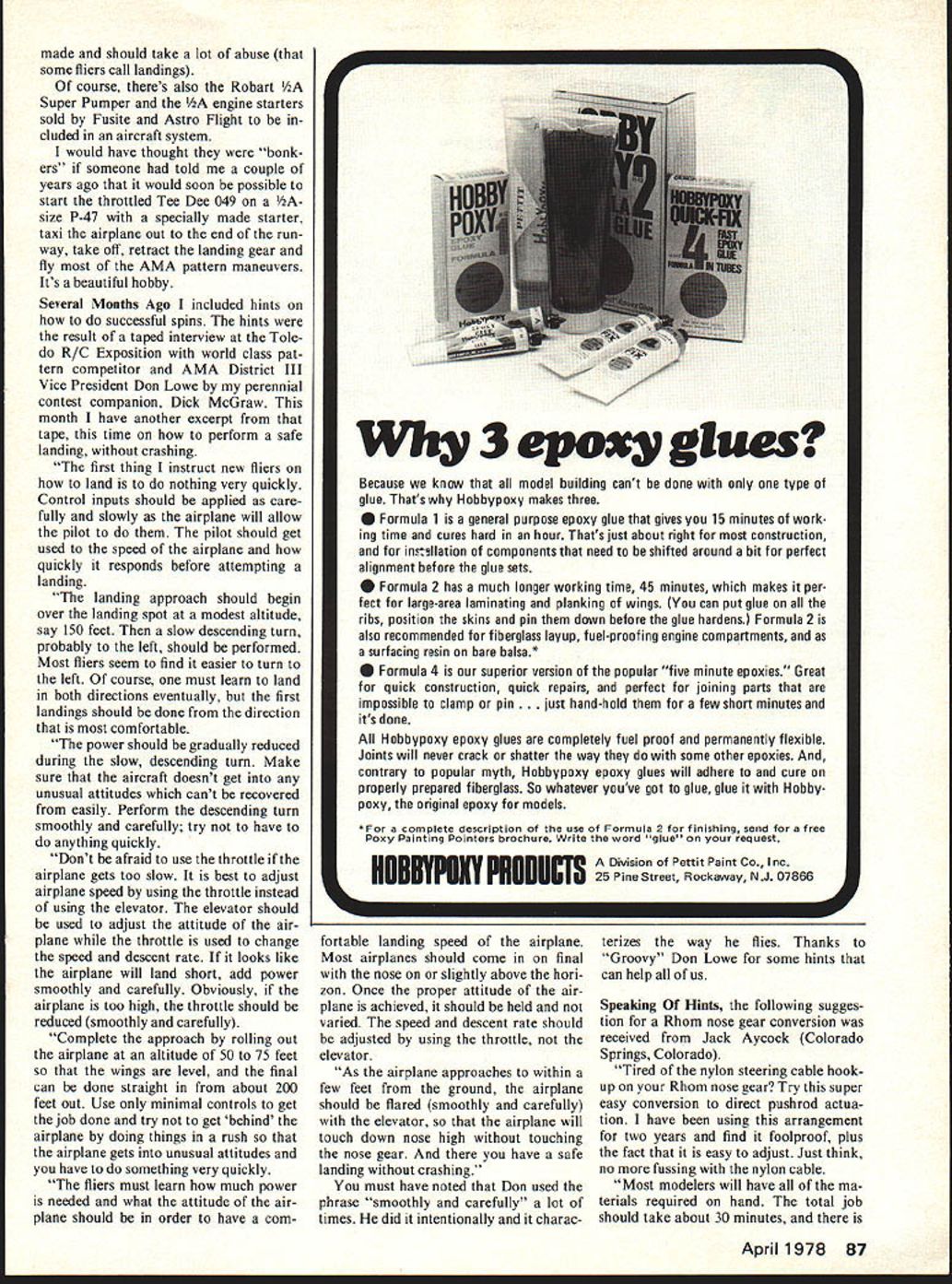
Speaking Of Hints, the following suggestion for a Rhom nose gear conversion was received from Jack Aycock (Colorado Springs, Colorado).
"Tired of the nylon steering cable hookup on your Rhom nose gear? Try this super easy conversion to direct pushrod actuation. I have been using this arrangement for two years and find it foolproof, plus the fact that it is easy to adjust. Just think, no more fussing with the nylon cable.
"Most modelers will have all of the materials required on hand. The total job should take about 30 minutes, and there is works to the benefit of both clubs and all the competitors.
Ron Van Putte, 12 Connie Drive, Shalimar, FL 32579
Transcribed from original scans by AI. Minor OCR errors may remain.

