
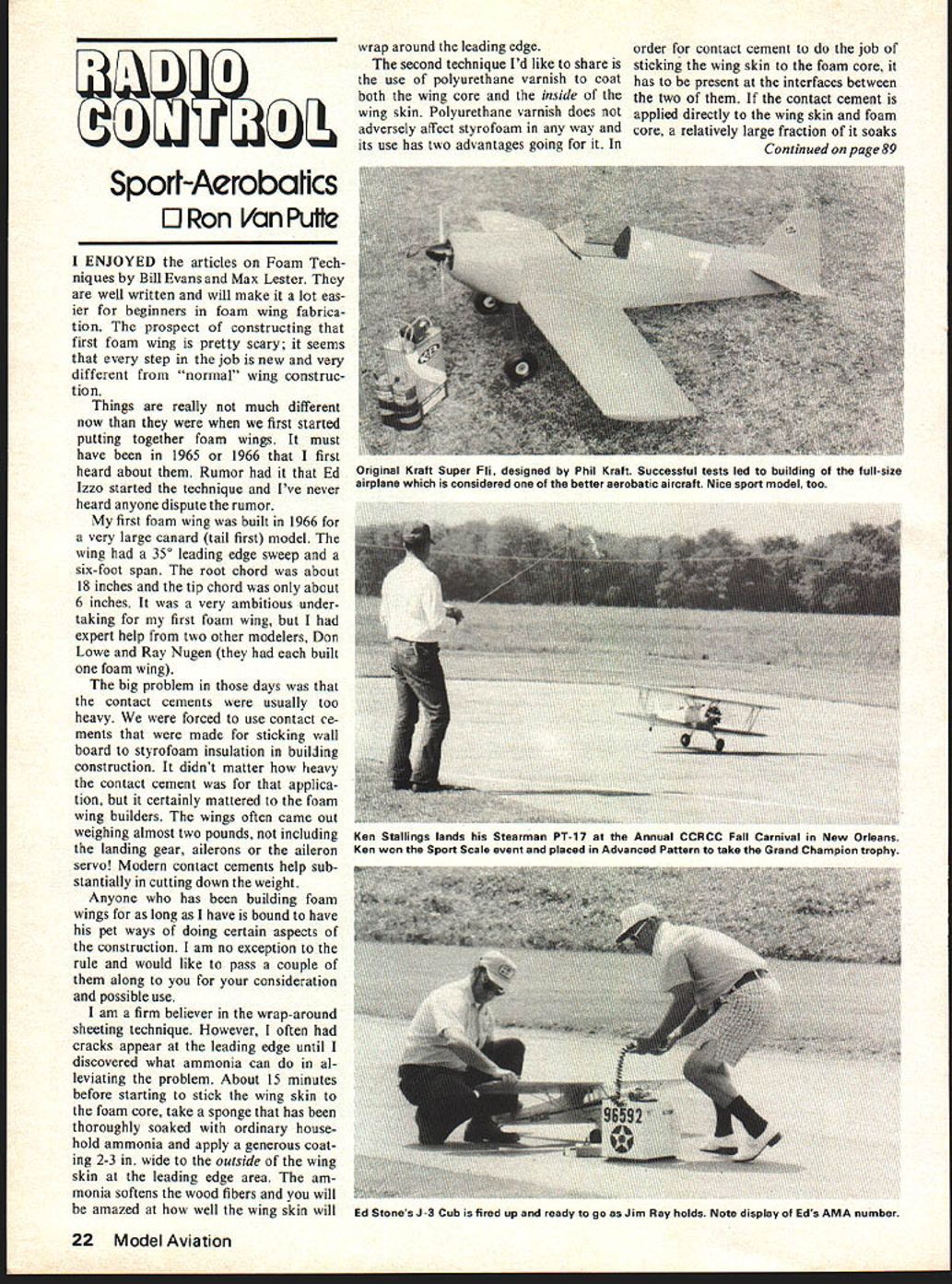
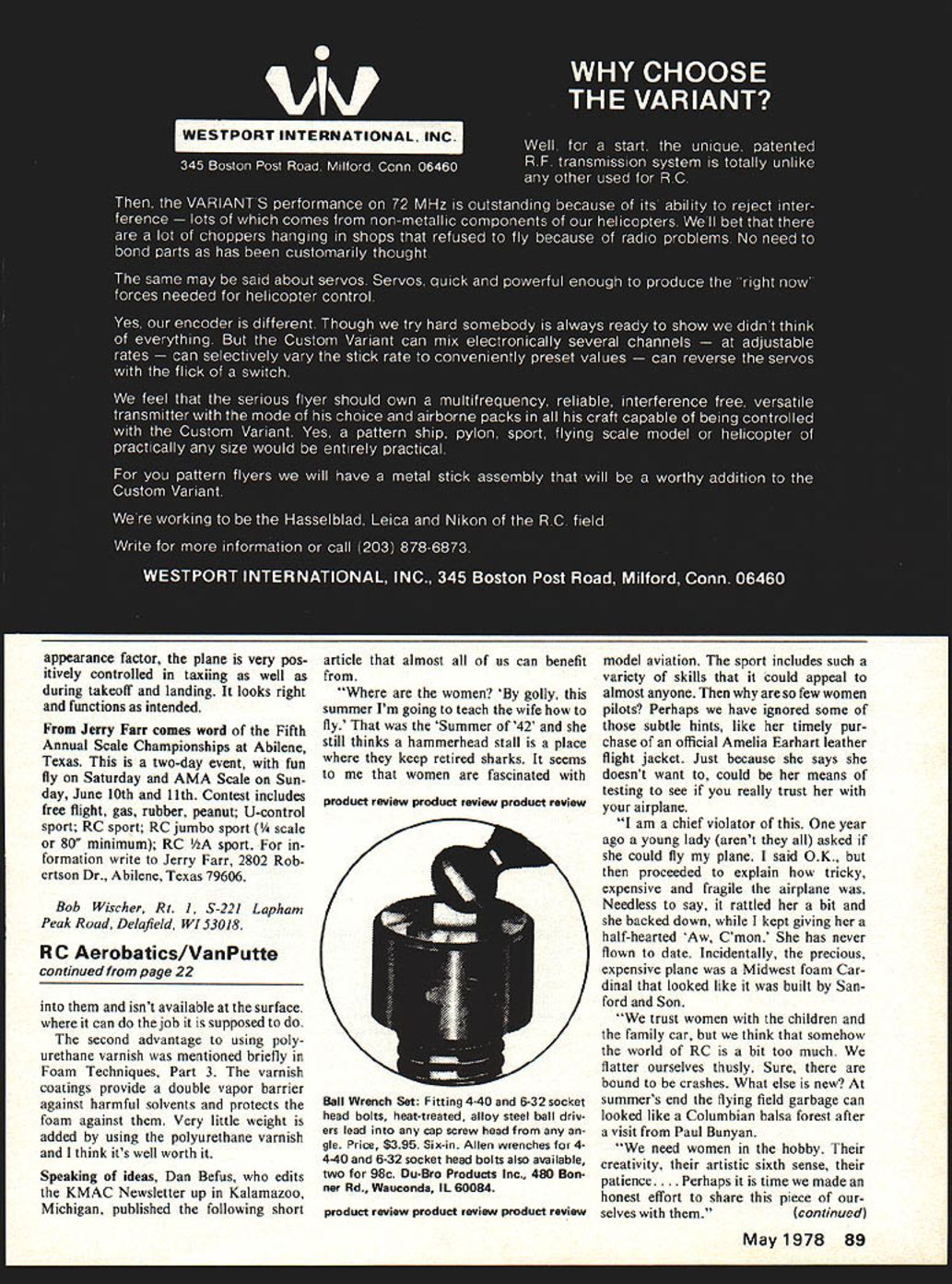
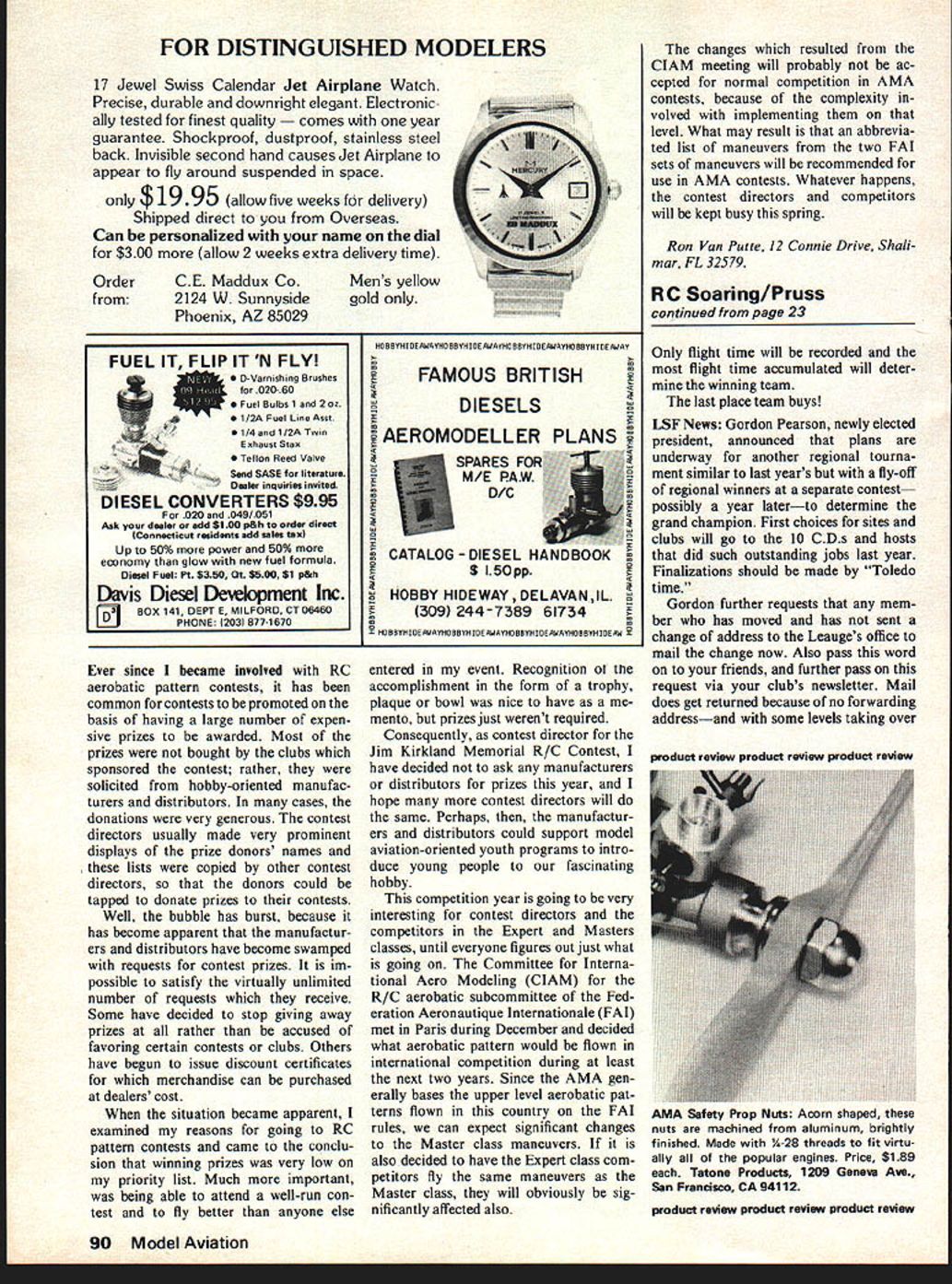
Radio Control: Sport-Aerobatics
Ron VanPutte
I enjoyed the articles on Foam Techniques by Bill Evans and Max Lester. They are well written and will make it a lot easier for beginners in foam wing fabrication. The prospect of constructing that first foam wing is pretty scary; it seems that every step in the job is new and very different from "normal" wing construction.
Things are really not much different now than they were when we first started putting together foam wings. It must have been in 1965 or 1966 that I first heard about them. Rumor had it that Ed Izzo started the technique and I've never heard anyone dispute the rumor.
My first foam wing was built in 1966 for a very large canard (tail first) model. The wing had a 35° leading edge sweep and a six-foot span. The root chord was about 18 inches and the tip chord was only about 6 inches. It was a very ambitious undertaking for my first foam wing, but I had expert help from two other modelers, Don Lowe and Ray Nugen (they had each built one foam wing).
The big problem in those days was that the contact cements were usually too heavy. We were forced to use contact cements that were made for sticking wall board to styrofoam insulation in building construction. It didn't matter how heavy the contact cement was for that application, but it certainly mattered to the foam wing builders. The wings often came out weighing almost two pounds, not including the landing gear, ailerons or the aileron servo! Modern contact cements help substantially in cutting down the weight.
Anyone who has been building foam wings for as long as I have is bound to have his pet ways of doing certain aspects of the construction. I am no exception to the rule and would like to pass a couple of them along to you for your consideration and possible use.
I am a firm believer in the wrap-around sheeting technique. However, I often had cracks appear at the leading edge until I discovered what ammonia can do in alleviating the problem. About 15 minutes before starting to stick the wing skin to the foam core, take a sponge that has been thoroughly soaked with ordinary household ammonia and apply a generous coating 2–3 in. wide to the outside of the wing skin at the leading edge area. The ammonia softens the wood fibers and you will be amazed at how well the wing skin will wrap around the leading edge.
The second technique I'd like to share is the use of polyurethane varnish to coat both the wing core and the inside of the wing skin. Polyurethane varnish does not adversely affect styrofoam in any way and its use has two advantages going for it. In order for contact cement to do the job of sticking the wing skin to the foam core, it has to be present at the interfaces between the two of them. If the contact cement is applied directly to the wing skin and foam core, a relatively large fraction of it soaks. into them and isn't available at the surface where it can do the job it is supposed to do.
The second advantage to using polyurethane varnish was mentioned briefly in Foam Techniques, Part 3. The varnish coatings provide a double vapor barrier against harmful solvents and protects the foam against them. Very little weight is added by using the polyurethane varnish and I think it's well worth it.
Speaking of ideas, Dan Befus, who edits the KMAC Newsletter up in Kalamazoo, Michigan, published the following short article that almost all of us can benefit from.
"Where are the women? 'By golly, this summer I'm going to teach the wife how to fly.' That was the 'Summer of '42' and she still thinks a hammerhead stall is a place where they keep retired sharks. It seems to me that women are fascinated with model aviation. The sport includes such a variety of skills that it could appeal to almost anyone. Then why are so few women pilots? Perhaps we have ignored some of those subtle hints, like her timely purchase of an official Amelia Earhart leather flight jacket. Just because she says she doesn't want to, could be her means of testing to see if you really trust her with your airplane.
"I am a chief violator of this. One year ago a young lady (aren't they all) asked if she could fly my plane. I said O.K., but then proceeded to explain how tricky, expensive and fragile the airplane was. Needless to say, it rattled her a bit and she backed down, while I kept giving her a half-hearted 'Aw, C'mon.' She has never flown to date. Incidentally, the precious, expensive plane was a Midwest foam Cardinal that looked like it was built by Sanford and Son.
"We trust women with the children and the family car, but we think that somehow the world of R/C is a bit too much. We flatter ourselves thusly. Sure, there are bound to be crashes. What else is new? At summer's end the flying field garbage can looked like a Columbian balsa forest after a visit from Paul Bunyan.
"We need women in the hobby. Their creativity, their artistic sixth sense, their patience ... Perhaps it is time we made an honest effort to share this piece of ourselves with them." Ever since I became involved with RC aerobatic pattern contests, it has been common for contests to be promoted on the basis of having a large number of expensive prizes to be awarded. Most of the prizes were not bought by the clubs which sponsored the contest; rather, they were solicited from hobby-oriented manufacturers and distributors. In many cases, the donations were very generous. The contest directors usually made very prominent displays of the prize donors' names and these lists were copied by other contest directors, so that the donors could be tapped to donate prizes to their contests.
Well, the bubble has burst, because it has become apparent that the manufacturers and distributors have become swamped with requests for contest prizes. It is impossible to satisfy the virtually unlimited number of requests which they receive. Some have decided to stop giving away prizes at all rather than be accused of favoring certain contests or clubs. Others have begun to issue discount certificates for which merchandise can be purchased at dealers' cost.
When the situation became apparent, I examined my reasons for going to RC pattern contests and came to the conclusion that winning prizes was very low on my priority list. Much more important was being able to attend a well-run contest and to fly better than anyone else entered in my event. Recognition of the accomplishment in the form of a trophy, plaque or bowl was nice to have as a memento, but prizes just weren't required.
Consequently, as contest director for the Jim Kirkland Memorial R/C Contest, I have decided not to ask any manufacturers or distributors for prizes this year, and I hope many more contest directors will do the same. Perhaps, then, the manufacturers and distributors could support model aviation-oriented youth programs to introduce young people to our fascinating hobby.
This competition year is going to be very interesting for contest directors and the competitors in the Expert and Masters classes, until everyone figures out just what is going on. The Committee for International Acro Modeling (CIAM) for the R/C aerobatic subcommittee of the Federation Aeronautique Internationale (FAI) met in Paris during December and decided what aerobatic pattern would be flown in international competition during at least the next two years. Since the AMA generally bases the upper level aerobatic patterns flown in this country on the FAI rules, we can expect significant changes to the Master class maneuvers. If it is also decided to have the Expert class competitors fly the same maneuvers as the Master class, they will obviously be significantly affected also.
The changes which resulted from the CIAM meeting will probably not be accepted for normal competition in AMA contests, because of the complexity involved with implementing them on that level. What may result is that an abbreviated list of maneuvers from the two FAI sets of maneuvers will be recommended for use in AMA contests. Whatever happens, the contest directors and competitors will be kept busy this spring.
Ron Van Putte, 12 Connie Drive, Shalimar, FL 32579.
Transcribed from original scans by AI. Minor OCR errors may remain.

