
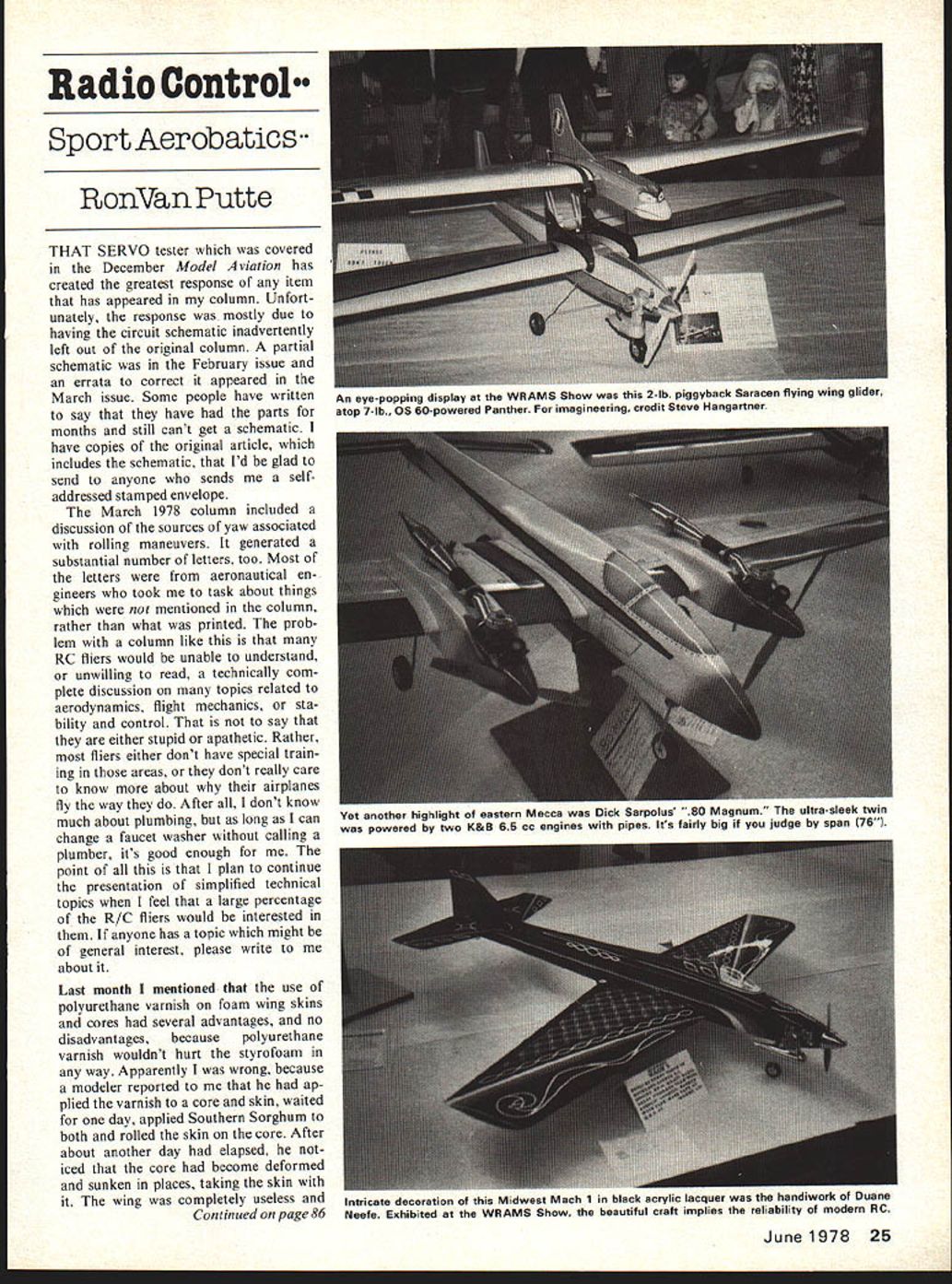
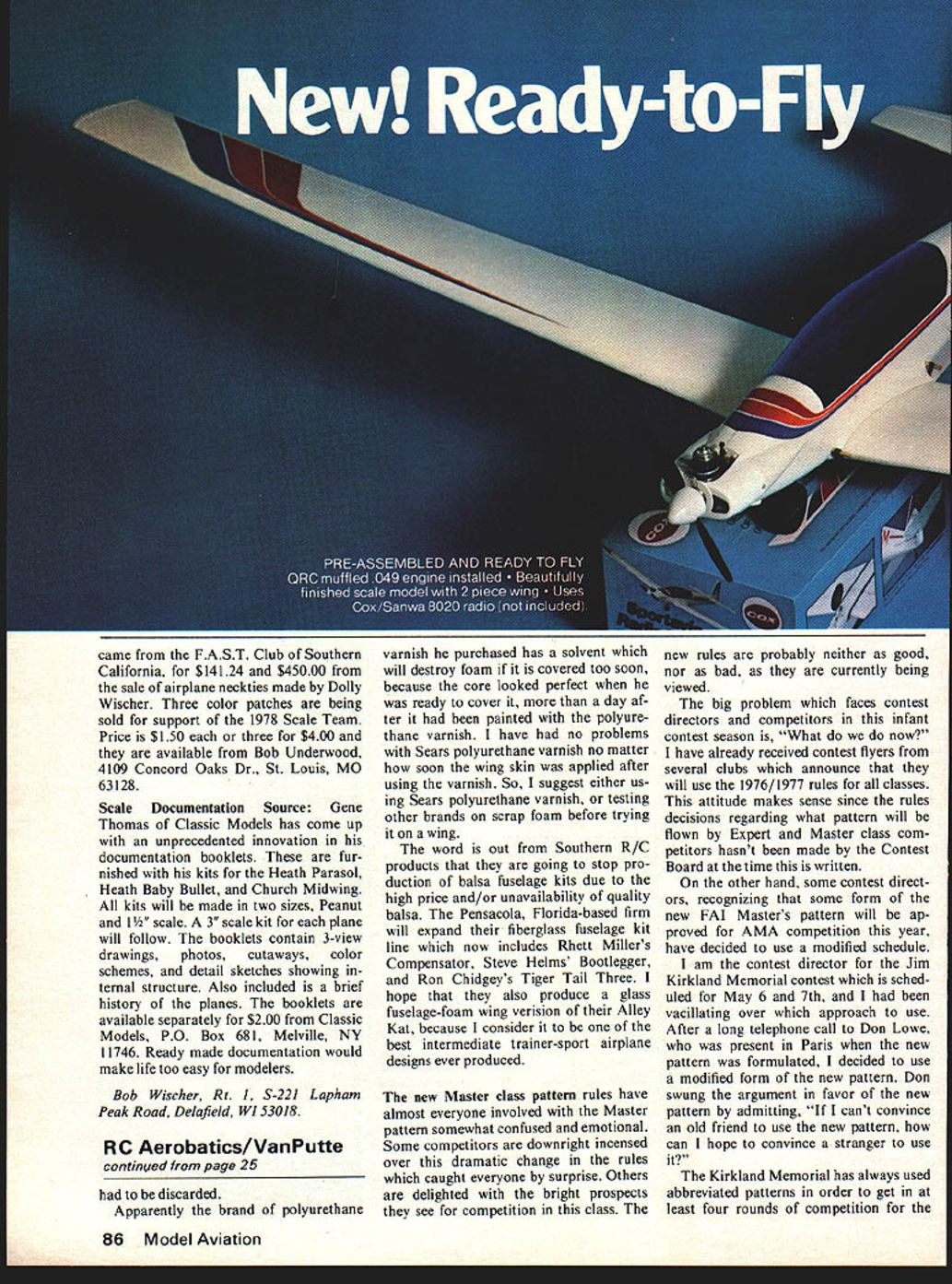
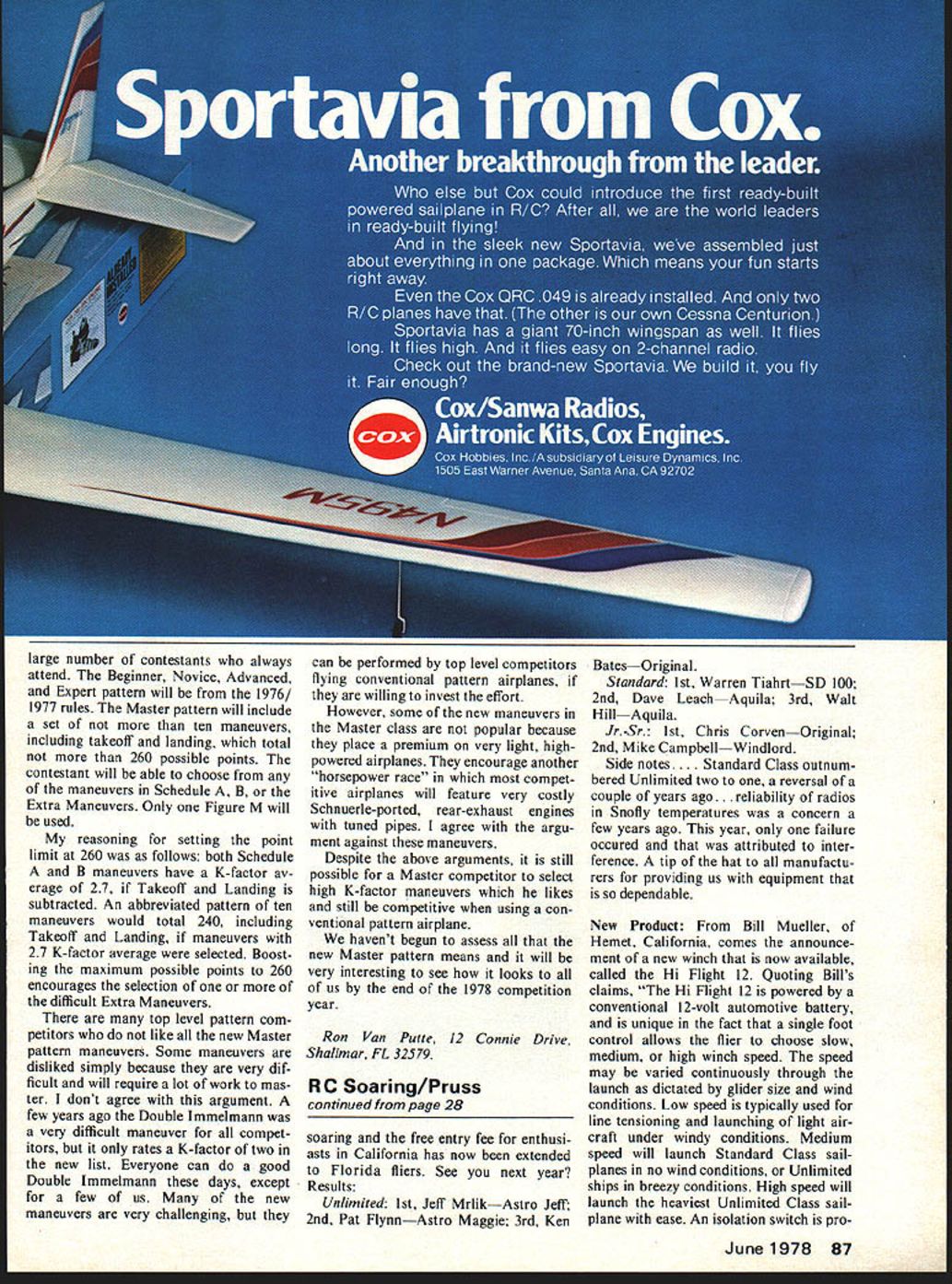
Radio Control: Sport Aerobatics
Ron Van Putte
THAT SERVO tester which was covered in the December Model Aviation has created the greatest response of any item that has appeared in my column. Unfortunately, the response was mostly due to having the circuit schematic inadvertently left out of the original column. A partial schematic was in the February issue and an errata to correct it appeared in the March issue. Some people have written to say that they have had the parts for months and still can't get a schematic. I have copies of the original article, which includes the schematic, that I'd be glad to send to anyone who sends me a self-addressed stamped envelope.
The March 1978 column included a discussion of the sources of yaw associated with rolling maneuvers. It generated a substantial number of letters, too. Most of the letters were from aeronautical engineers who took me to task about things which were not mentioned in the column, rather than what was printed. The problem with a column like this is that many RC fliers would be unable to understand, or unwilling to read, a technically complete discussion on many topics related to aerodynamics, flight mechanics, or stability and control. That is not to say that they are either stupid or apathetic. Rather, most fliers either don't have special training in those areas, or they don't really care to know more about why their airplanes fly the way they do. After all, I don't know much about plumbing, but as long as I can change a faucet washer without calling a plumber, it's good enough for me. The point of all this is that I plan to continue the presentation of simplified technical topics when I feel that a large percentage of the R/C fliers would be interested in them. If anyone has a topic which might be of general interest, please write to me about it.
Last month I mentioned that the use of polyurethane varnish on foam wing skins and cores had several advantages, and no disadvantages, because polyurethane varnish wouldn't hurt the styrofoam in any way. Apparently I was wrong, because a modeler reported to me that he had applied the varnish to a core and skin, waited for one day, applied Southern Sorghum to both and rolled the skin on the core. After about another day had elapsed, he noticed that the core had become deformed and sunken in places, taking the skin with it. The wing was completely useless and had to be discarded.
Apparently the brand of polyurethane varnish he purchased has a solvent which will destroy foam if it is covered too soon, because the core looked perfect when he was ready to cover it, more than a day after it had been painted with the polyurethane varnish. I have had no problems with Sears polyurethane varnish no matter how soon the wing skin was applied after using the varnish. So, I suggest either using Sears polyurethane varnish, or testing other brands on scrap foam before trying it on a wing.
The word is out from Southern R/C products that they are going to stop production of balsa fuselage kits due to the high price and/or unavailability of quality balsa. The Pensacola, Florida-based firm will expand their fiberglass fuselage kit line which now includes Rhett Miller's Compensator, Steve Helms' Bootlegger, and Ron Chidgey's Tiger Tail. I hope that they also produce a glass fuselage-foam wing version of their Alley Kat, because I consider it to be one of the best intermediate trainer-sport airplane designs ever produced.
The new Master class pattern rules have almost everyone involved with the Master pattern somewhat confused and emotional. Some competitors are downright incensed over this dramatic change in the rules which caught everyone by surprise. Others are delighted with the bright prospects they see for competition in this class. The new rules are probably neither as good, nor as bad, as they are currently being viewed.
The big problem which faces contest directors and competitors in this infant contest season is, "What do we do now?" I have already received contest flyers from several clubs which announce that they will use the 1976/1977 rules for all classes. This attitude makes sense since the rules decisions regarding what pattern will be flown by Expert and Master class competitors hasn't been made by the Contest Board at the time this is written.
On the other hand, some contest directors, recognizing that some form of the new FAI Master's pattern will be approved for AMA competition this year, have decided to use a modified schedule. I am the contest director for the Jim Kirkland Memorial contest which is scheduled for May 6 and 7th, and I had been vacillating over which approach to use. After a long telephone call to Don Lowe, who was present in Paris when the new pattern was formulated, I decided to use a modified form of the new pattern. Don swung the argument in favor of the new pattern by admitting, "If I can't convince an old friend to use the new pattern, how can I hope to convince a stranger to use it?"
The Kirkland Memorial has always used abbreviated patterns in order to get in at least four rounds of competition for the large number of contestants who always attend. The Beginner, Novice, Advanced, and Expert pattern will be from the 1976/1977 rules. The Master pattern will include a set of not more than ten maneuvers, including Takeoff and Landing, which total not more than 260 possible points. The contestant will be able to choose from any of the maneuvers in Schedule A, B, or the Extra Maneuvers. Only one Figure M will be used.
My reasoning for setting the point limit at 260 was as follows: both Schedule A and B maneuvers have a K-factor average of 2.7, if Takeoff and Landing is subtracted. An abbreviated pattern of ten maneuvers would total 240, including Takeoff and Landing, if maneuvers with 2.7 K-factor average were selected. Boosting the maximum possible points to 260 encourages the selection of one or more of the difficult Extra Maneuvers.
There are many top level pattern competitors who do not like all the new Master pattern maneuvers. Some maneuvers are disliked simply because they are very difficult and will require a lot of work to master. I don't agree with this argument. A few years ago the Double Immelmann was a very difficult maneuver for all competitors, but it only rates a K-factor of two in the new list. Everyone can do a good Double Immelmann these days, except for a few of us. Many of the new maneuvers are very challenging, but they can be performed by top level competitors flying conventional pattern airplanes, if they are willing to invest the effort.
However, some of the new maneuvers in the Master class are not popular because they place a premium on very light, high-powered airplanes. They encourage another "horsepower race" in which most competitive airplanes will feature very costly Schnuerle-ported, rear-exhaust engines with tuned pipes. I agree with the argument against these maneuvers.
Despite the above arguments, it is still possible for a Master competitor to select high K-factor maneuvers which he likes and still be competitive when using a conventional pattern airplane.
We haven't begun to assess all that the new Master pattern means and it will be very interesting to see how it looks to all of us by the end of the 1978 competition year.
Ron Van Putte, 12 Connie Drive, Shalimar, FL 32579.
Transcribed from original scans by AI. Minor OCR errors may remain.

