
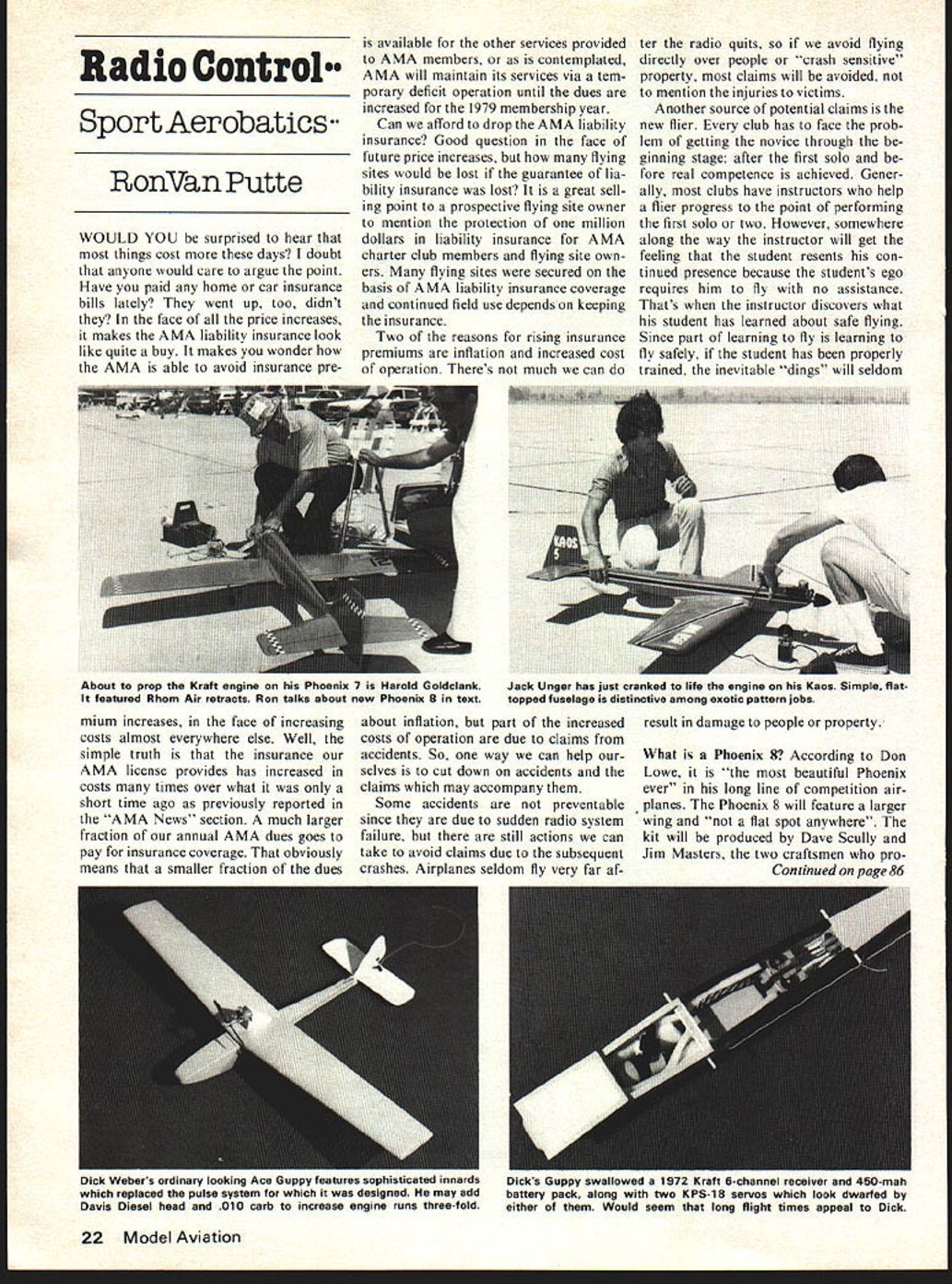
Radio Control: Sport Aerobatics
Ron Van Putte
WOULD YOU be surprised to hear that most things cost more these days? I doubt that anyone would care to argue the point. Have you paid any home or car insurance bills lately? They went up, too, didn't they? In the face of all the price increases, it makes the AMA liability insurance look like quite a buy. It makes you wonder how the AMA is able to avoid insurance premium increases in the face of increasing costs almost everywhere else. Well, the simple truth is that the insurance our AMA license provides has increased in cost many times over what it was only a short time ago as previously reported in the "AMA News" section. A much larger fraction of our annual AMA dues goes to pay for insurance coverage. That obviously means that a smaller fraction of the dues is available for the other services provided to AMA members, or as is contemplated, AMA will maintain its services via a temporary deficit operation until the dues are increased for the 1979 membership year.
Can we afford to drop the AMA liability insurance? Good question in the face of future price increases, but how many flying sites would be lost if the guarantee of liability insurance was lost? It is a great selling point to a prospective flying site owner to mention the protection of one million dollars in liability insurance for AMA charter club members and flying site owners. Many flying sites were secured on the basis of AMA liability insurance coverage and continued field use depends on keeping the insurance.
Two of the reasons for rising insurance premiums are inflation and increased cost of operation. There's not much we can do about inflation, but part of the increased costs of operation are due to claims from accidents. So one way we can help ourselves is to cut down on accidents and the claims which may accompany them.
Some accidents are not preventable since they are due to sudden radio system failure, but there are still actions we can take to avoid claims due to the subsequent crashes. Airplanes seldom fly very far after the radio quits, so if we avoid flying directly over people or "crash sensitive" property, most claims will be avoided, not to mention the injuries to victims.
Another source of potential claims is the new flier. Every club has to face the problem of getting the novice through the beginning stage: after the first solo and before real competence is achieved. Generally, most clubs have instructors who help a flier progress to the point of performing the first solo or two. However, somewhere along the way the instructor will get the feeling that the student resents his continued presence because the student's ego requires him to fly with no assistance. That's when the instructor discovers what his student has learned about safe flying. Since part of learning to fly is learning to fly safely, if the student has been properly trained, the inevitable "dings" will seldom result in damage to people or property.
RC Aerobatics/Van Putte
produced the original Phoenix 5 kits in Jim's basement. Dave also carved the Phoenix 5 plug from which most of the molds for the commercial fiberglass fuselages were cast.
Don told me that the Phoenix 8 will be available with an epoxy-glass fuselage, foam wing and stabilizer cores, plans and a competitive price tag. Those of us who have built and admired Phoenix airplanes over the years are looking forward to this new airplane, which was displayed for the first time at the Toledo Exposition in April. The line forms right behind me.
As we get closer to the first pattern contests using the new FAI maneuvers for competition in the Master class, there are questions which pop up about some of the maneuvers. I think that the Figure M with 1/4-rolls is one of the best maneuvers to come along in many years. However, I discovered that there are various interpretations about how it should be performed. After a number of telephone calls and other discussions, a consensus has emerged about how it should be done: both of the stall turns should be performed by yawing the airplane upwind. For example, if the maneuver is initiated by a pullup and a 1/4-roll to the right, the first stall turn would require a yaw to the right. The second 1/4-roll to the right, 1/2-outside loop, and third 1/4-roll to the right, would precede the left. Of course, an initial 1/4-roll to the left would require a yaw to the left and then to the right respectively on the two stall turns.
I'm sure that other maneuvers in the new FAI lists will be greeted with similar differences in interpretation. Doesn't it seem that this new program rushed upon all of us with very short warning and more than a little confusion?
For years, the slow roll was a maneuver that used to fascinate and terrify me at the same time. My first one was performed at a very high altitude and I was scared to death. Now, it is very comfortable to do and generally earns high scores for me in the Advanced class. There are three secrets to doing a good slow roll and I'd like to share them with you.
The first secret involves the use of either a slow roll button or dual rate ailerons. The roll button does nothing more than deflect the ailerons a small amount. If the aileron deflection is properly adjusted, the airplane will perform one roll in five seconds. When using dual rate ailerons, the low rate should be adjusted to give a five-second roll when the stick is held all the way to one side.
The second secret is to learn the coordination of rudder and elevator. Since my slow roll is to the right, I start bleeding in left rudder when the airplane has rolled about 45° and start taking it out about 135°, which is also where down elevator is eased in. The down elevator comes out at about 225° and right rudder comes in there. The right rudder is removed at 315° or 45° before the completion of the roll. My airplane stops rolling just as soon as I let go of the stick.
The most important secret should come as no surprise — you must practice. I did a lot of "dry" flying by using nothing more than the transmitter and my imagination before daring to try the first real slow roll. One of the most difficult things to learn was to use the proper rudder direction. Many was the time when flying friends heard me mutter, "Left rudder first, dummy!"
The people I really admire are the ones who use neither a roll button nor dual rate ailerons. Perhaps I'll never be that good, but there was a time when I didn't think I'd ever be able to do a slow roll, either.
Ron Van Putte, 12 Connie Drive, Shalimar, Florida 32579.
Transcribed from original scans by AI. Minor OCR errors may remain.

