
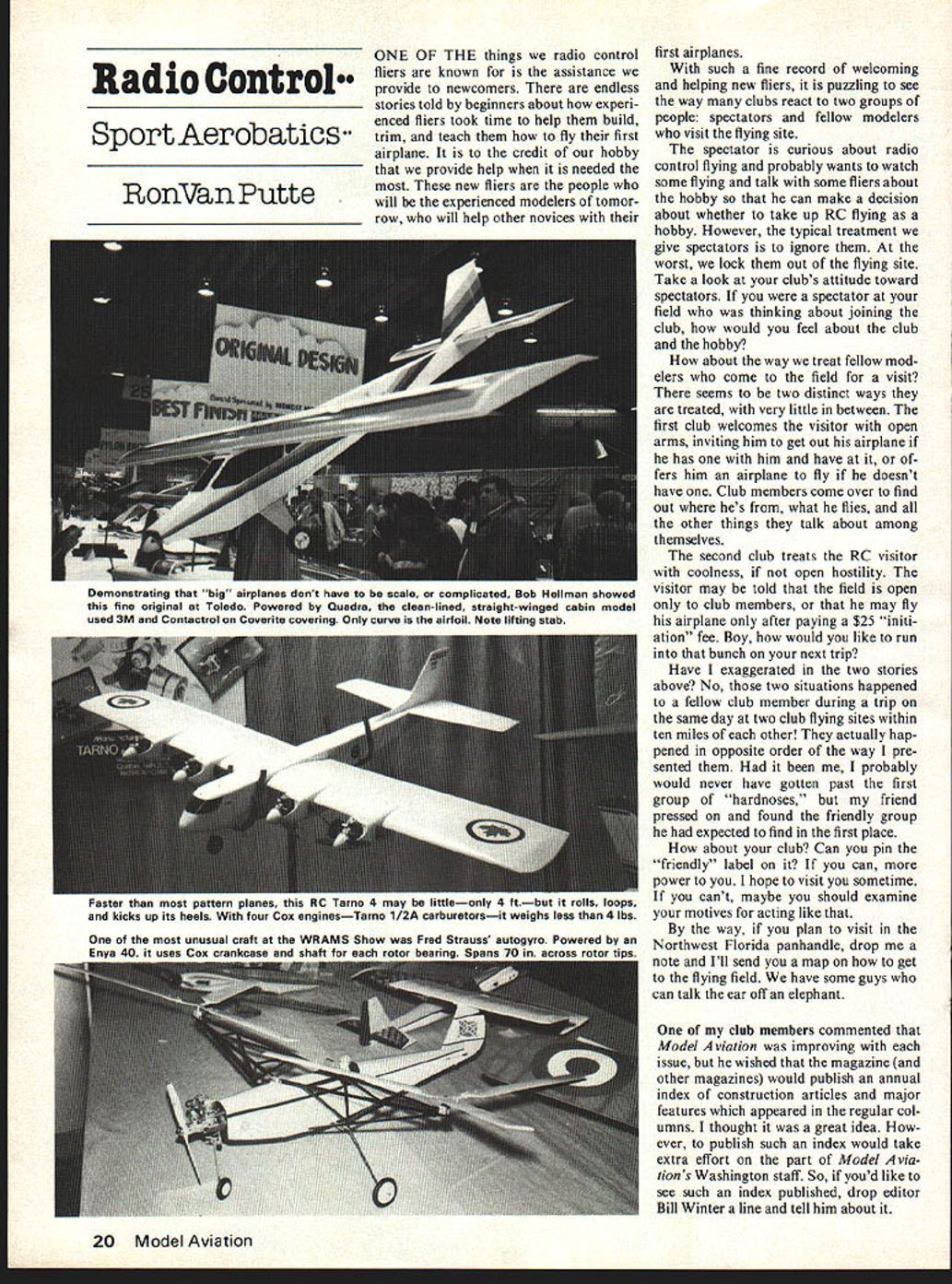
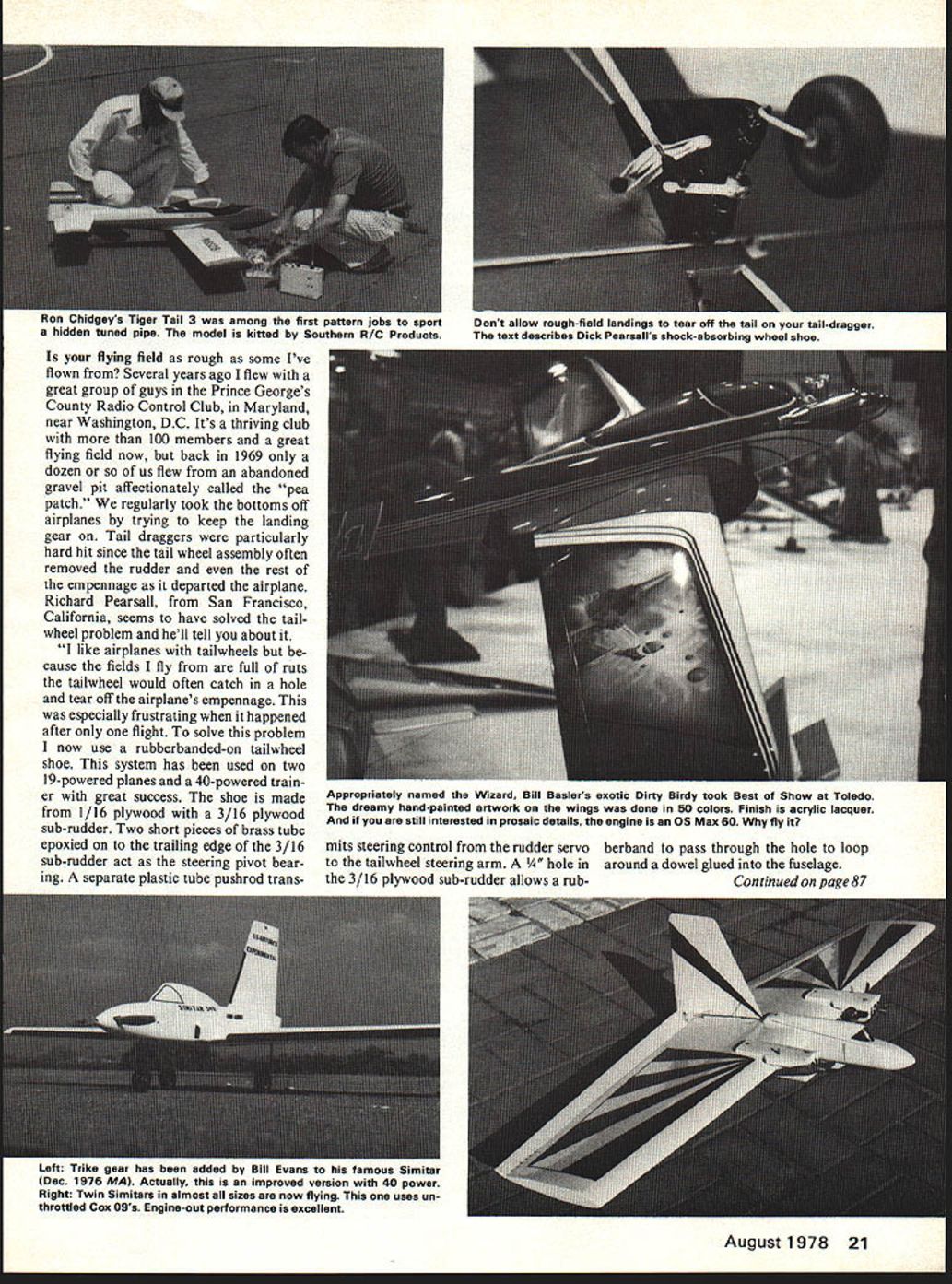
Radio Control: Sport Aerobatics
Ron Van Putte
ONE OF THE things we radio control fliers are known for is the assistance we provide to newcomers. There are endless stories told by beginners about how experienced fliers took time to help them build, trim, and teach them how to fly their first airplane. It is to the credit of our hobby that we provide help when it is needed the most. These new fliers are the people who will be the experienced modelers of tomorrow, who will help other novices with their first airplanes.
With such a fine record of welcoming and helping new fliers, it is puzzling to see the way many clubs react to two groups of people: spectators and fellow modelers who visit the flying site.
The spectator is curious about radio control flying and probably wants to watch some flying and talk with some fliers about the hobby so that he can make a decision about whether to take up RC flying as a hobby. However, the typical treatment we give spectators is to ignore them. At the worst, we lock them out of the flying site. Take a look at your club's attitude toward spectators. If you were a spectator at your field who was thinking about joining the club, how would you feel about the club and the hobby?
How about the way we treat fellow modelers who come to the field for a visit? There seems to be two distinct ways they are treated, with very little in between. The first club welcomes the visitor with open arms, inviting him to get out his airplane if he has one with him and have at it, or offers him an airplane to fly if he doesn't have one. Club members come over to find out where he's from, what he flies, and all the other things they talk about among themselves.
The second club treats the RC visitor with coolness, if not open hostility. The visitor may be told that the field is open only to club members, or that he may fly his airplane only after paying a $25 "initiation" fee. Boy, how would you like to run into that bunch on your next trip!
Have I exaggerated in the two stories above? No, those two situations happened to a fellow club member during a trip on the same day at two club flying sites within ten miles of each other! They actually happened in opposite order of the way I presented them. Had it been me, I probably would never have gotten past the first group of "hardnoses," but my friend pressed on and found the friendly group he had expected to find in the first place.
How about your club? Can you pin the "friendly" label on it? If you can, more power to you. I hope to visit you sometime. If you can't, maybe you should examine your motives for acting like that.
By the way, if you plan to visit in the Northwest Florida panhandle, drop me a note and I'll send you a map on how to get to the flying field. We have some guys who can talk the ear off an elephant.
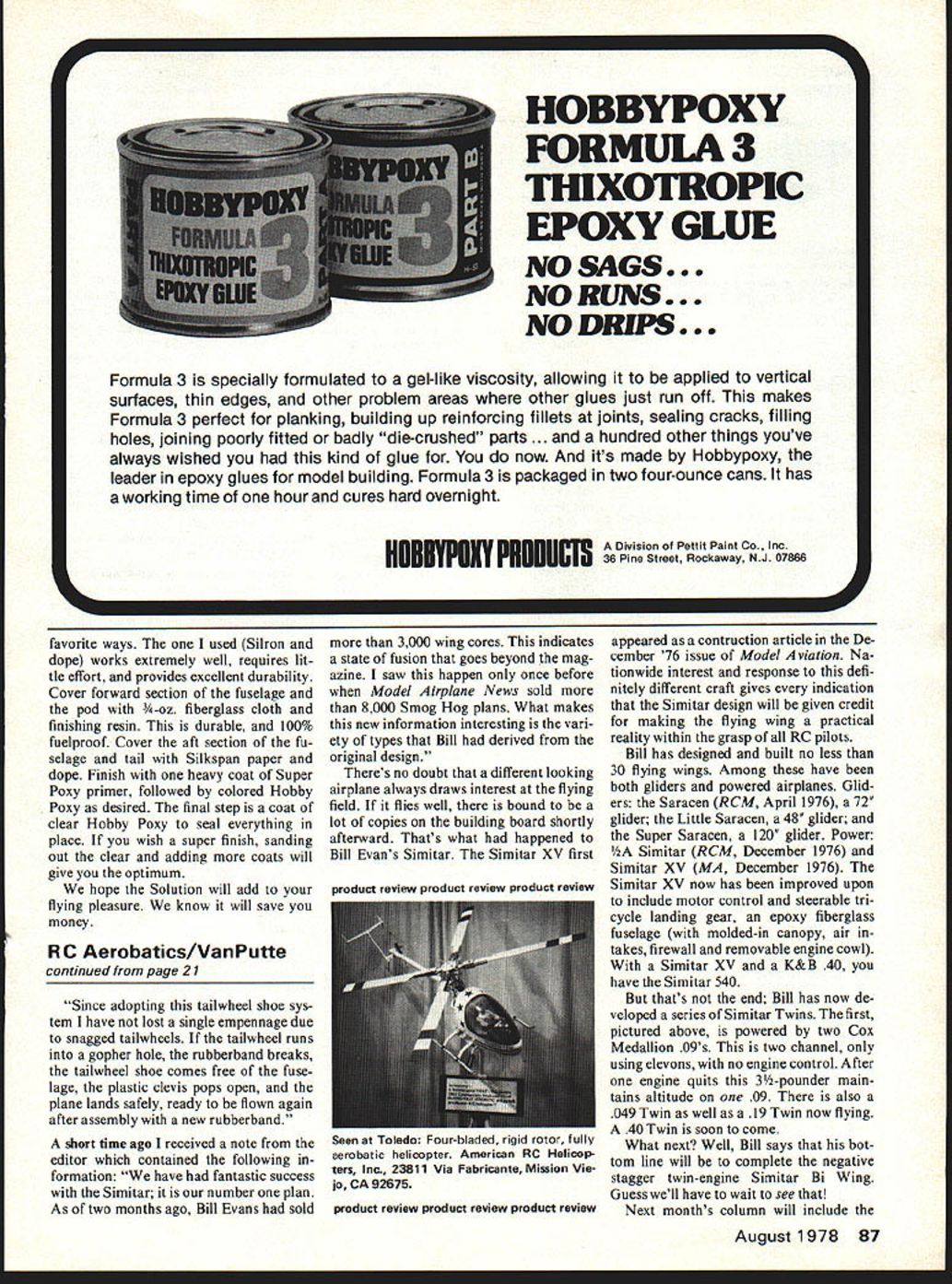
One of my club members commented that Model Aviation was improving with each issue, but he wished that the magazine (and other magazines) would publish an annual index of construction articles and major features which appeared in the regular columns. I thought it was a great idea. However, to publish such an index would take extra effort on the part of Model Aviation's Washington staff. So, if you'd like to see such an index published, drop editor Bill Winter a line and tell him about it. Is your flying field as rough as some I've flown from? Several years ago I flew with a great group of guys in the Prince George's County Radio Control Club, in Maryland, near Washington, D.C. It's a thriving club with more than 100 members and a great flying field now, but back in 1969 only a dozen or so of us flew from an abandoned gravel pit affectionately called the "pea patch." We regularly took the bottoms off airplanes by trying to keep the landing gear on. Tail draggers were particularly hard hit since the tailwheel assembly often removed the rudder and even the rest of the empennage as it departed the airplane. Richard Pearsall, from San Francisco, California, seems to have solved the tailwheel problem and he'll tell you about it.
"I like airplanes with tailwheels but because the fields I fly from are full of ruts the tailwheel would often catch in a hole and tear off the airplane's empennage. This was especially frustrating when it happened after only one flight. To solve this problem I now use a rubber-banded-on tailwheel shoe. This system has been used on two .19-powered planes and a .40-powered trainer with great success. The shoe is made from 1/16 plywood with a 3/16 plywood sub-rudder. Two short pieces of brass tube epoxied onto the trailing edge of the 3/16 sub-rudder act as the steering pivot bearing. A separate plastic tube pushrod transmits steering control from the rudder servo to the tailwheel steering arm. A 1/4" hole in the 3/16 plywood sub-rudder allows a rubberband to pass through the hole to loop around a dowel glued into the fuselage. "Since adopting this tailwheel shoe system I have not lost a single empennage due to snagged tailwheels. If the tailwheel runs into a gopher hole, the rubberband breaks, the tailwheel shoe comes free of the fuselage, the plastic clevis pops open, and the plane lands safely, ready to be flown again after assembly with a new rubberband."
A short time ago I received a note from the editor which contained the following information: "We have had fantastic success with the Simitar; it is our number one plan. As of two months ago, Bill Evans had sold more than 3,000 wing cores. This indicates a state of fusion that goes beyond the magazine. I saw this happen only once before when Model Airplane News sold more than 8,000 Smog Hog plans. What makes this new information interesting is the variety of types that Bill had derived from the original design."
There's no doubt that a different looking airplane always draws interest at the flying field. If it flies well, there is bound to be a lot of copies on the building board shortly afterward. That's what had happened to Bill Evans' Simitar. The Simitar XV first appeared as a construction article in the December '76 issue of Model Aviation. Nationwide interest and response to this definitely different craft gives every indication that the Simitar design will be given credit for making the flying wing a practical reality within the grasp of all RC pilots.
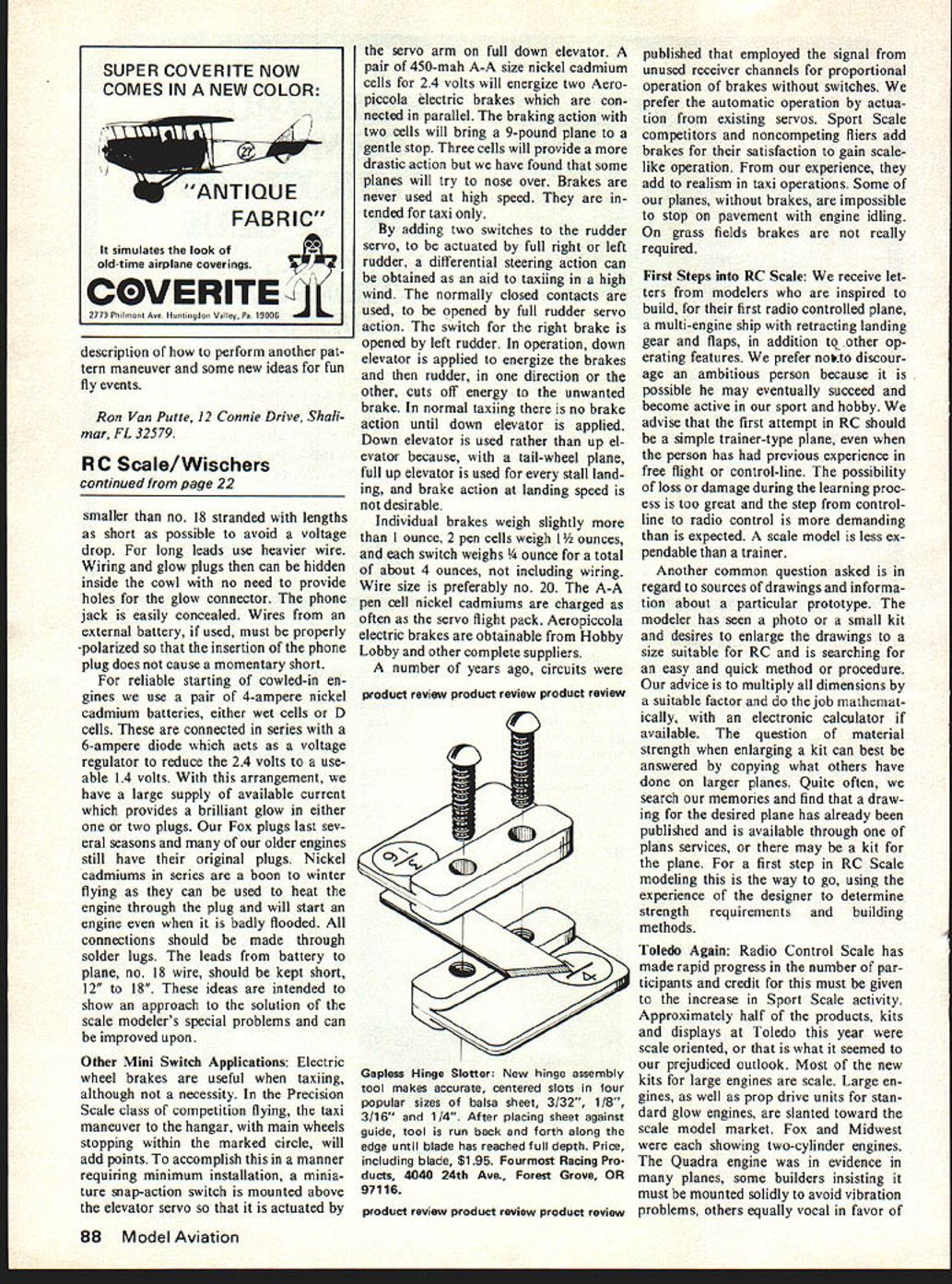
Bill has designed and built no less than 30 flying wings. Among those have been both gliders and powered airplanes. Gliders: the Saracen (RCM, April 1976), a 72" glider; the Little Saracen, a 48" glider; and the Super Saracen, a 120" glider. Power: 1/2A Simitar (RCM, December 1976) and Simitar XV (MA, December 1976). The Simitar XV now has been improved upon to include motor control and steerable tricycle landing gear, an epoxy fiberglass fuselage (with molded-in canopy, air intakes, firewall and removable engine cowl). With a Simitar XV and a K & B .40, you have the Simitar 540.
But that's not the end; Bill has now developed a series of Simitar Twins. The first, pictured above, is powered by two Cox Medallion .09's. This is two channel, only using elevons, with no engine control. After one engine quits this 3-1/2 pounder maintains altitude on one .09. There is also a .049 Twin as well as a .19 Twin now flying. A .40 Twin is soon to come.
What next? Well, Bill says that his bottom line will be to complete the negative stagger twin-engine Simitar. Bill Wing? Guess we'll have to wait to see that!
Next month's column will include the
Radio Control: Sport Aerobatics
Ron Van Putte
ONE OF THE things radio control fliers know is the assistance provided to newcomers. Endless stories are told beginners about experienced fliers who took time to help build, trim and teach to fly the first airplane. Credit for the hobby's growth is due to those who provide the help needed by new fliers. People who will be experienced modelers tomorrow will help other novices with their first airplanes. Such a fine record of welcoming and helping new fliers makes it puzzling to see the way clubs react to two groups of people—spectators and fellow modelers—who visit the flying site.
A spectator curious about radio control flying probably wants to watch some flying and talk to some fliers about the hobby. He can then make a decision about whether to take up RC flying as a hobby. However, the typical treatment given spectators is to ignore them; worst is to lock them out of the flying site. Take a look at clubs' attitude toward spectators. A spectator who comes to a field thinking about joining a club would judge the club and the hobby by the way he is treated by the fellow modelers when he comes to the field on a visit. It seems two distinct ways of treating visitors exist, with very little between them.
In the first, a club welcomes a visitor with open arms, inviting him to get out his airplane, offering to help if he doesn't have one, and even lending him an airplane to fly. Club members come over, find out what he flies and what he wants to know, and talk about other things among themselves.
The second type treats the RC visitor with coolness or open hostility. The visitor may be told that the field is open only to club members, or that club members may fly only after paying a $25 initiation fee. "Boy, I'd like to run that bunch next trip." I have exaggerated the two stories above, but neither situation is unheard of. A fellow club member and I, during a trip in the same day to two club flying sites within ten miles of each other, actually experienced the opposite order of treatment than I have presented. We probably would never have gotten past the first group of hardnoses if a friend hadn't pressed the matter; we found a friendly group where we had expected the first reaction.
Can we pin the "friendly" label on any one group? I hope to visit sometime; maybe I can't. Maybe we should examine the motives for acting as we do when planning a visit.
"Northwest Florida panhandle—drop me a note and I'll send a map and get you to the flying field; we have some guys who can talk ear off," some club members commented.
Model aviation is improving. In a recent issue I wished the magazine and other magazines would publish an annual index of construction articles and major features that appeared in regular columns. I thought that would be a great idea. If you would like to see such an index published, drop editor Bill Winter a line and tell him about it.
The text describes Dick Pearsall's shock-absorbing wheel shoe for flying fields rougher than some I've flown. Several years ago I flew with a great group of guys, the Prince George's County Radio Control Club in Maryland near Washington, D.C. It's a thriving club with 100 members and a great flying field. Back in 1969 a dozen of us flew an abandoned gravel pit, affectionately called "Pea Patch." We regularly took bottoms off airplanes trying to keep landing gear intact. Taildraggers were particularly hard hit since the tailwheel assembly was often removed; rudder rests and empennage departed the airplane.
Richard Pearsall of San Francisco, California, seems to have solved the tailwheel problem. He'll tell about how tailwheels cause fields to develop full ruts; the tailwheel would often catch in a hole and tear off the airplane's empennage. Especially frustrating when it happened after a flight, he solved the problem by using a rubber-banded-on tailwheel shoe system. He has used it on two .19-powered planes and a .40-powered trainer with great success.
The shoe is made of 1/16" plywood with a 3/16" plywood sub-rudder. Two short pieces of brass tube are epoxied to the trailing edge of the 3/16" sub-rudder to act as a steering pivot bearing. A separate plastic tube on the pushrod transmits steering control from the rudder servo. A rubberband passes through a hole or loop on the tailwheel stem...
Transcribed from original scans by AI. Minor OCR errors may remain.

